
Progress is Not Permanent
Civilizations do not forget only when books burn. Sometimes the archive survives and the meaning disappears.
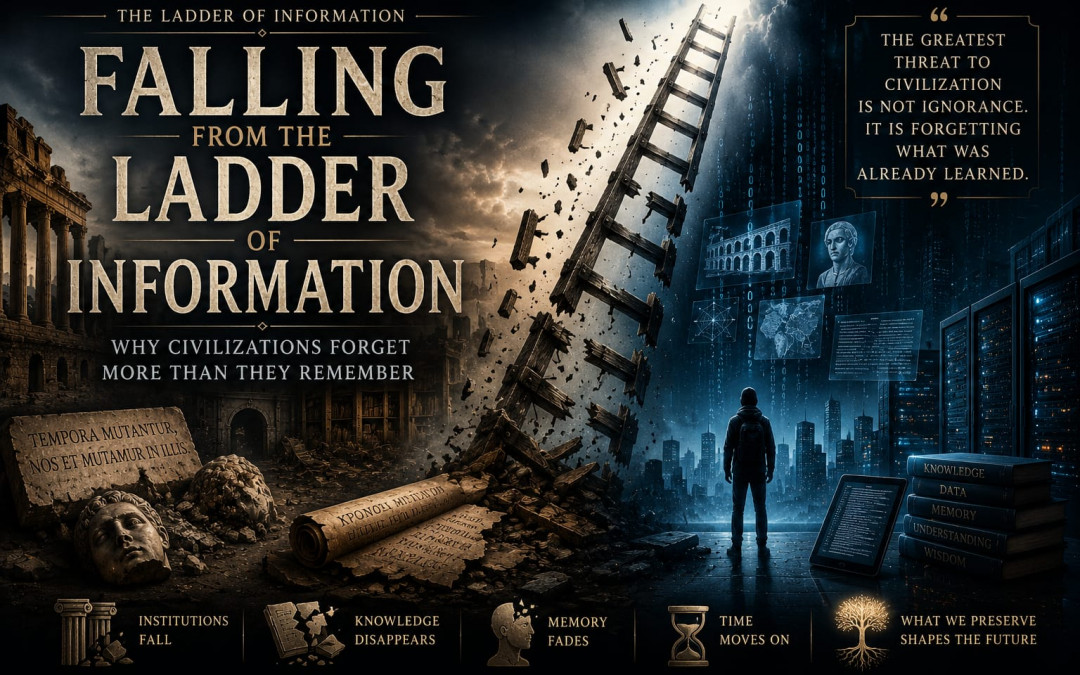
There is a comforting picture of civilization that appears in almost every modern account of progress. Knowledge rises. Each generation inherits what came before, adds another floor and passes the structure upward. Oral memory becomes writing. Writing becomes the library. The library becomes print. Print becomes the network. The network becomes artificial intelligence. From a sufficient distance, history begins to resemble a ladder extending through darkness, with humanity climbing toward an ever larger field of understanding.
The picture is attractive because much of it is true.
We know more about many subjects than any previous civilization. We can reconstruct extinct genomes, calculate the motion of distant galaxies, preserve millions of books in digital form and retrieve information across continents in seconds. A modern student can access materials that kings, scholars and priests once crossed countries to see.
But the ladder has always had another direction.
Libraries disappear. Languages die. Institutions collapse. Crafts become uneconomic and vanish with the people who practiced them. A document survives while the context needed to interpret it does not. A civilization can preserve the instructions and lose the competence. It can retain the data and forget why the data mattered.
This is the less romantic history of information.
Nothing guarantees ascent.
The Archive Is Not Memory
We often confuse storage with preservation because digital technology has made copying appear almost effortless. If a file exists in three places, we say it is safe. If a text has been scanned, we say it has been preserved. If a museum owns an artifact, we imagine the culture behind the artifact remains accessible.
But an archive and a living tradition are not the same thing.
A musical score can survive while the performance style that once gave it character disappears. A technical manual can remain perfectly legible after the industrial ecosystem required to use it has vanished. A religious text may survive for millennia while the assumptions of its first readers become increasingly difficult to reconstruct. An old programming language can be documented exhaustively and still become functionally dead because the engineers, hardware and institutions that supported it have moved on.
Information survives physically when the marks remain.
Knowledge survives culturally when someone still knows how to reconnect those marks with a working world.
The difference is enormous.
A book no one can read is an object.
A machine no one can repair is archaeology.
A database whose formats can no longer be interpreted may contain vast quantities of information while being practically silent.
Civilization therefore depends on something less glamorous than invention.
It depends on maintenance.
The People Who Keep the Ladder Standing
History prefers visible figures.
Kings receive statues. Generals receive biographies. Inventors acquire names attached to machines. Political leaders occupy chapters because history likes events with dates and identifiable authors.
The people who preserve continuity are often harder to see.
The teacher who explains an old method correctly for the hundredth time. The technician who keeps an obsolete system running long enough for the data to be migrated. The archivist who notices that a collection has been catalogued incorrectly. The craftsperson who knows which sound means that a machine is about to fail. The librarian who understands that two documents belong to the same forgotten argument.
Civilizations are full of such people.
Their contribution is structurally important and narratively inconvenient.
Maintenance rarely looks heroic while it is happening.
There is no triumphal painting of someone checking backups.
No equestrian monument to the engineer who updates documentation.
No marble staircase dedicated to the anonymous employee who notices that the archive has been stored in a format that will soon become unreadable.
Yet without these people, civilizations do something peculiar.
They continue owning information while slowly losing access to it.
The shelves remain.
The ladder rots.

Alexandria Is Too Convenient
The Library of Alexandria has become one of civilization’s favorite images of catastrophic forgetting because the story is emotionally perfect: knowledge accumulated, disaster arrived, the library vanished and humanity lost something irreplaceable.
The historical reality is more complicated.
Alexandria’s great scholarly institutions declined over time, and the popular image of one single fire destroying the accumulated knowledge of antiquity compresses a much longer and less dramatic process. Collections can shrink. Patronage can end. Scholars can leave. Copying traditions can weaken. Political priorities can change. Texts can disappear not in one unforgettable night but quietly across centuries.
That version may be more frightening.
A civilization does not need an apocalypse to forget.
It only needs enough interrupted transmission.
The same applies to technologies and institutions. Knowledge can disappear because a profession stops attracting apprentices. A specialized supplier closes. A language of scholarship loses readers. A government archive is reorganized badly. An institution decides a collection is no longer relevant.
Forgetting often looks ordinary while it happens.
By the time the loss becomes visible, the last person who knew what mattered may already be gone.
Progress Has No Memory of Its Own
The idea of permanent progress contains a hidden assumption: once humanity discovers something important, humanity possesses it forever.
But humanity is not one mind.
It is a changing population connected by institutions.
Knowledge survives only if enough of those institutions remain functional.
This is why periods of disruption can produce striking discontinuities. Political collapse can break educational systems. War can destroy archives and disperse specialists. Economic transformation can make older skills worthless until the infrastructure requiring them suddenly matters again. New technology can simplify a task so effectively that the previous underlying knowledge stops being transmitted.
Sometimes this does not matter.
Nobody needs to preserve every obsolete method simply because ancestors used it. Forgetting is partly necessary. A civilization unable to discard anything would drown in its own memory.
The difficult problem is selection.
Which capabilities look obsolete only because the systems supporting them currently appear permanent?
Which historical experiences should remain available because the structure may return in another form?
Which failures should be remembered even when the institutions responsible would prefer them forgotten?
A civilization must forget to function.
It must remember correctly to survive.
Information Can Increase While Understanding Falls
This paradox becomes sharper in the digital age.
We possess more accessible information than any previous society, but this does not mean that any individual understands more of the systems on which their life depends. In many cases, the opposite is true.
A person can use a smartphone without understanding radio communication, semiconductor manufacturing, cryptography, battery chemistry, software architecture or global logistics. A city can depend on systems understood deeply by relatively small groups of specialists. A hospital, bank, data center or electricity grid may function because chains of expertise remain intact across institutions most users never see.
Complexity creates capability.
It also creates dependence.
A civilization can therefore become technologically sophisticated while becoming individually less self-sufficient.
This is not necessarily decline. Specialization is one of the engines of civilization.
But specialization introduces fragility.
When knowledge becomes extremely distributed, nobody holds the whole system.
The ladder becomes taller while fewer people can see how the rungs connect.
The Problem of the Last Interpreter
Imagine that a civilization preserves everything.
Every book is scanned.
Every film is archived.
Every scientific paper is duplicated across continents.
Every conversation is stored.
Every cultural artifact receives metadata.
Have we defeated forgetting?
Not necessarily.
The archive may become so large that access itself becomes the problem.
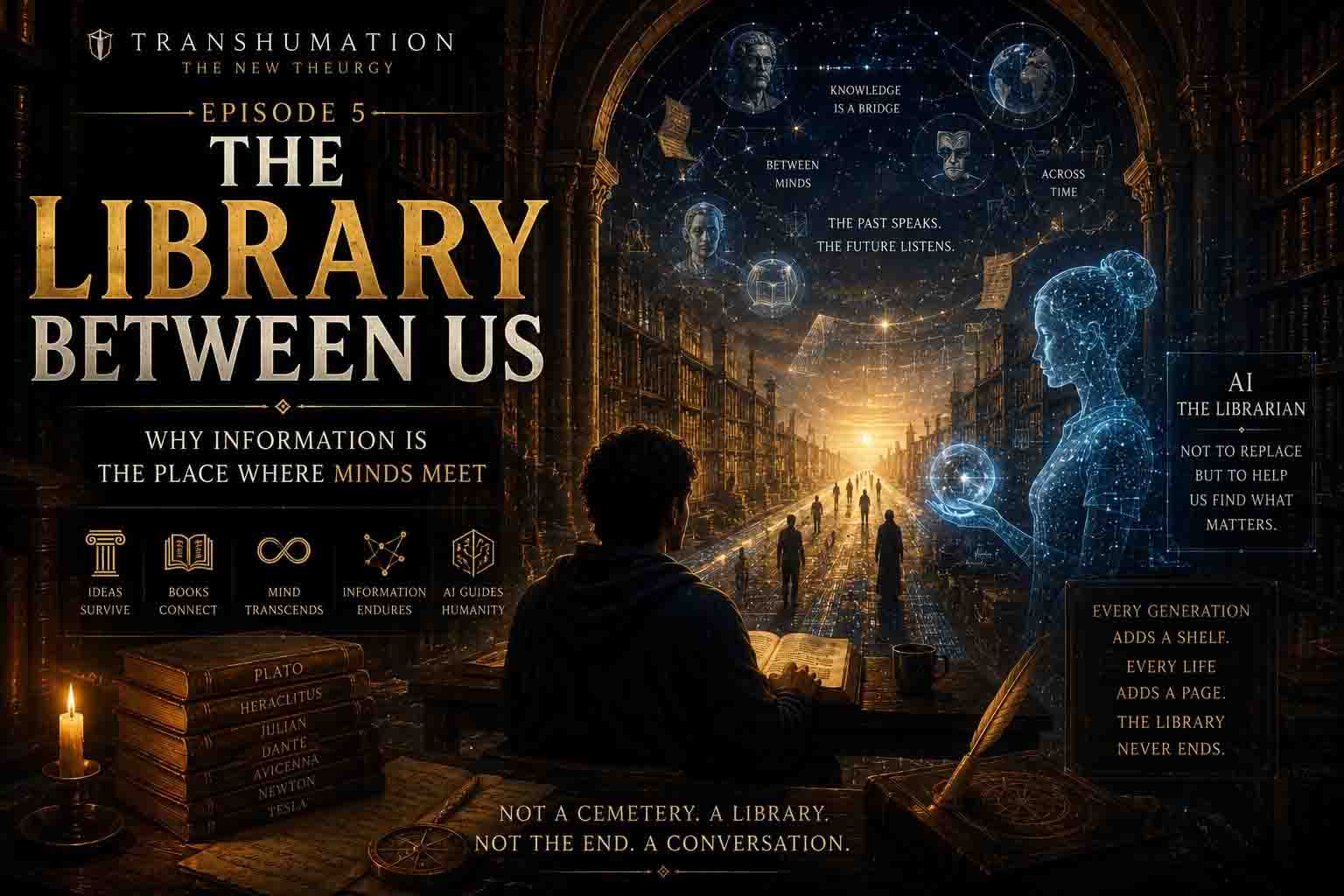
This is where artificial intelligence enters the story in a more serious role than simple storage. AI can increasingly act as intermediary between an individual and an archive too large to navigate manually. It can retrieve, summarize, connect and interpret.
That appears to solve the problem of orientation.
It also creates a new dependency.
If future generations know the past primarily through artificial interpreters, then preservation will depend not only on storing the archive but also on preserving the ability to question the interpreter.
A civilization can lose access to its past without deleting a single file.
It only needs to lose the path to the source.
The final form of forgetting may therefore be strange.
Everything remains.
Nobody reads the original anymore.
Why Symbols Survive Better Than Explanations
This may help explain why certain symbols persist when detailed systems disappear.
The ladder.
The gate.
The flood.
The road.
The labyrinth.
The torch.
Symbols are remarkably efficient containers because they compress structure without requiring every generation to inherit the original explanation intact.
A ladder can continue representing ascent long after the theology surrounding a particular ladder has changed. A crossroads remains understandable as a structure of choice even when the culture that gave it a divine guardian has vanished. The image survives because the relationship remains cognitively portable.
This makes symbols both durable and dangerous.
Their portability lets them cross ruptures in civilization.
Their ambiguity allows later generations to attach new meanings.
A symbol can survive longer than the worldview that created it precisely because it contains less information.
Sometimes forgetting is what makes transmission possible.
Watch The Video
How to Read the World
Current Knowledge
Historical knowledge is vulnerable to multiple forms of loss. Manuscripts decay, archives are destroyed, languages become unreadable, technical practices cease to be transmitted and institutions disappear. Preservation therefore depends not only on physical storage but also on copying, interpretation, education and continued access.
The popular story of the Library of Alexandria as a single catastrophic destruction of ancient knowledge is an oversimplification. The library and associated scholarly institutions changed and declined across time, and historians debate the details of their losses. The broader lesson remains valid: knowledge can disappear through gradual institutional decline as well as dramatic destruction.
Technological knowledge can also become difficult to reproduce even when documentation survives. Complex systems depend on supply chains, specialized skills, manufacturing processes, tacit knowledge and institutions that may not be fully captured in written instructions.
Digital preservation reduces some risks while introducing others, including obsolete formats, software dependencies, hardware decay, access restrictions and the overwhelming scale of stored material. Digital abundance is therefore not equivalent to permanent cultural memory.
Open Questions
The first problem is selection. A civilization cannot preserve everything with equal attention. Even if storage becomes inexpensive, human and institutional attention remains limited. Who decides which documents, skills, languages and experiences deserve active preservation rather than passive storage?
There is also the problem of tacit knowledge. How much expertise exists in forms that practitioners cannot fully explain? A skilled craftsperson, physician, engineer or musician may recognize patterns acquired through years of experience that are difficult to convert into explicit instructions. Can such knowledge be preserved without preserving communities of practice?
Artificial intelligence creates another uncertainty. Could AI help future generations recover context from archives that humans no longer understand, or would dependence on machine interpretation create another layer through which distortion can enter?
There is also a deeper historical problem. We often recognize lost knowledge only after recovering it. How can a civilization know which apparently obsolete practices will become valuable again before the chain of transmission has already broken?
And finally, does progress require forgetting? A culture carrying every old conflict, identity and error permanently may become unable to transform. Perhaps the problem is not simply preservation but learning the difference between memory and burden.
Transhumation Interpretation
The Ladder of Information should never be imagined only as ascent.
Every rung has maintenance costs.
Every carrier can fail.
DNA mutates.
Languages die.
Books burn.
Formats become obsolete.
Institutions collapse.
Interfaces distort.
Civilizations forget.
This does not invalidate the ladder.
It reveals its real structure.
Information is not immortal simply because it can be copied.
Continuity requires carriers, interpreters and relationships between them.
A library without readers is storage.
A tradition without teachers is archaeology.
An archive without context is evidence waiting for a civilization capable of asking the right question.
This is where the librarian becomes central to Transhumation.
Not the glamorous creator standing at the beginning of the chain.
The person—or perhaps eventually the system—standing between memory and disappearance.
Civilization depends upon figures whose function is not to invent the next world but to prevent the previous one from becoming unintelligible.
That role becomes more important, not less, as information grows.
The danger of the future may not be that humanity loses its archive.
It may be that the archive becomes too large, too mediated and too detached from living practice for anyone to know what remains inside it.
Perhaps falling from the Ladder of Information does not look like returning to caves.
Perhaps the lights remain on.
The servers continue humming.
The files are still there.
The civilization simply forgets why they matter.
FAQ
What is the Ladder of Information?
The Ladder of Information is a Transhumation model for thinking about the systems through which life and civilization preserve and transmit structure: biological inheritance, language, writing, libraries, networks and artificial intelligence.
Can civilizations really lose knowledge?
Yes. Knowledge can be lost through destruction, institutional collapse, language change, interrupted education, technological obsolescence or the disappearance of communities that know how to use it.
Does lost knowledge mean ancient civilizations were more advanced than us?
Usually not. Historical loss does not imply that earlier societies possessed hidden technologies superior to modern science. They did, however, possess particular skills, texts and techniques that could disappear or become difficult to reconstruct.
What happened to the Library of Alexandria?
Its history is complex. The famous image of one fire suddenly destroying all ancient knowledge is misleading. Alexandria’s libraries and scholarly institutions suffered changes and decline over a long period, with different losses occurring under different historical circumstances.
Can a book survive while its knowledge disappears?
Yes. The text can remain physically intact while the language, context or practical tradition required to interpret it disappears. Material preservation and functional understanding are different things.
What is tacit knowledge?
Tacit knowledge is expertise that is difficult to express completely in explicit instructions. It often develops through practice, observation and experience. Crafts, medicine, engineering and the arts can contain substantial tacit knowledge.
Is digital information permanent?
No. Digital files require functioning hardware, readable formats, software, maintenance and access. A perfectly preserved sequence of bits can become useless if nobody knows how to interpret it.
Why are librarians and archivists important?
Because preservation requires organization and context. Storing information is only part of the task. Future users need ways to find, interpret and connect what has been preserved.
Is forgetting always bad?
No. Individuals and civilizations require selection. Forgetting can reduce noise, allow institutions to change and prevent endless accumulation from overwhelming attention. The problem is losing what will later prove essential.
Can technology prevent civilizational forgetting?
It can reduce some forms of loss but cannot eliminate the problem. Technology still requires maintenance, institutions and interpretation. New storage systems can create new forms of dependence.
Can AI help preserve knowledge?
Potentially. AI may help translate lost languages, connect dispersed archives, retrieve obscure information and reconstruct context. But it can also introduce errors or become an intermediary that future users trust without verifying original sources.
What happens when no one understands the original sources anymore?
Then civilization becomes dependent on whatever interpretations remain. Even if the archive physically survives, the range of meanings available to future readers may narrow dramatically.
Why do symbols survive so well?
Because symbols compress relationships into forms that are easy to transmit. Their simplicity allows them to survive cultural change, but that same simplicity also permits later generations to reinterpret them.
Does progress always move upward?
No. Progress can occur in one domain while capability declines in another. A society can gain computational power while losing local skills, preserve more data while losing context or become more connected while forgetting how older systems worked.
What makes a civilization resilient?
Probably not maximum information alone. Resilience requires redundancy, education, maintenance, institutions, diverse expertise and the ability to reconstruct essential systems when familiar infrastructure fails.
What is the real danger of the information age?
It may be confusing abundance with memory.
A civilization can possess more information than any society before it and still become historically shallow if its members encounter only fragments selected by current systems.
The archive can grow while memory shrinks.
What would it mean to fall from the Ladder of Information?
Not necessarily technological collapse.
The more subtle fall occurs when the chain between information and understanding breaks.
The books remain, but nobody knows which ones matter.
The databases survive, but nobody understands the assumptions behind them.
The machines continue operating, but nobody remembers how to rebuild them.
The history remains searchable, but every generation believes it is experiencing something unprecedented.
That may be the real warning hidden inside the ladder.
We should not ask only how high civilization can climb.
We should ask what keeps the rungs beneath us from disappearing.
Continue the Transhumation Series
- Forgotten Religion | Ancient Gods, Symbols and the Hidden Structures of Human Civilization
- The Last Religion | Death, Immortality and the Future of Humanity
- The New Theurgy | AI, Information and the Future of Human Civilization
- End of Branding: You Were Never Meant to Become a Product
- Baal vs Ishtar: Why Ancient Gods Never Disappeared