
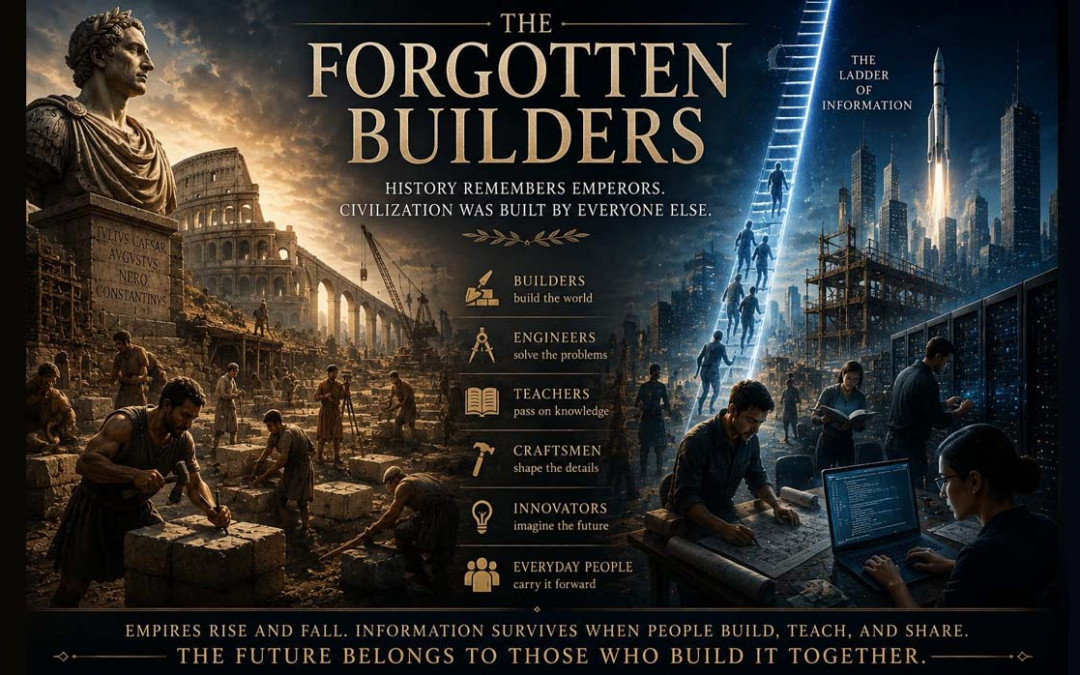
The Names Missing From Rome
We remember the emperor who ruled the city. Almost nobody remembers the people who made the city possible.
Ask someone to name a Roman and the experiment becomes almost embarrassingly easy. Caesar arrives first, although technically he was never emperor. Augustus follows. Nero, perhaps Marcus Aurelius, maybe Caligula if films have been doing most of the teaching. Give the person another minute and gladiators, senators and generals begin appearing. Rome comes back to life remarkably quickly.
Then ask a slightly different question.
Who built it?
Not who ordered a temple to be built, dedicated an aqueduct or placed his name above an arch. Who actually stood on a piece of ground, measured it, calculated what it could carry, negotiated for materials, hired workers, transported stone, solved drainage, discovered that yesterday’s plan would not work and invented another one before somebody important noticed?
Suddenly one of history’s most famous civilizations becomes strangely empty.
We know the men standing on the monuments. The people who made the monuments stand have almost disappeared.
That is a curious way to remember a civilization.
The Name Above the Door
Walk through the remains of the Roman world and names are everywhere. Emperors understood something modern corporations understand equally well: infrastructure can carry a signature. Buildings, roads, baths, temples and public works did more than perform practical functions. They communicated authority. Augustus could transform Rome and allow the transformation itself to become part of the story of Augustus.
But an inscription creates an illusion. It compresses an enormous network of human activity into a single name.
A road requires surveying, quarrying, transport, drainage, labor, maintenance and knowledge accumulated long before the person whose reign dates its construction. An aqueduct is not an emperor translated into stone. It is mathematics, administration, skilled labor, material supply, accumulated engineering experience and thousands of decisions, many of them made by people whose names will never appear in a schoolbook.
This is not uniquely Roman. We still do it.
We say Apple and imagine Steve Jobs. We say Renaissance and summon Leonardo or Michelangelo. We say Apollo and remember Armstrong. We attach a face to something that required a network because a face is easier to remember than a network.
Civilization may be collective.
Memory prefers protagonists.
Somewhere Under the Marble
Archaeology occasionally produces wonderful little acts of revenge against this habit.
A scratched name, an invoice, a workshop stamp, a builder’s mark, a piece of correspondence or an inscription can suddenly return an ordinary person to the world. For a moment Rome stops being marble emperors and becomes a place where somebody had to buy materials on Tuesday morning because work was supposed to begin on Wednesday.
That Rome interests me more.
It is closer to our own world than the cinematic empire of laurel wreaths and legions. Property changed hands. Contracts were negotiated. Goods arrived late. Craftsmen developed reputations. Merchants took risks. Builders encountered problems that existed nowhere in the original plan. Someone discovered that a wall was not where it was supposed to be.
The great machine of civilization depended upon millions of such unrecorded corrections.
This may explain one of history’s peculiar biases. History naturally preserves moments when something becomes visible: a coronation, a battle, an assassination, a treaty, the opening of a monument. Construction is harder to narrate because construction is mostly continuity. Ten thousand competent decisions rarely produce a dramatic scene.
Yet remove those decisions and there is no scene for Caesar to enter.
The stage disappears before the actor does.

The People Who Begin Before They Know
There is another reason builders deserve more attention. They operate in an uncomfortable territory between imagination and proof.
Once something works, its existence makes it look obvious. The bridge is standing, the company exists, the machine flies, the software runs. We can examine the finished object and reconstruct a neat sequence leading toward it. From the end of the story, uncertainty becomes difficult to see.
From the beginning, however, there was no finished object.
There was usually a badly drawn version of it.
The familiar mythology of innovation exaggerates the role of the lone visionary, but it preserves one important truth: somebody has to act while success is still uncertain. The Wright brothers did not possess the psychological advantage of growing up in a world full of airports. Early computer builders could not point toward billions of people carrying networked computers in their pockets. The first people working on any genuinely new system have fewer examples precisely because the examples have not yet been built.
That is not madness in the clinical sense, nor does every implausible idea deserve admiration. Most implausible ideas probably fail. The interesting quality is something narrower: the willingness to begin before reality has supplied enough evidence to make beginning comfortable.
Civilization needs people capable of crossing that gap.
The strange part is that once they succeed, the gap vanishes behind them.
The Ladder Is Made of Hands
We often imagine the Information Ladder as though civilization were climbing through increasingly sophisticated ideas: writing, mathematics, printing, electricity, computation, networks, artificial intelligence. Seen from far enough away, that is reasonable.
Come closer and the ladder changes.
Information cannot climb by itself. Someone has to preserve it, copy it, teach it, test it, translate it into machinery and build the infrastructure through which it moves. A mathematical insight without a school can disappear. A book without printers, libraries and readers becomes an object. Software without electricity, networks, hardware and maintenance is inert code.
Even knowledge that appears purely intellectual rests upon an extraordinary physical structure.
Newton needed paper.
Darwin needed ships, specimens, correspondence and printers.
A modern AI laboratory requires semiconductor fabrication, power stations, cooling systems, fiber-optic cables, data centers, engineers, researchers, technicians and enormous chains of industrial knowledge extending across continents.
At every higher rung, the ladder becomes less like a staircase built by geniuses and more like scaffolding assembled by people who will never have statues.
Perhaps that is why civilization can look almost supernatural from a distance. No single participant understands the whole thing. The person designing a chip does not need to know how to build the power station supplying the factory. The engineer maintaining a network does not need to manufacture the glass in its fiber. Each person inherits a structure created by others, modifies a tiny part of it and hands the result forward.
The miracle is not that somebody knows everything.
The miracle is that nobody has to.
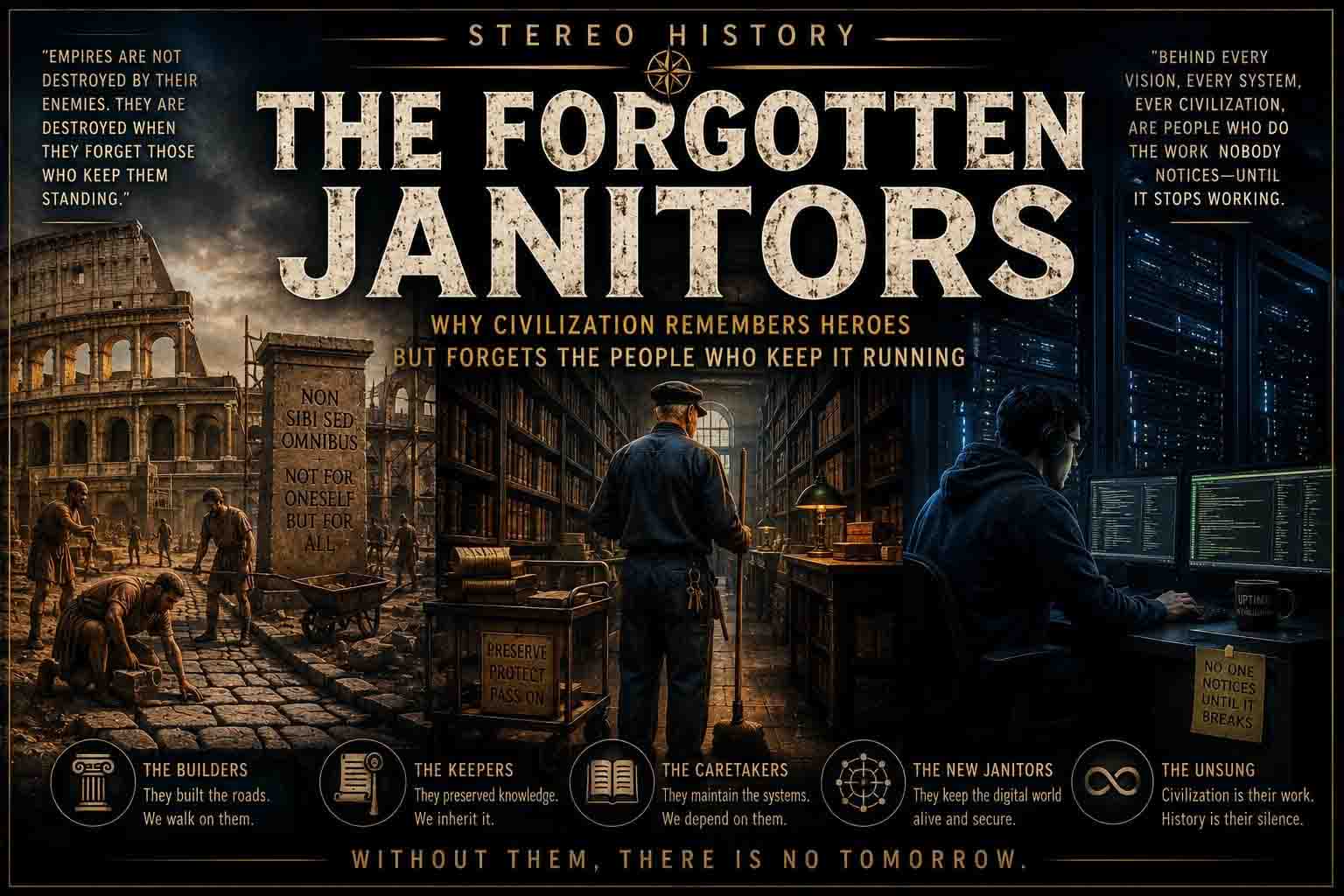
The Emperor Problem
This leaves us with a problem larger than historical fairness.
If we misunderstand how previous civilizations were built, we may misunderstand how our own civilization works.
The heroic model is seductive because it gives causation a face. A company succeeds because of its founder. A nation changes because of its leader. A technology appears because of an inventor. Sometimes one person genuinely does alter the direction of events enormously, and pretending otherwise would merely replace one simplification with another.
But direction and construction are different functions.
An emperor can decide that a road should exist. He cannot become the road.
A founder can establish the character of a company. She cannot personally perform every calculation, manufacture every component, answer every customer or maintain every server.
The interesting question is therefore not whether great individuals matter. Clearly they do. It is how much of civilization exists in the invisible space between their decisions.
That space may be where most civilization actually lives.
And perhaps our obsession with famous names tells us something about the limits of human memory. Networks are difficult to turn into stories. Structures have no faces. Thousands of small contributions do not fit neatly onto the cover of a biography.
So we place the emperor on the coin.
Then gradually forget the mint.
The Names We Are Forgetting Now
There is something slightly unsettling about realizing that the process has not ended.
Somewhere today, a person whose name almost none of us knows is solving a mundane engineering problem that may become part of ordinary life twenty years from now. Someone is improving a battery, correcting a piece of code, redesigning a cooling system, cataloguing biological data, maintaining an archive or teaching a child who will eventually build something neither of them can yet imagine.
Most of these people will not become historical figures.
That does not make their contribution historically small.
Perhaps the better way to think about civilization is not as a procession of giants but as a structure of inheritance. Each generation enters a world it did not build, receives tools it did not invent and knowledge it did not discover, then changes some small portion before leaving it to strangers.
Occasionally one of those strangers becomes Caesar.
Most become a missing name.
Yet if you could somehow remove the forgotten people from Rome—the surveyors, masons, merchants, teachers, sailors, clerks, engineers, mothers, craftsmen, farmers and thousands of others—the famous people would remain for only a moment.
There would still be an Augustus.
There just wouldn’t be a Rome for him to rule.
Watch The Video
How to Read the World
Current Knowledge
Historical research strongly supports the view of Rome as a highly complex society dependent on specialized labor, trade, administration, engineering and extensive infrastructure. Roman roads, aqueducts, ports and urban construction required organized systems involving skilled and unskilled workers, contractors, officials, merchants and technical specialists. Archaeology also preserves traces of ordinary economic life through inscriptions, graffiti, maker’s marks, contracts, workshops and material remains.
At the same time, it would be misleading to reduce Roman achievement either to emperors or to anonymous labor alone. Political authority, elite financing, military organization, engineering knowledge, local administration and large labor networks interacted in different ways across Roman history.
Open Questions
How much historical change can reasonably be attributed to exceptional individuals, and how much emerges from networks that would have produced similar developments without them? Why are human beings so much better at remembering agents than systems? Does storytelling itself distort our understanding of civilization by demanding protagonists?
And there is a more contemporary question: which people and infrastructures essential to our own civilization have become so ordinary that we have already stopped seeing them?
Transhumation Interpretation
From the perspective of Transhumation, the forgotten builder may reveal something fundamental about the Information Ladder. Civilization does not advance simply because information accumulates. Information must repeatedly acquire a carrier: a person, a book, a road, an institution, a machine, a server, a ritual, a teacher.
The carrier changes. The function survives.
Perhaps this is why history looks different when viewed one rung higher. Caesar, Augustus, Jobs or Armstrong remain important, but they cease to occupy the entire picture. Around them appears the larger structure that made their actions possible.
Civilization may remember itself through names.
But it survives through patterns of contribution.
And almost every one of us is standing inside a structure built by people we will never know.
FAQ
Why does history remember emperors more easily than ordinary builders?
Because historical memory favors visible individuals, dramatic events and named decision-makers. Large systems are harder to narrate, even when they depend on thousands of people whose work made those events possible.
Who actually built Roman civilization?
Roman civilization depended on a wide network of engineers, surveyors, craftsmen, merchants, laborers, administrators, sailors, builders and many others. Emperors could direct or finance projects, but they did not create infrastructure alone.
Why are anonymous contributors so often forgotten?
Their work was usually continuous rather than dramatic. History preserves battles, coronations and political crises more easily than years of maintenance, construction, logistics and small technical decisions.
Does the article argue that great individuals do not matter?
No. Leaders, inventors and founders can have enormous influence. The article argues that direction and construction are different functions, and that famous individuals often depend on much larger systems than historical storytelling suggests.
Why does the article compare Augustus with Steve Jobs?
Because both illustrate the tendency to attach complex systems to recognizable names. A ruler or founder may shape direction, but the structure depends on many contributors working below the level of public attention.
What is the “Emperor Problem”?
It is the tendency to confuse the visible leader with the whole system. The emperor becomes the symbol of the civilization, while the infrastructure and people that made his power possible disappear from memory.
Why are builders important to the Information Ladder?
Because information cannot move forward without carriers. Knowledge needs teachers, books, roads, machines, institutions, servers, laboratories and people capable of maintaining them.
What does the article mean by saying the ladder is “made of hands”?
It means that civilization does not advance through ideas alone. Ideas must be preserved, taught, translated into tools and physically supported by people and infrastructure.
Are ordinary workers historically more important than emperors?
Not necessarily more important, but often far more important than conventional narratives admit. Civilization emerges from interaction between leadership, institutions, technical knowledge, labor and accumulated infrastructure.
Why does history prefer protagonists?
Human beings understand stories more easily through recognizable agents. A single person provides a clear narrative center, while networks of thousands of contributors are harder to remember and represent.
What can archaeology tell us about forgotten people?
Archaeology can recover traces such as graffiti, maker’s marks, workshops, contracts, inscriptions and ordinary objects that reveal the economic and practical life hidden behind elite political history.
How does this idea apply to modern technology?
Modern systems such as AI, the Internet, space exploration and energy infrastructure depend on enormous networks of engineers, technicians, manufacturers, researchers and maintenance workers whose names are rarely known publicly.
Why does the article say civilization is a structure of inheritance?
Because every generation receives tools, knowledge and institutions it did not create from nothing. People modify only part of the inherited structure before passing it forward again.
What does the article mean by saying “the miracle is that nobody has to know everything”?
Complex civilization works through distributed knowledge. Different people understand different parts of the system, and cooperation allows the whole structure to function without any one person comprehending every component.
What is the main Transhumation interpretation?
Transhumation reads the forgotten builder as evidence that civilization survives through recurring functions rather than famous names. The carrier may change—from mason to engineer, from road to fiber-optic cable—but the underlying structure of contribution continues.
What is the main argument of the article?
History remembers civilization through faces, but civilization itself is built through networks. Remove the forgotten contributors, and the famous figures would have little left to rule, invent or transform.
Continue the Transhumation Series
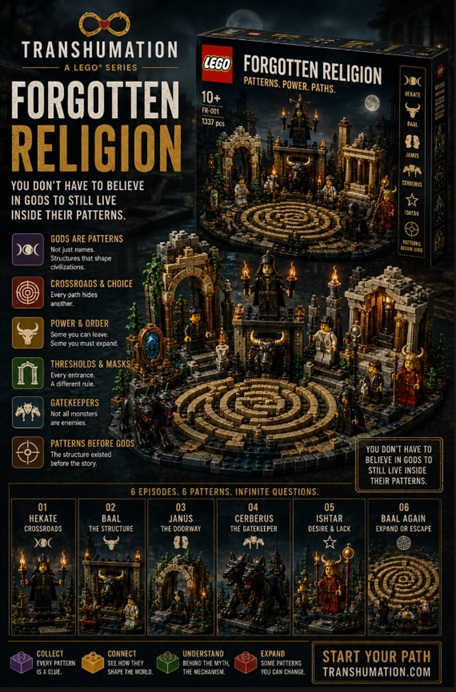
- Forgotten Religion | Ancient Gods, Symbols and the Hidden Structures of Human Civilization
- The Last Religion | Death, Immortality and the Future of Humanity
- The New Theurgy | AI, Information and the Future of Human Civilization
- End of Branding: You Were Never Meant to Become a Product
- Baal vs Ishtar: Why Ancient Gods Never Disappeared