
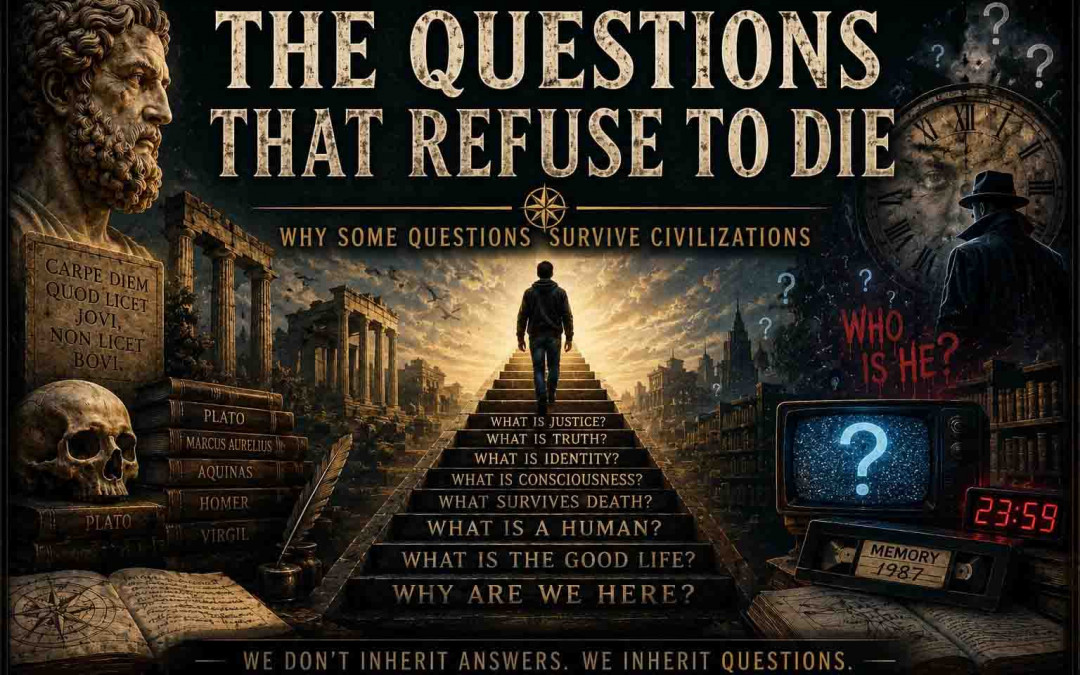
The Questions That Refuse to Die
Some questions are born with an expiration date.
What is the price of grain this winter? Who will govern the city next year? Which army controls the road? Which law applies to this property? At the moment they are asked, such questions can determine whether people eat, escape, inherit or die. They are not trivial merely because history eventually makes them obsolete. For the people living inside them, they may be the most important questions in the world.
Then the world that produced them disappears.
The currency changes. The border moves. The dynasty ends. The law is repealed. The road becomes a street beneath another city. A question that once filled council chambers can become so remote that a historian must explain why anyone cared about it.
Yet beside these temporary questions are others that behave differently.
What is justice? What makes a person the same person over time? Can power make something right? What distinguishes knowledge from conviction? What do we owe the dead? Is consciousness merely something the brain does, or have we not yet framed the problem correctly?
The wording changes. The assumptions change. Even the concepts contained in the question may shift across languages and centuries. Still, something recognizably similar returns.
Civilizations do not inherit only answers.
They inherit unfinished problems.
And some of those problems appear remarkably difficult to kill.
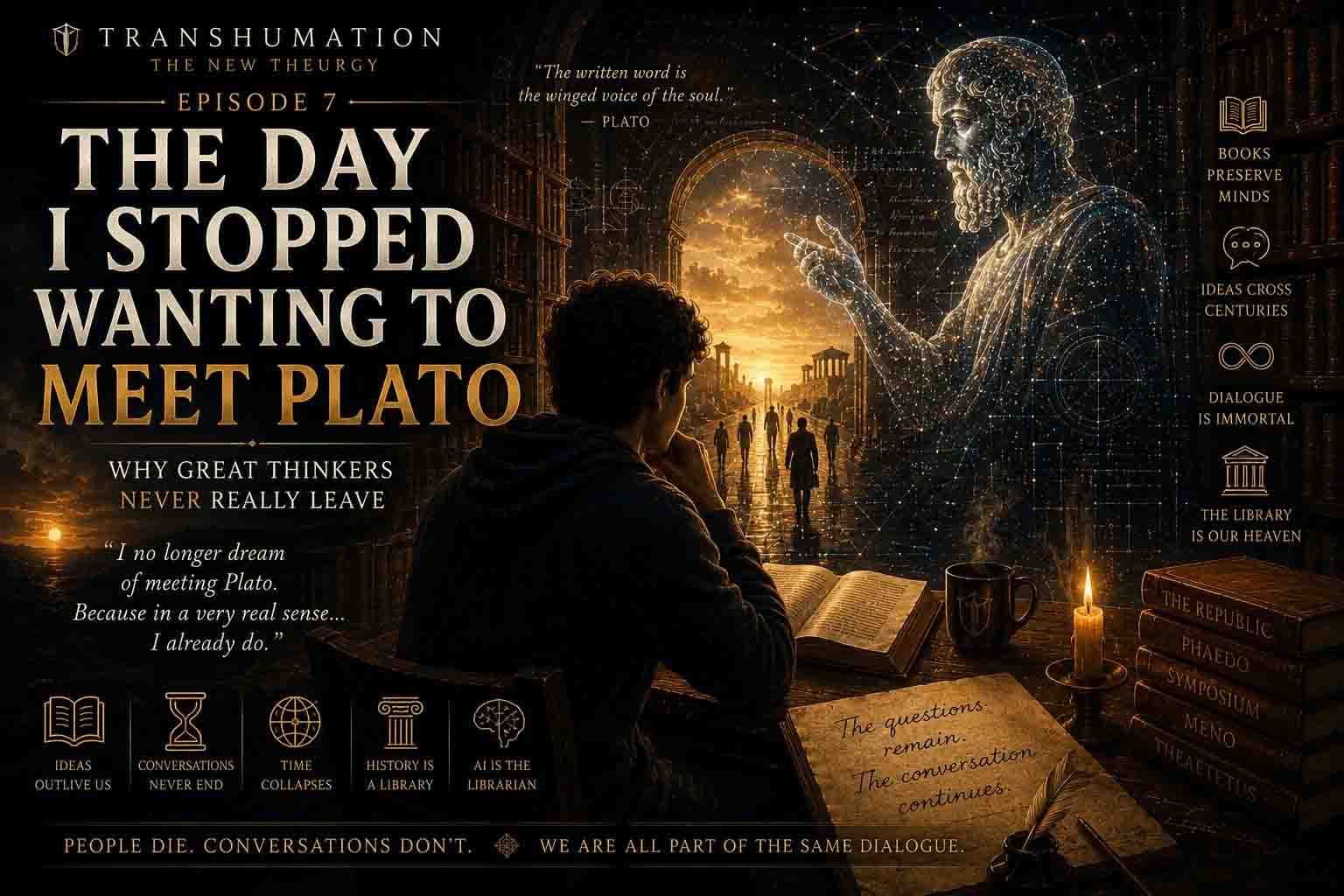
Why Are We Still Reading Plato?
The easy answer is that Plato was a genius.
That is probably true and not sufficient.
History is full of intelligent people whose works disappeared. Manuscripts burned. Languages died. Libraries were destroyed. Intellectual traditions lost political support. Texts that survived did so partly because generations of copyists, scholars, teachers, religious institutions, translators and collectors decided, for different reasons, that they were worth carrying forward.
Plato did not cross twenty-four centuries by philosophical force alone.
He had help.
That qualification makes his endurance more interesting, not less. Once preserved, his dialogues repeatedly became useful to people living in worlds he could not have imagined. Questions about justice could be reopened under empires, republics, churches and modern states. Questions about knowledge could survive changes in cosmology. Questions about appearance and reality could migrate from metaphysics into science, politics and eventually digital culture.
The answers did not remain fixed.
Neither did the questions, exactly.
What survived was more like a structure capable of being instantiated again.
A reader in Athens, Florence, London and a future digital city does not ask precisely the same question when asking what justice is. The surrounding institutions and assumptions are different. But enough of the problem remains recognizable for conversation to continue.
This may be one of civilization’s stranger forms of continuity.
We do not keep Plato alive.
We keep reopening some of his rooms.
A Question Is Not a Fossil
We often speak of ancient questions as though they were objects recovered intact from the ground.
They are not.
A question changes when the world around it changes.
Consider identity. For an ancient philosopher, the problem might involve soul, body, memory, character or metaphysical substance. A modern neurologist can add brain injury and cognitive continuity. Digital culture introduces avatars, persistent accounts and synthetic representations. Artificial intelligence adds the possibility of models that reproduce someone’s language or preferences after the original person is gone.
The old question has not simply survived unchanged.
It has acquired new experimental conditions.
That is why enduring questions are not fossils.
They are more like mathematical problems that can be run again under new parameters.
Each technological or cultural transformation supplies another test.
This is also why old philosophy can become unexpectedly contemporary without having “predicted” the future. Plato did not anticipate digital avatars. Heraclitus did not anticipate neural networks. Ancient debates about identity do not contain hidden descriptions of modern technology.
The connection is structural.
A new carrier exposes an old problem from another direction.

Why Great Works Refuse to Finish
Something similar happens with literature.
It is tempting to say that bad stories give answers while great stories ask questions. That sounds elegant, but literature is less obedient than aphorisms.
Many enduring works contain strong answers.
The Divine Comedy is hardly shy about metaphysical architecture. Greek epic carries moral and religious assumptions. Shakespeare’s plays are not philosophical questionnaires disguised as drama.
What distinguishes many durable works is not the absence of answers.
It is that their structures cannot be exhausted by one answer.
Hamlet remains readable after thousands of interpretations because no single description consumes the play. Is Hamlet’s delay psychological, ethical, theatrical, political or epistemological? What does the play assume about evidence? When does suspicion become knowledge? How much of identity is performance? Each reading can illuminate something while leaving the object larger than the interpretation.
The same is true of Don Quixote. It can concern madness, fiction, dignity, self-invention, changing media, the collision between models and reality, or several of these simultaneously. The text constrains interpretation; we cannot make it mean anything we wish. But the work contains enough structure to survive successive contexts without becoming identical to any one of them.
A great work therefore behaves differently from a solved equation.
Its value is not that nobody can understand it.
Its value is that understanding one part does not abolish the remainder.
The Hook in Reality
Science begins from questions too, but the romantic version of this story requires caution.
Not every anomaly is important.
Not every contradiction hides a revolution.
Most strange details are mistakes, noise, coincidence, bad measurement or misunderstood context. Human beings are excellent at discovering patterns because pattern recognition is useful, and equally excellent at discovering patterns that are not there.
The interesting anomaly is therefore not merely the thing that feels strange.
It is the thing that continues to resist explanation after serious attempts to make it ordinary.
That is the hook.
A result refuses to fit a model. An observation survives replication. A historical document contradicts a chronology. A mathematical relationship appears where the existing framework cannot comfortably contain it.
At that point, curiosity becomes more than aesthetic pleasure.
The anomaly places pressure on the model.
This is why good questions require the possibility of disappointing us. If every strange symbol confirms our theory, the theory is worthless. If every contradiction can be absorbed by adding another explanation, we are no longer investigating; we are protecting a story.
The questions worth carrying forward are often those strong enough to attack the framework in which they were born.
Civilization Does Not Climb in a Straight Line
The metaphor of a ladder is attractive because it suggests inheritance.
One generation stands where another stopped.
But it can also mislead.
We are not simply above Plato, Marcus Aurelius or Aquinas because our century comes later. We know things they did not know. We also inhabit categories they never needed and have forgotten techniques, assumptions and forms of attention that mattered deeply in their worlds.
History is not a staircase toward ourselves.
A better version of the ladder would contain branches, missing rungs and sections rebuilt by later civilizations.
Some questions disappear and return.
Some survive only in one tradition before being rediscovered elsewhere.
Some are translated so radically that scholars argue whether the same question survived at all.
Some apparently universal problems turn out to depend heavily on local language or institutions.
Civilization progresses, but not by simply replacing primitive questions with sophisticated ones.
Often the sophistication lies in discovering that the original question was badly formed.
Science has repeatedly advanced this way.
The answer is not always new.
Sometimes the achievement is realizing that we were asking for the wrong kind of answer.
What Makes a Question Survive?
An enduring question usually has several advantages.
It concerns a structure that reappears.
Justice survives because groups must repeatedly decide how goods, responsibilities, punishments and rights should be distributed. Identity survives because living beings change over time while social systems must still decide when continuity matters. Knowledge survives as a problem because humans must act on representations of a world they never perceive completely.
But structure alone is not enough.
The question also needs carriers.
Texts.
Teachers.
Institutions.
Translations.
Rituals.
Libraries.
Arguments.
A civilization can possess a profound question and still lose it.
This is an uncomfortable corrective to the romantic idea that the best ideas automatically survive.
They do not.
Survival is partly merit.
It is also infrastructure.
The Library of Alexandria matters not because every book inside it was immortal, but because civilization repeatedly discovers that thinking requires systems capable of carrying thought beyond one body and one generation.
A question without a carrier can die as completely as a person without descendants or records.
The Age of Instant Answers
Our own period introduces a curious reversal.
For much of history, answers were expensive.
A question might require travel, correspondence, access to books, specialist knowledge or years of training. Search engines dramatically reduced part of that cost. Conversational artificial intelligence reduces another layer by allowing people to approach large informational spaces through ordinary language.
This is an extraordinary achievement.
It also creates a new temptation.
When answers become cheap, we may begin treating the question as the disposable part.
Ask.
Receive.
Move on.
But a fluent answer can conceal a weak question.
“What causes the fall of civilizations?” already assumes that civilizations possess a sufficiently coherent thing called a fall and that something like a cause can be isolated. “Where is memory stored?” may encourage us to imagine memory as a physical object deposited in one location. “Will AI become conscious?” bundles together unsettled definitions of AI, consciousness and becoming.
The quality of the answer is constrained by the architecture of the question.
A powerful system can therefore give increasingly sophisticated answers to increasingly poorly framed problems.
That may become one of the paradoxes of artificial intelligence.
We acquire machines capable of answering before we have improved our ability to ask.
Can AI Give Answers Without Understanding the Question?
This depends partly on what we mean by understanding.
Current AI systems can analyze language, detect relationships, reformulate problems and produce explanations that are genuinely useful. They can sometimes expose assumptions the user did not notice. None of this establishes that they experience the question as a conscious subject would.
But perhaps the more interesting issue is practical rather than metaphysical.
Can AI help civilization preserve the genealogy of a question?
Instead of presenting only an answer, an intelligent librarian could show how the question changed.
What did Plato mean by justice?
What did later Christian thinkers change?
What happens when modern political theory adds individual rights?
What changes again when algorithmic systems distribute opportunities?
The AI becomes valuable not because it closes the conversation but because it helps the reader see the structure moving through history.
That is a more ambitious use of intelligence than instant certainty.
It preserves depth without forcing every reader to begin again at the first shelf.
Are Some Questions Universal?
This is where the article should remain deliberately uncertain.
It is tempting to imagine that any intelligent civilization anywhere in the universe would eventually ask what consciousness is, whether justice exists, what identity means and what survives death.
Perhaps.
But we do not know.
Some questions arise from features likely to be common to many intelligent organisms: limited knowledge, finite resources, social coordination, changing bodies and the difference between self and environment. Those constraints could generate recognizably similar problems elsewhere.
Other questions may be deeply human.
Our concepts of self are shaped by human memory, embodiment, reproduction, language and mortality. A radically different intelligence might divide the world into categories we cannot anticipate. It might find one of our deepest philosophical problems trivial and be tormented by a question we lack the cognitive architecture even to formulate.
That possibility should make philosophy more exciting.
Not less.
The universe may contain questions we have not yet evolved enough to ask.
Watch The Video
How to Read the World

Current Knowledge
Philosophical questions can persist for very long periods, but their survival depends upon historical transmission as well as intellectual durability. Plato’s works, for example, survived through complex traditions of copying, preservation, translation, education and commentary. Canonical status is therefore partly a history of institutions and carriers, not simply proof that one thinker asked objectively superior questions.
The meaning of a long-lived question can also change over time. Concepts such as justice, personhood, knowledge and consciousness have accumulated different philosophical, scientific, political and religious frameworks across centuries. Apparent continuity should therefore not be confused with perfect semantic identity.
Canonical literary works likewise survive for multiple reasons, including artistic qualities, institutional preservation, educational systems, political history, translation and continued cultural reinterpretation. Their persistence cannot be reduced to the simple claim that they ask questions rather than provide answers.
In science, unresolved anomalies can contribute to conceptual change when they survive careful investigation, but apparent anomalies often disappear through improved measurement, better evidence or corrected assumptions. An anomaly becomes scientifically important not merely because it is strange but because it continues to resist the existing model under disciplined testing.
Modern search and AI systems can dramatically reduce the cost of obtaining information, but fast access to answers does not remove the need to define terms, test assumptions and evaluate evidence. Well-formed questions remain a central part of serious inquiry.
Open Questions
One unresolved question concerns whether some philosophical problems persist because they are genuinely fundamental or because institutions repeatedly teach later generations to recognize them as fundamental. The distinction may be impossible to separate completely: a question can survive because it matters and continue to matter partly because it survived.
Another concerns translation. If a question passes through radically different languages and conceptual systems, how much can its meaning change before we are dealing with a new question that merely resembles the old one? This is especially important when modern concepts are projected backward onto ancient texts.
There is also an unexplored archive problem. We know the questions that successful traditions preserved. We know far less about potentially important intellectual structures lost because their languages, libraries or institutions disappeared. Any theory of “immortal questions” therefore suffers from survivor bias.
Artificial intelligence introduces another uncertainty. If answers become almost frictionless, will societies become better at questioning because more people can enter difficult fields, or worse because convenient synthesis encourages premature closure? Both outcomes are plausible.
The most speculative question remains whether some problems are independent of human culture. An extraterrestrial intelligence might encounter mathematics, prediction, uncertainty or coordination, but we have no evidence that it would divide those problems into the same philosophical questions humans do.
Transhumation Interpretation
The Questions That Refuse to Die belong at the center of Transhumation because they reveal a different kind of continuity from the one we usually seek.
A body survives through metabolism.
A text survives through copying.
A question survives through re-instantiation in another mind.
That does not mean the question floats independently of matter. It requires brains, voices, books, servers, classrooms and cultural institutions. But it can become increasingly independent of one specific carrier.
Plato dies.
A manuscript survives.
The manuscript is copied.
The language changes.
A translation appears.
A reader encounters the problem under different conditions.
The carrier changes repeatedly while enough of the structure remains for recognition.
This is precisely the sort of continuity Transhumation is interested in, but the question also provides an important boundary test.
Not everything that looks similar is the same pattern.
If the meaning has changed too far, continuity may be retrospective invention. If we connect Hekate, an ancient ladder, a modern interface and artificial intelligence merely because they all contain some abstract idea of mediation, we may be constructing rather than discovering structure.
The question must survive the return of detail.
This is the Test of Unnecessary Choice in another form: does the pattern still explain something after the coincidences and decorative similarities are removed?
Great questions survive this attack better than weak ones.
“What makes the same person persist through change?” remains difficult whether we approach it through Heraclitus, neurological injury, dementia, teleportation thought experiments or digital copying. The cases are not historically connected, but the structural problem repeatedly reappears because each case forces us to decide what kind of continuity matters.
This is where questions become unusually durable carriers of civilization.
Answers are often optimized for the conditions in which they were produced.
Questions can sometimes travel farther because they preserve the unresolved structure.
An ancient cosmological answer may become obsolete when astronomy changes.
The question of how observation constrains our model of the universe survives.
A political institution may disappear.
The problem of balancing individual freedom against collective power returns.
A theory of the soul may lose authority.
The question of personal continuity remains.
This does not mean questions are superior to answers.
Civilization needs answers.
Bridges should not remain philosophical possibilities. Medicine should not celebrate uncertainty when evidence can reduce it. Engineering progresses precisely because many questions are answered well enough to build upon.
The more important distinction is between closed problems and productive uncertainty.
A good civilization should know which is which.
Artificial intelligence makes that distinction newly urgent.
A system optimized to provide a useful answer may naturally compress disagreement, omit historical detours and present a coherent result. Often that is exactly what the user needs.
But a library cannot consist only of conclusions.
It must preserve pathways.
The discarded hypothesis.
The argument that failed.
The question that changed shape.
The uncertainty that remains genuinely unresolved.
Otherwise an intelligent interface risks producing a civilization that knows an extraordinary number of answers while forgetting why anyone asked the questions.
The Library of Mirrors therefore needs more than memory.
It needs intellectual ancestry.
Every important answer should retain, somewhere behind it, the architecture of the problem that produced it.
Who asked?
What did the words mean then?
Which assumptions were invisible?
Which evidence changed the argument?
What would falsify the current interpretation?
This is how AI could become a librarian of civilization rather than a vending machine for certainty.
The most advanced interface might not be the one that answers fastest.
It might be the one that knows when an answer has become too smooth.
There is also something quietly human in this idea.
We often imagine immortality as preserving the person.
Perhaps civilization more commonly preserves participation.
A dead thinker does not return when we read them. There is no reciprocity. Plato does not know that we opened the dialogue.
But a structure of inquiry can become active again inside another consciousness.
The person is gone.
The intellectual relation continues.
That is not resurrection.
It is something smaller and, perhaps, more defensible.
A question crosses time.
Another mind recognizes it.
The conversation begins again.
This may be one of civilization’s oldest technologies for moving beyond the lifespan of the individual.
Not eternal life.
Delayed participation.
And perhaps that is why the best questions seem to refuse death.
They are never perfectly preserved. They acquire new language, new evidence and new mistakes. Some disappear. Some return altered beyond recognition. Others remain because each new world exposes another side of the problem.
Civilization does not climb by abandoning every old question.
Sometimes it advances because the old question finally reaches a world capable of asking it better.
FAQ
What are “the questions that refuse to die”?
They are recurring problems about subjects such as justice, knowledge, identity, consciousness and meaning that remain intellectually productive across very different historical periods.
Why do some questions survive for thousands of years?
Partly because they concern structures that repeatedly reappear in human life, and partly because institutions, texts, libraries, teachers and translations successfully preserve them.
Why are we still reading Plato?
Not because Plato supplied final answers. His works survived historically, and the problems contained in them continue to generate meaningful disagreement under new circumstances.
Are great questions more important than answers?
Not inherently. Civilization needs reliable answers to many practical problems. Enduring questions become important where the problem remains genuinely open or where new conditions expose limitations in earlier answers.
Can AI make questions more important rather than less?
Potentially. AI can make answers easier to obtain, which increases the value of defining the problem correctly, exposing assumptions and knowing when apparent certainty exceeds the evidence.
Are some questions universal to any intelligent civilization?
We do not know. Other intelligences might encounter similar structural problems involving uncertainty, identity or cooperation, but they might conceptualize them in ways humans cannot recognize.
The deeper Transhumation possibility is more modest and more interesting: perhaps civilization survives not because it preserves all its answers, but because it keeps certain questions intact enough for another mind, in another century, to open them again.
Continue the Transhumation Series
- Forgotten Religion | Ancient Gods, Symbols and the Hidden Structures of Human Civilization
- The Last Religion | Death, Immortality and the Future of Humanity
- The New Theurgy | AI, Information and the Future of Human Civilization
- End of Branding: You Were Never Meant to Become a Product
- Baal vs Ishtar: Why Ancient Gods Never Disappeared