
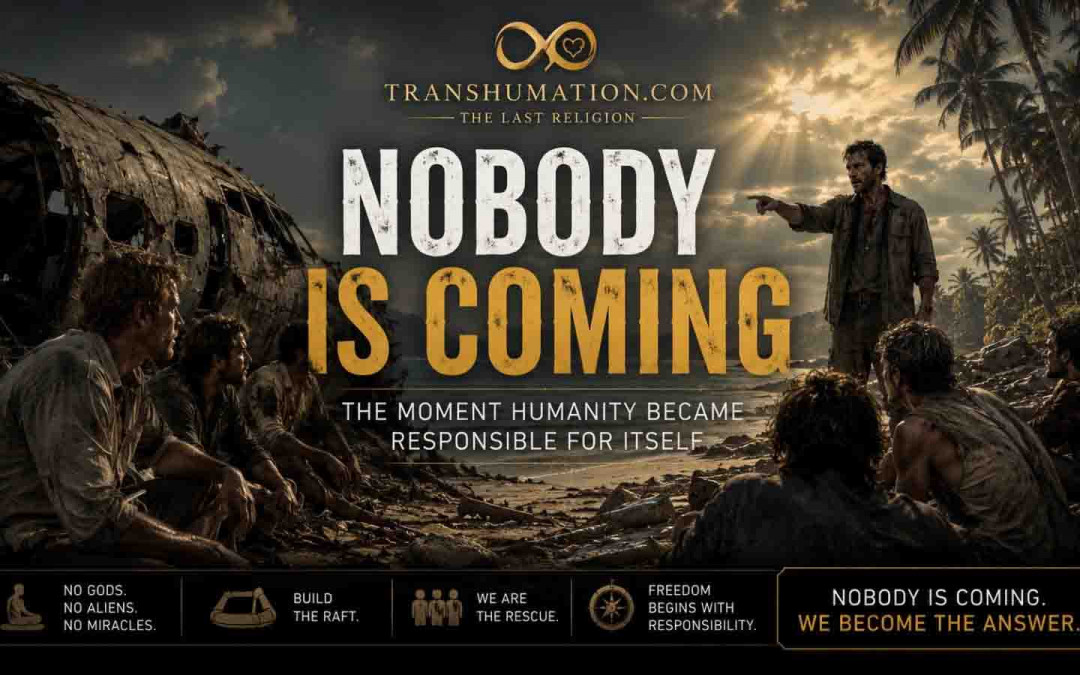
Nobody Is Coming
There is a particular kind of hope that depends on distance.
A group of survivors on a beach can endure almost anything if they believe a ship is already looking for them. Hunger becomes temporary. Fear becomes something to manage until rescue arrives. Even disagreement is softened by the assumption that the real solution exists somewhere beyond the horizon, moving toward them under its own power. Their task is not yet to escape. Their task is to remain alive long enough to be found.
Then the radio dies.
Or perhaps it works just long enough to deliver the one message nobody wanted: the search has been called off, the storm has closed the route, the coordinates were lost, nobody knows they are there. For a few minutes the news sounds like the end of hope. It is only later that someone notices the stranger consequence. Until that moment, the group had been waiting. Now they begin to look at the wreckage differently. A piece of metal becomes a tool. A torn sail becomes material. The shoreline becomes a problem of distance rather than merely the edge of a prison.
The sea has not changed.
The survivors have.
There is something almost cruelly optimistic in that shift. The loss of rescue removes comfort, but it also removes the excuse of passivity. The question changes from When will they come? to What can we build?
Civilizations may reach the same threshold.
The Morning After the Rescue Fails
Childhood is organized around the assumption that somewhere nearby is a person who knows what to do. It is one of the great luxuries of being young. A strange letter arrives and an adult understands it. Something breaks and an adult finds the right number to call. The child may be frightened, but the fear exists inside a larger architecture of protection.
Adulthood begins less dramatically than we pretend. It is not the eighteenth birthday or the first salary. It is the gradual discovery that the adults were never standing outside the system. They were improvising inside it. They knew more because they had lived longer, not because they possessed a final map.
That discovery can be unsettling because it changes the location of responsibility. A parent can advise, a teacher can explain, an expert can narrow uncertainty, but there are decisions for which no higher office exists. Eventually the hand on the bicycle lets go.
Civilization has spent much of its history constructing higher offices.
Gods.
Kings.
Prophets.
Traditions.
Sacred law.
Nature.
Progress.
History itself.
These systems were not all the same, and they should not be flattened into one crude story about dependence. But they often performed a related function: they placed human life inside an order larger than any individual decision. There was a framework. A source. A final court of appeal, even if people disagreed about what it demanded.
Then modernity introduced a possibility both liberating and frightening.
What if no answer arrives in a form everyone can recognize?
The Universe Does Not Send Instructions
There is an important difference between saying that God does not exist and saying that humanity does not receive unambiguous instructions from heaven.
The first is a metaphysical claim.
The second is simply where we find ourselves.
Believers disagree with one another. Skeptics disagree with believers. Philosophers disagree with both. Science can describe increasingly large parts of nature without settling why there is something rather than nothing, whether existence has purpose, or whether any mind stands behind it.
Meanwhile, the practical world continues.
The doctor has to choose a treatment.
The judge has to interpret the law.
The parent has to decide how much freedom to give a child.
The engineer has to decide what level of risk is acceptable.
A society has to decide what kind of technology it is willing to build before history supplies the consequences.
This is where “nobody is coming” becomes more interesting than a slogan of despair. It does not need to mean that nobody exists beyond us. It means we cannot suspend responsibility until the metaphysical dispute is settled.
The farmer still has to plant before the rain is guaranteed.
The raft still needs to be built.

The Civilizational Habit of Waiting
Human beings are extremely good at replacing one rescuer with another.
When religious certainty weakens, political ideologies can take its place. When politics disappoints, technology becomes the next candidate. We begin speaking about innovation as though it were a force descending toward us from the future, destined to solve scarcity, disease, loneliness, stupidity and perhaps death itself.
Artificial intelligence is especially vulnerable to this role because it appears at exactly the right historical moment. The library has become too large for any person to read. Institutions are too complex for any citizen to fully inspect. The volume of information exceeds human attention. Then a new kind of system arrives promising to summarize, predict, translate, compare and navigate.
It is easy to see the helicopter on the horizon.
But AI is not rescue from responsibility. At best, it is another tool inside it.
A better map does not choose the destination.
A stronger engine does not decide where the ship should go.
A system capable of answering more questions does not automatically know which questions deserve to govern a civilization.
Technology changes capability. It does not abolish judgment.
The Moment the Survivors Become Engineers
This is where the old story reverses.
For thousands of years, humanity asked whether some greater intelligence had created us, guided us, judged us, abandoned us, or planned a destination beyond what we could see. Now we are slowly moving into the creator’s side of the problem.
We edit genomes.
We build artificial systems that perform tasks once associated only with intelligence.
We redesign environments.
We preserve parts of memory outside the biological body.
We create systems whose behavior can become too complex for any one person to predict in detail.
That does not make us gods. It does something more awkward: it makes us responsible for things whose consequences may exceed our understanding.
The old question was Will someone save us?
The new question is increasingly What do we do with the power already in our hands?
This is adulthood in its least glamorous form. Not freedom as open sky, but freedom as liability. The more options a civilization acquires, the less it can pretend that outcomes were simply imposed on it.
Power expands the field of moral error.
The Raft Is Collective
There is another mistake hidden in the phrase “nobody is coming.” It can sound like an argument for the solitary hero: no rescue, therefore save yourself.
Civilization does not work that way.
A stranded group survives because knowledge is distributed. One person can repair a motor. Another can navigate. Someone knows how to treat an infection. Someone else notices weather patterns. The group becomes more capable not because one person suddenly knows everything, but because the parts begin to function as a system.
This is what mature responsibility actually looks like.
Not self-sufficiency.
Interdependence without illusion.
A functioning civilization is built from people who understand that they are not being rescued from above, but are also not required to become omnipotent alone. The doctor still needs the engineer. The engineer needs the farmer. The farmer needs the teacher. The teacher needs the institutions that preserve knowledge. The library still needs a librarian.
The old vertical structure—someone above will fix it—does not have to be replaced by isolation.
It can be replaced by a network.
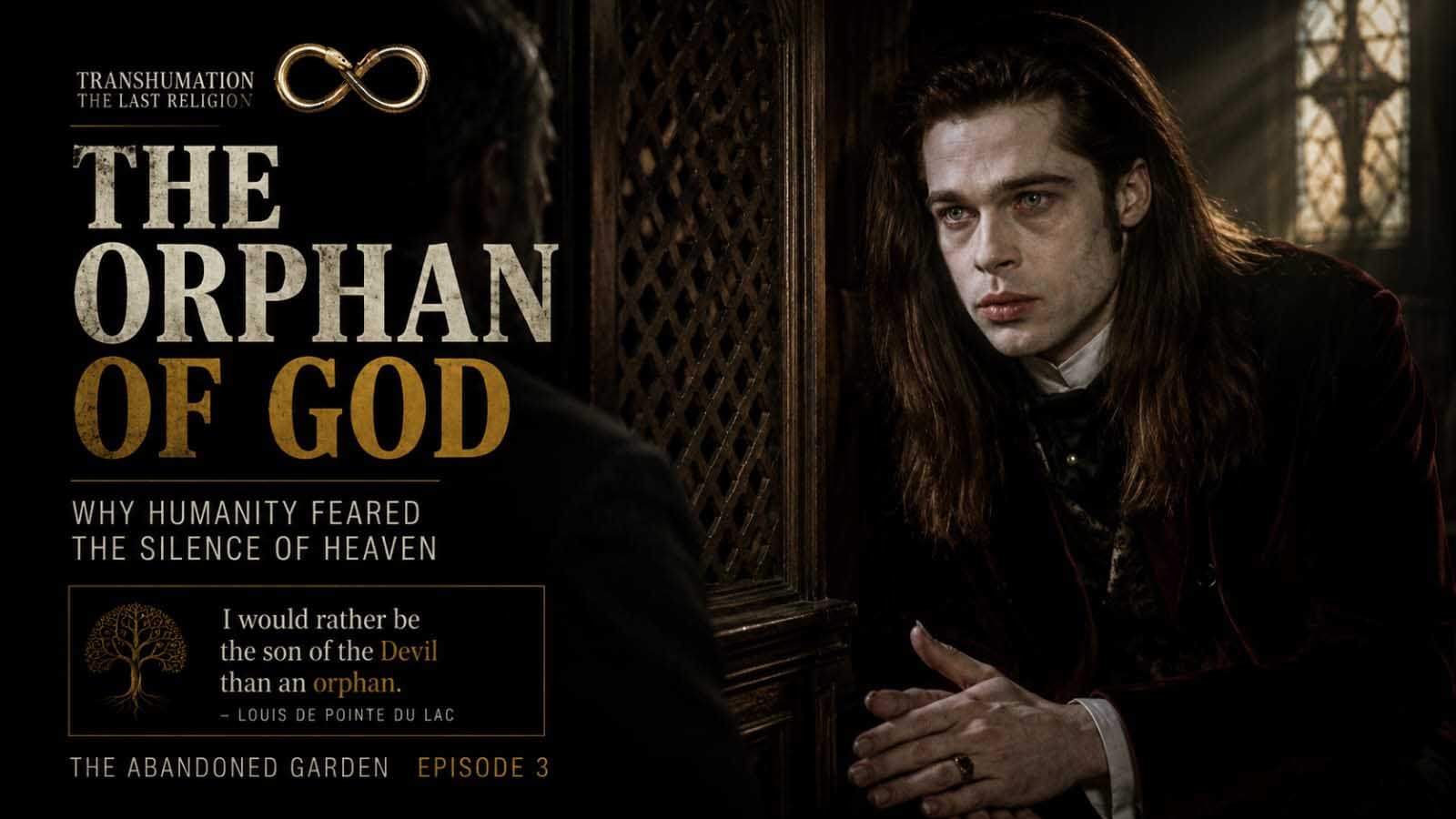
The Orphan Civilization
The word orphan sounds tragic because it describes loss before it describes inheritance.
But an orphan does not begin with nothing. There are rooms already built, debts already incurred, objects already labeled, stories already half-told. The problem is not the absence of a past. It is the absence of a final authority capable of explaining what to do with the inheritance.
Civilization is exactly this kind of estate.
We receive languages we did not invent, institutions we did not design, technologies built by dead people, moral traditions shaped by cultures we only partly understand, and problems whose causes began before we were born.
We inherit the house.
Then discover the roof is leaking.
That is why “nobody is coming” should not become a declaration that history, religion or tradition are useless. Quite the opposite. The mature orphan needs inheritance more than the child does because there is no longer anyone available to explain every object in the attic.
The challenge is learning what deserves preservation, what needs repair, and what should be thrown away.
The First True Freedom
Freedom is often described as the removal of external constraint, but the experience of freedom is usually closer to an unanswered question.
What now?
The child who finally gets permission to decide discovers that choice has a weight impossible to feel while someone else was deciding. A society that rejects one inherited authority still has to decide what will replace its function. A civilization that acquires powerful technologies still has to decide which uses should remain possible and which should be refused.
This is why responsibility and freedom arrive together.
The first is the cost of the second.
“Nobody is coming” becomes optimistic only when it is understood in this sense. It does not mean there is no hope. It means hope cannot remain a passive expectation that something external will enter the story and resolve its contradictions for us.
Perhaps no ship is coming.
Perhaps no final answer will arrive in time.
Perhaps some questions will remain open indefinitely.
That does not remove the obligation to build.
It sharpens it.
The Beach at the End
Imagine the same beach again.
The wreck is still there. The sea is still dangerous. The horizon remains empty.
But nobody is staring at it anymore.
Someone is cutting timber. Someone is repairing rope. Someone is arguing about the current. Someone is writing down what they know so that the others can use it. The absence of rescue is no longer the centre of the scene.
The work is.
This is the point where the phrase changes for the last time.
Nobody is coming.
Good.
Then we finally have to become the kind of people worth finding and we will save ourselves.
Watch The Video
How to Read the World

Current Knowledge
Human societies have historically relied on religious, legal, philosophical and political frameworks to organize moral authority, collective identity and responses to uncertainty. Modernity has not eliminated religion, and there is no single global transition from religious dependence to secular autonomy.
Psychological research suggests that perceived agency and self-efficacy can influence motivation and resilience, though individual responsibility is only one part of human action. Many serious problems require institutions, cooperation and structural support.
Modern technologies such as artificial intelligence and gene editing expand human capability, but they do not resolve questions of purpose, ethics or collective responsibility. There is no scientific basis for assuming technological progress will automatically produce desirable outcomes.
Current AI systems can assist with analysis, prediction and information processing, but they remain products of human institutions and design choices. Their capabilities do not remove human responsibility for how they are deployed.
Open Questions
Can a civilization sustain durable values without a universally accepted final authority, or will it continually create substitutes for one?
How should responsibility be distributed when no individual controls a complex system, yet the system still produces consequences? This is increasingly important for technology, markets, governments and AI.
There is also a deeper question about dependence. Does maturity mean learning to live without external guidance, or learning to use guidance without surrendering judgment?
And if humanity becomes capable of creating increasingly autonomous systems, will we reproduce the same problem we once directed toward gods: how much responsibility does a creator retain after the creation begins acting on its own?
Transhumation Interpretation
For Transhumation, “Nobody Is Coming” is not a claim that the universe is empty.
It is a structural transition:
waiting → uncertainty → agency → cooperation → responsibility
The important moment is not the disappearance of the rescuer.
It is the change in the observer.
Before the message, the survivors see wreckage.
After the message, they see materials.
The world did not change.
Their relation to it did.
That shift may describe civilization better than any myth of sudden enlightenment. Humanity does not become mature when it discovers that no higher intelligence exists. We do not know that. It becomes mature when uncertainty is no longer used as permission to postpone responsibility.
This matters even more as our power grows. We may become better at manipulating biology, building artificial systems and extending human functions into new carriers. But greater capability only increases the importance of judgment.
The future does not require humanity to become God.
It requires humanity to stop behaving like a child waiting for God to finish the homework.
Perhaps the true beginning of the Orphan Civilization is not the sentence:
Nobody is coming.
It is the sentence that follows:
Then what can we build together?
FAQ
What does “Nobody Is Coming” mean?
It means that humanity cannot postpone responsibility while waiting for guaranteed external rescue or perfect instructions.
Is this an anti-religious idea?
No. Religious belief and human responsibility can coexist. The article concerns action under uncertainty, not a proof against God.
Why can the phrase be optimistic?
Because it transforms passive waiting into agency and cooperation.
Does it mean we have to solve everything individually?
No. The central idea is collective responsibility, not radical self-reliance.
How does AI relate to the argument?
AI can increase human capability and help navigate complexity, but it does not decide what civilization should value.
What is the Orphan Civilization?
A Transhumation concept for a civilization that inherits the world without assuming an external authority will automatically correct its mistakes.
Why use stranded survivors as the central metaphor?
Because the story shows how the loss of rescue can change the same environment from a place of waiting into a field of action.
How does this connect to Transhumation?
It describes a recurring transition from dependence to responsibility as humanity gains greater power over information, technology and future forms of creation.
What is the central idea?
The important discovery is not that nobody is coming. It is that once waiting ends, civilization has to decide what it is capable of building with what remains.
Continue the Transhumation Series
- Forgotten Religion | Ancient Gods, Symbols and the Hidden Structures of Human Civilization
- The Last Religion | Death, Immortality and the Future of Humanity
- The New Theurgy | AI, Information and the Future of Human Civilization
- End of Branding: You Were Never Meant to Become a Product
- Baal vs Ishtar: Why Ancient Gods Never Disappeared