
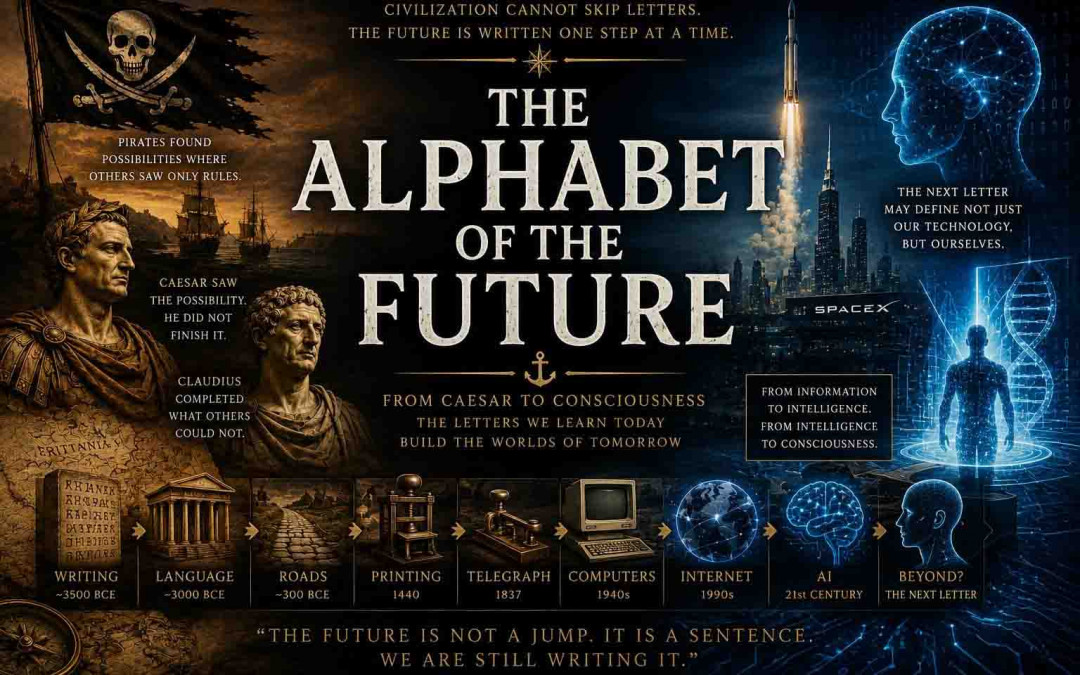
The Alphabet of the Future
A child learning to read does not begin with Shakespeare.
First there is an A. Then a B. A few sounds become words, words become sentences, sentences become stories, and only much later does the child discover that whole worlds can be built from the same handful of signs. The final result can look almost miraculous if we ignore the sequence that made it possible.
The future often creates the same illusion.
A smartphone appears in the hand as though civilization suddenly learned magic. It translates languages, stores libraries, navigates cities, records memory, connects people across continents and now increasingly generates text, images and software. Viewed from the surface, it looks like a single invention. Viewed historically, it is an archaeological site.
Inside it are layers of older achievements: semiconductors, radio, electricity, mathematics, metallurgy, writing, language, measurement, navigation, logic, printing, telecommunication. Remove enough of those earlier layers and the smartphone does not become less advanced. It becomes impossible.
This suggests a more useful way to think about the future. Perhaps progress is not a sequence of miracles but an alphabet. Each generation inherits a few letters, adds some of its own, and occasionally discovers that a combination nobody noticed before can form an entirely new word.
The future may feel sudden only because we usually notice the sentence after forgetting the alphabet.
Every Miracle Has Ancestors
Civilization has a habit of remembering the last visible step. The successful inventor receives the name. The completed bridge receives the photograph. The final machine becomes the object people point to when explaining the breakthrough.
But most breakthroughs are crowded with ancestors.
Electricity had to become measurable before it could become infrastructure. Telegraphy had to make distance negotiable before telephony could make voice portable. Computing required mathematics, logic, materials science, switching, storage and increasingly reliable ways of encoding information. The internet depended on computers, networks, protocols and institutions capable of standardizing communication across systems that were built by different people for different purposes.
What appears from the present as inevitability looked from the past like a collection of partial solutions.
This is why technological history can be misleading when told as biography. It encourages the idea that one extraordinary person “invented the future.” In reality, the extraordinary person usually arrives late enough to recognize that enough letters are already on the table.
Innovation is often recombination.
A new word becomes possible because the alphabet has become rich enough.
Caesar, Claudius and the Long Staircase
History outside technology works the same way.
Julius Caesar crossed to Britain in 55 and 54 BCE. Those expeditions did not result in permanent Roman conquest. Nearly a century later, under Claudius, Rome launched the invasion that established sustained imperial control over much of Britain.
It is tempting to tell these as separate stories: Caesar failed, Claudius succeeded.
But that framing may be too clean.
Caesar’s expeditions produced knowledge. They tested routes, logistics, political assumptions and the practical difficulty of operating across the Channel. They entered Britain into Roman strategic imagination in a different way. Later administrations inherited a world in which the possibility had already been explored.
Caesar did not “cause” Claudius’s invasion in a simple linear sense, and history should not be rewritten into a neat technological progression. But the structural point remains useful: later achievements often inherit information generated by earlier failures.
A failed attempt can become a letter.
The next generation may be the one that finally discovers the word.
This is why history often looks unfair. The final actor receives the monument while the incomplete steps disappear into footnotes. Yet the staircase does not care which step is famous.
Remove enough lower steps and the top one has nowhere to stand.

Pirates at the Edge of the Map
Pirates make the idea more interesting because they are specialists in unfinished systems.
They rarely invent the structures they exploit. They do not invent trade routes, ships, insurance, financial exchange or political borders. They discover the places where existing systems have become more valuable, more connected or more vulnerable than the institutions managing them fully understand.
That is why pirates appear repeatedly near periods of expansion. New routes create new opportunities. Weak governance creates new spaces. Faster communication creates new asymmetries. The pirate’s talent is not necessarily invention.
It is reading possibility before the centre has learned how to regulate it.
Something similar happens in commercial innovation. A market already exists. A technology already exists. A behavior already exists. Someone notices that the pieces can be connected differently.
The myth of the lone inventor hides this.
The pirate metaphor exposes it.
The future is often discovered first at the edge of an existing system, where rules are still incomplete and old categories have not caught up with new possibilities.
Silicon Valley and the Art of Arriving Late
The history of modern computing is full of this kind of inheritance.
Graphical interfaces existed before Apple popularized them for a mass market. Microsoft built on operating-system ecosystems and standards it did not invent from nothing. Netflix did not invent film, television or even home entertainment; it rearranged distribution, timing, recommendation and eventually production.
The same is true of almost every successful platform.
The interesting achievement is often not original creation in the mythic sense. It is recognizing that previous developments have made a new combination possible.
This is why phrases such as “Pirates of Silicon Valley” resonate. The point is not criminality. It is opportunism at the frontier of structure. Someone sees an opening before institutions have named it.
The future often belongs to people who recognize that the alphabet already contains a word nobody has assembled yet.
Consciousness and the Temptation to Skip Ahead
This becomes more dangerous when the subject is consciousness.
People ask whether minds can be uploaded, whether artificial intelligence will become conscious, whether biological life can be indefinitely extended, whether intelligence can migrate into another substrate.
These are reasonable questions.
But they are also the kind of questions civilizations love to ask too early.
A person looking at a smartphone in 1800 would not merely lack the device. They would lack the conceptual staircase required to understand why such a device could exist. There was no transistor, no radio network, no modern computer science, no global information infrastructure, no semiconductor industry.
The finished object would appear magical because too many letters were missing.
The same may be true of questions about consciousness transfer. We may currently possess fragments: neuroscience, computation, brain imaging, machine learning, information theory, interfaces between brains and machines. But we do not know whether the alphabet is complete enough to form the word.
This is not an argument that upload will happen.
It is an argument against treating today’s impossibility as final simply because the intermediate structures remain undiscovered.
The reverse caution matters equally. History also contains countless dreams that never became technologies. Not every imagined word belongs to the alphabet.
The question is not “Can we imagine it?”
The better question is “Which necessary letters are missing?”
The Universe as Sequence
Nature itself encourages this way of thinking.
Atoms form molecules. Molecules participate in chemistry. Chemistry enables self-replicating systems. Life develops nervous systems. Nervous systems make increasingly complex behavior possible. Language emerges. Culture accumulates. Technology externalizes functions that once existed only biologically.
Each layer depends on conditions established by earlier layers.
This does not mean the universe follows a predetermined ladder toward AI, civilization or humanity. Evolution has no demonstrated obligation to produce us. History is contingent. Extinctions, accidents, environmental shifts and chance matter enormously.
But complexity often requires prerequisites.
You do not get proteins without chemistry.
You do not get writing without symbolic communication.
You do not get software without systems capable of storing and manipulating formal instructions.
The universe may not move toward a single destination, but it repeatedly shows that some states become possible only after other states exist.
That is enough to make sequence important.
The future cannot always skip architecture.
Direction Without Destination
This creates a useful distinction between prediction and direction.
Nobody in ancient Rome could have predicted a smartphone. Trying to derive iOS from Roman roads would be ridiculous. But one can still see a broad historical movement toward greater capacity to transport people, orders, money and information across distance.
Nineteenth-century mathematicians could not predict today’s large language models in detail, but developments in logic, statistics, formal systems, computation and communication created a direction in which machine-mediated reasoning became increasingly plausible.
History rarely tells us exactly what comes next.
It sometimes tells us what kinds of things become easier to build.
That is a much more modest claim, but also a more useful one.
The destination remains hidden.
The alphabet becomes richer.
The Unfinished Alphabet
This is why the future usually looks inevitable only after it arrives.
Once the letters are assembled, the word feels obvious. Once a technology becomes infrastructure, people forget how many separate problems had to be solved before it could exist. The miracle disappears into normality.
Tomorrow’s civilization will probably do the same to us.
It may look back at technologies we consider impossible and see only missing intermediates. Or it may laugh at our confidence that certain dreams were destined to happen.
The future is not a script waiting to be read.
It is a language still being built.
Every generation inherits letters it did not invent. Some are old enough to feel natural. Others have only just entered the alphabet. Most people spend their lives using them without noticing how strange they once were.
Then occasionally somebody sees that the available letters can form a word nobody has written yet.
That is when history changes direction.
Watch The Video
How to Read the World

Current Knowledge
Major technological breakthroughs generally depend on prior discoveries, infrastructure, materials, institutions and accumulated technical knowledge. Innovation is therefore often cumulative rather than appearing independently from earlier work.
Caesar’s expeditions to Britain in 55 and 54 BCE did not establish permanent Roman rule. The Claudian invasion of 43 CE did. The relationship between these events is historically complex, and it would be too strong to claim that Caesar directly prepared every condition for Claudius’s later success, though earlier expeditions contributed to Roman knowledge and strategic imagination concerning Britain.
Modern computing likewise emerged through many layers of prior work in mathematics, logic, electronics, semiconductor technology, networking and software. No single person or company created the modern digital environment alone.
In biology and physics, more complex structures can depend on earlier physical and chemical conditions, but this does not imply that evolution or cosmic history follows a predetermined sequence toward intelligence or civilization.
Open Questions
How predictable is technological development once enough prerequisites exist? Some innovations appear nearly inevitable when several groups independently reach similar solutions, while others depend heavily on contingent historical choices.
Can we identify missing “letters” for future technologies such as whole-brain emulation, radically extended lifespan or machine consciousness, or are we still too early to know what the relevant prerequisites even are?
There is also a deeper historical problem. Does cumulative development produce genuine direction, or do we impose direction retrospectively because we already know which technologies survived?
And when multiple paths can lead to similar functions, does civilization really follow one alphabet, or many overlapping alphabets that occasionally converge on the same word?
Transhumation Interpretation
The Alphabet of the Future is a Transhumation model for continuity across generations.
The central structure is simple:
possibility → experiment → inheritance → recombination → new function
The important point is that progress does not usually require preserving the same form.
A Roman road and a fibre-optic network are not the same technology, but both participate in the larger civilizational problem of reducing distance.
A manuscript, printing press and database are not the same carrier, but each extends the survival and movement of information.
A failed expedition and a later conquest are not the same event, but the earlier attempt can change the informational environment inherited by the later one.
This is why the future is older than we think.
Every supposedly new thing contains ancestors.
Transhumation asks which functions survive these changes of carrier. If a structure can migrate from roads to cables, from scribes to databases, from biological memory to external archives, then the interesting historical unit may not always be the object.
It may be the function.
This also changes how we approach the most speculative questions. Consciousness upload should not be treated as inevitable simply because information can change carriers. But neither should it be dismissed only because today’s carrier appears indispensable.
The useful question is narrower:
Which parts of the structure are genuinely carrier-dependent, and which are not?
That is how the alphabet grows.
Not by jumping directly to the final word, but by discovering one constraint at a time.
The future may never give us the word we expect.
But it will still have to spell whatever comes next.
FAQ
What is the Alphabet of the Future?
It is the idea that major technological and civilizational changes depend on earlier layers of knowledge, infrastructure and possibility.
Why can’t civilization simply skip letters?
Because many later capabilities require prerequisites. Some technologies cannot exist until supporting knowledge and systems are already available.
How does Julius Caesar fit the idea?
His expeditions to Britain did not produce permanent conquest, but they illustrate how earlier attempts can contribute information and precedent later generations inherit.
Why are pirates important here?
Pirates often exploit possibilities created by existing systems before institutions fully understand or regulate them, making them useful symbols of innovation at the edge.
Did Silicon Valley invent everything it popularized?
No. Many successful technologies built on earlier interfaces, standards, networks and ideas. Their achievement often lay in recombination, scaling or timing.
Does this mean mind uploading will eventually happen?
No. The article argues only that apparent impossibility can sometimes reflect missing prerequisites. It does not claim that every imagined technology is achievable.
Does nature itself follow an alphabet?
Only as a metaphor. More complex systems often depend on earlier physical and biological conditions, but there is no evidence that the universe is progressing toward one predetermined outcome.
How does this connect to Transhumation?
Transhumation looks for functions that survive changes in carrier. The Alphabet of the Future asks which earlier structures make later transformations possible.
What is the central idea?
The future is rarely created from nothing. It becomes possible when enough earlier discoveries, failures and structures accumulate for civilization to form a new word from an old alphabet.
Continue the Transhumation Series
- Forgotten Religion | Ancient Gods, Symbols and the Hidden Structures of Human Civilization
- The Last Religion | Death, Immortality and the Future of Humanity
- The New Theurgy | AI, Information and the Future of Human Civilization
- End of Branding: You Were Never Meant to Become a Product
- Baal vs Ishtar: Why Ancient Gods Never Disappeared