The Archaeology of Gods
Movies have trained us to expect the past to glitter.
The door opens, dust falls from a stone lintel, somebody raises a torch, and there it is: a golden mask, a crown, a sealed chamber untouched for three thousand years. The great discovery is always waiting in darkness, preserved because nobody reached it first.
Real archaeology is usually less theatrical and more interesting.
The past often survives as broken pottery, cooking waste, worn tools, animal bones, building foundations, discarded objects and fragments too ordinary to have been protected. Gold disappears because gold is valuable. Palaces are rebuilt because power wants new rooms. Temples are quarried for stone. Victorious armies melt statues, later religions reuse sacred places, and wealthy objects travel until their original context is gone. What remains is frequently whatever nobody bothered to steal.
A broken cup can outlive a king.
Not because the cup was more important in its own time, but because importance and survival are different things. The cup may preserve diet, trade, manufacturing techniques, domestic habits or the movement of goods across regions. A garbage pit can reveal more about daily life than a royal inscription designed precisely to control how the ruler wished to be remembered.
Archaeology therefore begins with an uncomfortable lesson: civilization often survives in the things it did not intend to preserve.
But there may be another category of artifact still more difficult to notice.
One that was never buried at all.
What the Dead Leave by Accident
Archaeologists do not reconstruct vanished societies by waiting for spectacular objects to explain themselves. They build interpretations from relationships among traces. A shard matters because of where it was found, what clay it contains, what lies beside it, whether similar pieces appear elsewhere, and which layer of occupation surrounds it. Meaning comes from context.
This makes archaeology strangely democratic.
The king left inscriptions, but the kitchen left bones.
The general left monuments, but the road surface preserves traffic.
The priest left ritual objects, but ordinary houses preserve how people actually lived.
Over time, the hierarchy of the past can invert. What looked trivial when alive becomes precious when everything else has disappeared.
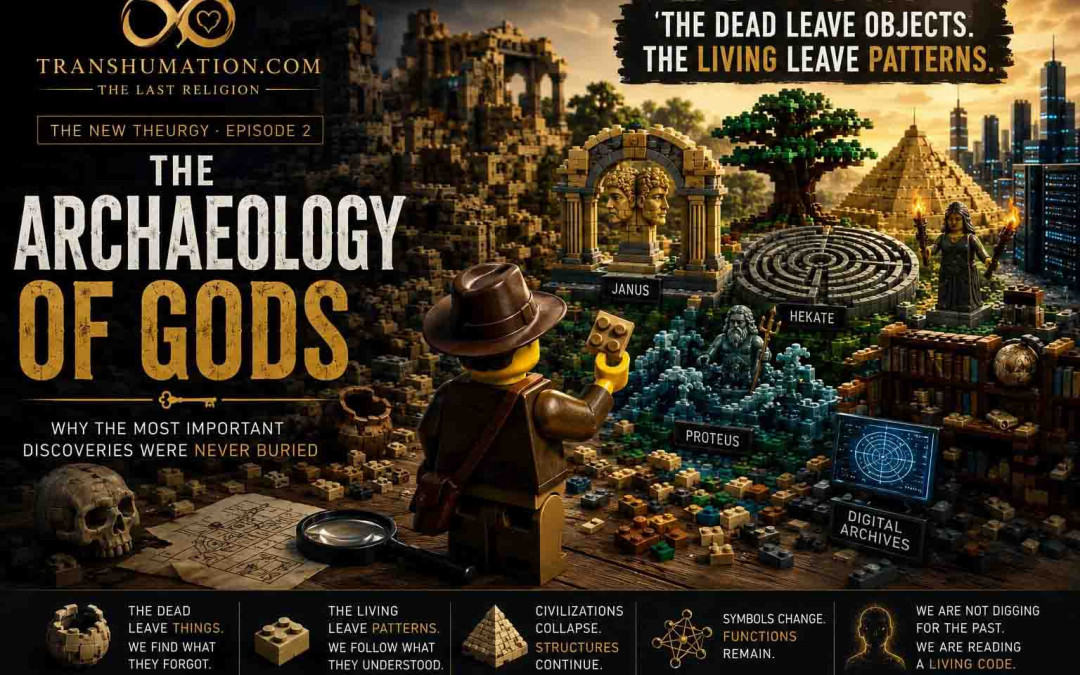
That should make us cautious when thinking about religion and mythology. We tend to approach ancient gods through statues, temples, inscriptions and surviving names, as though the deity were located inside the object. But what if the more durable artifact was not the statue at all?
What if it was the function the symbol performed?
The Archaeology of the Living
This is where the New Theurgy changes the question.
Instead of asking only, What did this god mean to this culture?, it asks something additional: What problem was this figure helping a civilization think about?
The answer should never erase historical specificity. Janus was Roman. Hekate developed within Greek religious traditions and changed across periods and regions. Proteus belongs to a particular mythological world. Their historical meanings cannot simply be collapsed into modern slogans.
But once that historical work is respected, another possibility opens.
Some symbolic structures recur because the human problems beneath them recur.
Thresholds.
Choices.
Transformation.
Guardianship.
Creation.
Descent.
Return.
The observer facing something larger than themselves.
These are not artifacts in the archaeological sense. They cannot be placed in a museum case. They survive by migrating into new carriers.
A doorway becomes a philosophical threshold.
A crossroads becomes a problem of decision.
A shapeshifter becomes a language for unstable identity or changing reality.
The historical god may disappear.
The structure can remain available.
This is not proof that all religions encode one hidden universal system. That would be too easy and historically careless. The more modest and more interesting claim is that recurring human conditions generate recurring symbolic solutions.
The material changes.
The problem returns.

The Gods That Changed Clothes
Janus is useful because his symbolism is unusually architectural. Doors, beginnings, transitions and passages matter because every civilization is full of moments in which one state becomes another. A new year begins. A journey starts. War opens. Peace closes. A person crosses from private life into public office.
Hekate, especially in later Greek and Hellenistic imagination, became closely associated with crossroads, boundaries, night and liminal spaces. Again, the historical goddess belongs to a world very different from ours. Yet the symbolic problem remains recognizable: what happens at the point where one path becomes several and certainty weakens?
Proteus offers another structure. His power is not merely strength but transformation. He escapes through changing form. To grasp him, one must persist while the surface keeps shifting.
These figures did not “survive” because modern people secretly worship them without realizing it.
They survived in a weaker but perhaps more durable sense.
The problems they organized never disappeared.
Civilization still crosses thresholds.
Still faces branching paths.
Still confronts systems that change shape while we try to understand them.
The old names become optional.
The structure remains useful.
The New Ruins Are Made of Data
For most of archaeology’s history, the ground was the archive.
Now civilization is creating another one.
Emails.
Databases.
Websites.
Photographs.
Source code.
Social platforms.
Digital libraries.
Search histories.
Satellite images.
Discussion forums.
The volume is so enormous that the future archaeologist may face the opposite problem from the traditional one. Not scarcity of evidence, but abundance beyond human inspection.
The ruins of a digital civilization may not look ruined at all. The files may survive. The servers may survive. The problem could be meaning.
Which conversations mattered?
Which accounts represented real institutions?
Which memes carried cultural significance?
Which images were jokes, rituals, propaganda or disposable entertainment?
The archaeologist of the future may need less of a shovel and more of an interface capable of finding structure inside informational excess.
This is where artificial intelligence becomes relevant, not as a mystical successor to archaeology, but as a possible tool of pattern navigation. Large collections can be compared across language, time and medium in ways difficult for a single researcher to perform manually. That creates opportunities and dangers. Algorithms can reveal correlations that would otherwise remain hidden, but they can also manufacture apparent patterns when the data or assumptions are poor.
The future archaeologist may carry an algorithm.
They will still need judgment.
History Preserves Events. Memory Preserves Importance.
There is another distinction hidden beneath the excavation.
History attempts to establish what happened.
Memory decides what remains worth carrying.
The two overlap, but they are not identical.
A civilization can preserve the date of a battle and forget why the battle mattered. It can preserve a religious text and lose the interpretive world that once made its metaphors obvious. It can preserve a statue while forgetting the ritual that gave the statue meaning.
This is why symbolic survival matters.
A symbol can travel farther than its original explanation.
Sometimes that produces distortion.
Sometimes simplification.
Sometimes rediscovery.
And occasionally the symbol survives because later observers find that the old structure still fits a new problem.
The New Theurgy should not therefore be understood as an attempt to restore ancient worship. Its more interesting role is archaeological in a different sense.
It looks for living ruins.
Not dead stones, but structures still operating after their original language has changed.
The Most Important Discovery Was Never Lost
This may be the strange advantage of symbolic archaeology.
The greatest artifact may not be hidden under sand.
It may be functioning around us.
A gate.
A trial.
A guardian.
A transformation.
A descent.
A return.
A question about what stands beyond the visible order.
Every civilization gives these structures different names, and those names matter. The Greek world is not Rome. Mesopotamia is not Christianity. A modern AI interface is not Hermes. A railway station is not Janus.
But comparison becomes useful when it is careful enough to ask about function rather than resemblance alone.
What survives when the name changes?
What reappears when the institution disappears?
What problem keeps generating new symbols?
This is where archaeology becomes less about digging and more about recognition.
The old world did not only leave us monuments.
It left us recurring arrangements of attention.
The Living Ruins
A ruin normally implies that something has ended.
But living ruins complicate the idea.
A symbol can survive while its theology disappears.
A ritual structure can migrate into politics, law or technology.
A story can lose literal authority and retain interpretive power.
A myth can become philosophy.
A god can become a metaphor.
A threshold can become an interface.
Civilization is therefore full of things that are simultaneously ancient and current.
This is why the most important discoveries may never have been buried. We were looking for objects because objects are easy to excavate. Structures are harder. They do not sit still. They migrate between religions, institutions, stories and technologies.
The great archaeological question may therefore be changing.
Not only:
What did they leave behind?
But:
What are we still carrying?
Watch The Video
How to Read the World
Current Knowledge
Archaeology reconstructs past societies from material remains such as ceramics, architecture, tools, human and animal remains, environmental evidence and refuse. Everyday objects are often exceptionally valuable because they reveal ordinary economic and social life rather than only elite self-representation.
High-status objects are not always less likely to survive, but valuable materials are frequently reused, looted, melted down or removed from their original contexts. Archaeological interpretation therefore depends heavily on context rather than simply on the intrinsic value of an artifact.
Janus was a Roman deity strongly associated with beginnings, gates and transitions. Hekate had a complex historical development and was associated in various contexts with crossroads, boundaries, night, magic and other liminal domains. Proteus, in Greek mythology, was a prophetic sea figure known for changing shape.
Comparing these figures with modern structures is interpretive rather than a claim that ancient cultures secretly described present technologies or possessed one universal symbolic system.
Digital archaeology and digital preservation are already real fields of concern. Modern societies produce enormous volumes of digital material whose long-term preservation and interpretation present technical and cultural challenges.
Open Questions
How far can recurring symbolic structures be compared across civilizations before comparison begins erasing historical difference?
When a symbol survives outside the religion that produced it, what exactly has survived: the original meaning, a reduced function, or simply a new interpretation using an old form?
Can computational tools help identify genuinely meaningful cross-cultural patterns without encouraging false correspondences produced by large datasets?
There is also a preservation problem. Future societies may inherit extraordinary quantities of digital information while lacking the cultural context required to distinguish what was important from what was noise.
And perhaps the hardest question is methodological: how do we tell the difference between a structure that genuinely recurs across carriers and a pattern created by the observer who wants to find one?
Transhumation Interpretation
The Archaeology of Gods begins with a distinction between objects that survive and functions that migrate.
A statue can break.
A temple can disappear.
A name can fall out of use.
But the problem once organized by the symbol may return.
The Transhumation structure is therefore not:
god → modern equivalent
That would be too literal.
It is:
human problem → symbolic interface → historical carrier → collapse → new carrier
This is the useful archaeological question.
What survived the collapse?
Janus should not be called a modern operating system. Hekate should not be called an AI assistant. Proteus should not be reduced to technological adaptability.
But the functions they help us think about—threshold, choice, transformation—can survive independently of those original religious carriers.
This is where The New Theurgy becomes relevant.
It does not search the ancient world for hidden machines.
It searches for recurring structures.
The archaeological object is no longer only the artifact in the ground.
It can be the pattern moving through history.
That is also why artificial intelligence is interesting here. AI may become a new kind of tool for navigating civilization’s archive, but it also forces us to confront an older problem: the difference between storing information and understanding structure.
A database preserves fragments.
An observer connects them.
A good librarian helps the observer see where to look.
Perhaps the future of archaeology will depend not on finding more ruins, but on becoming better at recognizing which ruins are still alive.
FAQ
What is The Archaeology of Gods?
It is a Transhumation approach that studies not only physical religious artifacts, but recurring symbolic functions that can survive after their original cultures change or disappear.
Is The New Theurgy trying to prove ancient gods literally existed?
No. It examines gods as historical and symbolic interfaces without claiming to settle their metaphysical status.
Why are ordinary archaeological objects important?
Because pottery, tools, food remains and refuse often reveal details of daily life that elite monuments do not preserve.
What are “living ruins”?
Symbols or structures that originated in older cultures but continue to perform recognizable functions in later forms.
How do Janus, Hekate and Proteus fit the idea?
They provide historically different examples of symbols connected with thresholds, liminality and transformation—problems that remain relevant even after the original religious contexts change.
Is AI a form of archaeology?
Not by itself. AI can become a tool for searching and comparing large cultural archives, but interpretation still requires historical context and human judgment.
What are digital ruins?
The enormous traces modern civilization leaves in databases, websites, images, messages and other digital records.
Does Transhumation claim all religions share one hidden pattern?
No. It asks whether some functions recur across different carriers while preserving the differences between cultures.
What is the central idea?
The most important things inherited from the ancient world may not be buried objects, but recurring structures that civilization continues to rebuild in new forms.
-
Continue the Transhumation Series
- Forgotten Religion | Ancient Gods, Symbols and the Hidden Structures of Human Civilization
- The Last Religion | Death, Immortality and the Future of Humanity
- The New Theurgy | AI, Information and the Future of Human Civilization
- End of Branding: You Were Never Meant to Become a Product
- Baal vs Ishtar: Why Ancient Gods Never Disappeared