
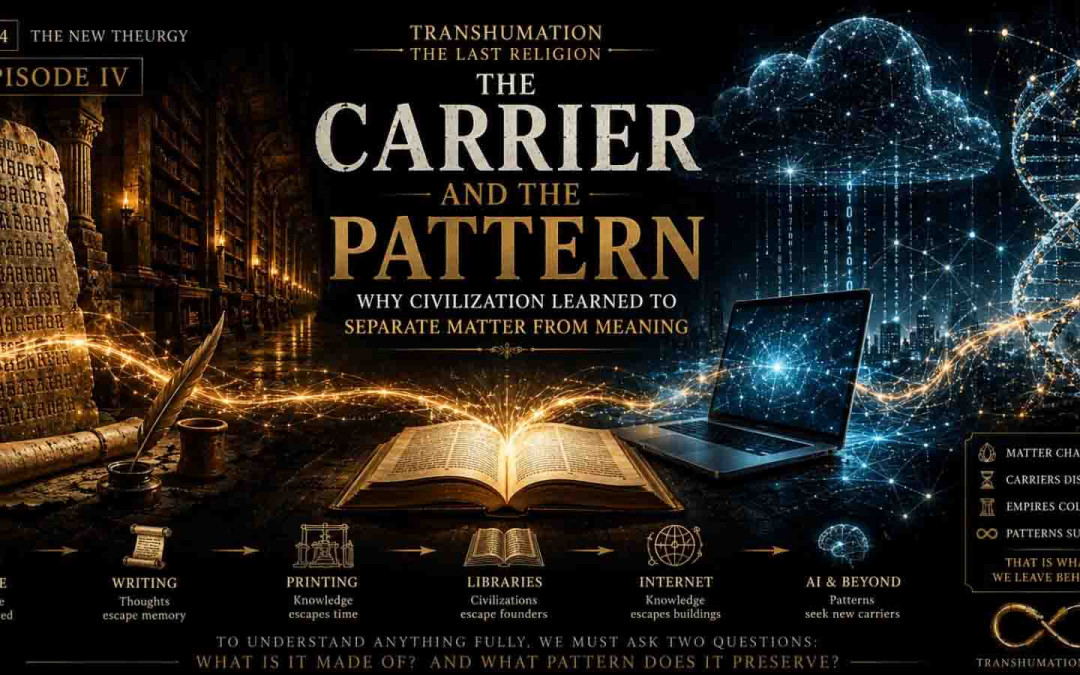
The Meaning Has No Wight
Walk into the rare-book room of an old library and the physical objects demand attention before the ideas do. Leather has dried differently on every binding. Paper has yellowed. Ink has faded toward brown. Some pages carry fingerprints belonging to readers nobody can identify; others have margins cut by later binders or notes added by hands separated from the original author by centuries. A conservator looking at the object sees chemistry, humidity, fibers, glue, pigments and damage. A reader opening the same volume may care about none of those things at first. They have come because somewhere inside this fragile arrangement of matter is an argument, a story, a mathematical relation or a sentence that can still reorganize a living mind.
The distinction seems obvious only because civilization has spent thousands of years teaching us to make it.
The page is not the poem. The sound wave is not the melody. The hard drive is not the photograph. The particular molecules forming a strand of DNA are not identical with the sequence we describe when we compare that DNA across cells or generations. In every case, however, the temptation is to go too far. Meaning does not float free of matter. A poem without any inscription, memory, sound, nervous system or other physical realization is not something we know how to observe. Information always appears through a carrier.
The remarkable discovery was therefore not that civilization separated matter from meaning.
It learned to separate a particular carrier from a pattern capable of being instantiated again.
Once that distinction became technically useful, civilization changed.
The Book That Survives Its Book
Imagine that the last surviving physical copy of a forgotten manuscript is photographed page by page before a fire destroys it. The paper is gone. The binding is gone. The stains, weight and smell of the original volume may be gone as well. Yet a scholar can still read the sentences the following morning from a digital image.
Something was lost.
Something survived.
That pair of facts is more important than either one alone.
The digital copy is not materially identical with the manuscript. For some historical questions, that difference is decisive. A codicologist may need the original fibers. A conservator may want the binding. A historian may learn something from the sequence of repairs, ink layers or marginal annotations that a transcription failed to capture. The carrier can itself contain information.
But if the question is what proposition occurred on page forty-seven, the pattern can survive the destruction of the original object.
Civilization gradually learned to exploit this distinction deliberately. Writing allowed linguistic structures to persist beyond the biological memory of an individual speaker. Copying allowed those structures to outlive one manuscript. Printing multiplied the number of carriers so dramatically that destroying a single copy no longer threatened the text itself. Digital networks then made replication almost frictionless across enormous distances.
At no point did information become immaterial.
It became less dependent upon one particular material instance.
That is a very different claim, and a much more powerful one.
Civilization’s Great Trick Was Redundancy
The romantic history of writing often describes humanity as freeing thought from the mind. There is truth in the metaphor, but it hides the mechanism.
What civilization really learned was redundancy.
An oral tradition survives because many nervous systems carry overlapping versions of it. A manuscript survives because a copyist produces another material inscription. A printed book survives because hundreds or thousands of physically separate objects embody sufficiently similar sequences. A digital file survives because its encoded structure can be recreated across drives, servers and networks.
Persistence therefore emerges not from escaping matter but from being rewritable into new matter.
This explains why a library is more than a warehouse of objects. Its deepest function is not preserving paper forever. Paper does not last forever. The function is maintaining enough continuity that important structures can be transferred before their present carriers fail.
Civilizations do the same with skills. A surgeon teaches another surgeon. A mathematician trains students. A craft becomes a manual, a school, an apprenticeship or a technical standard. The individual carrier disappears; the practice survives if enough of its structure can be reconstructed elsewhere.
Sometimes it cannot.
That is why lost knowledge is possible.
A pattern that fails to reach another carrier dies with the one that contained it.
DNA Makes the Metaphor More Dangerous
Biology seems to offer an even cleaner version of the argument, but it is also where careless language can mislead.
DNA is a physical molecule with specific chemical properties. Its chemistry is not incidental packaging around some ghostly information. Molecular structure is exactly what makes replication, transcription, mutation and interaction with cellular machinery possible.
Yet biology also gives us a legitimate informational perspective.
A DNA sequence can be described abstractly. Researchers can compare sequences obtained from different cells, organisms or physical samples. The particular atoms do not have to remain the same for a sequence relationship to persist across reproduction. Biological inheritance therefore depends not on preserving one original molecular object forever, but on repeatedly constructing new molecular instances with sufficient structural continuity.
Life is not simply copying a file, of course. Organisms are dynamic systems involving gene regulation, cellular organization, metabolism, development and constant interaction with environments. The old slogan that DNA is a complete “instruction manual” is too simple for modern biology.
But the underlying lesson remains.
Biological continuity does not require preservation of the original matter.
It requires organized processes capable of maintaining and reproducing relevant structure through changing matter.
This is where the carrier-and-pattern distinction stops being merely about libraries.
It begins approaching the question of life.
A File Makes the Idea Feel Obvious
Computers made carrier independence part of ordinary experience.
You can write a document on one laptop, save it to a server, open it on a phone, copy it to another storage device and print it on paper. The electrical and magnetic states involved at every stage are different. The hardware changes. The encoding may even change during conversion.
Yet you recognize the document.
This does not mean literally nothing changed. Metadata may disappear. Fonts may render differently. Compression can remove information. Conversion can introduce errors. The notion of “the same file” already depends upon which properties we decide are relevant.
That complication is useful.
Patterns are never independent of criteria.
A novel can remain the same novel after changing typeface, but not after replacing half the sentences. A photograph can survive compression, but sufficiently aggressive compression eventually destroys what the viewer regarded as essential. A melody can be transposed into another key while remaining recognizable, but at some point alteration produces another composition.
Carrier independence therefore generates a second question.
Not merely: Can this pattern move?
But: Which parts must remain invariant before we continue calling it the same thing?
That question becomes much harder when the object is a person.
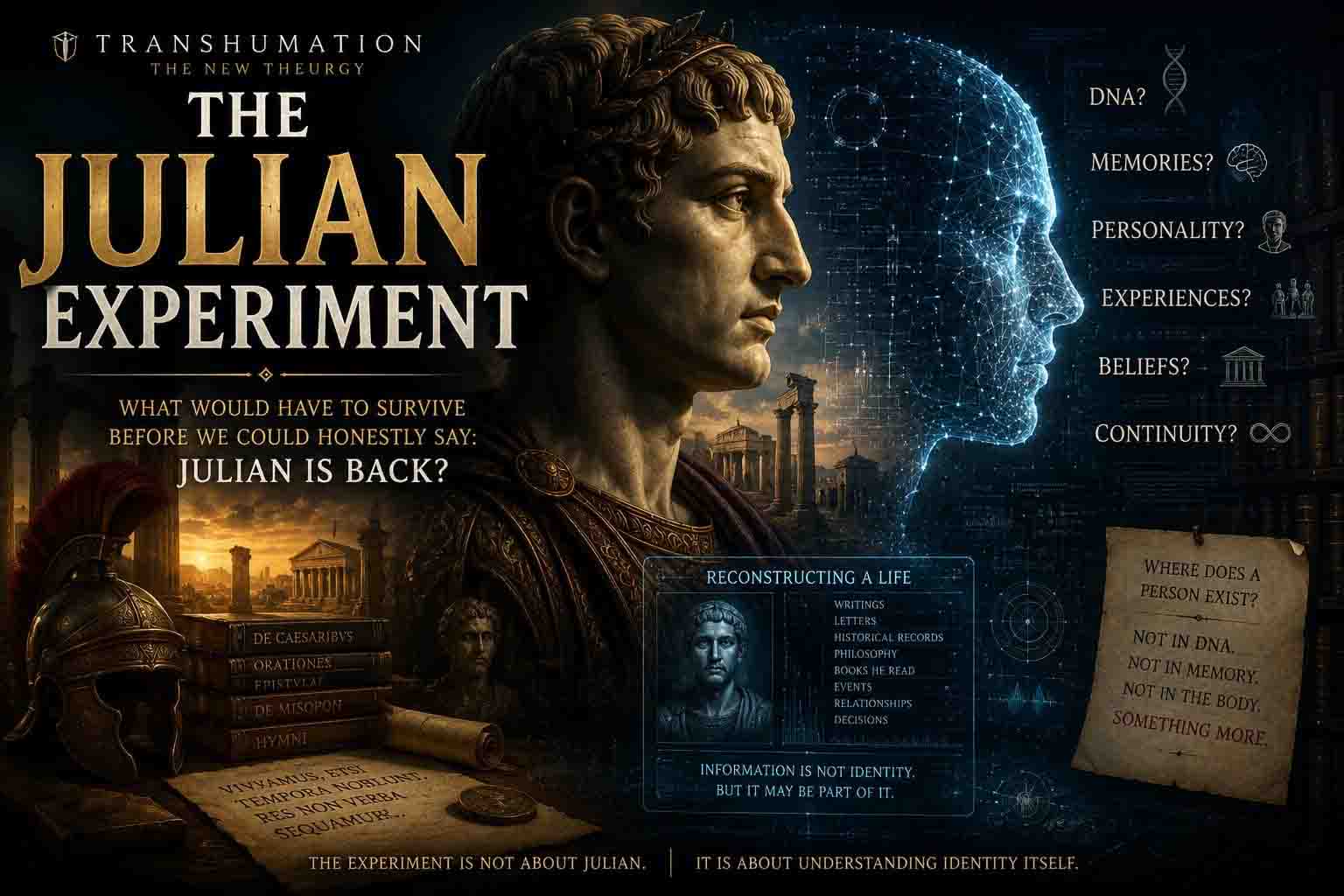
The Human Being Is Where the Metaphor Stops Being Easy
Human bodies change continuously. Cells turn over at different rates. Proteins are broken down and rebuilt. Molecules enter through food and air and leave through metabolism. Some biological structures persist much longer than others, so the popular claim that the body simply “replaces every atom every seven years” is not accurate.
Still, the larger fact is undeniable: material change occurs throughout a life without ordinary personal identity resetting every time metabolism replaces matter.
A seventy-year-old person is not made from precisely the same physical material as the infant they once were.
Yet we usually treat them as one continuing person.
This makes pattern tempting.
Perhaps memories, personality, relationships, habits, neural organization and bodily continuity together form a structure that persists while matter changes. Perhaps the person is less like a statue and more like a whirlpool: the material passing through changes while an organized process continues.
But here the library analogy reaches its limit.
A book can be copied twice without creating a paradox. Two identical copies of Hamlet are still Hamlet. If a human mind could be copied twice with perfect memories, personality and behavioral dispositions, we would suddenly have two individuals claiming the same past and immediately experiencing different futures.
The pattern may have survived perfectly.
The observer appears to have branched.
That is why carrier independence cannot simply be promoted from books and DNA to consciousness.
A pattern can survive copying.
Whether you survive copying is another question entirely.
Institutions Are Patterns Too — But Not Only Patterns
Civilization itself is filled with structures whose material components can change without destroying recognizable continuity.
A university can replace every professor, student and building over centuries while still claiming institutional identity. A company can move headquarters, change owners and replace its technology without instantly becoming a completely unrelated organization. A religion can lose temples and build new ones. A legal system can be carried through new courts, languages and political regimes.
But here again, the carrier is not irrelevant.
A nation without territory may continue culturally, but territory, population, institutions and political recognition can matter enormously to statehood. A religion is not reducible to its temples, but material practices, bodies, objects and places can be central to religious life. A company is not merely an abstract brand floating independently of employees, contracts, capital and infrastructure.
The useful question is therefore never simply whether the pattern matters more than the carrier.
It is:
Which properties belong to the continuity we care about, and which carriers are necessary to maintain them?
Sometimes the answer changes with the question.
For a poem, wording may be essential while paper is replaceable.
For a painting, replacing the canvas with a perfect digital image may preserve appearance while destroying the original artwork as a historical object.
For a human being, we do not yet know which distinction will prove decisive.
Civilization as a Machine for Re-instantiation
Seen from this perspective, many of civilization’s institutions perform the same basic task in different forms.
Schools rebuild knowledge inside new nervous systems.
Libraries move texts between generations.
Museums preserve objects and the interpretive context required to recognize them.
Law maintains agreements and institutional procedures beyond the lives of individual lawmakers.
Scientific communities reproduce methods rather than merely conclusions.
Archives preserve evidence from events whose witnesses will eventually disappear.
What survives is rarely untouched.
Patterns mutate during transmission. Languages shift. Interpretations change. Errors enter copies. Institutions alter the very traditions they claim to preserve.
Continuity is therefore not perfect duplication.
It is controlled transformation.
This may be one of the most important corrections to the digital fantasy of immortality. Civilization has never preserved itself by freezing everything. It survives by changing enough to enter the next carrier without changing so much that recognition becomes impossible.
The river remains only because the water moves.
Watch The Video
How to Read the World
Current Knowledge
Information, as studied in physics, biology and computer science, always requires some physical implementation when it is stored or transmitted. There is no established scientific evidence for information existing operationally without a physical carrier. What can change is the particular substrate used to instantiate an informational structure.
Writing, printing and digital technologies increased the durability and reach of cultural information by allowing replication across multiple physical carriers. This does not make the carriers irrelevant; different media preserve different features, and every act of copying can introduce loss or transformation.
DNA provides a powerful example of structural continuity across generations, but describing DNA simply as software or a complete instruction manual is misleading. Biological development depends upon molecular chemistry, cellular machinery, regulation and environmental interaction as well as nucleotide sequence.
Personal identity remains philosophically and scientifically unresolved at the level required by hypothetical mind uploading. Neuroscience strongly associates memory, personality and conscious experience with biological brain processes, but there is currently no empirical demonstration that reproducing the informational organization of a brain on another substrate would preserve the same first-person observer.
Open Questions
The first unresolved problem is how to define the pattern that matters. A digital document can tolerate some changes while remaining recognizable, but personal identity may depend upon properties we have not yet identified. Similarity is not automatically continuity.
There is also the question of causal history. Two structures may be physically and informationally indistinguishable at one moment while possessing different histories. Does identity depend only on present organization, or partly on the continuous process through which that organization arose?
Biology introduces another challenge. Some features of living systems appear highly portable at the informational level; others depend intimately upon embodiment, metabolism and environment. We do not know how far carrier independence extends before changing the carrier changes the phenomenon itself.
Artificial intelligence may eventually make this distinction practically urgent. If highly detailed models can reproduce a deceased person’s language, memories and behavioral tendencies, society will need vocabulary capable of distinguishing preservation of pattern from preservation of person.
Transhumation Interpretation
The carrier and the pattern may be one of the cleanest boundaries inside Transhumation.
A weak version of the idea says that information escapes matter.
It does not.
A stronger version says that some structures can escape dependence on one particular piece of matter by being recreated in another.
That is already extraordinary.
A sentence written on parchment can survive on a server whose materials the author could never have imagined. A mathematical relationship can move from chalkboard to computer memory without becoming a different relationship. A melody can pass through voice, vinyl, magnetic tape and digital encoding while remaining recognizable enough for listeners to identify it.
The carrier changes.
The structure survives through transformation.
Civilization is built upon that possibility.
But Transhumation becomes interesting exactly where the analogy threatens to become too easy.
We know a book can survive copying.
We know a genetic sequence can survive molecular replacement.
We know institutions can survive turnover of their members.
We do not yet know whether an observer survives replacement of the substrate generating conscious experience.
That is the boundary.
The mistake of simplistic transhumanism is to move too quickly from “patterns can migrate” to “therefore persons can migrate.” The first proposition has countless demonstrations. The second remains an open problem.
Perhaps identity depends primarily upon organization.
Perhaps biological embodiment contains indispensable features.
Perhaps gradual transformation preserves something that discontinuous copying cannot.
Perhaps the concept of a single persistent self will eventually prove less clean than ordinary experience suggests.
The important thing is not to decide before the evidence arrives.
This also gives the carrier-and-pattern distinction a wider civilizational use. Whenever we encounter an inherited structure, we can ask two questions. What material system currently carries it? And which relationships must survive before we still recognize the thing itself?
A library is not merely shelves, but without carriers there is no library.
A civilization is not merely monuments, but meaning does not survive without people, objects and institutions capable of carrying it forward.
A person is not merely atoms.
But we should not confuse that observation with proof that the person is therefore downloadable.
Between those sentences lies almost the entire future problem of Transhumation.
The deepest lesson may therefore be more modest than “the pattern matters more than the matter.”
Sometimes it does.
Sometimes the carrier contributes to the pattern.
Sometimes changing the carrier changes the thing itself.
The difficult work is discovering which kind of object we are dealing with.
Civilization became powerful when it learned that a message could survive its parchment.
Its next great question may be whether the observer can survive the same trick.
FAQ
What is the difference between a carrier and a pattern?
The carrier is the physical system in which something is instantiated; the pattern is the organization or relationship we recognize across different instances. A book’s paper is one carrier, while the linguistic structure of its text can be reproduced elsewhere.
Can information exist without matter?
As far as established science shows, stored or transmitted information requires a physical implementation. Carrier independence means independence from one specific carrier, not independence from matter altogether.
Is DNA just biological information?
No. DNA has informational properties, but its chemistry and interaction with cellular systems are essential. Calling it simply a code or instruction manual is useful only as a limited metaphor.
Why are computers such a useful example?
Because everyday computing demonstrates how recognizable informational structures can move repeatedly between very different physical devices while remaining usable.
Does this mean human identity is a pattern?
Possibly in part, but that does not settle the question of personal identity. A perfect copy of memories and personality could still create a new subject rather than preserve the original observer.
What is the deeper Transhumation question?
Not whether patterns can change carriers. We already know that many can.
The difficult question is which patterns can change carriers without losing the thing we actually care about.
For a book, civilization solved that problem centuries ago.
For a human being, we have barely learned how to ask it.
Continue the Transhumation Series
- Forgotten Religion | Ancient Gods, Symbols and the Hidden Structures of Human Civilization
- The Last Religion | Death, Immortality and the Future of Humanity
- The New Theurgy | AI, Information and the Future of Human Civilization
- End of Branding: You Were Never Meant to Become a Product
- Baal vs Ishtar: Why Ancient Gods Never Disappeared