
The Mirror Between Us
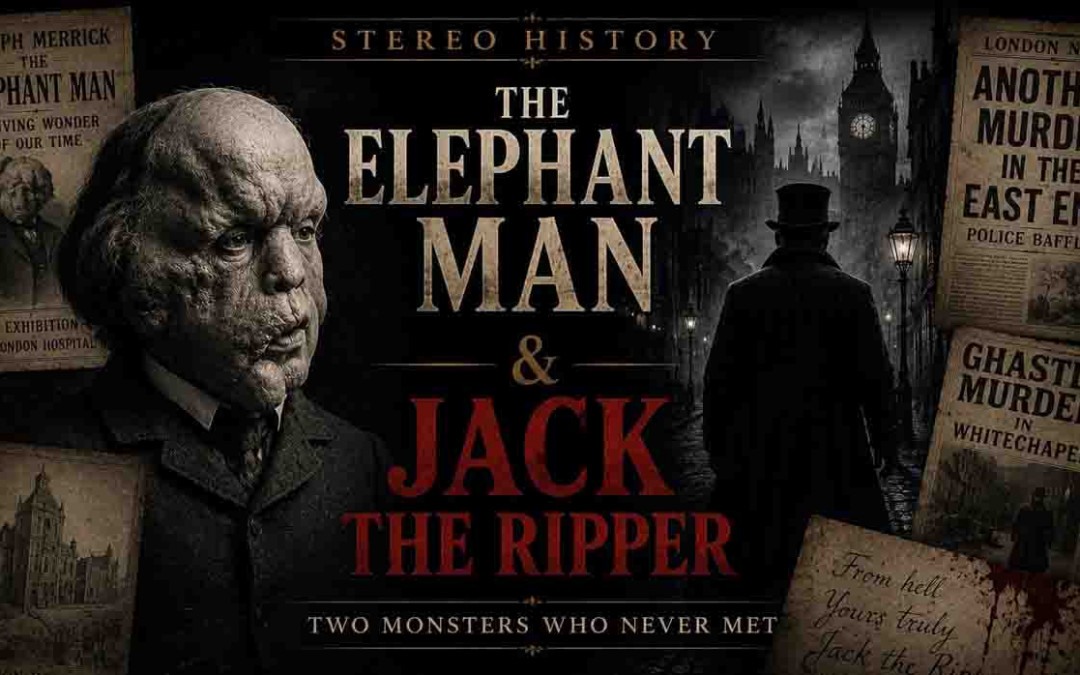
In the autumn of 1888, Joseph Merrick was living inside the London Hospital in Whitechapel.
Outside its walls, another figure was taking possession of the same neighborhood.
Merrick was already known to the public as the Elephant Man. His body had been exhibited, advertised and stared at. His appearance was so unusual that strangers could believe they understood something about him before he spoke. Only when people spent time with him did the assumption begin to collapse. Behind the body that Victorian audiences had been invited to treat as spectacle was an intelligent, shy, emotionally sensitive man capable of conversation, affection, imagination and considerable social awareness.
A few streets away, London was trying to perform the opposite operation.
There was no body to examine.
No confirmed face.
No name.
No known biography.
Yet a personality began to emerge.
Jack the Ripper.
The contrast is almost too perfect. One man possessed an unforgettable appearance that concealed an ordinary human interior. The other committed extraordinary violence while leaving behind so little reliable identity that newspapers, police, witnesses, hoaxers and frightened citizens gradually built a character around the absence.
There is no evidence that Joseph Merrick and the Whitechapel murderer ever met.
They did not need to.
Victorian London placed them in the same experiment.
The question was simple.
Can you tell what a person is by looking at the surface?
The city received two contradictory answers.
The Man Whose Body Spoke Before He Did
Merrick’s problem was not invisibility.
It was excess visibility.
Before anyone heard his voice, his body had already begun speaking on his behalf. The growths affecting his skin, skeleton and proportions were not interpreted merely as medical conditions. They entered a nineteenth-century visual culture in which physical difference could easily become entertainment, moral suggestion and social classification.
This mattered because Victorian society was fascinated by the possibility that bodies revealed hidden truths.
Faces were measured.
Skulls were classified.
Doctors, criminologists and popular writers repeatedly attempted to connect anatomy with temperament, intelligence, degeneration or criminality. Cesare Lombroso’s theories of the supposedly “born criminal,” although developed in Italy, belonged to a much wider late-nineteenth-century appetite for finding moral character written into physical form.
The idea now seems crude.
At the time it could look scientific.
Merrick exposed the danger beautifully because the reading failed almost completely.
The body appeared threatening.
The person was not.
Frederick Treves, the surgeon whose relationship with Merrick would later make both men famous, initially encountered him as a medical curiosity. Yet the more Merrick became known as an individual rather than displayed as an object, the less useful his extraordinary exterior became as a description of him.
That reversal is the important part.
The public could see almost everything about Merrick’s physical difference.
It could initially see almost nothing about Merrick.
The Man Whose Absence Became a Face
Jack the Ripper presented the opposite problem.
The murders attributed to the Whitechapel killer produced evidence, witnesses, police theories and enormous public attention, but they did not produce an unquestionably identified man.
That vacuum did not remain empty.
It filled.
Newspapers described suspects.
Illustrators imagined faces.
Witness descriptions circulated and contradicted one another.
Letters arrived claiming to come from the murderer. Most were almost certainly hoaxes or inventions. Yet one of them, the famous “Dear Boss” letter, helped popularize the name Jack the Ripper.
That name may be one of the most successful acts of involuntary branding in modern criminal history.
Before the identity of the murderer was known, a persona had already acquired a signature.
The distinction is crucial.
Someone committed the crimes.
“Jack the Ripper” became something larger: the cultural figure constructed around the crimes.
Those two things are not necessarily identical.
The murderer had a height, an age, a voice, habits, relationships, perhaps a profession and certainly a private history. Much of that disappeared.
The Ripper persona acquired instead whatever the public imagination required.
Surgeon.
Butcher.
Madman.
Gentleman.
Foreigner.
Doctor.
Sexual monster.
Secret aristocrat.
Invisible predator.
The less certain information existed, the more narrative space became available.
Merrick suffered because people assumed his visible exterior revealed the invisible person.
The Ripper became famous because people allowed an invisible person to acquire an imagined exterior.
The two mistakes are mirror images.
Whitechapel Was Their Shared Stage
The geographical coincidence makes the comparison more than an abstract literary trick.
Merrick had been given a permanent home at the London Hospital in 1886. By 1888 he was living in the institutional world of medicine, philanthropy and Victorian respectability while the surrounding East End became synonymous in the national imagination with murder.
The London Hospital stood on Whitechapel Road.
The canonical Ripper murders unfolded in Whitechapel and neighboring Spitalfields and Aldgate.
It is therefore possible to imagine, without inventing any meeting, both stories existing simultaneously within an astonishingly small urban space.
Inside the hospital was a man whose appearance had made him famous before people understood him.
Outside was a murderer whose fame grew precisely because nobody could establish his appearance.
Victorian London could walk between those two forms of uncertainty.
That proximity also prevents us from treating the cases as distant legends that later historians accidentally placed together. Merrick and the Ripper belonged to the same media environment, the same city and substantially the same moment.
What separated them was not history.
It was visibility.

Jekyll Was Already Waiting in the Theatre
There was a third figure in London.
He was fictional.
Robert Louis Stevenson’s Strange Case of Dr Jekyll and Mr Hyde had been published in 1886. By 1888, theatrical adaptations were attracting audiences, including Richard Mansfield’s famous performance in London.
The cultural coincidence became difficult to ignore once the Whitechapel murders began.
Jekyll and Hyde offered Victorian audiences a man whose respectable exterior concealed another identity. The transformation made visible something society feared might normally remain invisible: respectable civilization and violence occupying the same human being.
This was not simply a story about a monster.
It was a story about the failure of appearance.
The gentleman could contain Hyde.
The deformed man could contain Merrick.
The anonymous stranger could contain the murderer.
These were radically different cases, and they should not be collapsed into one Victorian obsession. But together they reveal a culture becoming increasingly uncertain about the old assumption that the moral person could be read from the visible surface.
That anxiety would become one of modernity’s permanent themes.
The monster no longer required horns.
He might wear evening clothes.
He might possess an ordinary face.
He might have no face at all.
The Monster Was Not Leaving the Body
It would be tempting to say that the nineteenth century marked the moment when monsters stopped being physical and became informational.
That would be too clean.
Human cultures had imagined invisible enemies, demons, anonymous assassins and morally deceptive figures for thousands of years. Victorian London did not invent fear of the unseen.
What changed was the machinery surrounding it.
Mass newspapers could circulate the same name through an enormous urban population.
Cheap illustrated publications could manufacture recognizable images of someone whose actual appearance remained unknown.
Telegraphy could move information rapidly.
Police investigation produced public speculation.
Letters could enter news circulation.
The modern city allowed strangers to live among one another in unprecedented numbers.
The result was a new scale of narrative production.
The Ripper could become recognizable without being identified.
That is the paradox.
A person nobody knew became a figure everybody knew.
The murderer vanished.
The brand survived.
Merrick Moved in the Opposite Direction
Merrick’s historical trajectory is almost the inverse.
The label came first.
THE ELEPHANT MAN.
The individual arrived later.
As he became known by doctors, visitors and members of polite society, the sensational category weakened. People learned that Merrick made things, read, conversed, formed attachments and possessed a complicated emotional life.
His humanity did not emerge because some hidden essence suddenly appeared.
It emerged because people accumulated information capable of challenging the first visual judgment.
This is an important distinction.
Empathy was not produced simply by “looking deeper.”
It was produced by replacing one model of the person with a more detailed one.
The spectacle compressed Merrick into appearance.
Relationship restored dimensions the spectacle had removed.
The historical irony is severe.
A society fascinated by reading character from bodies encountered one of the clearest examples of why the method could fail.
Meanwhile, several streets away, the same society was desperately trying to infer a body from character.
A Murderer Made From Missing Information
The mystery surrounding Jack the Ripper has survived partly because the case contains enough evidence to constrain imagination but not enough to end it.
That is almost the ideal condition for mythology.
If nothing were known, there would be no story.
If everything were known, much of the mystery would collapse into biography.
Instead we possess an incomplete structure.
Victims.
Dates.
Locations.
Police records.
Witness statements.
Newspaper reports.
Letters of uncertain authenticity.
Medical observations.
Suspects.
Contradictions.
The gaps are large enough for generations to enter.
Every new suspect fills them differently.
A doctor makes one version of the Ripper possible.
A sailor produces another.
A butcher changes the interpretation of the wounds.
An aristocrat changes the politics.
A local resident changes the geography.
A foreign suspect changes the social fear.
The unknown individual becomes almost infinitely reusable because the missing information can be rearranged around whatever theory a generation finds persuasive.
That is not a reason to stop historical investigation.
It is a reason to distinguish investigation from mythology.
Evidence attempts to reduce the number of possible Rippers.
Culture tends to increase them.
Two Kinds of Immortality
More than a century later, Merrick and the Ripper are still present in public memory for almost opposite reasons.
Merrick survives because the label proved inadequate.
The Ripper survives because the label became extraordinarily successful.
Joseph Merrick gradually recovered a name from a spectacle.
Jack the Ripper acquired a name while losing the human being behind it.
That difference produces two very different kinds of cultural immortality.
Merrick’s story encourages reconstruction of personhood. We want to know what he thought, whom he trusted, what he read, what frightened him and what ordinary pleasures were available to him.
The Ripper story encourages reconstruction of identity. We want the missing name.
One asks us to put information back into a person who had been reduced to an image.
The other asks us to put a person back into information that has survived without one.
Perhaps that is why they remain such powerful counterparts.
The historical Merrick became more human as knowledge increased.
The historical Ripper threatens to become less mythological if knowledge ever becomes complete.
The Screen Has Made the Victorian Problem Larger
The comparison becomes uncomfortable in digital culture.
We routinely interact with identities detached from bodies.
A username speaks.
A profile argues.
A generated voice explains.
An anonymous account accumulates followers.
A person may become famous through fragments of text without ever becoming physically recognizable.
At the same time, photographs and videos circulate faster than any Victorian newspaper could have imagined, allowing appearance to dominate judgment with equal force.
We therefore reproduce both errors continuously.
We reduce a person to an image.
We construct a person from information.
The Merrick problem and the Ripper problem coexist on the same screen.
Artificial intelligence makes the distinction still more unstable because coherent language can now appear without the kind of visible human author we historically associated with language. Digital avatars can possess faces without biological bodies. A public identity can be distributed across platforms, recordings, photographs and written archives even after the person is dead.
None of this makes the Ripper an anticipation of AI.
The historical contexts are completely different.
What survives is a structural problem.
How much of a person do we think we know when the interface gives us only selected evidence?
Victorian London asked through newspapers, photographs, medicine and spectacle.
We ask through profiles, databases, video and machines.
The interface improved.
The danger did not disappear.
Watch The Video
How to Read the World
Current Knowledge
Joseph Carey Merrick lived at the London Hospital from 1886 until his death in 1890 after earlier periods in workhouses and public exhibition. His physical condition produced severe skeletal and soft-tissue abnormalities. Modern retrospective diagnosis has been debated, although Proteus syndrome is frequently proposed; certainty is limited because no complete modern clinical examination was possible.
Merrick was publicly exhibited under the name “Elephant Man,” but descriptions from people who knew him personally portray an intelligent and emotionally sensitive individual whose personality contrasted strongly with the assumptions generated by his physical appearance.
The canonical Whitechapel murders associated with Jack the Ripper occurred in 1888 within the same broad East End environment in which Merrick was living. No historically verified meeting or direct connection between Merrick and the murderer is known.
The identity of Jack the Ripper remains unproven. Numerous suspects have been proposed, but no candidate has achieved evidentiary consensus. The famous name itself became public through correspondence sent to the press and police; at least much of the enormous volume of Ripper correspondence is believed to have been fraudulent.
Strange Case of Dr Jekyll and Mr Hyde was published before the murders, in 1886, and theatrical versions were being performed during the Ripper panic. Contemporary audiences could therefore encounter fictional anxieties about hidden identity at the same time newspapers were struggling to imagine the unidentified Whitechapel killer.
Late-nineteenth-century medicine and criminology also contained influential attempts to connect physical appearance with moral character or criminal disposition. Many such theories, especially biological determinism of the Lombrosian kind, are no longer accepted as valid scientific methods for identifying criminality.
Open Questions
The historical identity of Jack the Ripper remains the obvious unresolved problem, but the cultural question may be almost as interesting. How much of the figure now called Jack the Ripper belongs to the unknown murderer, and how much was produced by newspapers, police institutions, hoax correspondence and subsequent popular culture?
Merrick presents the opposite historiographical difficulty. We possess accounts from people who knew him, but many were written from unequal relationships between physician, visitor, patron and patient. Recovering Merrick’s own perspective from a world that so often spoke about him rather than with him remains difficult.
Another question concerns the development of the modern criminal persona. The Ripper was certainly not the first famous murderer, nor the first anonymous one, but the combination of metropolitan journalism, police investigation, sensational correspondence and an unresolved series of crimes made the case unusually powerful. How much did 1888 contribute to the later template of the anonymous serial killer as a cultural character?
Finally, there is the larger psychological problem shared by both men. Human beings make extremely rapid judgments from faces, bodies, narratives and reputations because doing so is socially useful. The unanswered question is how effectively those instincts can be corrected once the first model has formed.
Transhumation Interpretation
Merrick and the Ripper belong in Transhumation because together they expose two opposite failures of the human interface.
With Merrick, the carrier overwhelms the pattern.
The body becomes so visually dominant that observers mistake one extraordinary physical feature for an explanation of the entire person.
With the Ripper, the carrier disappears.
Fragments remain: crimes, places, documents, testimony, perhaps genuine words and certainly many false ones. From those fragments the culture constructs a pattern powerful enough to survive without secure knowledge of the original individual.
One person is buried beneath his appearance.
The other disappears beneath his representation.
This is exactly why the distinction between person, interface and information matters.
A face is information about a person.
It is not the person.
A biography is information about a person.
It is not the person.
A collection of memories, photographs and writing can preserve extraordinary traces.
Those traces do not automatically become the consciousness that produced them.
Merrick demonstrates the danger of assuming that visible form contains too much truth.
The Ripper demonstrates the danger of assuming that narrative contains enough.
Modern digital culture multiplies both problems.
A profile photograph may cause us to make instant judgments about someone we have never met. At the same time, a collection of messages can create an extraordinarily powerful feeling that we understand a person whose physical existence remains almost entirely outside our experience.
Artificial intelligence will make this even harder.
Imagine a historical figure reconstructed from thousands of letters, diaries, photographs and eyewitness reports. A model might generate plausible speech, preserve vocabulary, reproduce habits of argument and answer questions in a style recognizable from surviving documents.
The simulation could become dramatically better than a Victorian wax figure.
It could still be wrong about the person.
The Ripper case gives us the extreme version of the warning. When enough information is missing, a coherent narrative can be created from fragments while remaining fundamentally mistaken.
The system may look complete because the gaps have been filled elegantly.
History knows this problem well.
So does AI.
Merrick gives the opposite warning. More sensory information does not necessarily produce more understanding. You can see a body in extraordinary detail and still misunderstand almost everything important about the individual.
One case suffers from excessive visibility.
The other from excessive interpretability.
Between them sits the human tendency to confuse an interface with whatever lies behind it.
That is also why the comparison with Jekyll and Hyde remains valuable. Stevenson makes the inner division visible by changing the body. Merrick demonstrated that an unusual body need not imply an unusual morality. The Ripper demonstrated that terrible morality may possess no recognizable physical signature at all.
Put them together and an old fantasy collapses.
There is no reliable face of evil.
There is no reliable face of goodness either.
Appearance provides evidence about bodies.
Behavior provides evidence about actions.
Narrative organizes evidence.
None is identical with the whole person.
That lesson becomes increasingly important as human identity migrates through digital systems.
We are already entering a culture in which someone can be present socially without being present physically. Reputation can survive the body. Images can circulate without context. Voices can be synthesized. Written style can be modeled. A dead person can leave enough information for future systems to create something that feels disturbingly conversational.
At that point, the Victorian problem returns in technological form.
How much of the person are we actually encountering?
The answer cannot simply be “the body,” because Merrick shows how little a body can tell us about character.
It cannot simply be “the information,” because the Ripper shows how efficiently information can construct a person who may never have existed in the form imagined.
That leaves Transhumation in the uncomfortable middle.
We need the carrier.
We need the pattern.
We need the history.
And perhaps, when consciousness is involved, we need something about continuity that none of those alone can provide.
Joseph Merrick was turned into a monster because people saw too much and understood too little.
Jack the Ripper became a monster of another kind because people saw too little and imagined too much.
The distance between those mistakes is smaller than it looks.
It is the distance between a human being and the model we construct of one.
Victorian London could not close that gap.
Neither can we.
We have simply built much more powerful machines for filling it.
FAQ
Did Joseph Merrick and Jack the Ripper ever meet?
There is no evidence that they did. They were, however, physically close in historical terms: Merrick was living at the London Hospital in Whitechapel while the Ripper murders were taking place in the surrounding East End in 1888.
Why compare them?
Because they illustrate opposite forms of misidentification. Merrick’s visible body caused strangers to invent a personality for him, while the Ripper’s invisible identity allowed society to invent a body and personality around the crimes.
Was Merrick really called a monster?
He was exhibited as the “Elephant Man” and treated as a human curiosity, but people who knew him personally described a much more complex and sympathetic individual than the spectacle suggested.
Did the press create Jack the Ripper?
The press did not create the murderer or the murders. It helped create Jack the Ripper as a public persona, especially through sensational reporting and circulation of correspondence claiming to come from the killer.
What does Jekyll and Hyde have to do with this?
Its London theatrical popularity coincided with the Ripper panic and offered audiences another version of the same anxiety: a respectable exterior might conceal a radically different interior. It is a cultural parallel, not evidence of a direct connection to the murders.
What is the deeper Transhumation question?
Merrick warns us that a body can reveal far less about a person than we assume. The Ripper warns us that information can create a far more complete person than the evidence warrants.
Between them lies a problem that digital civilization has not solved:
when we recognize someone through an interface, how much of the human being are we actually seeing?
Continue the Transhumation Series
- Forgotten Religion | Ancient Gods, Symbols and the Hidden Structures of Human Civilization
- The Last Religion | Death, Immortality and the Future of Humanity
- The New Theurgy | AI, Information and the Future of Human Civilization
- End of Branding: You Were Never Meant to Become a Product
- Baal vs Ishtar: Why Ancient Gods Never Disappeared