
Walk into an ancient temple.
Open a medieval manuscript.
Look at a corporate logo.
Open a smartphone.
At first glance, these things seem unrelated.
Different eras.
Different civilizations.
Different technologies.
Different beliefs.
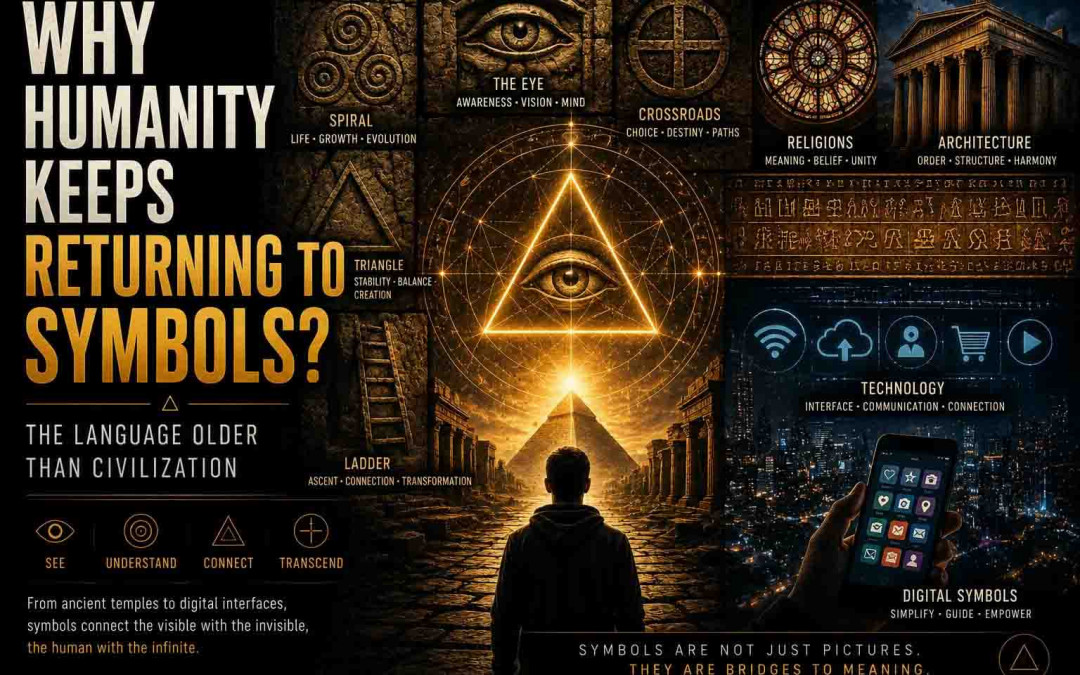
Yet surprisingly often, the same shapes appear.
The circle.
The triangle.
The crossroads.
The eye.
The ladder.
The spiral.
Again and again.
Across centuries.
Across continents.
Across religions.
Across systems.
Why?
The usual explanation is tradition.
People inherit symbols from previous generations.
That is true.
But it does not explain everything.
Many symbols appear among cultures that never directly interacted.
Many return after centuries of disappearance.
Many emerge in completely new technological contexts.
The question is not merely why symbols survive.
The question is why humanity keeps rediscovering them.
Symbols Compress Complexity
Reality is complicated.
Far more complicated than any individual can fully understand.
Symbols act as compression algorithms.
They allow vast amounts of meaning to fit inside a simple image.
A flag represents a nation.
A cross represents a tradition.
An icon on a screen represents an entire software system.
The symbol becomes an interface between the individual and something larger.
Without symbols, complexity becomes difficult to navigate.
The Return of the Triangle
Consider the triangle.
Three points create the simplest stable structure.
With one point there is existence.
With two points there is relation.
With three points there is space.
Balance.
Meaning.
Choice.
The triangle appears in architecture.
Religion.
Mathematics.
Engineering.
Technology.
Not because civilizations copied each other.
But because stability itself repeatedly leads intelligence toward similar solutions.
Perhaps some symbols survive because they describe real structural problems.

The Observer Problem
One of the oldest symbols is the eye.
Why?
Because every experience contains an observer.
Every civilization eventually encounters the same mystery.
Who is looking?
Who is aware?
Who experiences reality?
The eye becomes more than an organ.
It becomes a symbol of consciousness itself.
A reminder that every system ultimately depends on someone observing it.
Symbols and Technology
Modern people often believe symbols belong to the past.
Yet technology uses symbols constantly.
Icons.
Logos.
Buttons.
Avatars.
Notifications.
Every interface is built from symbolic language.
As systems become more complex, symbols become more necessary.
Not less.
The internet did not eliminate symbols.
It multiplied them.
The Language Older Than Civilization
Perhaps symbols are not merely cultural artifacts.
Perhaps they are solutions.
Ways of navigating reality.
Tools developed whenever intelligence encounters complexity.
If that is true, symbols may be older than any civilization.
Not historically.
Structurally.
Any intelligence facing the same questions might discover similar symbolic shortcuts.
The triangle.
The circle.
The ladder.
The crossroads.
Not because they are magical.
But because they are useful.
And useful ideas have a habit of surviving.
Long after the civilizations that first carried them disappear.
Maybe humanity keeps returning to symbols for the same reason explorers keep returning to maps.
The symbols are not the destination.
They are how we learn to navigate the unknown.
Want To Explore More..?
Watch The Video Below
Discover More Here...
Do Symbols Create Meaning? Or Do We?
FAQ
Why do humans use symbols?
Symbols help humans communicate complex ideas, emotions, and experiences that are difficult to express directly.
Why do similar symbols appear in different cultures?
Many civilizations faced similar challenges and may have independently discovered similar symbolic structures.
Are symbols invented or discovered?
Some symbols may be inventions, while others may reflect recurring patterns that emerge naturally from human perception and cognition.
Why are symbols important in religion?
Religious symbols condense complex beliefs, stories, and values into recognizable forms.
Do symbols still matter in the digital age?
Yes. Modern logos, icons, avatars, emojis, and interfaces function as symbols that help people navigate increasingly complex systems.
The Core Questions of Transhumation
Explore the full journey:
- End of Reality — Where Do You Really Exist?
- End of Physics — Are the Laws of Reality Real?
- End of the Real World — Reality Is No Longer Required
- End of Consciousness — Beyond the Human Mind
- End of Death — When Human Limits Disappear
- End of Religion — When Technology Replaces Faith