
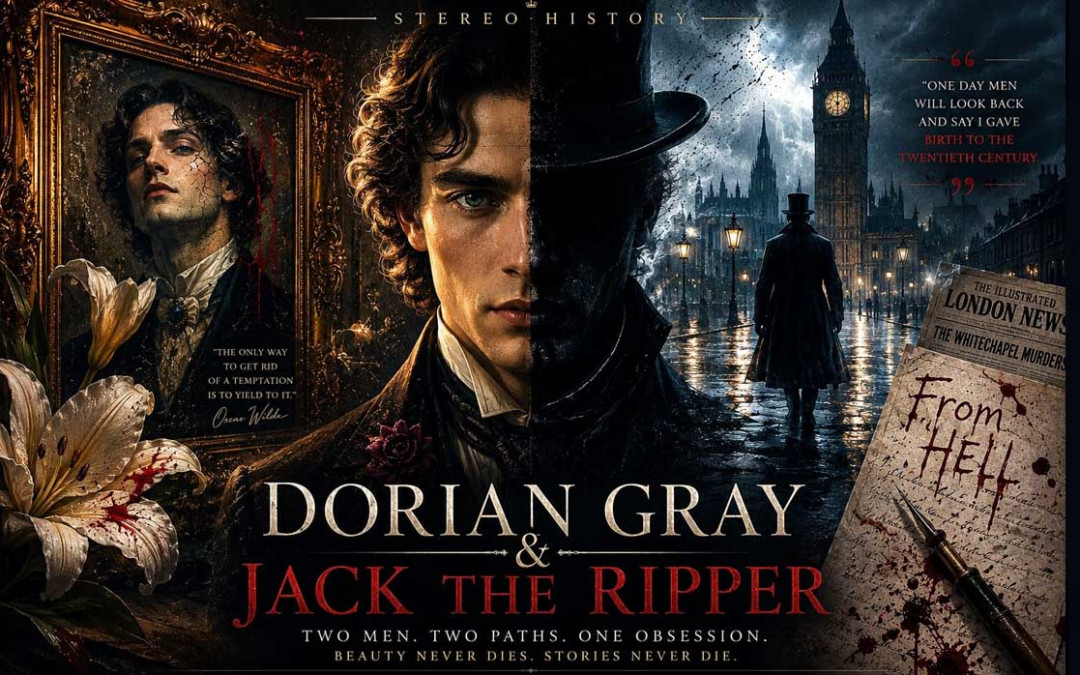
Dorian Gray and Jack the Ripper
In the summer of 1890, readers of Lippincott’s Monthly Magazine encountered a young man who discovered the most elegant imaginable method of cheating time.
Dorian Gray would remain beautiful.
The portrait would pay.
Age, corruption, cruelty and consequence would migrate away from the visible body and accumulate somewhere else, hidden behind a locked door. The arrangement was impossible, but its seduction required almost no explanation. Oscar Wilde had identified one of the oldest human fantasies and given it a distinctly modern mechanism: keep the surface intact and transfer the damage to another carrier.
Only two years had passed since the Whitechapel murders.
London had already acquired another figure who seemed to have escaped the ordinary relationship between body and identity. Nobody possessed a confirmed portrait of the murderer. Nobody could confidently attach the crimes to a biography. Yet the name Jack the Ripper had entered public culture with extraordinary force.
Dorian Gray was fictional and visibly beautiful.
The Ripper was real in the minimal sense that somebody committed the murders, but the person behind the name disappeared almost completely.
One man tried to preserve the image by sacrificing what stood behind it.
The other lost the image and survived almost entirely as what remained outside the body: a name, a sequence of events, a geography and an expanding archive of stories.
They are not equivalent figures.
But placed beside one another, they expose two radically different ways in which a human being can become separated from time.
The Portrait Takes the Damage
Dorian’s bargain is often described as a fantasy of eternal youth. That is true, but it is not the most interesting part of the mechanism.
Youth is only what other people see.
The portrait performs a stranger function.
It externalizes consequence.
Dorian’s body remains socially credible while another representation records what his visible life refuses to reveal. The painting becomes archive, witness and accusation at once. It knows what the face conceals.
This is why Wilde’s invention remains more disturbing than a simple story about vanity. The novel asks whether identity can be divided between appearance and accumulated history.
What makes Dorian Dorian?
The beautiful face society recognizes?
The private memories?
The actions?
The corrupted portrait?
The consciousness that knows there is a portrait upstairs?
The novel refuses to let those things remain comfortably aligned.
Modern readers often see social media in Dorian Gray because the resemblance is irresistible. Profiles preserve selected versions of people. Photographs can freeze appearances while years pass. Cosmetic technologies can modify the visible evidence of aging. Public identities can remain polished while private lives collapse.
But Wilde did not predict Instagram.
He identified an older tension that Instagram happens to intensify.
The face we present and the life that produced it are never exactly the same object.
Technology has simply made the distance easier to manage.
The Man Behind Jack the Ripper Disappeared
The Whitechapel murderer presents almost the inverse problem.
There is no portrait taking the damage.
There is barely a portrait at all.
Witnesses supplied descriptions, but they were inconsistent, incomplete and necessarily limited. Police examined suspects. Newspapers produced illustrations. Later generations manufactured increasingly confident faces for television, books and museums.
Yet no authenticated image of the killer exists because no authenticated identity exists.
Instead, something else survived with remarkable clarity.
The name.
Jack the Ripper.
That name did not emerge from a verified confession. It became famous through correspondence sent during the murders, particularly the “Dear Boss” letter. Whether that letter was written by the murderer is deeply doubtful; the enormous body of Ripper correspondence contains many hoaxes, inventions and opportunistic performances.
This means that one of history’s most recognizable criminal identities may have been named by someone who was not the criminal at all.
That is extraordinary.
The historical murderer disappeared.
The cultural character acquired branding.
A signature.
A tone.
Eventually almost a mythology.
Dorian tries to detach his appearance from his actions.
The Ripper persona becomes detached from the man whose actions created the case.
In both stories, representation begins to live an independent life.

The Voice Nobody Can Authenticate
The letters are where the comparison becomes especially dangerous.
Read some of the famous Ripper correspondence and a personality seems to materialize.
Mockery.
Boasting.
Threat.
Humor.
Performance.
A voice.
It is tempting to say that the murderer survived through that voice.
We cannot.
We do not know that it belonged to him.
Even the celebrated “Dear Boss” letter and postcard attributed to “Saucy Jacky” have long been regarded with suspicion. Some contemporaries and later investigators suspected journalistic invention; other letters were plainly fabricated by members of the public.
The famous voice may therefore be precisely the opposite of a preserved personality.
It may be a personality created to fill an absence.
And this makes the Ripper case far more relevant to modern information culture than a genuine confession would have been.
Human beings dislike informational voids.
Give us crimes without a criminal and we construct one.
Give us a signature without a verified author and we hear a voice.
Give us fragments and we search for coherence.
Eventually the reconstruction becomes so familiar that we forget which parts were actually evidence.
The Ripper may not have left us his voice.
Victorian London may have invented one for him.
Wilde Did Not Predict Social Media
There is another temptation worth resisting.
Wilde appears so modern that we want to make him prophetic.
Celebrity.
Beauty.
Scandal.
Public persona.
Aesthetic self-invention.
The distance between private behavior and public image.
All of these feel immediately recognizable in twenty-first-century culture.
Yet they were already intensely Victorian.
Late-nineteenth-century London had newspapers, theatrical celebrities, society portraiture, advertising, gossip, celebrity trials and an increasingly sophisticated culture of public image. Wilde was not looking through a supernatural telescope toward TikTok.
He was looking very carefully at his own world.
That is why Dorian Gray travels so well.
The technologies change while the underlying problem remains recognizable.
People still want social surfaces that do not reveal every consequence of private life.
We still respond intensely to beauty.
We still confuse presentation with character.
We still discover that an image can acquire value independently of the person it supposedly represents.
Digital culture did not invent Dorian’s problem.
It industrialized the tools available for managing it.
One Has Too Much Face, the Other None
Dorian and the Ripper occupy opposite ends of visibility.
Dorian’s face becomes tyrannically stable.
Nothing appears to happen to it.
The face lies precisely because it remains consistent while the person changes.
The Ripper has no stable face.
Every generation supplies another.
The absence lies differently: it invites projection.
One case contains too much visual certainty.
The other contains too little.
Both remind us that identity cannot be reliably recovered from appearance alone.
This connects them unexpectedly with another pair from Victorian London: Joseph Merrick and the Ripper.
Merrick’s body was interpreted as though appearance revealed character.
The Ripper’s unknown body allowed character to be projected onto absence.
Dorian introduces a third variation.
The body can remain beautiful while character changes completely.
Taken together, these figures dismantle the fantasy that visible form and moral identity naturally correspond.
Victorian culture was particularly fascinated by that problem because it existed alongside new attempts to read character scientifically from bodies, faces and skulls.
Wilde’s fictional portrait quietly destroys the whole premise.
If the face can remain perfect while the person becomes monstrous, physiognomy has lost the game before it begins.
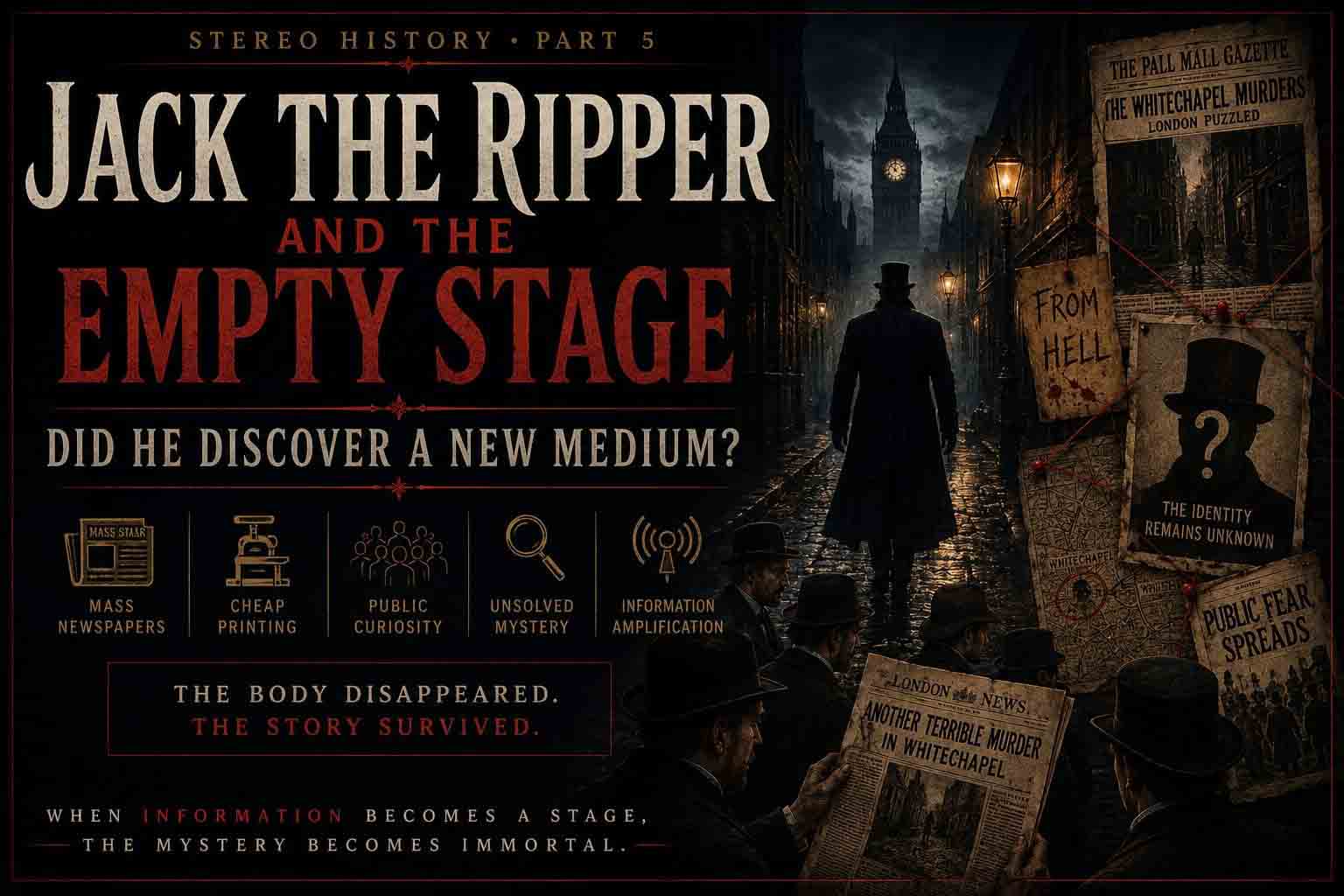
Two Different Kinds of Survival
More than a century later, Dorian Gray and Jack the Ripper remain culturally present, but the mechanisms are radically different.
Dorian survives because the text survives.
Every new reader reconstructs him.
The carrier changes from magazine to book, paperback, film, theatre, television and digital edition, but the character remains recoverable because enough narrative structure continues to be transmitted.
The Ripper survives because the historical record never closed.
Police files.
Newspaper reports.
Maps.
Medical testimony.
Witness statements.
Letters.
Photographs of streets.
Photographs of victims.
Suspects.
Books.
Arguments.
The archive remains permanently incomplete.
That incompleteness is part of the survival mechanism.
If the killer had been arrested on 10 November 1888, confessed, been tried and left a well-documented biography, the case would still matter historically.
But it would be a different cultural object.
Mystery creates interpretive space.
Dorian is immortal because his story is complete enough to be retold.
The Ripper is immortal partly because his story is incomplete enough to be rewritten.
Information Outlives the Person, but Not Cleanly
It is easy to derive a seductive principle from cases like these:
information survives while matter dies.
That needs qualification.
Information also requires matter.
Wilde’s novel survives because physical copies, printing systems, libraries, digital storage and repeated reproduction preserved it. Ripper records survive because paper, photographs, archives, institutions and later digitization carried them forward.
The pattern can move.
The carrier cannot disappear entirely.
More importantly, survival of information does not equal survival of the person.
Oscar Wilde survives culturally.
Oscar Wilde is dead.
His writings allow readers to encounter structures of thought, humor and style that originated in a living consciousness. They do not restore that consciousness.
The same distinction is even clearer with the Ripper.
A century of information has preserved the cultural entity called Jack the Ripper while failing to preserve the basic fact we most want.
Who was he?
Information can survive spectacularly and still lose the person.
That is one of the central paradoxes of archives.
Civilization can remember almost everything except the thing that mattered most.
Dorian’s Future Is Already Here, but Only Partly
Modern technology has brought several parts of Dorian’s fantasy into ordinary life.
A photograph can preserve youth indefinitely.
A digital avatar can remain twenty-five while its user becomes seventy.
Cosmetic medicine can alter some visual evidence of aging.
A social profile can preserve a curated identity long after the person who created it has changed.
Artificial intelligence can potentially generate new material in the style of an archive, making a static digital identity increasingly interactive.
None of these technologies has solved Dorian’s actual problem.
The person still ages.
The body remains causal.
Memory changes.
Relationships change.
Death remains.
We have become better at preserving representations of youth, not youth itself.
That distinction would probably have interested Wilde.
His portrait does not truly defeat time either.
It relocates the evidence.
The fantasy depends upon consequence continuing somewhere.
Modern digital identity sometimes works in much the same way.
The profile does not stop time.
It selects what time is allowed to display.
The Ripper’s Future Is Stranger
The technological future of the Ripper problem may be even more unsettling.
Imagine feeding every surviving police document, newspaper report, witness statement, map, medical opinion and letter from the Whitechapel case into a sophisticated artificial system.
The system could produce a coherent Ripper.
It might estimate speech.
Movement.
Likely occupation.
Geography.
Personality.
Even a plausible face.
The reconstruction could become extraordinarily convincing.
And still be wrong.
This is the difference between coherence and truth.
A system can fill missing information so elegantly that the absence stops feeling like absence.
That is precisely what culture has been doing to Jack the Ripper since 1888.
Artificial intelligence may simply become better at it.
This is why provenance matters so much for the Library of Mirrors.
A good librarian must distinguish:
what survives,
what is inferred,
what is reconstructed,
and what was invented because an empty shelf made us uncomfortable.
The Ripper is a nearly perfect test case.
His cultural identity is enormous.
His historical identity is missing.
The Portrait and the Archive
Dorian Gray hides his truth inside one object.
Jack the Ripper disperses his absence across thousands.
The portrait becomes darker as Dorian attempts to keep his visible identity stable.
The archive becomes larger as generations attempt to stabilize the Ripper.
Neither process succeeds.
Dorian eventually has to confront the portrait.
The Ripper archive continues expanding without producing consensus.
This gives the two figures a strange symmetry.
Dorian’s problem is too much continuity of appearance despite changing reality.
The Ripper’s problem is too much changing representation surrounding one inaccessible reality.
Both expose the instability of the relationship among person, image and history.
And both become more relevant as digital identity makes those relationships easier to separate.
A human being can now leave behind photographs, videos, location data, conversations, messages, preferences and years of recorded language.
Future generations may possess more information about an ordinary person born today than nineteenth-century historians possess about prime ministers.
Yet the problem will remain.
Which part of that archive was the person?
None of it individually.
Perhaps not all of it together.
Watch The Video
How to Read the World
Current Knowledge
Oscar Wilde’s The Picture of Dorian Gray first appeared in Lippincott’s Monthly Magazine in 1890 and was subsequently revised and expanded for book publication in 1891. The novel explores beauty, morality, influence, concealment and the division between outward appearance and accumulated consequence.
The canonical Whitechapel murders associated with Jack the Ripper occurred primarily in 1888, shortly before Wilde’s novel appeared. The identity of the murderer remains unproven despite a very large number of proposed suspects.
The name “Jack the Ripper” became famous through correspondence claiming to come from the murderer, particularly the “Dear Boss” letter. The authenticity of that correspondence is uncertain, and much of the enormous body of Ripper letters is known or strongly suspected to consist of hoaxes.
There is therefore no secure basis for treating the literary voice of the famous Ripper letters as the authenticated voice of the murderer. The cultural personality derived from those letters must be distinguished from the unknown historical individual.
Modern digital technologies can preserve representations of appearance, speech and behavior for long periods, but preserving information about a person is not equivalent to preserving that person’s consciousness or first-person continuity.
Open Questions
The first open question belongs to Wilde. Why does Dorian’s problem remain so culturally portable? Is the novel enduring because it captures a specifically modern obsession with appearance, or because the deeper conflict between public image and private consequence is much older than modern celebrity culture?
The Ripper raises the inverse problem. How much of the figure now recognized worldwide belongs to the historical murderer, and how much was created by newspapers, hoax letters, police speculation and more than a century of books, films and suspect theories?
There is also an archival question. At what point does adding information improve our reconstruction of a lost individual, and at what point does interpretation begin producing a coherent character that the evidence itself cannot support?
Artificial intelligence will make that distinction increasingly difficult because models can generate plausible continuities across missing evidence. The result may feel more complete than the historical record while being less trustworthy.
The deepest open question concerns personal survival. If future technology preserves appearance, voice, memory, style and behavioral tendencies, would that constitute preservation of a person or only an extraordinarily detailed portrait capable of responding?
Transhumation Interpretation
Dorian Gray and Jack the Ripper form an unusually useful pair for Transhumation because they demonstrate two opposite failures of continuity.
Dorian preserves the carrier we naturally trust.
The face remains.
The body appears stable.
Recognition continues.
Yet the underlying person changes morally and psychologically until the visible continuity becomes deceptive.
The Ripper gives us the reverse.
The carrier disappears.
No confirmed face.
No secure biography.
No authenticated voice.
Yet a pattern becomes so culturally stable that almost everyone recognizes the name.
One has continuity of appearance without continuity of character.
The other has continuity of narrative without continuity of identity.
That distinction reaches directly into the problem of digital survival.
Suppose a future system reconstructs someone’s face perfectly.
That solves the Dorian side.
Now preserve the person’s writing, speech, memories and humor.
That seems to solve more.
Now allow the model to generate new responses.
The representation becomes interactive.
But the Julian Experiment returns immediately.
If the biological person remains alive while the digital version begins speaking, two systems now possess the same claimed past.
Which one is the continuation?
The fact that other people recognize both does not answer the first-person question.
Dorian teaches us that a preserved face can lie about continuity.
The Ripper teaches us that a stable story can survive without the original person being recoverable at all.
Together they warn against a future category error:
recognition is not identity.
This is particularly important because modern civilization increasingly preserves people as layered archives.
Face.
Voice.
Writing.
Search history.
Photographs.
Messages.
Location.
Preferences.
Social relationships.
Perhaps eventually neural data.
The archive becomes richer.
It may eventually become rich enough to simulate.
But the richer the simulation becomes, the easier it may be to forget the distinction between reconstructing a recognizable pattern and continuing the observer who originally generated it.
This is where Wilde’s portrait becomes unexpectedly useful.
The portrait is not Dorian.
It is a representation linked to him by impossible magic.
Our future portraits may require no magic at all.
They may speak.
Move.
Remember.
Adapt.
The technological achievement would be extraordinary.
The metaphysical conclusion would remain unproven.
Jack the Ripper provides the darker version of the same warning.
Give humans fragments and they can construct a person.
Give machines fragments and they may construct one even more convincingly.
The result can acquire a face, voice and psychological continuity that never existed historically.
A missing person becomes an informational character.
That is already what happened culturally in Whitechapel.
AI could automate the process.
So the central Transhumation question is not simply what can survive time.
Many things can.
A name.
A photograph.
A joke.
A melody.
A criminal case.
A novel.
A behavioral model.
The difficult question is what kind of survival each one represents.
Dorian wants the self to survive while time is displaced elsewhere.
Jack the Ripper shows how the representation can survive after the self has become inaccessible.
Modern technology increasingly gives us the ability to preserve the representation.
We should be careful not to call that immortality before we know what, exactly, crossed.
Perhaps that is the real link between Wilde’s beautiful young man and the faceless murderer of Whitechapel.
One kept the portrait and lost himself inside it.
The other lost himself and left civilization with nothing but the portrait it invented afterward.
Time defeated both men.
The representations simply negotiated better terms.
FAQ
Did Dorian Gray and Jack the Ripper exist at the same time?
The Ripper murders occurred in 1888. The Picture of Dorian Gray first appeared in 1890, so they belong to essentially the same late-Victorian cultural moment, although Dorian is fictional.
Did Jack the Ripper really write the famous letters?
We do not know, and many are considered hoaxes. The famous literary “voice” of the Ripper should therefore not be treated as securely belonging to the murderer.
Why does Dorian Gray feel so modern?
Because the novel explores the gap between visible identity and private consequence, a tension intensified today by photography, social media, cosmetic technologies and digital self-presentation.
Why is Jack the Ripper still culturally powerful?
Partly because the case remains unresolved. Enough evidence survives to constrain interpretation, but enough is missing to allow successive generations to reconstruct the unknown person differently.
Do digital archives make a form of immortality possible?
They can preserve increasingly rich traces of a person. That is cultural or informational survival, not evidence that the person’s consciousness continues.
What is the deeper Transhumation question?
Dorian Gray preserves the image while the person changes. Jack the Ripper preserves the story while the person disappears.
Digital civilization may soon preserve both image and story extraordinarily well.
The unanswered question is whether preserving everything by which others recognize us is the same thing as preserving the one who was there to be recognized.
Continue the Transhumation Series
- Forgotten Religion | Ancient Gods, Symbols and the Hidden Structures of Human Civilization
- The Last Religion | Death, Immortality and the Future of Humanity
- The New Theurgy | AI, Information and the Future of Human Civilization
- End of Branding: You Were Never Meant to Become a Product
- Baal vs Ishtar: Why Ancient Gods Never Disappeared