
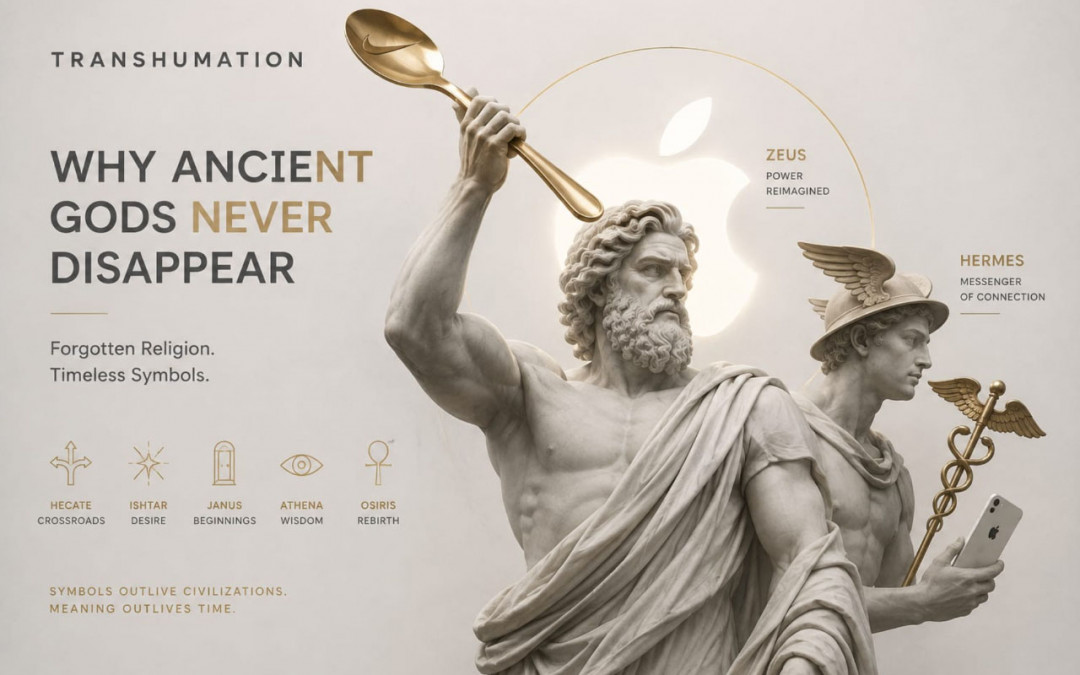
Truly Followers
In 30 B.C., Cleopatra died and the world of the pharaohs effectively closed behind her. Egypt would pass through Roman, Byzantine, Arab and Ottoman rule. Priests disappeared, temples fell silent, languages changed, and eventually even the ability to read hieroglyphs was lost. By any reasonable institutional measure, the old Egyptian religion had lost.
Osiris did something stranger.
Two thousand years later, his face can still be recognized in museums. His story is translated into languages that did not exist when his priests performed their rites. Children encounter Egyptian gods before they know much about Egyptian history; filmmakers, novelists and game designers keep returning to them. Isis suffered an even more improbable fate: a divine name once invoked beside the Nile crossed civilizations, religions, alphabets and continents and remains immediately recognizable in the twenty-first century.
This is not unique to Egypt. Hecate survived the disappearance of the religious world that worshipped her. Janus survived Rome. Ishtar survived cities whose ruins had to be excavated before modern scholars could properly reconstruct their histories. Athena no longer receives the civic cult she once did, yet her owl still looks entirely at home on a university seal.
Civilizations die much more completely than some of their gods.
That leaves us with a small historical treasure hidden in plain sight. Perhaps the most interesting thing about an ancient god is not that people once believed in it. It is that, occasionally, the civilization dies and the god refuses to go with it.
The Poet Who Built Something Taller Than Rome
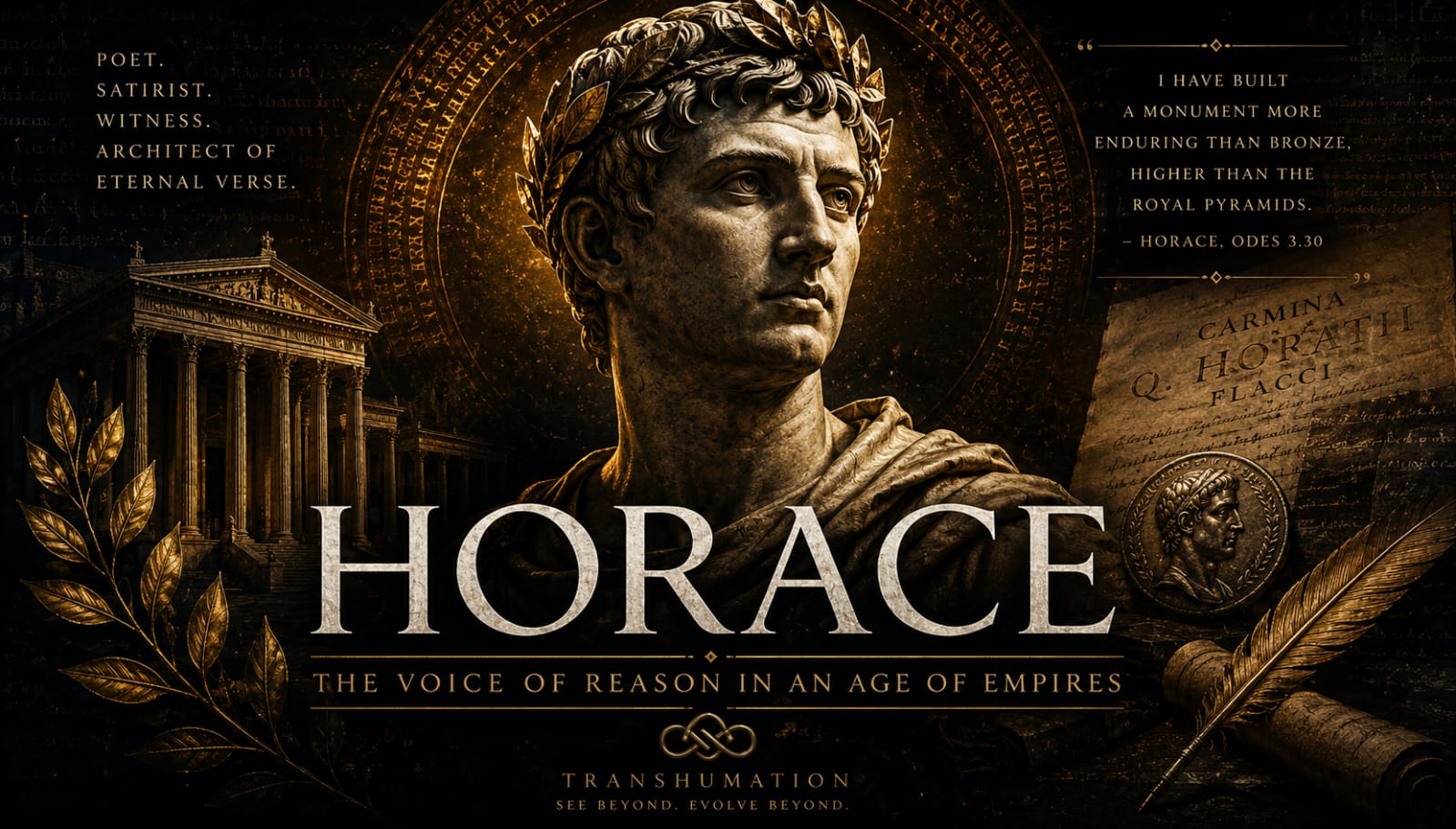
Horace understood this problem unusually well. Near the end of the third book of his Odes, he made one of literature’s great wagers against mortality. Exegi monumentum aere perennius: I have raised a monument more lasting than bronze.
The boast becomes more interesting as the poem continues. Horace imagined his reputation surviving while Rome itself continued—while religious ceremonies persisted and the pontifex climbed the Capitoline accompanied by the silent Vestal Virgin. It was a perfectly sensible image of permanence for a Roman. Rome supplied the horizon against which permanence could be imagined.
Rome then proceeded to betray the metaphor.
The Vestal order disappeared. The ancient state religion disappeared. The political system Horace knew disappeared. Even the Western Roman Empire eventually disappeared. Yet schoolchildren who have never watched a Vestal procession can still read the sentence in which Horace imagined one.
His monument survived the landscape used to describe its survival.
There is something almost mischievous about this. Stone appears durable because we can touch it; information appears fragile because it depends upon a carrier. Yet over long enough periods the relationship can reverse. A temple can be burned once. A poem, once sufficiently copied, must be destroyed everywhere.
The same principle helps explain the peculiar immortality of gods. A statue of Hecate can be smashed. Hecate herself is more difficult to smash because she is no longer located entirely inside the statue. She has escaped into stories, descriptions, copies, translations, paintings, names and eventually databases. The carrier can die while the arrangement moves elsewhere.
The first secret of divine immortality may therefore have surprisingly little to do with divinity.
It may begin with information.
The God Beneath the Costume
That still leaves a harder question. Most ancient information did not survive. Countless names, songs, local traditions and stories vanished. Why do certain gods repeatedly return?
The easy answer is cultural inheritance. Greek and Roman mythology became deeply embedded in European literature, education and art; archaeological discoveries later revived interest in older Near Eastern religions. That explains a great deal. We should not manufacture a metaphysical mystery where libraries, schools and museums already provide a historical mechanism.
But transmission alone does not explain why particular figures remain so reusable.
Consider Hecate. Her ancient identity was considerably richer and stranger than the modern shorthand “goddess of crossroads and witchcraft.” Her associations changed over time and included liminality, night, torches, magic and other religious functions. Yet the crossroads remains extraordinarily effective because we still understand the situation before anybody explains the goddess.
A road becomes two roads.
You cannot take both.
You do not know what waits at the end of either.
Suddenly a piece of ancient religious geography becomes psychological.
This does not mean that choosing between two jobs constitutes the worship of Hecate, or that an ancient Greek secretly meant “career transition” when leaving an offering at a crossroads. That would replace history with a modern projection. The stronger observation is simpler: the ancient symbol remains intelligible because the human situation to which it can be attached has not disappeared.
The costume belongs to an era.
The problem does not.
And that distinction gives us a better test for the survival of gods. Instead of asking only whether the name survived, remove the name and ask what remains.

Ishtar After Ishtar
Ishtar makes the experiment more dangerous because she demonstrates how easily a beautiful theory can become too neat.
It is tempting to describe her simply as desire: the ancient force that today appears as ambition, sexuality, consumption, exploration and technological progress. The metaphor is seductive. It is also historically inadequate.
The Mesopotamian Ishtar—closely related to the Sumerian Inanna—could encompass love and sexuality, but also warfare, political power and other domains that resist reduction to a single modern psychological category. Ancient gods were not tidy icons in a universal symbolic dictionary. Their meanings accumulated, contradicted one another and changed with cities and centuries.
Yet this complexity may actually strengthen the larger argument.
What survives is not necessarily a definition. It can be a geometry of relationships.
Ishtar is fascinating because incompatible forces coexist inside her: attraction and violence, fertility and destruction, power and vulnerability, ascent and descent. Her famous journey into the underworld remains compelling not because modern readers secretly retain Mesopotamian theology, but because the story presents transformation through a sequence that remains disturbingly legible. At successive gates, something is surrendered. Status disappears. Power disappears. The figure who entered cannot simply remain what she was.
That is why myths can migrate into worlds that no longer accept their cosmology. The reader does not need to believe in the underworld described by the story to recognize what it means to lose the things by which one identified oneself.
Perhaps this is one reason the strongest gods survive their religions.
They contain structures that can be reused without requiring the original belief.
The Door Rome Left Behind
Janus offers an even cleaner experiment.
He belongs so specifically to Rome that there is no straightforward Greek equivalent from which he was merely copied. His domain included beginnings, passages, gates and transitions; his familiar two-faced representation turned the strange condition of a threshold into an image almost impossible to misunderstand.
One face behind.
One face ahead.
The extraordinary thing is that Rome disappeared without making thresholds obsolete.
We still divide lives into before and after. We still create ceremonies around beginnings. We still treat doors differently from walls because crossing one changes our position. Political systems speak of transitions; technology passes through generations; children become adults; immigrants cross borders; patients wait for diagnoses that can divide a biography into two eras.
Again, none of this proves Janus was a supernatural being. Nor does it prove that every threshold is secretly Janian.
It reveals something more modest and, for Transhumation, more useful.
Rome discovered an extraordinarily efficient way of giving a face to transition.
Once invented, the image became portable.
The civilization had created something that no longer required the civilization.
The Interface That Escaped the Temple
This is where the word interface becomes useful, provided we handle it carefully.
An interface does not need to contain the system it represents. Its job is to make interaction possible.
The small weather symbol on a phone does not contain the atmosphere. A map of London does not contain London. The tiny battery icon at the top of a screen is not a battery. Each compresses a reality into a form appropriate to the observer.
Ancient gods could sometimes perform an analogous function. They turned forces, transitions, obligations and uncertainties into entities with names, attributes, places and stories. The sea could be addressed. Justice could be represented. A boundary could have a guardian. The terrifying abstraction of death could acquire geography.
We should resist the temptation to conclude that ancient people therefore regarded their gods as metaphors. Often they plainly did not. Ritual and religious experience cannot be reduced to an elegant information-theory analogy invented two thousand years later.
The structural observation lies elsewhere.
Whether a god was understood literally, symbolically or through some combination alien to our modern categories, personification made enormous realities cognitively manageable. The god became a point at which a human-scale mind could encounter something larger than itself.
This may also explain why mythology remains attractive in an age filled with scientific models. Science can describe a phenomenon with extraordinary precision without necessarily producing an image capable of living inside ordinary human experience.
We can understand the statistics of mortality.
Or we can meet Osiris.
Those are not competing scientific propositions. They are different informational objects doing different jobs.
What Must a God Lose to Survive?
Now the puzzle changes.
Perhaps ancient gods survive not despite losing their temples, but partly because they are capable of losing them.
Imagine two ancient religious ideas. The first depends entirely upon one priesthood, one political institution, one inaccessible sanctuary and one ritual performed according to an exact calendar. Destroy that civilization and the information becomes difficult to carry forward.
The second possesses a memorable name, an extraordinary image and a story attached to a recurring human problem.
One has heavy luggage.
The other can travel.
This may be the hidden selection pressure operating across cultural history. Symbols that depend too completely upon their original environment become archaeological objects. Symbols capable of being detached, translated and reinterpreted can enter new carriers.
Hecate can leave the shrine and enter Shakespeare, occult revival, modern fiction and popular culture. Janus can become an adjective. Osiris can move from funerary religion into painting, literature, museums and cinema. Athena can lose her temple cult yet remain shorthand for wisdom, strategy and civilization.
Each migration changes the object. The Hecate encountered by a twenty-first-century reader is not identical to the Hecate encountered by an ancient worshipper. Cultural survival is therefore not preservation in amber.
It is survival through controlled mutation.
That distinction matters enormously. The immortal symbol is not the one that never changes.
It is the one that can change without becoming completely unrecognizable.
The Gods We Do Not Call Gods
This is where the argument becomes uncomfortable, because the ancient world stops looking safely ancient.
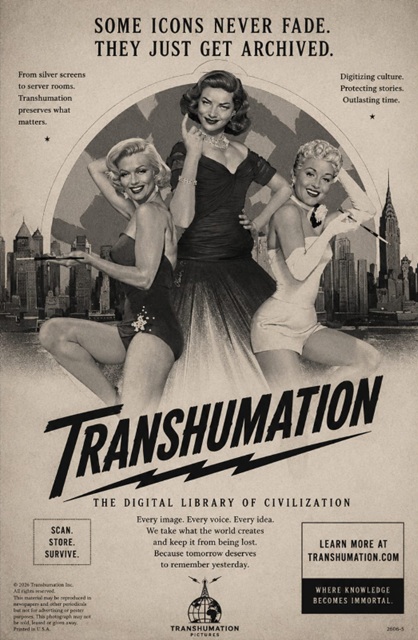
Modern civilization is surrounded by faces used to compress realities larger than the people represented by them. Einstein becomes “genius.” Marilyn Monroe becomes beauty, desire and the machinery of celebrity. Elvis becomes rebellion, sexuality and a particular transformation of mass culture. Stalin can become an almost grotesquely compressed image of dictatorship, terror and centralized power.
The human beings themselves were infinitely more complicated than these symbolic versions.
That is precisely the point.
Culture compresses.
A person becomes an image. The image becomes a story. The story can eventually travel among people who know remarkably little about the original life. At that stage, the symbolic object has begun to acquire an existence partly independent of its historical carrier.
Calling Marilyn Monroe a “goddess” would tell us very little. She was a twentieth-century actress, not Ishtar in disguise. Stalin was not a dark deity. Elvis did not found a religion simply because pilgrims visit Graceland.
But placing them beside ancient gods produces a useful question.
What exactly is the mechanism by which a historical individual becomes larger than his or her biography?
That mechanism may share something with the older machinery of mythology: compression, repetition, recognizable attributes, narrative simplification and the attachment of enormous collective emotions to a single human form.
Perhaps we did not stop producing symbolic figures.
Perhaps we merely changed the factories.
The Treasure the Ruins Could Not Keep
Return finally to the ruined temple.
An archaeologist can measure its stones. A historian can reconstruct its cult as carefully as surviving evidence allows. A museum can place the statue behind glass. All of these approaches treat the ancient object with the seriousness it deserves.
But there is another experiment available to us.
Remove the temple.
Remove the priesthood.
Remove the sacrifice.
Remove the empire.
Remove, finally, belief itself.
Then ask what is still functioning.
If Hecate can still make a crossroads feel inhabited by possibility, something survived. If Janus still provides an instantly intelligible image of transition, something survived. If the descent of Ishtar can still describe the frightening experience of losing identity piece by piece, something survived.
We do not yet know exactly what that something is.
It may be cognitive efficiency. It may be cultural inheritance. It may be narrative selection. It may reflect recurring features of human psychology and social organization. For a believer, it may suggest that myth occasionally points toward realities that human beings rediscover rather than invent.
Fidelio requires us to leave those possibilities separated until evidence allows us to join them.
But the ruins already tell us one thing.
The temple was never the strongest part of the god.
The strongest part was whatever could escape it.
Watch The Video
How to Read the World
Current Knowledge
Ancient Mediterranean and Near Eastern religions were diverse systems that changed substantially across places and periods. Deities could acquire new attributes, merge with other gods, travel between cultures and be interpreted differently by different communities. Modern reconstructions therefore cannot safely reduce a deity to one fixed “meaning.”
The survival of Greek and Roman mythology in particular was strongly aided by textual preservation, education, art and later European engagement with classical antiquity. Egyptian and Mesopotamian religious traditions were also substantially reconstructed through archaeology, decipherment and modern scholarship. Their modern visibility is therefore not evidence that symbols survive independently of physical and cultural transmission.
Cultural information can nevertheless persist while particular material carriers disappear. Texts, images and stories can be copied into successive media, with each act of transmission allowing information to survive beyond the lifetime of an individual manuscript, monument or institution.
Open Questions
Why are certain mythological figures unusually adaptable while others become specialist knowledge? How much of their longevity comes from historical accidents of preservation, and how much from the kinds of human experiences their stories represent? At what point does reinterpretation preserve an ancient symbol, and at what point does it create a new object wearing an old name?
There is also a larger question. If different civilizations repeatedly create symbolic representations around death, thresholds, desire, justice and transformation, are we primarily observing cultural transmission—or independent responses to recurring structures in human existence?
Transhumation Interpretation
Transhumation does not propose that Hecate, Ishtar, Janus and Osiris are merely psychological labels, nor that modern celebrities are ancient gods reborn. That would turn a useful structural hypothesis into mythology of our own.
The more interesting proposition is that a god may contain something capable of surviving the death of the god’s original world.
The carrier changes: temple to manuscript, manuscript to painting, painting to photograph, photograph to screen, screen to database. The interpretation changes with it. Yet occasionally enough of the arrangement survives for a person separated by two thousand years to recognize the old shape.
This suggests a useful test for Forgotten Religion. When examining an ancient symbol, remove everything that belongs exclusively to its historical costume and ask what remains. If nothing remains, we have an artifact of a vanished civilization. That is already valuable.
But if a recognizable function survives—if the same problem keeps generating new carriers—then we may have found something else.
Not proof that the god survived.
Evidence that the pattern did.
Perhaps this is why the most interesting gods behave less like monuments than information. A monument survives by resisting change. Information survives by moving through it.
The temple tries to remain standing.
The god learns to travel.
FAQ
Why do ancient gods remain recognizable after their religions disappear?
Several mechanisms contribute: preservation of literature, education, art, archaeology and later reinterpretation. Some mythological figures may also remain culturally useful because their stories can be attached to recurring human experiences such as death, transition, desire, conflict and uncertainty.
Were ancient gods simply symbols or metaphors?
No. That would impose a modern interpretation on diverse ancient religions. Worshippers could understand gods as genuine divine agents and interact with them through ritual. Transhumation’s “interface” model concerns one possible function of divine representations, not a claim about what ancient people really believed.
Is Hecate really just a goddess of crossroads?
No. Hecate’s historical religious identity was considerably broader and changed across periods. Crossroads and liminality are important associations, but reducing her to a single modern archetype would distort the evidence.
Does Transhumation claim that celebrities are modern gods?
No. The comparison concerns the process by which complex people or forces can become culturally compressed into portable symbolic figures. Similarity of function does not establish identity.
Why do some symbols survive while others disappear?
There is probably no single reason. Memorable imagery, adaptable stories, cultural transmission, political influence, literary preservation and connection to recurring human concerns can all contribute.
Continue the Transhumation Series
- Forgotten Religion | Ancient Gods, Symbols and the Hidden Structures of Human Civilization
- The Last Religion | Death, Immortality and the Future of Humanity
- The New Theurgy | AI, Information and the Future of Human Civilization
- End of Branding: You Were Never Meant to Become a Product
- Baal vs Ishtar: Why Ancient Gods Never Disappeared