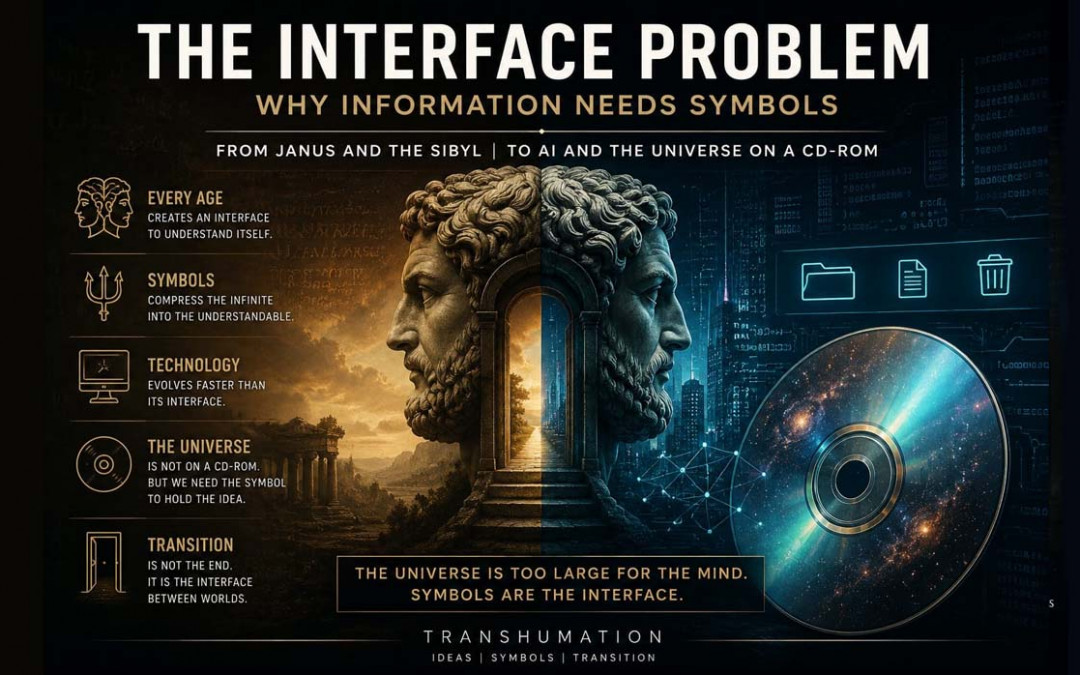
The Interface
Civilization has never suffered from too little reality. The problem has always been how much of reality a human mind can use at once.
Imagine being placed in front of a modern computer with no screen, no icons, no folders, no search box and no familiar desktop. You are given direct access to the underlying machine and told that everything you need is there. The files exist. The processor works. The memory is intact. Nothing important is missing.
The machine is powerful.
It is also nearly useless to you.
The problem is not information. The problem is interface.
Modern civilization has spent decades solving this problem in software while barely noticing how old it is. A graphical folder is not a folder. A desktop is not a desk. A trash bin contains no metal and occupies no corner of the room. These images are deliberate fictions designed to make a complex computational system navigable by a mind that evolved long before computers existed.
The metaphor is inaccurate.
That is precisely why it works.
We live inside similar metaphors everywhere. Money represents value without being value itself. A map removes almost everything from a landscape in order to make the landscape usable. A constellation connects stars that may be unimaginably distant from one another because a human observer needs a shape. A flag compresses history, territory, loyalty and conflict into colored cloth.
Civilization does not function by presenting reality in full resolution.
It functions by finding ways to reduce reality without making it useless.
This may be one of the defining problems of the information age.
We have become extraordinarily good at producing more reality than a human being can process.
Now we need better interfaces to survive it.
Reality Has Always Been Too Large
The idea that modern people are overwhelmed by complexity can make earlier civilizations look psychologically simple. They were not.
A farmer in antiquity did not understand the political machinery of an empire any more completely than an ordinary citizen today understands global finance. A medieval merchant could not hold the theological, legal, dynastic and economic structures of Europe inside his head. An ancient sailor navigated oceans whose meteorology and geology were largely invisible to him.
Human beings have always lived inside systems larger than their ability to comprehend directly.
The solution was never complete knowledge.
It was compression.
Stories compressed history.
Ritual compressed social order.
Genealogy compressed relationships.
Gods compressed forces that were difficult to imagine abstractly.
Law compressed thousands of possible conflicts into repeatable rules.
Symbols made large structures cognitively portable.
This does not mean ancient religion was merely primitive data visualization. Gods were worshipped, feared, loved, invoked and embedded in living religious worlds. Reducing them to psychological diagrams would destroy the very history we are trying to understand.
But symbols can perform more than one function at once.
A deity can belong to a religious system and still provide a human mind with a way of thinking about a structure that would otherwise remain difficult to hold.
That is where Janus becomes useful.
Janus Has Two Faces Because Time Is Difficult
Janus is associated with entrances, beginnings, transitions and passages. The familiar double face looks in two directions at once.
There is no need to modernize him into an ancient operating system.
The image already does enough.
A threshold is strange because it belongs to neither side completely. The doorway is part of the room you are leaving and the room you are entering. The first day of a year contains the past immediately behind it and an unknown future immediately ahead. A political transition, marriage, migration or death produces a similar ambiguity.
Janus gives that ambiguity a face.
The symbol does not explain transition scientifically.
It makes transition mentally graspable.
Hekate performs a different compression. Crossroads contain several futures simultaneously, but a person can inhabit only one of them at a time. The physical roads exist together. Biography does not. Once the traveller chooses, possibility becomes history.
Again, the goddess is not simply a diagram of decision theory.
But the crossroads gives uncertainty a place.
The mind can stand there.
This is what successful interfaces do.
They transform relationships into environments we can enter.
The Universe on a Disc
Imagine being handed a small silver disc and told that it contains the universe.
The statement is obviously absurd if taken physically. Even describing the state of the observable universe at complete resolution would involve problems far beyond the storage capacity of any ordinary medium, and the universe itself is not reducible to a consumer data format.
Yet the image works instantly.
A disc suggests storage.
Storage suggests information.
Information suggests compression.
The mind suddenly has something it can manipulate.
This is why metaphors become dangerous and indispensable at the same time.
A useful metaphor conceals almost as much as it reveals. Calling DNA a code helps us think about inherited information, but DNA is not literally software written by a programmer. Calling the brain a computer highlights certain kinds of processing while hiding biological properties that do not fit the analogy. Calling the universe information may illuminate relationships while quietly smuggling in assumptions about what information actually is.
The problem is not that metaphors are false.
The problem begins when we forget that they are interfaces.
A good interface hides complexity deliberately.
A bad philosophy mistakes the interface for the system behind it.
Windows Did Not Simplify the Computer
The graphical desktop offers one of the cleanest examples.
Early computers required users to interact more directly with command structures and file systems. Graphical interfaces changed the relationship between person and machine. Icons, windows, menus and pointers turned invisible operations into spatial actions.
A file could be dragged.
A folder could be opened.
A document could be placed in a trash bin.
None of these actions described what the machine was literally doing at the hardware level.
The genius of the interface was that the user no longer needed to know.
This was not merely aesthetic design. It redistributed cognitive labor.
The machine handled complexity.
The human handled symbols.
Modern artificial intelligence may represent another change of this kind.
Until recently, digital interfaces largely required us to learn their organizational logic. Search demanded keywords. Databases demanded fields. Software demanded menus. AI increasingly permits something more natural to humans: ask in ordinary language.
The shift appears small.
It may be enormous.
The interface is moving from icon to conversation.
The Library Has Become Too Large for the Reader
Civilization has an information problem that would have been unimaginable to most earlier societies.
We can preserve too much.
There are more books than one person can read, more scientific papers than one researcher can follow, more images than anyone can inspect, more news than anyone can verify, more video than a lifetime can watch. The global archive grows continuously while the biological bandwidth of human attention remains painfully limited.
The scarcity has changed.
Information used to be difficult to preserve.
Now orientation is difficult to preserve.
This is why the librarian becomes more important as the library grows.
A library of ten books barely requires organization. A library of ten million requires catalogues, classification systems, specialists and tools for retrieval. A global archive containing substantial portions of recorded human culture requires interfaces powerful enough to help the individual navigate without pretending to have absorbed the whole.
Artificial intelligence enters precisely here.
It can compare, translate, summarize, retrieve, reorganize and connect information at scales impossible for an individual reader.
That makes AI potentially valuable.
It also makes the interface powerful.
A librarian traditionally helps a reader locate books.
A conversational system can increasingly tell the reader what the books supposedly say.
The difference is profound.
The interface has begun interpreting the library.
The Crisis Is Not Information
Modern civilization often describes itself as suffering from misinformation, information overload or fractured attention. All of these diagnoses contain part of the problem.
But underneath them sits something older.
Humans need orientation.
A person can know hundreds of facts about climate change, artificial intelligence, genetics, economics, astronomy and political history without possessing a coherent picture of how those facts relate. Information accumulated without structure can increase confusion rather than decrease it.
Meaning requires selection.
Selection requires criteria.
Criteria require some model of what matters.
This is where an interface stops being neutral.
Every map leaves something out.
Every search ranking establishes an order.
Every curriculum decides what deserves transmission.
Every myth emphasizes some relationships and hides others.
Every AI response compresses possibilities into one visible path.
The question is therefore not whether civilization can eliminate interfaces.
It cannot.
The question is whether we remember that an interface always interprets.
The New Theurgy
The word theurgy belongs to a very different world from graphical user interfaces. In late antique Neoplatonic traditions, theurgy involved ritual practices intended to establish contact or alignment with divine realities. Symbols and ritual acts participated in a metaphysical system whose assumptions were religious, not technological.
Modern computation is not ancient theurgy.
An algorithm is not an angel.
A prompt is not automatically an invocation.
A neural network is not a divine intermediary.
But The New Theurgy can use the old idea structurally.
The ancient problem was how a finite human being could approach an order considered larger than ordinary human understanding.
The modern problem is how a finite human mind can navigate systems containing more information, complexity and predictive power than the individual can inspect directly.
In both cases an intermediary appears.
Symbol.
Ritual.
Priest.
Oracle.
Book.
Interface.
Model.
AI.
The historical meanings differ.
The structural role recurs.
Something stands between the individual and a system too large to encounter without mediation.
That is the Interface Problem.
What Happens When the Interface Becomes the World?
There is a final danger, and it may be the most important one.
An interface initially exists to simplify reality.
Eventually users may stop noticing anything behind it.
A child growing up with digital maps may know the city primarily through the instructions the map provides. A person encountering history through algorithmic summaries may never see the archive from which those summaries were produced. A recommendation system can become less like a guide to culture and more like the environment in which culture appears.
At that point the interface stops feeling like interpretation.
It starts feeling like reality.
This is not a hypothetical problem reserved for future AI systems. Human beings have always lived through symbolic models. Nations, religions, markets and institutions can become so familiar that their underlying assumptions disappear from awareness.
Technology simply increases the speed and intimacy of the process.
The most successful interface is the one we stop seeing.
That is also what makes it dangerous.
Watch The Video
How to Read the World
Current Knowledge
Human cognition operates under significant limits of attention, working memory and processing capacity. People therefore rely on simplification, categorization, models and external representations to navigate complex environments. Maps, diagrams, language, writing and graphical interfaces all reduce complexity while preserving selected relationships useful for particular tasks.
Human-computer interaction has repeatedly demonstrated the importance of interface design. Graphical user interfaces allowed users to manipulate complex digital systems through visual metaphors such as desktops, windows, folders and icons rather than interacting directly with lower-level machine operations.
Symbols and metaphors also play central roles in cognition and culture. They can make abstract relationships easier to think about, but metaphors highlight some features while obscuring others. Scientific language frequently uses metaphor productively while remaining vulnerable to confusion when analogy is mistaken for literal mechanism.
Artificial intelligence increasingly functions as an informational intermediary. Modern systems can retrieve, summarize, translate and reorganize large quantities of text and other data. These capabilities do not make AI omniscient, neutral or necessarily conscious. AI systems can make errors, reproduce biases and present uncertain information with misleading confidence.
There is no scientific basis for describing ancient gods such as Janus or Hekate literally as information interfaces. Using them that way is a modern interpretive analogy.
Open Questions
The first problem is epistemic. If humans necessarily rely on interfaces to understand complex systems, how can we distinguish useful simplification from distortion? Every model excludes information. At what point does compression change the conclusion rather than merely make it comprehensible?
A second problem concerns trust. As artificial intelligence becomes an intermediary between individuals and large bodies of knowledge, how often should the user inspect the underlying sources rather than trust the synthesis? A system can make access easier while simultaneously increasing dependence on its interpretation.
There is also a cultural question. Shared myths and symbols once provided broad frameworks through which communities interpreted mortality, power, nature and social order. Modern societies possess more information but often share fewer interpretive frameworks. Is this genuinely a crisis of meaning, or simply the normal consequence of pluralistic societies containing several competing maps?
Another question concerns artificial interfaces themselves. Could AI become so effective at interpreting the world that individuals increasingly encounter events only after algorithmic selection? If so, the central political problem of AI may eventually concern not whether machines become conscious, but who controls the systems deciding what humans get to see.
And finally, can a civilization deliberately design an interface to itself without turning that interface into another ideology?
Transhumation Interpretation
Transhumation is most useful here not as an answer but as an interface consciously aware that it is an interface.
That distinction matters.
A doctrine says:
This is reality.
An interface says:
This is one way of approaching reality from where we currently stand.
The second claim is weaker.
It may also be more durable.
Transhumation places mythology, technology, consciousness, religion, information and civilizational history beside one another not because they are secretly identical, but because structural similarities become visible when different carriers are compared.
Janus does not become software.
Hekate does not become an algorithm.
Theurgy does not become artificial intelligence.
The library does not become a brain.
But thresholds recur.
Guides recur.
Memory recurs.
Translation recurs.
Systems larger than individuals recur.
The need for orientation recurs.
This is where symbolic thinking becomes useful without becoming superstition.
A symbol can function like an icon on a desktop.
The icon does not contain the complete machine.
It provides an intelligible point of entry.
The danger begins when we worship the icon because we have forgotten the system exists behind it.
Transhumation should therefore behave like a transparent interface.
Its symbols should invite entry while remaining vulnerable to inspection.
Its mythology should open questions rather than close them.
Its analogies should reveal structures without pretending to establish historical causation.
Its central discipline should remain the ability to leave the interface when the evidence behind it no longer supports what the symbol suggests.
Perhaps this is the deeper meaning of The New Theurgy.
Not the return of ritual as technological magic.
The return of conscious mediation.
Human beings remain finite.
Reality remains larger than any individual mind.
The archive grows.
The machines grow.
The models grow.
The problem is no longer whether we will use interfaces.
We already do.
The problem is whether we can build interfaces powerful enough to guide us without becoming unable to see beyond them.
FAQ
What is an interface?
An interface is a layer that allows one system to interact with another without requiring complete access to its internal complexity. A computer desktop is a familiar example: users manipulate icons and windows instead of directly controlling electronic operations inside the machine.
Why do humans need interfaces?
Because human attention and working memory are limited. Complex systems become usable when information is selected, organized and represented in forms the mind can navigate.
What does “information is not understanding” mean?
Information can exist without being organized into a useful mental model. Understanding involves seeing relationships, context and implications rather than merely possessing more facts.
Are symbols a kind of interface?
They can be. Symbols compress complex relationships into memorable forms. Their usefulness does not mean they literally contain everything they represent.
Why use Janus and Hekate?
Because their historical associations with thresholds, transitions, entrances and crossroads provide powerful images for experiences involving uncertainty and passage. The article uses them interpretively rather than claiming ancient religions developed modern interface theory.
What does the Universe on a CD-ROM mean?
It is a deliberately impossible metaphor showing how compression helps thought. The universe obviously cannot be placed on an ordinary disc, but the image makes the relationship between enormous reality and limited representation intuitive.
What did graphical interfaces actually change?
They changed how humans interacted with computers. Visual metaphors such as folders, desktops and trash bins hid technical complexity behind representations users could understand quickly.
Is AI another kind of interface?
Increasingly, yes. AI can stand between a user and large bodies of information, translating natural-language questions into searches, comparisons and generated explanations.
Does that make AI a librarian?
It can perform some librarian-like functions, such as retrieval, organization and synthesis. But a good librarian also provides provenance, context and paths back to the sources. AI becomes dangerous when synthesis replaces verifiability.
Why do people feel lost in an age with so much information?
Information abundance can exceed human capacity for attention and interpretation. More available knowledge does not automatically provide a coherent worldview, reliable priorities or shared meaning.
Is mythology basically an old user interface?
Not literally. Mythology was embedded in religion, ritual, politics and culture and cannot be reduced to information design. The analogy is useful only at the structural level: myths can make complex human and cosmic relationships cognitively accessible through narrative and symbol.
What is The New Theurgy?
The New Theurgy is a Transhumation framework for examining modern symbolic interfaces between individuals and systems larger than them, especially artificial intelligence, information networks and cultural memory. It borrows the historical word theurgy without claiming that modern technology is identical to ancient religious practice.
Can an interface distort reality?
Every interface distorts in the sense that it selects and simplifies. The important question is whether the distortion preserves the relationships relevant to the task or hides something necessary for understanding.
Are scientific theories interfaces too?
In one limited sense, yes. Scientific models simplify aspects of reality so that relationships can be measured, tested and predicted. Their crucial difference from purely symbolic systems is that scientific models are expected to survive empirical testing and to be revised when observations contradict them.
Can AI become too powerful as an interface?
Yes. If users increasingly receive knowledge only through AI-generated interpretation, the system may acquire substantial influence over which evidence is visible, which interpretations appear plausible and which questions are asked.
What happens when people forget that the interface is an interface?
Then representation can begin functioning as reality. A simplified map becomes mistaken for the territory. Categories feel natural rather than constructed. Algorithmic rankings appear objective because the selection process disappears from view.
Is Transhumation itself vulnerable to this problem?
Completely.
If Transhumation becomes so confident in its symbols that every new fact can be forced into Hekate, Janus, ladders, mirrors or information theory, it stops functioning as an interface and becomes a closed mythology.
Its survival therefore depends on remembering that its symbols are tools.
They should reveal.
They should compress.
They should connect.
But they should also be removable.
What would a good interface for civilization look like?
It would simplify without pretending nothing had been omitted. It would preserve access to evidence. It would distinguish observation from interpretation. It would make uncertainty visible. It would allow competing maps to be compared.
Most importantly, it would teach the user that there is always something behind the screen.
Perhaps that is the deepest version of the Interface Problem.
Humanity has always needed a picture small enough to hold.
The danger begins when the picture becomes so convincing that we forget to turn it over.
Continue the Transhumation Series
- Forgotten Religion | Ancient Gods, Symbols and the Hidden Structures of Human Civilization
- The Last Religion | Death, Immortality and the Future of Humanity
- The New Theurgy | AI, Information and the Future of Human Civilization
- End of Branding: You Were Never Meant to Become a Product
- Baal vs Ishtar: Why Ancient Gods Never Disappeared