
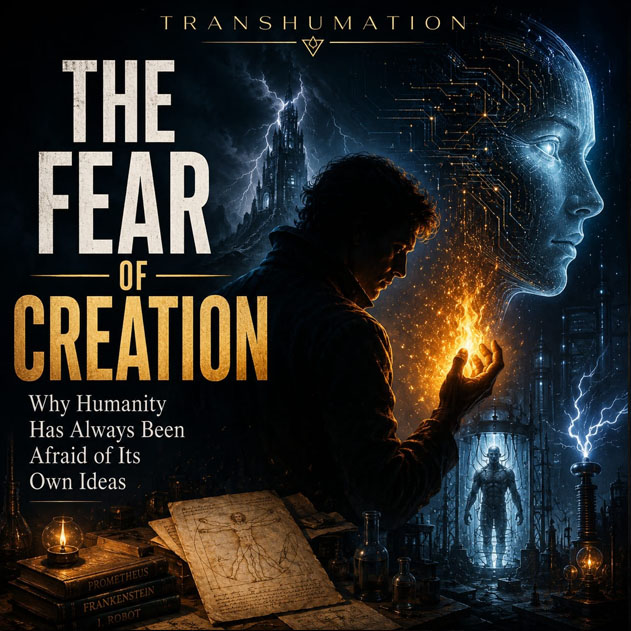
The Fear of Creation
Why Humanity Has Always Been Afraid of Its Own Ideas
For as long as civilization has existed, humanity has feared its greatest creations. Every major breakthrough has been accompanied by the same question: Have we gone too far? Whether it was fire, writing, printing, electricity, or artificial intelligence, every new technology first inspired fear before becoming part of everyday life.
Perhaps the real story of civilization is not the history of invention. Perhaps it is the history of learning to live with what we create.
Frankenstein Was Never About the Monster
Mary Shelley’s Frankenstein is often remembered as a horror story about a monster brought to life.
But the novel asks a much deeper question.
What happens when humans become creators?
The monster itself is not born evil. Fear begins when Victor Frankenstein abandons his own creation. The tragedy is not that something new was created, but that humanity was unprepared to take responsibility for it.
The story has remained relevant because every generation creates its own „Frankenstein.”
Prometheus and the First Forbidden Technology
Long before Frankenstein, Greek mythology told a similar story.
Prometheus stole fire from the gods and gave it to humanity. Fire represented far more than warmth. It symbolized knowledge, technology, and civilization itself.
For this act, Prometheus was punished.
Since then, the same pattern has repeated throughout history. Every powerful new discovery appears to cross an invisible boundary, and every generation wonders whether some forms of knowledge should remain forbidden.
Why New Ideas Feel Dangerous
The fear of creation rarely comes from creation itself.
It comes from uncertainty.
Every new invention changes the balance of power. It creates possibilities that did not exist before. It forces society to adapt, and adaptation has never been comfortable.
Humans naturally fear what they cannot fully predict. We often mistake uncertainty for danger.
Artificial Intelligence Is the New Prometheus
Today, artificial intelligence occupies the same symbolic place that fire once did.
Some people see opportunity. Others see catastrophe.
The debate sounds remarkably familiar.
People ask whether AI will replace humanity, escape human control, or fundamentally change civilization. Similar fears surrounded printing, industrial machines, electricity, and even the internet.
Technology changes.
The questions remain the same.
Creation Is Never the Final Problem
History suggests that inventions themselves are rarely the greatest danger.
The greater challenge is how people decide to use them.
Fire can destroy cities or cook food.
Electricity can power hospitals or weapons.
Artificial intelligence can expand human knowledge or amplify human mistakes.
Technology reflects the civilization that creates it.
A Different Way to See Progress
Perhaps humanity has misunderstood creation for thousands of years.
Progress is not the opposite of responsibility. The two must grow together.
Every discovery expands human freedom, but it also expands human responsibility. The more powerful our creations become, the more important our choices become.
The End of the Fear
Maybe the greatest illusion is believing that creation itself is the enemy.
Without creation there would be no civilization, no science, no art, and no future.
The real question has never been whether humans should create.
The real question is whether we are willing to become wise enough to care for what we create.

FAQ
Why does humanity fear new technologies?
Because new technologies introduce uncertainty and challenge existing ways of thinking and living.
What is the main message of Frankenstein?
The novel is less about creating life and more about the responsibility that comes with creation.
Why is Prometheus important in this discussion?
Prometheus symbolizes the moment humanity received knowledge and technology, showing that progress has always involved risk.
How does artificial intelligence fit this pattern?
AI represents the latest stage in humanity’s long history of creating powerful new tools that inspire both hope and fear.
Is technology inherently dangerous?
History suggests that technology itself is neutral. Its impact depends on how people choose to use it.
What is the central idea of this article?
The greatest danger is not creation itself, but our fear of it and our willingness—or unwillingness—to take responsibility for what we create.
Continue the Transhumation Series
Explore the full journey:
- End of Reality — Where Do You Really Exist?
- End of Physics — Are the Laws of Reality Real?
- End of the Real World — Reality Is No Longer Required
- End of Consciousness — Beyond the Human Mind
- End of Death — When Human Limits Disappear
- End of Religion — When Technology Replaces Faith