
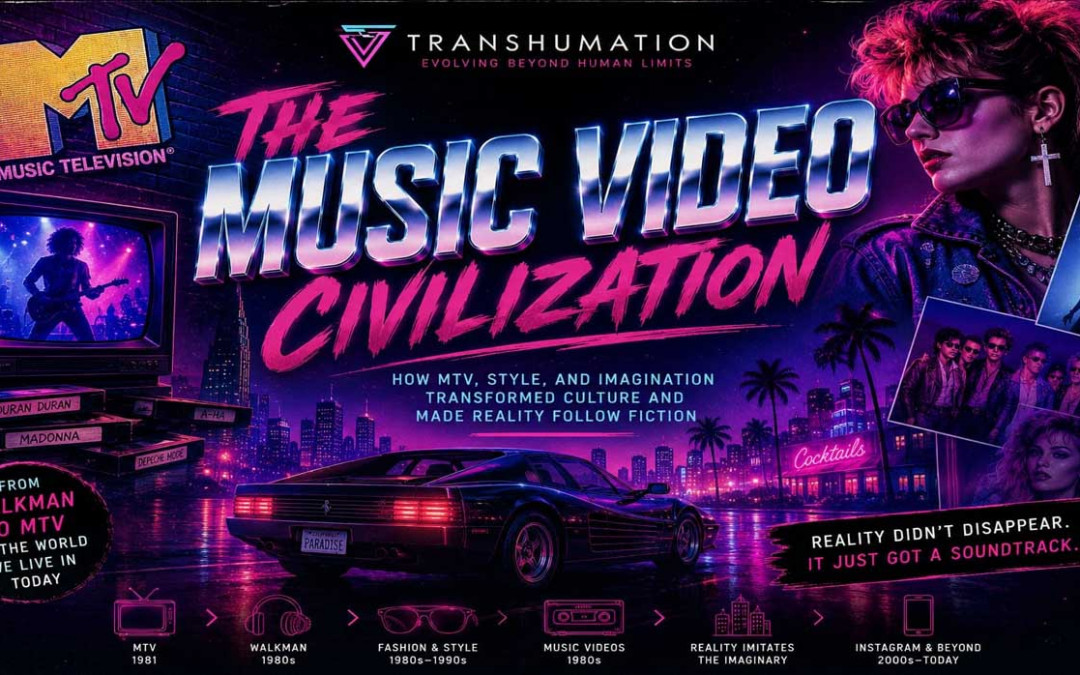
Please Don`t Stop the Music
When Reality Learned to Look Like Its Own Representation
Imagine a nightclub in 1987 that looks as though it came from a music video.
Now reverse the sentence.
Imagine a music video in 1987 that looks as though it came from a nightclub.
The distinction seems trivial until you try to decide which image came first.
The video borrows the club’s lighting. The club owner has already borrowed the lighting from fashion photography. Fashion photography has borrowed poses from cinema. Cinema has absorbed music, street style and advertising. The audience watches the video, copies the clothes, changes the nightlife, and six months later another director photographs the altered nightlife as the next new aesthetic.
The loop closes.
Then accelerates.
This is one of the defining features of late-twentieth-century visual culture. Images no longer merely represent the world, if they ever did. They become prototypes for environments that people subsequently build, inhabit and photograph again.
The important change is therefore not that fiction suddenly conquered reality.
Human culture had always done that.
Kings dressed according to images of kings. Cities imitated imagined ideals. Architecture embodied political stories. Religious paintings shaped posture, clothing and ritual. Cinema influenced hairstyles and courtship long before MTV existed.
What changed was the speed, density and portability of the feedback.
A three-minute music video could package clothing, gesture, eroticism, architecture, movement, lighting, aspiration and identity into something immediately repeatable.
The song acquired a world.
Then people began trying to live inside it.
When the Song Acquired Architecture
Before music video, recorded music was already capable of constructing imaginary environments.
A song could evoke a city, a bedroom, a battlefield or a future that did not exist. Album covers supplied images. Concerts supplied performance. Radio created celebrity without requiring physical presence.
Music video intensified the arrangement by giving the song a visual territory.
A listener no longer had only a voice and a melody.
There was a room.
A body.
A haircut.
A car.
A choreography.
A color temperature.
A way of walking into the room.
This seems obvious now because contemporary music culture is inseparable from visual identity. But the connection matters. Once sound and image were circulated together repeatedly through television, artists became not merely performers but inhabitable aesthetic systems.
The audience could borrow pieces.
Not necessarily the entire world.
Perhaps only the jacket.
The posture.
The haircut.
The lighting in a bedroom.
The fantasy of what a city at night was supposed to feel like.
The song ceased to be only something one listened to.
It became something one could partially become.
MTV Did Not Invent the Dream
It would be easy to turn the launch of MTV in 1981 into a neat civilizational date.
Before MTV: reality.
After MTV: image.
History does not behave that politely.
Hollywood had already created global fantasies of romance, wealth, masculinity, femininity and urban life. Advertising had long turned products into lifestyles. Fashion photography had transformed bodies into surfaces for aspiration. Television had already brought commercial imagery into domestic space.
Even cinema had never been simply a transparent window onto the world.
German Expressionism distorted it.
Musicals reorganized it.
Technicolor intensified it.
Surrealism attacked it.
Science fiction constructed alternatives to it.
What music video changed was not the existence of stylization.
It changed its compression and circulation.
The form did not need to explain why the room was blue, why the singer was standing in the desert, why dancers appeared in a warehouse or why a suburban street suddenly looked apocalyptic.
Narrative continuity could be abandoned in favor of atmosphere.
A video could move directly from image to image because the song supplied continuity.
This made music video extraordinarily efficient at carrying style.
Story could become optional.
Mood could become the architecture.
Three Minutes of Identity
The music video’s great invention may have been the compression of identity.
A feature film gives a character time to develop.
A novel may spend hundreds of pages explaining a world.
A music video can establish a personality in seconds.
Leather jacket.
White room.
Motorcycle.
Red light.
A particular movement of the shoulders.
The performer has already become legible.
This is not shallow merely because it is compressed.
Symbols work by compression.
The danger begins when compression is mistaken for completeness.
Music video trained audiences to read identity at extraordinary speed. Style became a dense packet of information. Fashion, movement and environment told the viewer what kind of person had entered the frame before the person said anything at all.
Contemporary digital culture has inherited this logic almost perfectly.
A profile picture.
A ten-second clip.
A bedroom in the background.
A pair of shoes.
A filter.
A song attached to a post.
A person can now present an entire implied biography through carefully selected fragments.
The music video did not invent personal branding.
But it helped normalize the idea that identity can be designed as an audiovisual surface.
The Walkman Gave the Image an Interior
The Walkman belongs to the same transformation, but in a different position.
MTV supplied public imagery.
Portable audio supplied private atmosphere.
A person could watch an artist inhabit an intensified world on television, then put on headphones and carry the emotional residue of that world into ordinary public space.
This is where the two technologies become interesting together.
The video tells you what the song might look like.
The headphones allow the song to reorganize what your own life feels like.
The external city remains ordinary.
The internal montage begins.
A wet street becomes cinematic.
A subway journey acquires tension.
A suburban afternoon develops melancholy.
The listener is not actually entering the music video.
But the logic has moved inward.
The self becomes partly director and partly audience.
Reality does not need to change physically for its emotional interpretation to be redesigned.
That was already the argument of the Walkman.
Music video civilization adds another layer:
eventually people begin redesigning the physical world so that it resembles the emotional representation.
When the Apartment Wants to Be Photographed
Consider how contemporary interiors are increasingly encountered.
A restaurant may be designed not only for eating but for appearing in photographs.
A hotel lobby may be lit partly according to how its surfaces behave on a phone screen.
A retail space may contain one wall whose practical function is negligible but whose photographic function is obvious.
A home can be arranged according to an aesthetic discovered through images produced by other homes already arranged according to earlier images.
At some point, representation begins participating in design before the physical object exists.
This is more significant than the claim that “Instagram made everything fake.”
The objects remain real.
The meal is real.
The room is real.
The building has weight.
But the anticipated image of the object becomes one of the forces shaping the object itself.
A room can now be designed partly for its future representation.
Reality acquires a rehearsal.
That is one of the central features of Music Video Civilization.
We increasingly build things while imagining how they will appear through an interface.
The Feedback Loop Has No Original
The question “Does media shape people or do people shape media?” begins to fail because it assumes a clean direction of causation.
Culture rarely supplies one.
A subculture creates a style.
A photographer notices it.
A magazine packages it.
A musician adopts it.
A corporation markets it.
Millions of people encounter the commercial version.
Some imitate it.
Others reject it.
The next subculture develops partly in opposition to the commercial copy.
A new photographer documents that reaction.
The cycle begins again.
Nothing here is purely organic.
Nothing is purely manufactured.
The media image is both output and input.
This explains why arguments about authenticity become so difficult.
People often imagine that somewhere behind commercial culture there must be a pure original version.
Sometimes there is a specific source.
Often there is a genealogy.
But once feedback becomes sufficiently dense, the distinction between original and copy starts behaving less like a straight line and more like an ecosystem.
The image changes life.
Life changes the image.
The changed image changes life again.
Culture becomes recursive.
The Plato Problem
Plato enters this story only if we are careful.
He did not argue that a teenager first visualizes a lifestyle and therefore reality obediently manufactures it.
Nor does the existence of media-generated aesthetics prove the theory of Forms.
But modern civilization has made one ancient philosophical relationship strangely tangible.
Increasingly, the model can precede the object.
An architect builds digitally before concrete is poured.
A fashion designer constructs an imagined silhouette before the garment exists.
A film production creates a world that later influences architecture, fashion or consumer design.
A brand constructs an ideal user before products are marketed toward people invited to resemble that ideal.
The pattern moves from model to instance.
Then the instance produces new models.
This is not Platonic metaphysics.
It is a technological and cultural feedback system.
But it does make the distinction between form and manifestation feel less abstract.
A lifestyle can exist first as an organized image.
Then people purchase the furniture.
Adopt the clothing.
Visit the places.
Change the body.
Alter the room.
Construct the physical approximation.
The image does not merely document desire.
It helps give desire its shape.
When Representation Becomes Instruction
This is the crucial transition.
An image can describe.
An image can also instruct.
The difference is not always explicit.
An advertisement rarely needs to say, “Please reorganize your life around this room.” It can simply present the room as an image of completion.
A fitness video need not issue a philosophical argument about the ideal body. It shows one.
A luxury campaign does not have to define success in language. It builds a visual grammar from cars, architecture, watches, posture and absence of visible effort.
The viewer learns the structure before consciously analyzing it.
This gives images enormous cultural power.
They can function as compressed models of desirable reality.
The more technically reproducible they become, the more widely those models circulate.
Music video was particularly effective because it joined the model to emotion.
A room is not merely shown.
It arrives with music.
A car does not simply move.
It moves with rhythm.
A face is not simply beautiful.
It appears at the emotional climax of the song.
The visual object becomes attached to feeling.
That association can survive after the video ends.
The Self Becomes a Production
Eventually the same machinery turns inward.
The modern individual increasingly possesses tools once reserved for media industries.
Camera.
Editing.
Music.
Typography.
Distribution.
Audience analytics.
Filters.
Synthetic imagery.
Now artificial intelligence.
A person no longer merely consumes representations of identity.
The person produces them.
This does not mean everyday life has become fake.
Human beings have always presented themselves socially through clothing, manners, titles, stories and selective disclosure.
What changes is the sophistication of the production apparatus.
A personal life can now possess something resembling art direction.
The holiday acquires a visual theme.
The meal becomes content.
The exercise routine becomes narrative.
The relationship develops a public iconography.
Even private grief can acquire an aesthetic surface.
The individual becomes simultaneously person, editor, archive and broadcaster.
That is why Music Video Civilization is not really about MTV.
MTV is an early visible expression of a much larger transition.
Life becomes increasingly conscious of its own representation while it is being lived.
The Image Begins Designing the Body
There is a darker side to the loop.
Once images become standards rather than representations, physical bodies may begin adapting to the image.
Cosmetic procedures.
Fitness regimes.
Fashion.
Makeup.
Dental aesthetics.
Filters that alter expectations of skin and facial proportion.
These phenomena have different histories and motivations, and it would be absurd to blame all of them on music television or social media.
But together they reveal the same structural possibility.
A representation can become normative enough that the carrier attempts to conform to the model.
This reverses the traditional assumption about portraiture.
Once, the image was expected to resemble the person.
Increasingly, the person may try to resemble the image.
That is a profound reversal.
And artificial images may intensify it because the model no longer even needs to be constrained by a physical original.
The standard can be generated first.
Reality receives the assignment afterward.
The Music Video Civilization
This is why the phrase should not mean that modern civilization has become superficial, theatrical or unreal.
It means something more precise.
We increasingly inhabit environments shaped by recursive representation.
The world produces images.
Images reorganize desire.
Desire reorganizes the world.
The changed world produces new images.
The loop continues.
At first the process operated through magazines, cinema, television and advertising.
Then digital platforms accelerated it.
Recommendation algorithms personalized it.
AI may eventually begin generating not merely individual images but adaptive aesthetic environments around each user.
The music video becomes civilization not because everyone starts dancing under neon lights.
It becomes civilization when the logic of the music video escapes the screen.
Mood organizes space.
Identity becomes editable.
Representation becomes instruction.
The image anticipates the object.
And the object is built partly so that it can return successfully to the image.
Watch The Video
How to Read the World
Current Knowledge
Music videos existed before MTV, and the relationship among music, fashion, cinema, performance and advertising developed over many decades. MTV’s launch in 1981 nevertheless helped create a highly visible mass platform in which music and visual identity became tightly integrated, particularly within youth culture.
Cinema before the music-video era was never simply devoted to realistic representation. Experimental film, musicals, expressionism, fantasy, advertising and other visual traditions had long used stylization and deliberate distortion. Music video’s distinctive contribution lay partly in its compressed duration and freedom from ordinary narrative continuity.
Media influence and social behavior operate through reciprocal processes rather than simple one-way causation. Artists borrow from existing cultures, audiences adopt elements of media imagery, industries commercialize those adaptations, and subsequent creators respond to the changed environment.
Portable audio technologies such as the Walkman helped normalize individualized listening in public space, while television supplied shared visual imagery. Later digital technologies combined both processes with personal production and global distribution.
Contemporary social media has further reduced the distinction between media producer and audience. Individuals can now construct and distribute curated visual identities using tools once available primarily to professional industries.
Open Questions
One important question concerns the strength of media influence. When people adopt a style encountered in media, are they being shaped by the image, recognizing an existing desire or participating in a more complicated feedback process? In most cases, separating those influences cleanly is difficult.
Another problem concerns authenticity. If a subculture influences media and later members of that subculture begin imitating the commercial representation of themselves, is the later version less authentic, or has authenticity itself become part of the feedback loop?
Artificially generated imagery raises a more radical question. Until recently, visual ideals generally remained constrained at some point by photographed bodies, constructed sets or physically manufactured objects. Generative systems can produce convincing models without requiring any original physical instance. What happens when people begin adapting themselves and their environments to images of things that never existed?
There is also a social question. If algorithmic systems increasingly supply different aesthetic worlds to different people, can a shared visual culture survive, or will Music Video Civilization fragment into millions of personalized cultural environments?
Transhumation Interpretation
Music Video Civilization matters to Transhumation because it provides a clear example of the relationship between model, interface and world becoming circular.
The ordinary model seems simple.
Reality exists.
Someone represents it.
The representation travels.
But modern media increasingly add another step.
The representation returns.
It changes behavior.
Behavior changes physical environments.
Those environments become the material for another representation.
The map begins altering the territory it was supposed to describe.
This is not proof that physical reality has become secondary to information.
The nightclub still requires walls, electricity and bodies.
The clothes still require material.
The modified body remains biological.
The physical world retains the ability to contradict every image built upon it.
But information increasingly participates in determining which physical arrangements people attempt to produce.
This gives the image causal power without making it magically independent of matter.
That distinction belongs at the center of Transhumation.
A pattern can migrate through carriers.
An aesthetic begins in a drawing.
Moves into clothing.
Enters a photograph.
Appears in a video.
Changes a room.
Returns to another image.
At every stage the carrier changes.
The structure is neither perfectly preserved nor completely lost.
This is cultural re-instantiation.
But the Music Video Civilization also exposes a danger in the idea of carrier-independent patterns.
Patterns do not merely survive.
They can acquire authority.
Once an image becomes a sufficiently powerful model, people can begin treating correspondence with the model as evidence of success.
The representation stops being descriptive.
It becomes normative.
This is where the interface can quietly become the world.
A luxury advertisement does not merely show a lifestyle.
It can become part of the machinery through which a person learns to recognize luxury.
A social platform does not simply display attractiveness.
It can participate in defining what attractiveness is expected to look like.
A political image does not simply document authority.
It can manufacture the appearance through which authority becomes recognizable.
The model begins teaching the observer what counts as reality.
Artificial intelligence may push this much further.
For the first time, adaptive systems can potentially construct representations around the individual rather than merely distribute the same representation to millions of viewers.
The twentieth-century music video said:
Here is the world of this song.
The twenty-first-century system may increasingly say:
Here is the version of the world calculated for you.
That is a different degree of power.
The old media object was visible.
You knew when MTV was on.
You knew when the magazine was open.
You knew when the film began.
An adaptive interface can become continuous.
Music.
Recommendations.
Navigation.
Commerce.
Social interpretation.
News.
Generated images.
Eventually perhaps augmented perception.
The representation no longer waits on a screen.
It accompanies the observer.
And if it becomes sufficiently seamless, the central Transhumation question changes.
We no longer ask only whether reality is being represented accurately.
We ask who selected the representation through which reality became intelligible in the first place.
This is why Music Video Civilization is not a nostalgic article about MTV.
MTV is simply the elegant historical doorway.
The larger subject is civilization learning to live recursively between world and image.
We build an environment.
We photograph it.
The image changes desire.
Desire redesigns the environment.
The new environment produces another image.
Soon there is no meaningful first frame.
The future danger is not that reality disappears.
The danger is subtler.
We may increasingly inhabit physical reality according to models whose origins we can no longer see.
And perhaps that is the final evolution of the music video.
Not a civilization living inside fiction.
A civilization continuously rebuilding itself according to its own reflection.
FAQ
What is “Music Video Civilization”?
It is a metaphor for a culture in which media images do not merely represent reality but participate in shaping the environments, identities and behaviors that later become reality.
Did MTV create this process?
No. Art, cinema, advertising, fashion and literature had influenced behavior long before MTV. MTV accelerated and concentrated a particular audiovisual version of the feedback loop.
Why were music videos especially influential?
They could compress music, fashion, movement, color, personality and aspiration into a few minutes, giving audiences a highly portable model of identity and atmosphere.
Did reality literally start copying music videos?
Sometimes particular styles moved directly between media and everyday culture, but the larger process is reciprocal. Media borrow from society while society simultaneously borrows from media.
What does Plato have to do with it?
Not because Plato predicted modern media. The useful comparison is that modern civilization increasingly works through models that precede particular objects and environments. A representation can become a template for something later made physical.
What is the deeper Transhumation question?
If representation increasingly helps design reality, then the important question is no longer only whether an image is true.
It is what happens when the image becomes the model that reality is expected to obey.
Continue the Transhumation Series
- Forgotten Religion | Ancient Gods, Symbols and the Hidden Structures of Human Civilization
- The Last Religion | Death, Immortality and the Future of Humanity
- The New Theurgy | AI, Information and the Future of Human Civilization
- End of Branding: You Were Never Meant to Become a Product
- Baal vs Ishtar: Why Ancient Gods Never Disappeared