
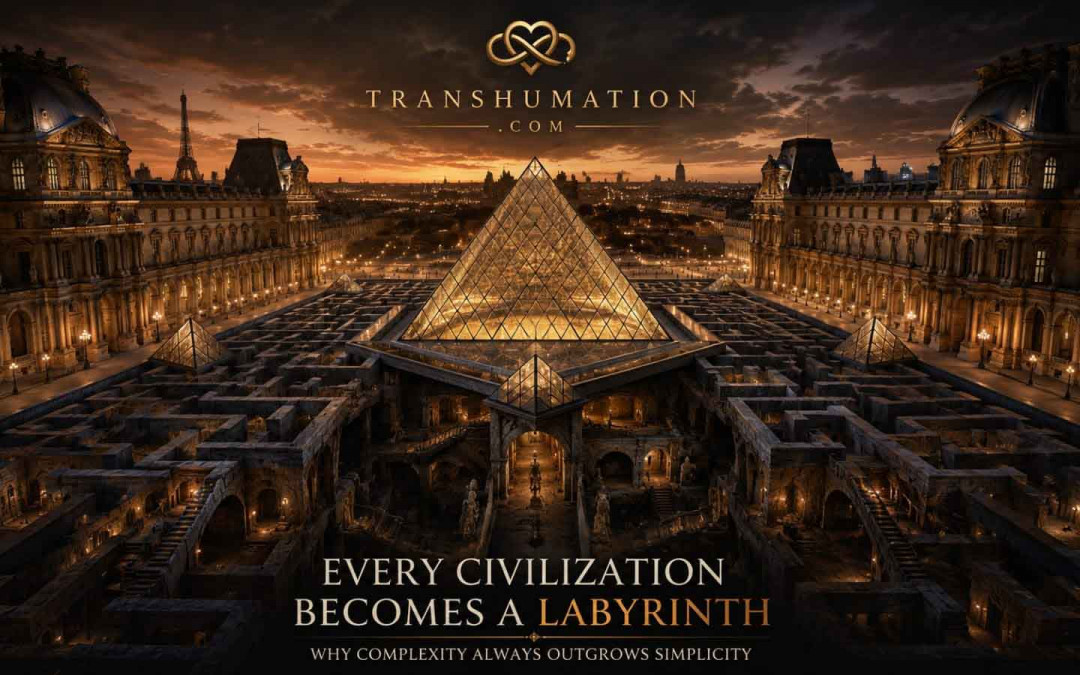
Every civilization begins with simplicity.
A village needs few rules.
A kingdom needs more.
An empire needs thousands.
Success creates complexity.
And complexity creates a labyrinth.
The irony is that civilizations rarely collapse because they stop growing.
They collapse because they become too difficult to understand.
The Price of Success
Imagine building a house.
One room.
Then another.
Then another.
Each new room solves a problem.
Years later, the house has become a mansion.
Beautiful.
Historic.
Almost impossible to navigate.
Civilizations grow the same way.
Every generation adds another law.
Another institution.
Another tradition.
Another bureaucracy.
Nothing is removed.
Everything is preserved.
Until nobody understands the whole structure anymore.
Rome Never Stopped Building
The Roman Empire was never finished.
Every emperor added something.
New roads.
New provinces.
New taxes.
New offices.
New reforms.
The empire became stronger.
It also became more complicated.
Managing Rome eventually became as difficult as conquering it.
Complexity became Rome's invisible enemy.
The Louvre Was Not Unique
The Louvre is only one example.
Universities become labyrinths.
Governments become labyrinths.
Corporations become labyrinths.
Computer software becomes labyrinths.
Even families accumulate traditions, expectations, and unspoken rules over generations.
Growth is natural.
Navigation is not.
The Digital Empire
The Internet promised simplicity.
Instead, it created billions of pages.
Infinite information.
Endless choices.
Finding knowledge became harder than producing it.
Search engines appeared.
Then recommendation algorithms.
Now artificial intelligence.
Each new layer exists for the same reason.
Not to create more information.
But to help us survive the information we already created.
Every Labyrinth Needs an Ariadne
Greek mythology understood this long ago.
The Minotaur was dangerous.
But the labyrinth was the greater problem.
Without Ariadne's thread, even victory meant nothing.
Perhaps every civilization eventually needs its own thread.
A map.
A guide.
A librarian.
An interface.
Something that allows ordinary people to move through extraordinary complexity.
The Hidden Pattern
Civilizations do not evolve in a straight line.
They oscillate.
Expansion.
Simplification.
Expansion.
Simplification.
Every period of growth eventually demands a new interface.
The printing press.
The index.
The encyclopedia.
The search engine.
Artificial intelligence.
Each one appears when complexity exceeds human memory.
The Future of Civilization
The future may not belong to the civilization with the largest libraries.
Or the fastest computers.
Or the tallest buildings.
It may belong to the civilization that builds the best interfaces.
Because information without navigation becomes noise.
Knowledge without access becomes archaeology.
Power without simplicity becomes paralysis.
Perhaps this is the oldest lesson in history.
Every civilization eventually becomes a labyrinth.
The greatest civilizations are not those that stop building.
They are the ones that remember to leave a way out.
Want to Explore More ?
Watch The Video Below
Continue reading
You Can`t Fight Three Forces
FAQ
What does "Every Civilization Becomes a Labyrinth" mean?
It describes the tendency of successful civilizations to become increasingly complex until they require new ways of navigating their own systems.
Why do civilizations become more complicated?
Each generation adds new institutions, technologies, laws, and traditions. Over time these layers create systems that few people fully understand.
Why is the Louvre used as an example?
The Louvre grew over centuries into a magnificent but confusing structure. The glass pyramid simplified access without replacing the original building, making it a perfect metaphor for modern interfaces.
How does this relate to Rome?
The Roman Empire expanded continuously, creating administrative complexity that eventually became one of its greatest challenges.
What is the connection to Greek mythology?
The Labyrinth represents complexity, while Ariadne's thread symbolizes an interface—a simple guide through a complicated system.
Why are search engines and AI part of the same story?
Both emerged because humanity produced more information than individuals could easily navigate. They function as interfaces rather than replacements for knowledge.
What is the central idea of the article?
The greatest challenge of advanced civilizations is not creating complexity but making complexity understandable.
How does this connect to The New Theurgy?
The New Theurgy explores recurring structures across civilizations. The labyrinth is one of those universal patterns, and the interface is humanity's recurring solution.
How does this connect to Transhumation?
Transhumation argues that civilization increasingly evolves through better interfaces that organize knowledge, reduce complexity, and allow humanity to continue building without becoming trapped by its own success.

The Core Questions of Transhumation
Explore the full journey:
- End of Reality — Where Do You Really Exist?
- End of Physics — Are the Laws of Reality Real?
- End of the Real World — Reality Is No Longer Required
- End of Consciousness — Beyond the Human Mind
- End of Death — When Human Limits Disappear
- End of Religion — When Technology Replaces Faith