
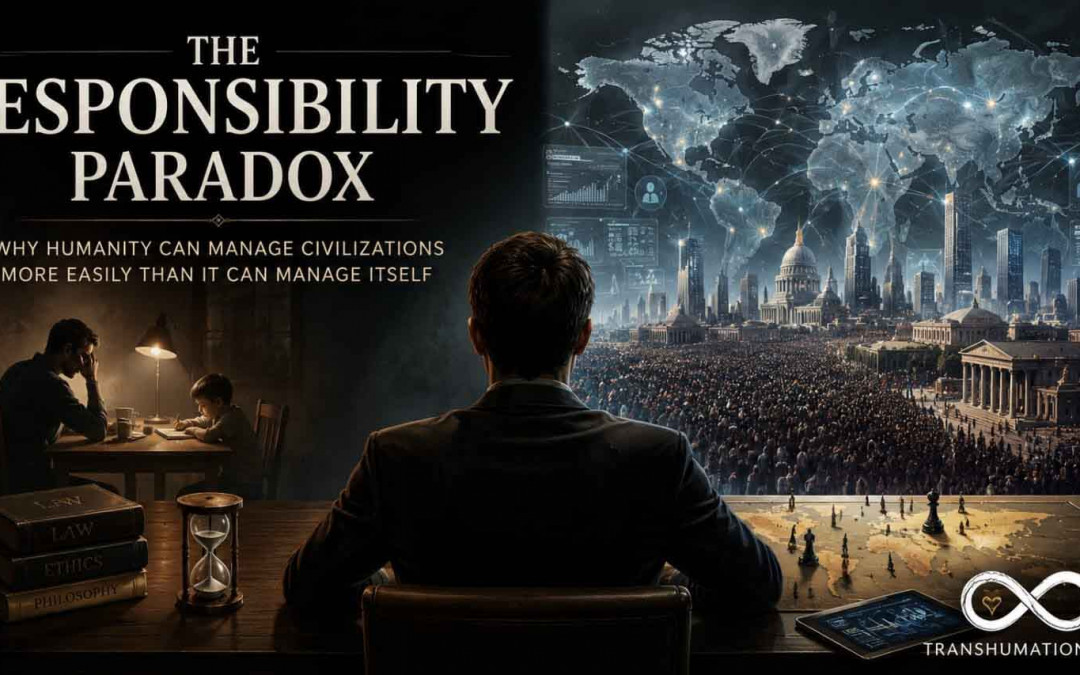
The Responsibility Paradox
A parent sits at a kitchen table trying to decide whether to tell a child something painful. The decision concerns one person, perhaps two, and yet it can occupy an entire night. Every possible consequence has a face. The parent imagines the disappointment, the silence at breakfast, the sentence that cannot be taken back. Somewhere else, on the same evening, a committee changes a policy that will affect several million people. A software team alters the ranking system of a platform used across continents. An executive approves a restructuring that will remove thousands of jobs. The numbers are incomparably larger, but the emotional experience of responsibility may be strangely smaller. The decision arrives through documents, dashboards, forecasts and percentages. Nobody can picture a million faces at once.
That may be the real Responsibility Paradox. Human beings are capable of constructing institutions whose decisions operate on scales far beyond the emotional equipment through which individual responsibility originally evolved. We can care intensely about one person in front of us while participating quite calmly in systems whose consequences are distributed among strangers we will never meet. The larger the machinery becomes, the easier it is for responsibility to dissolve into process: the policy required it, the market demanded it, the algorithm recommended it, the regulations permitted it, the committee approved it.
Nothing supernatural has happened. Responsibility has not vanished.
Visibility has.
And civilization has become exceptionally good at building rooms in which enormous consequences can occur without any single person feeling their full weight.
The Face and the Number
Personal responsibility is difficult partly because it resists abstraction. When someone we know is affected by our decision, there is little distance between action and consequence. We hear the reaction, remember the history, anticipate the future encounter. Even an objectively minor decision can feel enormous because the emotional circuit is complete.
Large institutions operate differently. They need abstraction simply to function. A minister cannot individually know every citizen affected by a tax policy. A hospital administrator cannot personally experience every patient outcome. An engineer maintaining a system used by hundreds of millions of people cannot inspect every consequence of every design choice. Civilization could not operate at scale if every decision required intimate emotional contact with everyone affected by it.
Abstraction is therefore not a moral defect.
It is infrastructure.
The problem begins when the abstraction necessary for coordination also becomes insulation from consequence. A human being becomes “a user.” A neighborhood becomes “a market.” A dismissed employee becomes a reduction in headcount. A civilian becomes collateral damage. A harmful interaction becomes a statistical anomaly below an acceptable threshold.
The language may be technically necessary and still alter moral perception.
This is one reason a decision affecting one identifiable person can sometimes feel heavier than a policy affecting thousands. The difference is not necessarily that the policymaker cares less. The human mind simply encounters one case as a relationship and the other as a model.
Civilization increasingly governs through models.
Rome Did Not Solve Responsibility
Rome offers a useful historical example precisely because it never solved the problem cleanly.
The Roman Republic distributed political authority among magistracies, assemblies, the Senate, religious offices and legal traditions, while actual access to influence remained heavily shaped by status, wealth, family and patronage. The imperial system later concentrated extraordinary authority in the emperor while preserving many republican forms and administrative institutions beneath him.
Neither arrangement created a simple location called responsibility.
An emperor could claim responsibility for order while delegating violence to governors, generals and officials. A provincial administrator could defend an action as obedience to imperial policy. Senators could possess status without possessing decisive power. Soldiers could carry out decisions made far away from the place where their consequences became visible.
The Roman lesson is therefore not that antiquity understood responsibility better.
It is that large systems have always created a gap between authority, action and consequence.
Someone authorizes.
Someone administers.
Someone executes.
Someone experiences the result.
Sometimes these are the same person.
Increasingly, they are not.
The larger a civilization becomes, the more sophisticated its mechanisms for separating those roles must become. This makes administration possible. It also makes moral responsibility harder to locate.

The Rise of the Administrator
Modern civilization has elevated a figure far less theatrical than the king but potentially more important to everyday life: the administrator.
The administrator does not necessarily command loyalty, wear ceremonial clothing or claim divine legitimacy. The administrator controls permissions, protocols, classifications, access and continuity. Most people do not encounter this authority as a command to obey. They encounter it as a condition of participation.
Your account has been suspended.
Your application has been rejected.
Your content has been deprioritized.
Your payment cannot be processed.
Your credentials have expired.
The gate does not announce itself as political power. It appears as procedure.
This is one of the great shifts from visible sovereignty toward infrastructural authority. A monarch could say, “I forbid you.” A modern system is more likely to say, “You are not eligible.”
The difference is not cosmetic.
Traditional authority often required a recognizable ruler. Administrative authority can be embedded in forms, databases, scoring systems, software permissions and institutional routines. It may derive partly from competence and function rather than birth or sacred status, but it is not necessarily voluntary. Citizens cannot simply opt out of every administrative system that governs taxation, identity, banking, healthcare or law, and even commercial platforms can become difficult to avoid once participation in them becomes socially or economically important.
The administrator therefore presents a peculiar moral problem.
Power becomes easier to exercise precisely because it looks less like power.
When the Spotlight Becomes a Dashboard
Technology magnifies this structure dramatically.
A nineteenth-century newspaper editor could influence thousands of readers. A modern recommendation system can alter what hundreds of millions of people encounter without anyone composing a direct message to those people. A small modification in ranking, notification timing or interface design can shift attention across populations at a scale that earlier rulers could barely imagine.
Yet the person making the change may experience it primarily as an experiment.
Click-through rate rises by 1.7 percent.
Retention improves.
False positives decline.
Revenue increases.
The dashboard is not lying. Those are real measurements. The difficulty is that the dashboard is an interface, and every interface reveals some consequences while concealing others.
A statistic can show increased engagement without showing a marriage damaged by compulsive use. A credit model can improve overall predictive accuracy while producing serious errors for individuals. An optimization system can reduce average waiting time while creating a small group of people who are consistently disadvantaged.
This does not mean algorithms are uniquely immoral.
It means scale produces moral blind spots.
The spotlight becomes brighter while the stage becomes too large to see.
AI Makes the Gap More Complicated
Artificial intelligence introduces a further layer because systems can now contribute to classifications, recommendations and decisions in ways that are neither simple human commands nor independent moral acts.
An AI system can recommend which applicant deserves further review, detect patterns associated with fraud, rank medical images, filter information, suggest sentences to a writer or decide which advertisement appears before a particular user. In more automated settings, its output can directly trigger downstream action.
It is tempting to describe this by saying that responsibility is now shared between humans and machines.
That formulation needs care.
Current AI systems can participate causally in decisions without obviously possessing moral responsibility in the way persons or institutions do. They do not become accountable merely because their output mattered. Responsibility remains distributed among those who design, deploy, purchase, regulate, monitor and rely upon the system, although precisely how it should be allocated remains a serious legal and ethical problem.
AI therefore does not remove human responsibility.
It can make the causal chain longer.
The developer did not make the individual decision. The manager did not write the model. The user did not design the training process. The organization relied on a vendor. The vendor relied on data collected elsewhere.
Everyone touched the system.
Nobody appears to own the whole consequence.
That is the modern form of the paradox.
The Comfortable Sentence: “The System Did It”
Complex institutions have always produced versions of this sentence.
The regulations required it.
Head office decided.
The computer rejected the application.
Those are sometimes accurate descriptions. No individual employee may possess the authority to reverse the outcome. Systems genuinely constrain the people operating inside them.
But the phrase can also perform a psychological trick. It converts a network of human decisions into an apparently natural event.
The system did not descend from the weather.
Someone designed part of it. Someone approved another part. Some rules emerged unintentionally from interactions among many actors. Other constraints accumulated historically until nobody currently working inside the institution could explain exactly why they existed.
This is why saying that “every system comes from one human decision” would also be too simple. Complex systems often produce outcomes nobody individually intended. Markets, bureaucracies, legal traditions and technological networks develop emergent behavior precisely because many local choices interact.
Responsibility therefore cannot always be traced backward to a single author.
But neither does emergence erase accountability.
The challenge is to locate responsibility in systems whose outcomes are real even when intention is fragmented.
Watch The Video
How to Read the World

Current Knowledge
Psychological research has repeatedly shown that human moral judgment and helping behavior can be affected by factors such as psychological distance, identifiable victims, group size and diffusion of responsibility. These effects are not absolute laws, and individuals vary enormously, but people often respond more strongly to vivid individual cases than to large statistical harms.
Modern organizations necessarily divide labor and decision-making across specialized roles. This allows institutions to operate at scales impossible for individuals, but it can also create principal-agent problems, information gaps and situations in which no participant has complete visibility over the consequences of the system.
Algorithmic systems and artificial intelligence increasingly participate in decision-making across commercial, administrative and professional contexts. Their outputs can influence human outcomes, but legal and ethical responsibility remains tied to human actors and institutions rather than being automatically transferred to the technology itself.
Historical political systems, including Rome, also distributed authority through complex institutional structures. It would therefore be misleading to describe the modern problem as entirely new. What technology changes is chiefly the speed, reach and opacity with which decisions can propagate.
Open Questions
The first unresolved question is how much responsibility a person can reasonably carry for consequences they could not individually predict. If a programmer contributes one component to a system used by millions, neither complete innocence nor complete responsibility seems adequate. We still lack a universally satisfying model for moral responsibility inside highly distributed technological organizations.
There is also the problem of interfaces. If decision-makers encounter people primarily as datasets, risk scores and aggregate statistics, can institutions design mechanisms that restore enough human context to prevent abstraction from becoming indifference without making large-scale administration impossible?
AI adds another difficulty. As systems become more autonomous in operation and more difficult for individual users to interpret, accountability may become increasingly separated from direct control. Can someone be fully responsible for an outcome they had authority to authorize but insufficient technical ability to understand?
Finally, there is an older philosophical question beneath all of these modern ones: is responsibility fundamentally a property of individuals, or can institutions themselves meaningfully bear responsibility? Law often treats corporations and states as accountable entities, but moral responsibility is more difficult because institutions do not experience guilt, remorse or conscience in the ordinary human sense.
Transhumation Interpretation
The Responsibility Paradox reveals something important about power: civilization has learned to amplify human agency faster than it has learned to amplify human perception of consequence.
A hunter could see much of the world affected by a single decision. A Roman governor could not. A modern platform engineer cannot. The radius of action has expanded far beyond the radius of empathy.
That does not mean ancient responsibility was purer or modern people are less moral.
It means technological civilization changes the geometry of action.
The New Theurgy is interested in interfaces, and responsibility may be one of the places where interfaces matter most. Every large system places an interface between the decision-maker and reality. The minister sees a briefing. The executive sees a projection. The engineer sees telemetry. The user sees a recommendation. Each interface compresses complexity enough to make action possible.
But compression has a moral cost.
What disappears from the interface can disappear from the decision.
This leads to a useful Transhumation principle: the more power an interface gives us, the more carefully we should ask what the interface prevents us from seeing.
AI makes this principle urgent because intelligence itself is becoming part of the interface. A system can interpret complexity before presenting it to us. It can tell us which applicant is risky, which story matters, which patient deserves attention, which route is efficient and which anomaly can be ignored.
The danger is not necessarily that the machine becomes the ruler.
The danger may be that the human ruler gradually encounters reality only through the machine.
At that point responsibility has not disappeared. It has become architecturally distant from consequence.
This also changes the old question of authority. The king was responsible partly because everyone could see where power was concentrated. Modern systems may be more distributed, more democratic and technically more competent while making the location of responsibility harder to identify.
Perhaps mature technological civilization will therefore require something more demanding than accountability after failure.
It will require the deliberate design of responsibility back into the interface.
Who will be affected?
Who cannot appeal?
Which consequence is invisible in this metric?
Who has authority to stop the process?
Which human being must finally say, “Yes, I approve this”?
Those questions sound administrative rather than spiritual. But perhaps that is exactly where the old question of conscience has migrated.
Responsibility did not leave civilization when priests and kings lost authority.
It entered the architecture.
And the more invisible that architecture becomes, the more important it is to remember that no system can absolve us merely by becoming complicated.
FAQ
What is the Responsibility Paradox?
It describes the strange situation in which individuals may feel enormous responsibility toward one visible person while participating in systems that affect millions with much less immediate emotional weight.
Why does large-scale responsibility sometimes feel easier?
Because large systems convert people and consequences into abstractions such as statistics, categories and procedures. This makes coordination possible but can also create psychological distance.
What is the Administrator Problem?
It is the problem of power exercised through rules, permissions and systems rather than obvious personal command. The administrator may influence access profoundly without resembling a traditional ruler.
Does AI become responsible for decisions it helps make?
Not automatically. AI can influence outcomes causally, but current systems are not generally treated as independent moral agents. Responsibility remains distributed among people and institutions that build, deploy and govern them.
Can responsibility really belong to a system?
Institutions can be held legally and politically accountable, but whether collective moral responsibility exists independently of individual responsibility remains philosophically contested.
What is the deeper Transhumation question?
Technology keeps extending the distance over which one decision can have consequences. The important challenge may therefore be not merely making systems more intelligent, but ensuring that intelligence does not make responsibility invisible.
A civilization becomes dangerous not only when nobody is responsible.
It may become equally dangerous when everyone is responsible for a small piece and therefore nobody can see the whole.
Continue the Transhumation Series
- Forgotten Religion | Ancient Gods, Symbols and the Hidden Structures of Human Civilization
- The Last Religion | Death, Immortality and the Future of Humanity
- The New Theurgy | AI, Information and the Future of Human Civilization
- End of Branding: You Were Never Meant to Become a Product
- Baal vs Ishtar: Why Ancient Gods Never Disappeared