
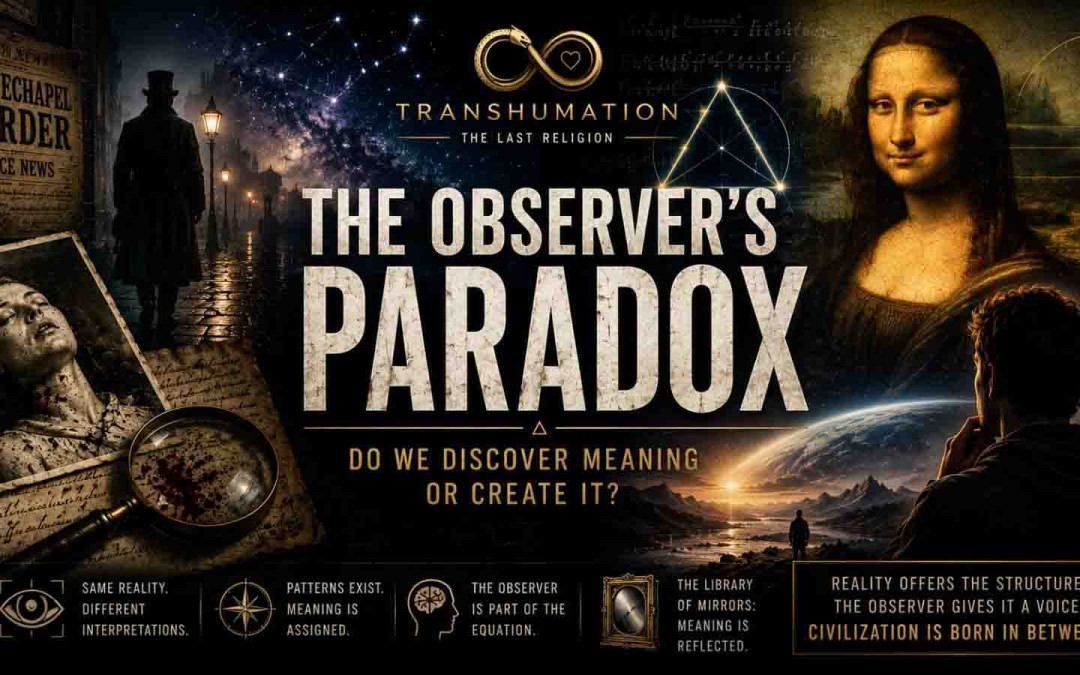
You Look But Do Not See
A child looking at a stain on the ceiling can find a face within seconds. Two dark patches become eyes, a crack becomes a mouth, and suddenly the plaster is looking back. Nothing physical has changed. The wall has not acquired a hidden portrait. Yet the experience is real enough that once the face appears, it becomes difficult not to see it.
Adults perform more sophisticated versions of the same operation.
We connect stars into constellations. We hear intention in music. We read character into a painted expression. We discover patterns in history, markets, mythology, crime scenes and mathematics. Sometimes the pattern is so objective that denying it would be absurd. Sometimes it is so culturally dependent that another civilization would have drawn a different picture entirely. Most interesting cases lie somewhere between those extremes.
This creates a problem more serious than the familiar question, What does this mean?
Before interpretation comes another question:
Where did the meaning come from?
Was it waiting inside the object?
Did the observer place it there?
Or does meaning appear only in the meeting between the two?
The Sky Never Changed
The night sky is a useful place to begin because it separates physical structure from cultural pattern with unusual clarity.
The stars existed long before anyone named them. Their positions can be measured. Their light has wavelengths. Their motion can be modelled. These are not matters of taste. But the lines connecting them into Orion, a dragon, a hunter, an ancestor or some other figure are not written across the sky.
Human beings supplied those.
Different cultures grouped stars differently because a constellation is not simply a thing found in nature. It is a relation selected by an observer. The underlying points are physical. The figure is interpretive.
That does not make the constellation meaningless.
For sailors, farmers and storytellers, constellations could organize time, direction, memory and mythology. A pattern partly created by observers could still perform real functions.
This is one of the first important distinctions.
A pattern does not need to be physically inscribed in nature in order to become culturally real.
But cultural reality should not be confused with physical necessity.
The sky offers both at once.
The Triangle That Refuses to Stay Only a Triangle
Geometry seems to promise escape from this ambiguity.
A triangle has three sides. Its internal angles behave according to formal rules. In Euclidean geometry, its properties can be demonstrated independently of whether anyone finds them beautiful, sacred or politically useful.
That part is structure.
Then meaning arrives.
An engineer may think of load distribution and rigidity. A theologian may see a Trinity. An occult tradition may treat the triangle as ascent, descent, balance or fire. A graphic designer may simply see an efficient shape. A philosopher may use it as an example of form independent of a particular drawing.
The geometry did not change.
The semantic field did.
This is important because it shows that objective structure and interpreted meaning do not cancel one another. A triangle can possess properties that are true regardless of the observer while also supporting meanings that depend heavily on culture and context.
The observer does not invent the three-sided structure.
The observer does help decide what the structure signifies.
Meaning can therefore be neither completely arbitrary nor completely contained in the object.
It can be constrained by reality without being determined by it.
Two People Under the Same Universe
Now enlarge the triangle until it becomes the cosmos.
One person looks at order, regularity, mathematical structure and the apparent intelligibility of nature and sees evidence of a Creator. Another sees the success of naturalistic explanation and concludes that physical processes are sufficient. A third suspends judgment because the evidence seems unable to settle the metaphysical question.
They are not standing under different skies.
They are interpreting the same reality through different assumptions about what kinds of conclusions the evidence permits.
This does not mean all interpretations are equally strong. Scientific claims can be tested against observation. Historical claims can be compared with evidence. Logical contradictions can be exposed. Interpretation is constrained.
But the observer still brings a framework.
A person trained in physics notices different regularities than a person trained in theology. A biologist notices structures a musician may not. A culture teaches its members which questions are worth asking before they ever encounter the object.
This is the Observer’s Paradox.
We need interpretation in order to understand the world.
But interpretation changes what becomes visible.
Jack the Ripper and the Dangerous Pattern
Few subjects demonstrate this danger better than Jack the Ripper.
The surviving material is finite: murders, locations, wounds, witness statements, police files, newspapers, disputed letters, graffiti, objects and chronology. Yet the number of possible interpretations has become enormous.
Some investigators see ritual.
Some see sexual pathology.
Some see medical knowledge.
Some see theatricality.
Some see no coherent hidden structure at all.
The evidence has not multiplied at the same rate as the theories.
This is exactly where pattern recognition becomes dangerous.
Human beings are extraordinarily good at detecting relations. That ability allows us to discover real structures, but it also produces false positives. Once a pattern becomes emotionally attractive, later evidence can be recruited into it rather than used to test it.
This is why the strongest method is not simply to notice a pattern.
It is to try to break it.
If removing one element destroys the structure, that matters.
If the same rule explains several independent choices, that matters more.
If ordinary explanations account for the evidence equally well, the exotic pattern loses force.
The observer participates in meaning.
The observer must therefore also police interpretation.
The Mona Lisa Does Not Contain One Viewer
The Mona Lisa provides the gentler version of the same problem.
Millions of people have stood before the painting. Some see mystery. Some technique. Some disappointment because the physical object is smaller than expected. Others are more interested in the crowd than the portrait.
The painting is stable enough to be measured and conserved.
The experience is not.
This is why saying that “no two people see the same painting” is metaphorically useful but literally too strong. They are looking at the same material object. Yet they do not encounter it from the same history, knowledge, expectation or emotional state.
The painting does not change.
The relation changes.
And sometimes the relation changes the work’s cultural meaning.
A painting can begin as a portrait and later become a symbol of genius, mystery, celebrity, theft, tourism and mass reproduction. None of those later meanings replaces the original object.
They accumulate around it.
The work becomes larger than the intentions of its creator because future observers keep adding interpretive layers.
The Library of Mirrors
A library makes this relationship easier to see.
A book can sit unopened for a hundred years and preserve information perfectly well. But meaning remains dormant until a reader encounters it.
The same sentence can produce different effects in different generations.
A political argument can become history.
A religious text can become literature for one reader and revelation for another.
A scientific book can become obsolete in factual content while remaining invaluable as evidence of how a civilization once thought.
The library therefore does not merely store answers.
It stores mirrors.
Each reader enters with a different set of questions and discovers different reflections.
This does not mean books contain no meaning before they are read. Authors choose words. Grammar constrains interpretation. Context matters. Some readings are clearly better supported than others.
But the final act of meaning requires an observer capable of connecting information to a world.
A library exists for readers, not for books.
Without readers, it is preservation.
With readers, it becomes civilization.
When the Observer Becomes the Experiment
The greatest illusion may be believing that observation is passive.
Every question filters the field.
Ask whether a historical figure was ambitious and you notice different evidence than if you ask whether he was afraid. Ask whether a technology liberates people and you notice different consequences than if you ask who controls it. Ask whether a myth is literally true and you may miss what function it performed.
The question is not neutral.
It selects.
This is why science developed methods designed to constrain observers: controls, replication, measurement, blinding, statistical analysis, falsification. These methods do not remove the observer entirely. They create procedures that make personal expectation less powerful.
The same discipline is useful outside laboratories.
Before asking what a pattern means, ask how many different patterns the same evidence could support.
Before accepting a coincidence, ask how many opportunities existed for coincidence.
Before interpreting a symbol, ask what is historically attested and what has been added later.
The observer cannot leave the experiment.
But the observer can become a better instrument.
Meaning as a Third Thing
We often frame the debate badly.
Either meaning exists objectively in the world, or humans invent it.
But perhaps meaning is more like music.
A score has structure before anyone performs it. The performer does not invent the notes, yet the music becomes an event only when structure passes through an interpreter.
Meaning may work similarly.
Reality supplies constraints.
The observer supplies context.
The encounter produces significance.
This would explain why meaning can be both stable and variable. A text can support a range of interpretations without supporting every interpretation. A symbol can change meaning across cultures while retaining physical form. A historical event can be reinterpreted without changing what actually happened.
Meaning is not pure discovery.
It is not pure invention.
It is relation.
Watch The Video
How to Read the World
Current Knowledge
Human perception is not a direct recording of reality. Cognitive science shows that attention, prior knowledge, expectation and context influence what people notice and how sensory information is interpreted.
Pattern recognition is fundamental to human cognition and can identify genuine regularities, but it can also produce false positives, especially when evidence is sparse or ambiguous. Scientific methods aim to reduce these errors through measurement, replication, controls and explicit testing of alternative explanations.
Constellations demonstrate the distinction between physical structure and cultural interpretation particularly clearly. Stars have objective positions and properties, while the figures drawn between them vary historically and culturally.
Geometric objects such as triangles have formal properties independent of symbolic interpretation, while religious, philosophical and cultural meanings attached to those forms vary between traditions.
Open Questions
How much meaning can exist independently of an observer? Mathematical structures appear to support strong claims of observer-independent truth, but symbolic meaning seems to require interpretation.
Can artificial intelligence become an observer in the relevant sense, or does it merely transform patterns according to learned structures without subjective experience? If AI begins identifying patterns humans consistently miss, how should we distinguish superior detection from sophisticated projection?
There is also a methodological problem. When several interpretations fit the same evidence, what standards should determine which one survives? Simplicity, predictive power, historical plausibility and falsifiability all help, but no single rule settles every domain.
Transhumation Interpretation
The Library of Mirrors is a central Transhumation model for the relationship between information and observers.
The structure is simple:
reality → pattern → observer → interpretation → meaning
But the sequence is not one-way.
Interpretation changes what the observer looks for next.
The next observation is therefore made by a changed observer.
This creates a loop.
A book changes the reader.
The changed reader returns to the book.
The same information can then reveal something previously invisible.
This is why Transhumation treats interpretation as a technology rather than merely an opinion. A better interpretive framework can reveal structure that was always present but inaccessible. A bad framework can create patterns that collapse under pressure.
The test is not whether interpretation exists.
It always does.
The test is whether the interpretation survives contact with evidence.
This is also why meaning cannot simply be reduced to intention. Leonardo may not have intended every meaning later viewers found in the Mona Lisa. Jack the Ripper may not have intended every pattern investigators see in the evidence. A triangle does not intend symbolism at all.
Yet interpretation can still transform the observer.
That transformation is real even when the creator’s intention is unknown.
Perhaps this is the deepest meaning of the Library of Mirrors.
Civilization does not merely preserve objects.
It preserves opportunities for future observers to become different by encountering them.
The world supplies structure.
The observer supplies a question.
Meaning appears in the meeting.
And then the observer leaves changed.
FAQ
What is the Observer’s Paradox?
It is the problem of distinguishing meaning that belongs to reality from meaning produced through human interpretation.
Do observers create all patterns?
No. Many patterns are objectively measurable. The difficulty lies in separating discovered structure from added interpretation.
Why are constellations useful examples?
The stars are physically real, but cultures connect them into different figures, showing how interpretation can organize the same underlying reality differently.
Why use a triangle?
A triangle has objective geometric properties while also carrying different symbolic meanings across science, religion and culture.
How does Jack the Ripper fit the argument?
The case demonstrates how limited evidence can support many competing interpretations and why patterns must be tested rather than merely noticed.
What is the Library of Mirrors?
It is the idea that preserved information becomes meaningful through encounters with observers, and those encounters can change the observer.
Does this mean meaning is subjective?
Not entirely. Interpretation can vary while still being constrained by evidence, structure and context.
Can AI interpret meaning?
AI can identify and generate complex patterns, but whether it possesses subjective experience or meaning in the human sense remains unresolved.
How does this connect to Transhumation?
Transhumation treats civilization as a system in which information survives through changing carriers and becomes active again when a new observer interprets it.
What is the central idea?
Meaning may be neither something we simply discover nor something we freely invent. It may emerge when the structure of reality meets the structure of an observer.
Continue the Transhumation Series
- Forgotten Religion | Ancient Gods, Symbols and the Hidden Structures of Human Civilization
- The Last Religion | Death, Immortality and the Future of Humanity
- The New Theurgy | AI, Information and the Future of Human Civilization
- End of Branding: You Were Never Meant to Become a Product
- Baal vs Ishtar: Why Ancient Gods Never Disappeared