
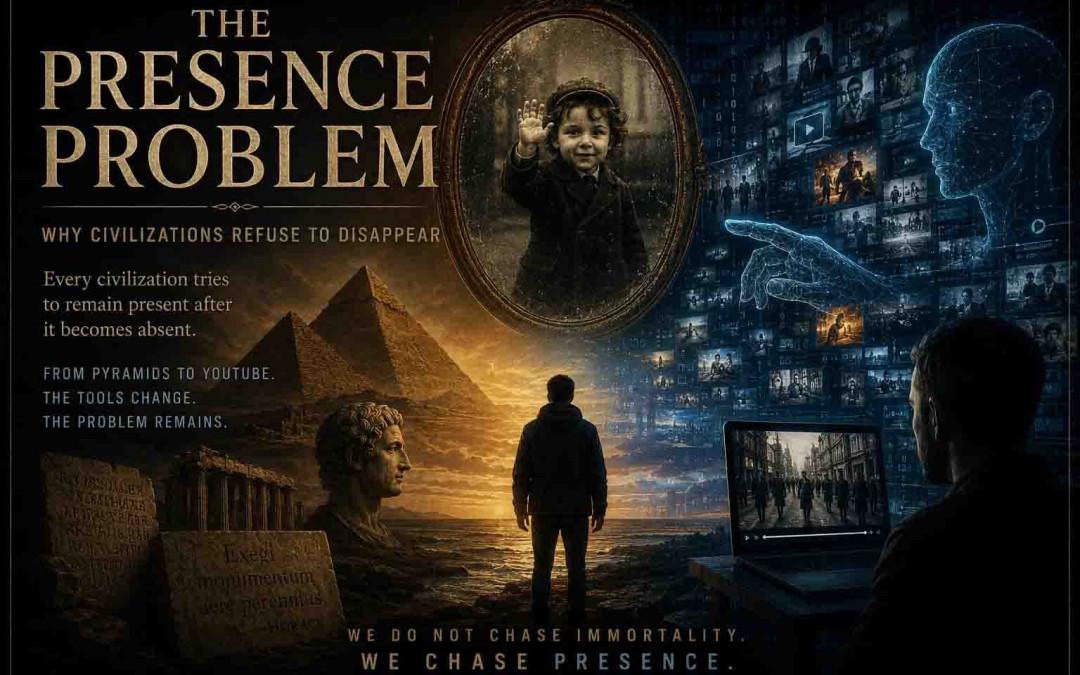
Imagine a city that no longer exists.
Its buildings have collapsed.
Its rulers are forgotten.
Its language has vanished.
Its people are dust.
And yet somehow it still speaks.
A poem survives.
A statue remains standing.
A fragment of writing is discovered.
A face appears in an old photograph.
A voice emerges from a century-old recording.
The civilization is gone.
Yet something remains present.
This may be one of the oldest problems in human history.
Not survival.
Not power.
Not wealth.
Presence.
The desire to remain present after becoming absent.
The Strange Goal of Civilization
When historians study civilizations, they often focus on what those civilizations achieved.
Wars.
Empires.
Economies.
Technology.
But beneath all of these lies a quieter ambition.
To be remembered.
The pyramids are not merely tombs.
The Roman roads are not merely infrastructure.
Ancient temples are not merely religious buildings.
They are messages.
Civilizations talking to people they will never meet.
Every monument is a conversation with the future.
Every archive is a refusal to disappear.
Every story is an act of resistance against time.
Horace Was Right
More than two thousand years ago, Horace wrote that he had created a monument more lasting than bronze.
At the time, this seemed impossible.
Bronze survives.
Stone survives.
Empires survive.
Poetry does not.
Or so people thought.
Today the empire that surrounded Horace is gone.
The institutions he knew have vanished.
The rituals that defined his world disappeared centuries ago.
Yet Horace remains.
His information survived the structures that created it.
This is the Presence Problem in its purest form.
The body disappears.
The information remains.
The Camera Changes Everything
For most of history, presence was symbolic.
A statue represented a ruler.
A painting represented a face.
A text represented a voice.
Then something changed.
The camera arrived.
For the first time in history, ordinary people could look directly into the future.
Most of them did not know it.
Children waved.
Workers smiled.
Families stared curiously into strange machines.
They thought they were looking at a camera.
In reality, they were looking at us.
A hundred years later we watch them.
They cannot hear us.
Yet they affect us.
Their expressions survive.
Their emotions survive.
Their humanity survives.
The conversation is incomplete.
But it exists.
The Internet Is a Presence Machine
The internet is often described as a communication network.
That is true.
But it may be something larger.
It is the most powerful presence machine humanity has ever built.
For thousands of years, people struggled to preserve fragments of themselves.
A name.
A story.
A portrait.
A monument.
Today billions of people leave traces every day.
Photos.
Videos.
Messages.
Ideas.
Memories.
Humanity is building the largest archive of presence ever created.
Not because someone planned it.
Because everyone participates.
Why AI Matters
Artificial intelligence introduces a new possibility.
Not merely preserving information.
Interacting with it.
The difference is profound.
A photograph preserves a moment.
A video preserves movement.
A book preserves thought.
AI begins to preserve patterns.
Ways of speaking.
Ways of reasoning.
Ways of responding.
Whether this eventually becomes something resembling continuity is still unknown.
But the direction is clear.
Technology increasingly attempts to preserve not only what people did.
But how they existed.
The Real Question
Most discussions about immortality ask the wrong question.
Can humans live forever?
The deeper question may be different.
Can presence survive absence?
Civilizations have been trying to answer this question for thousands of years.
The pyramids were one answer.
Poetry was another.
Photography was another.
Film was another.
The internet is another.
AI may become the next.
Different tools.
The same problem.
The Civilization of Presence
Perhaps this explains something surprising.
Why humans create art.
Why they write books.
Why they tell stories.
Why they build monuments.
Why they upload videos.
Why they preserve photographs.
Why they leave messages for people they will never meet.
Every civilization tries to remain present after it becomes absent.
From pyramids to YouTube.
From Horace to AI.
The tools change.
The problem remains.
And perhaps the history of humanity is simply the history of increasingly sophisticated attempts to answer it.
Want to Explore More..?
Watch The Video Below
Continue reading...
Hope - The Final Technology

FAQ
What is the Presence Problem?
The Presence Problem is the human desire to remain present after becoming physically absent through memory, culture, art, technology, and information.
Why do civilizations build monuments?
Monuments are attempts to communicate with future generations and preserve identity beyond a civilization's lifespan.
How does technology solve the Presence Problem?
Photography, film, the internet, and AI allow information, voices, and experiences to survive long after their creators disappear.
Is digital memory a form of immortality?
Not biological immortality, but a form of informational continuity that allows ideas, personalities, and experiences to influence future generations.
Why is the Presence Problem important?
Because it may explain why humans create stories, religions, art, archives, and technologies in the first place.

Continue the Transhumation Series
Explore the full journey:
- End of Reality — Where Do You Really Exist?
- End of Physics — Are the Laws of Reality Real?
- End of the Real World — Reality Is No Longer Required
- End of Consciousness — Beyond the Human Mind
- End of Death — When Human Limits Disappear
- End of Religion — When Technology Replaces Faith