Cerberus Was Never Just a Monster
Why the Dog at the Gates of Hades May Have Been Guarding Something More Important Than the Dead
There is a question about Cerberus so obvious that it is surprisingly easy to miss. The Greeks imagined one of the most consequential places accessible to the human imagination: the boundary between the world of the living and the kingdom of the dead. Greek mythology could populate such a place with almost anything. It had giants, serpents, chimeras, creatures with wings and claws, monsters assembled from several animals at once. And yet when someone was needed to stand at the gates of Hades, they chose a dog.
We rarely ask why, because we have been distracted for more than two thousand years by the heads. Three of them, at least in the version that eventually conquered Western imagination. The heads make Cerberus spectacular; they make him suitable for paintings, statues, films and video games. But suppose for a moment that we ignore them. Imagine the entrance to Hades without the mythology we already know: a road descending into darkness, a boundary from which ordinary travellers do not return, and somewhere beside the gate the sound of a dog. Suddenly Cerberus begins to feel less like an arbitrary monster and more like something strangely familiar. Dogs have been standing beside our doors for a very long time.
That is where the trail begins. Not with death, and certainly not yet with artificial intelligence, but with perhaps the most ordinary animal in the human household.
The Dog at the Door
Dogs occupy an unusual position in human history because they belong simultaneously to our world and to its edge. Long before they slept on sofas, they hunted beside us, guarded settlements and warned of approaching danger. A watchdog does not create the distinction between inside and outside; it makes that distinction visible. There is the protected place, there is whatever lies beyond it, and there is an animal whose attention is fixed on the moment when one becomes the other.
Cerberus performs a remarkably similar function. Ancient accounts differ over his appearance—Hesiod famously gives him fifty heads, while the three-headed version eventually became dominant—but his location is remarkably persistent. He belongs to the threshold of Hades. He is not principally a monster wandering through Greece looking for innocent victims. He waits. The heroes who encounter him have come to him because they are attempting something extraordinary: crossing a boundary that ordinarily separates two conditions of existence.
This does not make Cerberus harmless. Ancient mythology did not require its guardians to be friendly, and there is little reason to turn him retrospectively into a philosophical Labrador. But danger and evil are not identical. The sea can kill without being evil; a cliff can terrify without wishing us harm. A locked door can imprison someone, but it can also protect whatever lies behind it. Once that distinction is made, the familiar picture begins to shift. Perhaps Cerberus is frightening not simply because the Greeks needed a monster in their Underworld, but because some boundaries acquire meaning precisely because crossing them is dangerous.
Most of us encounter a strangely similar lesson before we ever hear the name Cerberus. For a child, a dog can be a first friend from another species, a first responsibility and an early experience of loyalty that requires almost no explanation. But dogs also grow old faster than we do. For many people, the death of a beloved animal becomes the first intimate encounter with mortality: yesterday something waited at the door; today it does not. Nothing visible has happened to the architecture of the house, yet the world has divided itself permanently into before and after.
There is no historical reason to claim that this childhood experience explains the Greek invention of Cerberus. That would turn a structural resemblance into a false origin story. But it does suggest a more interesting question. Perhaps the enduring relationship between dogs and boundaries matters because dogs accompany human beings unusually close to moments of uncertainty: outside and inside, safety and danger, companionship and loss. And once we begin looking at Cerberus as a creature of the threshold rather than merely a monster of death, another ancient figure appears nearby.
Hecate at the Crossroads
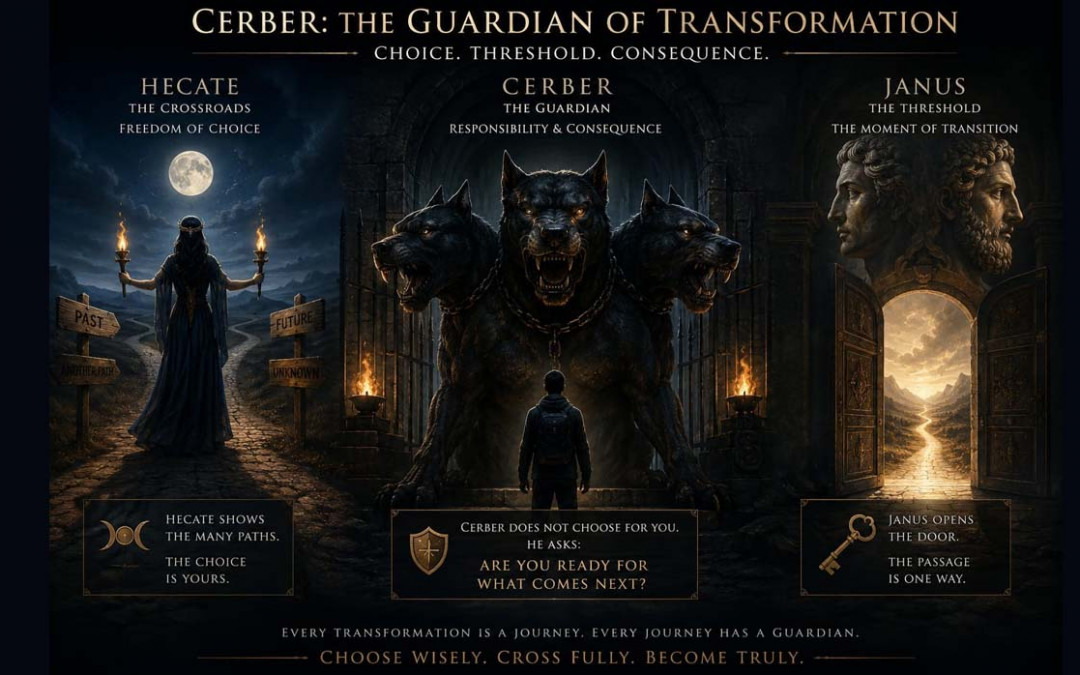
Hecate accumulated different attributes across centuries of Greek and later religious traditions, but crossroads, night, ghosts, liminal places and dogs became important parts of her imagery. The relationship should not be made neater than the ancient evidence allows. Modern retellings sometimes present Hecate as though she simply commanded Cerberus within one fixed mythological system; the surviving traditions are considerably messier than that. Yet structurally they inhabit remarkably similar territory. Hecate belongs where paths divide. Cerberus belongs where worlds meet.
It is tempting to seize immediately upon another coincidence: Hecate’s later triple imagery and Cerberus’s familiar three heads. Past, present and future; birth, life and death; three roads and three watchers. These interpretations are beautiful, but beauty is not evidence. Ancient sources do not provide a reliable key telling us that Cerberus’s three heads represented those concepts, and the older descriptions of the animal make any neat numerical theory difficult to defend. If there is a treasure here, it probably lies deeper than the number three.
The more durable relationship may instead concern what each figure does. A crossroads presents possibilities, but it cannot choose for the traveller. Standing before three roads is an experience of freedom precisely because more than one future remains available. A threshold is different. Once crossed, it converts possibility into consequence. In that sense Hecate and Cerberus can be read—not as parts of a secret ancient code, but as two stages of a structure that human beings continue to encounter. At the crossroads we ask, Which way? At the gate we confront another question: What happens to me once I have chosen?
This is where the old myth begins to escape the museum. Our lives are full of decisions that initially resemble doors because doors appear reversible. We open them and close them. We enter and leave. Modern technology has made this intuition even stronger. We undo, restore, cancel and recover. A deleted photograph returns from the trash. A document travels backwards through its revision history. The digital world has trained us to expect a hidden route back.
Life is not built entirely that way.
The Door That Disappears Behind You
A child can become an adult but cannot genuinely return to childhood. A person can regret discovering something but cannot recreate the mind that existed before knowing it. Relationships can be repaired, sometimes magnificently, yet the repaired relationship contains the history of the fracture. Someone who has encountered death closely can recover happiness and even innocence of another kind, but mortality has entered the architecture of the world. There are transformations in which returning is impossible for a peculiar reason: the person capable of returning no longer exists in precisely the same form.
That may be the most interesting way to look again at the dog standing before Hades. Cerberus guards the most irreversible transition the Greeks could imagine. Death is not merely another geographical destination in the myth; it is the ultimate one-way door. The guardian therefore does something more subtle than preventing movement. His presence gives weight to the crossing. A threshold without consequence is merely an opening. A threshold from which one cannot return becomes an event.
Modern software occasionally produces a strangely mundane echo of this ancient structure. Most buttons obey us without ceremony, but occasionally a system pauses before an irreversible operation and asks: Are you sure? This action cannot be undone. It is almost comically small compared with the gates of Hades—a grey dialogue box instead of a three-headed hound—and yet the function is recognisable. Something stands between the world before the action and the world after it and forces us, however briefly, to notice that they may not be identical.
This is where the monster’s heads become interesting again. Perhaps their precise symbolic meaning matters less than we have assumed. Cerberus can acquire fifty heads in Hesiod, three in the enduring iconography, serpentine features in other descriptions, and eventually an entire afterlife in medieval art, fantasy novels and computer games. The anatomy migrates. The function survives. Again and again, civilization remembers that somewhere between one state and another there ought to be a guardian.
And now the old trail suddenly reaches something very new.
We Are Building Doors Without Dogs
Artificial intelligence is usually discussed as though its decisive moment will announce itself. We imagine the arrival of AGI, machine consciousness or some unmistakable technological threshold after which historians will be able to draw a line and write a date beside it. Reality may be much less theatrical. The important transition could occur gradually, as societies delegate enough memory, judgment, communication and intellectual labour to artificial systems that returning to the previous arrangement becomes economically and culturally unrealistic. There may be no trumpet, no sentient machine introducing itself, no newspaper headline declaring that the old world ended yesterday. We may simply discover one morning that the gate has been behind us for years.
Genetic engineering raises a similar problem. So do brain-computer interfaces, persistent virtual environments and technologies that might eventually alter ageing or biological identity. Their most important question may not initially be whether they are good or bad. That binary often arrives before we understand the structure of the choice. A better first question is whether a particular change is reversible—and, if not, what exactly must be preserved before we cross.
This is where the ancient cast returns in an unexpectedly useful order. Hecate stands at the crossroads because more than one future remains possible. Janus belongs to the doorway because a transition has begun. Cerberus waits after possibility has narrowed into consequence. None of them needs to be treated as a supernatural prediction of technology. Their value lies precisely in the fact that the materials can change while the function remains recognisable.
Civilizations have always crossed one-way doors. Agriculture altered the relationship between humans and land. Writing changed memory. Printing changed authority. Industrialization changed time, labour and landscape. The internet changed communication before most of us understood what exactly had been exchanged. None of these transformations simply made humanity better or worse. They changed the conditions under which subsequent choices became possible.
The frightening possibility is therefore not that new technologies will confront us with monsters. It is that some of the most important thresholds may look completely ordinary. A software update. A medical procedure. A new workplace tool. A convenience adopted because everyone else has already adopted it. The gate may resemble a button, and the guardian may have been removed because friction is bad for conversion.
Only afterwards do we discover that the road back has disappeared.
What the Dog Was Guarding
This brings us back to the childish question with which we began. Why a dog?
We cannot know with certainty what every Greek listener saw in Cerberus, and mythology rarely leaves us the explanatory manuals modern readers desire. The historical Cerberus should therefore remain partly strange. He was a fearsome guardian of Hades, not a motivational metaphor invented for the digital age.
But perhaps that is precisely why the structural resemblance matters. The dog is familiar enough to accompany us and dangerous enough to stop us. It belongs beside the house but watches what approaches from beyond it. It can be friend and guardian without ceasing to possess teeth. Of all the monsters the Greeks might have imagined at the ultimate threshold, they placed there an animal whose relationship with humanity has always involved trust, protection and the boundary of home.
Maybe the treasure was never hidden in the three heads.
Maybe it was the gate.
As children, we imagine monsters standing between us and whatever we want. Growing older teaches us a stranger possibility: sometimes the guardian is there because what we want will change us once we possess it. The dragon is not always protecting the treasure from the hero. Sometimes it is protecting the hero from reaching the treasure without understanding its price.
Humanity is now approaching doors that the ancient world could not have imagined. Some may lead nowhere. Some may open onto extraordinary futures. A few may alter the meaning of being human sufficiently that the people on the other side will look back at us as inhabitants of another world.
Perhaps we do not need Cerberus to stop us.
Perhaps we need him because somebody should still be standing at the door asking whether we have noticed that it only opens one way.
Watch the Video
Continue reading
Three Forces that Control Your Life
Current Knowledge
Cerberus is the guardian dog of Hades in Greek mythology and is consistently associated with the boundary between the living and the dead, although ancient descriptions of his physical appearance vary. Hesiod describes a fifty-headed hound, while the three-headed form became the most culturally enduring version. Dogs also possessed funerary, ritual and liminal associations in parts of the ancient Mediterranean world. Hecate was independently associated with dogs, crossroads, night and other liminal settings, although the surviving evidence does not justify reducing Hecate and Cerberus to a single fixed symbolic system.
There is likewise no established ancient evidence that Cerberus’s three heads represented past, present and future, birth, life and death, or other modern tripartite schemes. Such interpretations may be philosophically productive, but they should remain interpretations rather than claims about what the Greeks demonstrably believed.
Open Questions
The more interesting historical question may be why canine figures became so persistent around ideas of guardianship, death and passage, and why the image of Cerberus survived even as his anatomy changed between sources and eras. The modern question is more uncomfortable: how can we recognise an irreversible transition before we cross it? Technological societies are exceptionally good at measuring capability—what can be done—but much less reliable at identifying the point at which widespread adoption makes returning to an earlier condition practically impossible.
Artificial intelligence makes that problem immediate. The decisive threshold may not be machine consciousness or AGI. It may be a quieter moment when enough human functions have migrated into artificial systems that removing them would change the civilization attempting the removal. Whether such a threshold exists, and where it lies, remains an open question.
Transhumation Interpretation
Transhumation does not propose that Cerberus secretly represented artificial intelligence or that Greek mythology encoded a forgotten technological doctrine. The more interesting possibility is that the symbol survived because the function survived.
Change the religion, the century, the animal and the material of the door, and human beings repeatedly encounter the same structure: possibility becomes choice; choice produces consequence; consequence transforms the person or society that made the choice. Some transformations can be reversed. Others change the traveller sufficiently that returning to the original state becomes impossible.
Hecate can therefore be read as the crossroads, where several futures remain open. Janus becomes the door, the moment at which one condition becomes another. Cerberus stands somewhere deeper in the structure. He is not necessarily the guardian who prevents transformation.
He is the guardian who makes irreversibility visible.
And perhaps that is why the old dog still matters.
The future may not need another monster warning us not to enter.
It may need something standing quietly beside the most attractive doors, reminding us to look behind ourselves before we walk through.
How to Read the World
FAQ
Was Cerber really a monster in Greek mythology?
Traditionally Cerber was the multi-headed dog guarding the entrance to the underworld. However, many symbolic interpretations view him as a guardian of transitions rather than a purely evil creature.
What does Cerber symbolize?
Cerber can symbolize boundaries, transformation, responsibility, and the irreversible consequences of important life choices.
What is the connection between Hecate and Cerber?
In later traditions and magical texts, Hecate became associated with dogs, crossroads, and the underworld. Cerber and Hecate share themes of thresholds and transitions.
Why is Cerber depicted as a dog?
Dogs have long symbolized loyalty, protection, guidance, and guardianship. These qualities align naturally with Cerber’s role as a guardian of passage.
How does Cerber relate to modern life?
Cerber can be interpreted as a symbol of life’s irreversible transformations—growing up, facing mortality, changing identity, and crossing technological or philosophical thresholds.
What is the main lesson of Cerber?
The myth suggests that true transformation is meaningful precisely because it cannot be undone. Cerber protects the significance of crossing from one state of being into another.
Continue the Transhumation Series
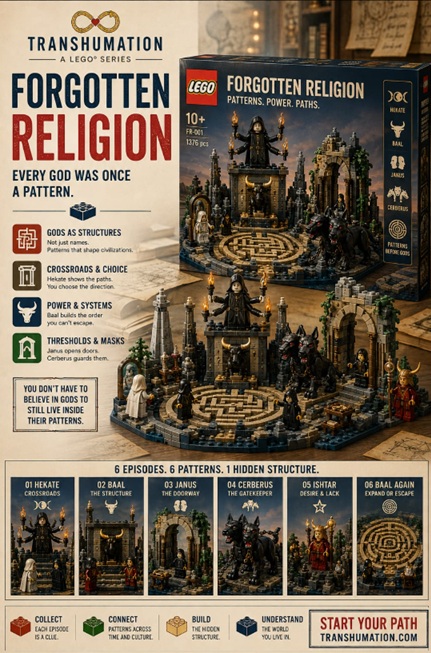
- Forgotten Religion | Ancient Gods, Symbols and the Hidden Structures of Human Civilization
- The Last Religion | Death, Immortality and the Future of Humanity
- The New Theurgy | AI, Information and the Future of Human Civilization
- End of Branding: You Were Never Meant to Become a Product
- Baal vs Ishtar: Why Ancient Gods Never Disappeared