
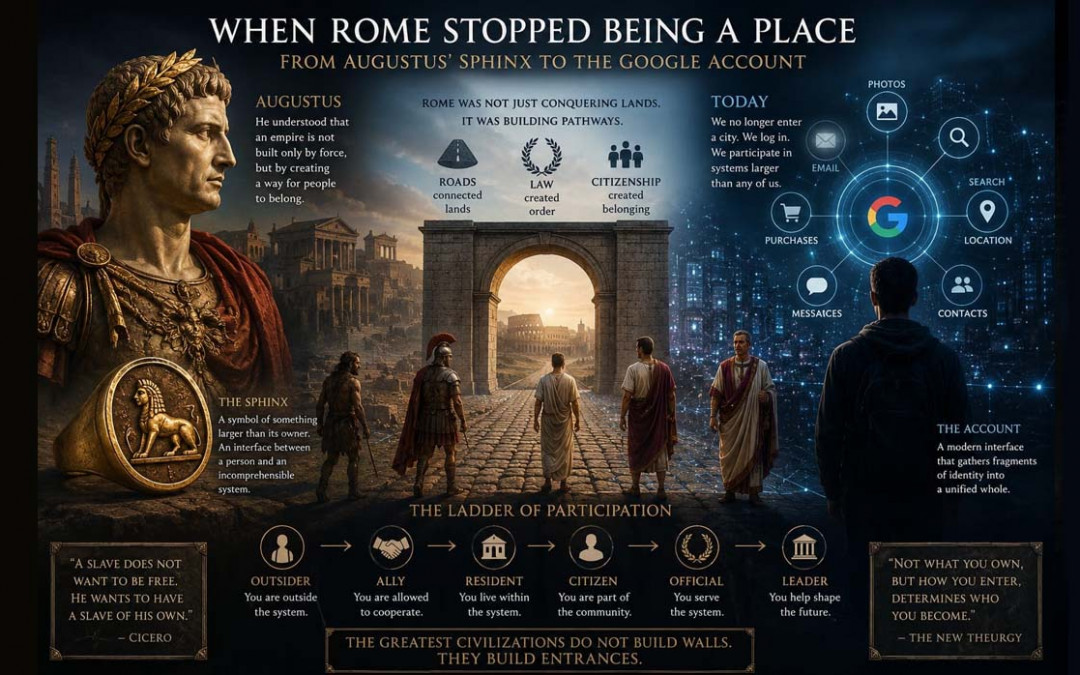
The Empire You Could Enter
Rome discovered something stranger than conquest: a civilization could become larger than the place that created it.
A man is born in southern Spain, almost two thousand kilometres from Rome. He grows up beneath a different sky, among families whose ancestors were not Roman, in a town that had once belonged unmistakably to the provinces. Then, in AD 98, that man becomes emperor. Trajan’s accession is usually remembered as part of the political history of imperial Rome, but there is something almost more interesting hidden inside it. By the time a man born in Italica could rule from the imperial centre, Rome had accomplished a transformation far stranger than territorial expansion. The city still existed — its streets, temples, Senate, crowds and monuments were real — but Roman identity had begun to escape the geography that created it. You could become Roman without being born in Rome. Millions of people could participate in a civilization whose physical centre most of them would never see.
We hardly notice how peculiar this is because we now live inside systems built upon the same problem. We belong to banks whose vaults we have never entered, companies whose headquarters we will never visit, communities without meeting places and networks distributed across continents. A small photograph in the corner of a screen can open fifteen years of messages, purchases, memories and relationships. The interface is tiny; the world behind it is enormous. Rome obviously did not invent the internet, and searching for technological prophecy in antiquity would tell us very little. But Rome encountered a problem that has become increasingly important in the digital age: how does a human being enter something too large to experience directly?
When Rome Stopped Being a Place
Conquering foreigners was hardly a Roman invention. What became unusual was what could happen after conquest. Roman citizenship remained unequal, political and selective for much of the empire’s history, and Rome could be brutally clear about the difference between those who possessed privileges and those who did not. Yet the boundary was capable of moving. Communities acquired different forms of status; provincial elites entered Roman administration; freed people and their descendants could find paths into civic life; military service could provide another route toward belonging. Under Claudius, the admission of prominent provincials from Gaul to the Senate became important enough for the emperor to defend publicly.
This suggests that the interesting distinction is not simply between an open civilization and a closed one. Rome was both, depending upon whom we are discussing and when. The more useful distinction may be between a wall and an entrance. A wall establishes who belongs on either side; an entrance preserves the boundary while creating a mechanism for crossing it. Rome accumulated such mechanisms remarkably well. Roads moved bodies, law moved obligations and rights, languages moved administration and culture, while citizenship gave political form to an identity that could travel far beyond the city itself. The process was neither uniform nor peaceful, and local identities did not simply vanish beneath a Roman one. Yet precisely because Roman identity could coexist, compete and mix with other identities, Rome became capable of absorbing people without requiring the empire to become geographically smaller.
Something profound follows from this. A civilization that can only be inherited is limited by birth. A civilization that can, under certain conditions, be entered has discovered another method of expansion. Rome’s territory grew through conquest, but its idea grew through participation. By the time Caracalla extended citizenship to most free inhabitants of the empire in AD 212, the word Roman could describe people separated from the original city by extraordinary distances, languages and histories. Rome had not ceased to be a place. It had become something more difficult to define: a system in which a person could acquire a position.
Augustus and the Tiny Sphinx
There is a wonderfully small object near the beginning of the imperial story. Ancient sources associate Augustus with several signet devices during his life, among them a sphinx; later traditions describe him using the image of Alexander and eventually his own portrait. We should resist giving the sphinx some secret meaning for which the evidence does not exist. The more interesting fact is almost banal. An empire containing armies, governors, taxes, roads, temples, ships, grain supplies, laws and millions of human beings could sometimes express authority through an image small enough to fit on a ring.
Augustus could never personally inhabit the entire structure called Rome. No emperor could. A governor encountered one part of it, a merchant another, a soldier another and a farmer in Egypt something different again. Even the man supposedly standing at its centre received the empire through reports, letters, messengers, maps, officials and representations. Yet a seal pressed into wax could allow his authority to become present in a room where Augustus himself was absent. The symbol was obviously not the emperor and the seal was not the empire, but that was precisely its usefulness: it compressed a relationship with something enormous into an object a human being could recognize.
We often talk about symbols as though they were decorations placed upon power after the important work has already been done. Scale suggests another possibility. Perhaps the larger a structure becomes, the more urgently it requires compression. A village can know its leader personally; an empire cannot. A crown can compress monarchy, a flag can compress a nation, a cross can open an entire religious cosmology, and a corporate mark can summon products, experiences, reputation and expectations almost instantly. None contains the reality it represents. Each provides a manageable entrance to something that would otherwise exceed immediate human perception.
At sufficient scale, civilization requires an interface.

The Account With Your Name on It
Open almost any major digital service and look at the small circle in the corner. It may contain your photograph, your initials or an anonymous silhouette. Touch it and the disproportion becomes remarkable. Behind an icon a few millimetres wide may sit years of photographs, correspondence, purchases, documents, contacts, saved places, preferences, subscriptions and authentication credentials. The account is not the system, just as the Roman seal was not Rome, but it provides an authorized point of entry into a structure whose physical machinery the user will probably never see.
This is where the historical comparison becomes useful, provided we do not make it too literal. The internet is not the Roman Empire, a user account is not Roman citizenship, and a technology company is not Augustus. The durable similarity lies one level deeper: both worlds confront the problem of participation at scales beyond individual comprehension. A Roman road, legal status, seal or office allowed a person to interact with a civilization extending far beyond the immediate encounter. A digital account performs a comparable structural task in another medium. It makes an enormous distributed system locally accessible.
The digital version, however, introduces a peculiar inversion. We create an account because we want the system to recognize us, but eventually the account can become part of the mechanism through which the system decides who we are. Lose access and nothing metaphysical happens to the person sitting in front of the screen. Yet parts of civilization may abruptly cease to recognize that person. The photographs, purchases, correspondence and permissions remain somewhere in the machinery, but the authenticated path connecting them to their owner has broken. We usually describe this as an inconvenience. Philosophically, it is rather strange: the human being remains present while a portion of their socially operative identity has become inaccessible.
And this raises a much older question.
What Problem Was the Soul Trying to Solve?
Calling a digital account a modern soul would be clever but shallow. A database does not become consciousness because it contains photographs, and a technological analogy cannot settle a theological question that civilizations have debated for millennia. There is, however, a better way to make the comparison. Instead of asking whether an account is a soul, we can ask what kinds of problems different concepts of identity have been built to solve.
A human life is already an extraordinary problem of continuity. The child you once were no longer exists in precisely the same biological or psychological state. Cells change, memories disappear or are reconstructed, beliefs reverse, relationships alter and the body ages. Nevertheless, we gather these changing states beneath a single word: me. Philosophical and religious traditions developed radically different explanations for what makes that continuity possible, and the soul became one of history’s most durable answers. It connected change to identity and, in many traditions, identity to the possibility of survival beyond bodily death.
Technology approaches the problem from almost the opposite direction. It does not begin by locating an immortal essence; it accumulates traces. A photograph is not a memory, but it can reactivate one. A message is not a relationship, but it records a moment within one. Search histories, locations, purchases and conversations are not a person, yet together they can produce an increasingly detailed external representation of a life. The resemblance worth investigating is therefore not metaphysical but structural. Both problems concern continuity among fragments: what belongs together, what persists through change, and what allows scattered moments to remain recognizable as belonging to one identity?
The questions resemble each other without requiring the answers to be the same. That distinction matters to Transhumation. The interesting historical pattern is often not that an old object returns wearing modern clothes, but that an old problem survives long enough to demand a new interface.
When the Entrance Changes the Person
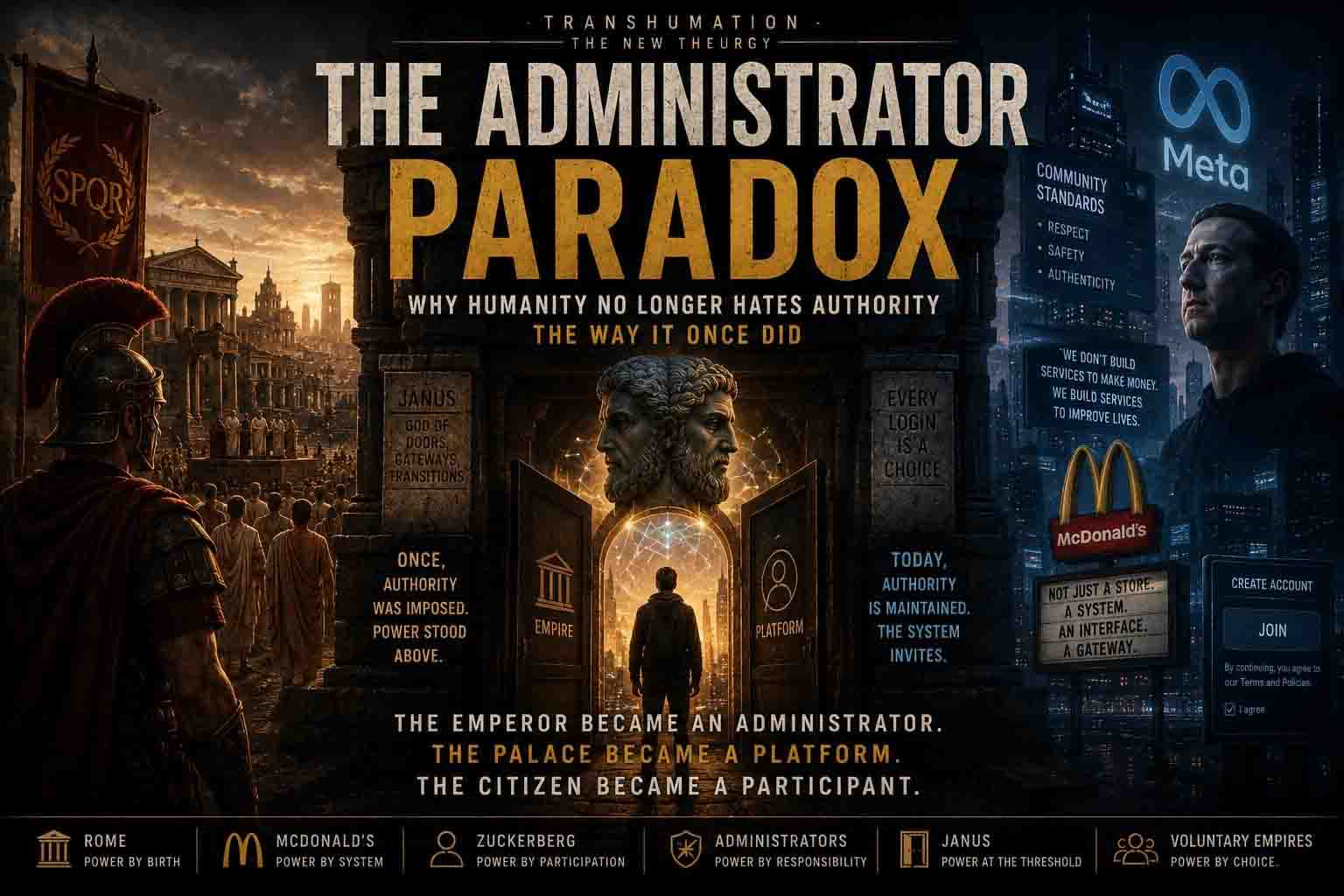
There is another reason Rome matters here. Interfaces are rarely neutral doors. Once people enter a system, the system begins shaping the people capable of moving within it. Provincial participation in Roman life could involve language, education, names, clothing, political ambitions, legal expectations, religious practices and ideas about prestige. Historians rightly resist treating „Romanization” as a simple process in which Rome erased passive local cultures. The reality was more complicated: identities overlapped, local practices survived, and Rome itself changed as provincial populations entered its structures.
That complexity reveals the deeper mechanism. People entered Rome, but Rome also entered them. Something similar occurs in digital systems. At first we create a profile to represent ourselves to the platform. Then we learn which photographs fit the profile, which descriptions belong in the boxes provided, which achievements can be entered into the career history and which aspects of personality can be translated into searchable categories. The interface begins as a representation of the person, but the person gradually learns how to become legible to the interface.
Artificial intelligence may push this process much further. Until recently, participation in complex technological systems often required learning their interfaces: menus, commands, forms, categories and specialized languages. Conversational AI reverses part of that relationship. Instead of teaching ourselves how the information architecture works, we increasingly ask for what we want in ordinary language and allow the system to translate the request internally. Civilization’s newest entrance may therefore be neither a road nor a seal nor even an icon. It may simply be a conversation.
This looks like simplification, and for the user it often is. But it creates a paradox. The easier the entrance becomes, the less of the structure behind it we may need to understand. A Roman traveller could see the road beneath his feet. A digital user sees an icon. A person speaking to an AI system may eventually see almost nothing except an answer. The interface becomes more natural precisely as the machinery becomes less visible.
The Empire Without a Capital
Ask where Rome was and the question has an obvious answer, even if Roman civilization extended far beyond it. Ask where the internet is and the answer becomes stranger. You can point to a data centre, an undersea cable, a satellite, a router or a telephone, but none of them is the internet. The system exists through relationships among physical components scattered across the planet. Its entrances can appear almost anywhere, allowing people separated by thousands of kilometres to occupy the same digital environment without moving physically toward a common centre.
Perhaps this is the longer historical movement worth watching. First civilizations built places; then they constructed roads between places. Institutions eventually became larger than the buildings containing them, while symbols and documents allowed authority to travel beyond the physical presence of rulers. Digital systems pushed the entrance still further away from the centre until, finally, the gate itself became portable. We carry access to banks, libraries, workplaces, communities and vast stores of human knowledge in our pockets.
Rome did not predict any of this. That would be the least interesting conclusion. What Rome shows us is that the problem is older than the machinery currently solving it. Human beings repeatedly construct realities that become too large for individual human beings to encounter as wholes. When that happens, we create smaller things through which the larger thing becomes accessible: a road, a title, a ritual, a seal, a passport, an account, an icon, a conversation.
Perhaps this is why the best interfaces eventually become invisible. We stop seeing the entrance and experience only the world beyond it. Nobody opening a banking application thinks about server architecture; nobody touching a profile photograph imagines the data centres responding to the gesture. The extraordinary complexity disappears behind an ordinary action.
That may also be where the next Transhumation question begins. The problem is no longer simply whether our interfaces are becoming more powerful. It is whether they are becoming so complete that they begin mediating realities we can no longer reach without them.
Rome once discovered that a civilization could become larger than the city that created it. We now inhabit systems that have gone one step further: they may possess no meaningful centre that an ordinary participant could ever visit.
And yet we enter them every morning.
Watch the Video
How to Read the World
Current Knowledge
Roman citizenship expanded over centuries and was never permanently restricted to people born in the city of Rome. Provincial elites increasingly participated in Roman political and administrative structures, and emperors including Trajan came from outside Italy. Claudius supported admitting qualified provincial elites from Gaul into the Roman Senate, while Caracalla’s Constitutio Antoniniana of AD 212 extended Roman citizenship to most free inhabitants of the empire.
Roman integration was neither uniform nor equivalent to modern ideas of inclusion. Conquest, slavery, hierarchy and legal inequality remained fundamental features of Roman society, while local identities and traditions could coexist with, resist or reshape Roman culture. Ancient literary sources also associate Augustus with signet devices including a sphinx, Alexander the Great and later his own image; no specific Transhumation interpretation of those images should be treated as established historical fact.
Open Questions
When does membership in a civilization cease to depend primarily upon geography? Can digital belonging ever become as socially consequential as territorial citizenship, or does physical territory remain fundamentally different? More importantly, what happens when an interface moves beyond representing a person and begins determining which parts of that person are recognized by the surrounding system?
Conversational AI introduces another uncertainty. If increasingly complex systems can be reached through ordinary language, are we finally making civilization more understandable — or merely constructing a perfect entrance behind which the machinery can become almost completely invisible?
Transhumation Interpretation
Transhumation does not require Rome, religion and digital technology to be versions of the same institution. Their forms, purposes and historical circumstances are radically different. The more interesting continuity may lie in a problem that survives all three: complexity produces a need for interfaces.
Whenever a structure becomes larger than individual comprehension, humans create compressed methods of entering, navigating and identifying themselves within it. Citizenship, seals, symbols, accounts and conversational AI may therefore be understood not as repetitions of the same object, but as different solutions to a recurring structural problem.
The carrier changes. The function survives.
That suggests another way of reading technological history. Instead of asking only what new machines allow us to do, we can ask which ancient human problems have migrated into them. Rome made it possible for millions of people to participate in a world larger than the city called Rome. Digital civilization allows us to participate in worlds that may no longer possess a city at all.
The next question is therefore not merely what is the interface?
It is whether, one day, the interface becomes the only part of the world we can still see.
FAQ
What does it mean that Rome became an interface?
Rome gradually transformed from a geographic city into a system of participation. People from different cultures could become Roman through citizenship, language, institutions, and shared identity. The empire became larger than its physical location.
Why is Roman citizenship compared to an interface?
Roman citizenship provided a pathway from outsider to participant. Like modern digital platforms, it allowed individuals to enter a larger system, gain access to its benefits, and eventually become part of its structure.
What is the connection between Augustus’ sphinx and modern symbols?
The sphinx on Augustus’ signet ring represented something larger than a single person. Like modern logos, avatars, or national symbols, it acted as an interface between individuals and complex systems that cannot be fully understood directly.
How did Rome become larger than a city?
Rome expanded beyond geography by integrating people from across the empire. Provincial citizens could become senators, generals, and even emperors, making Rome a shared identity rather than merely a place.
Why does the article compare the soul to a Google Account?
Both attempt to unify scattered experiences into a coherent identity. While a Google Account is not a soul, it gathers memories, relationships, preferences, and history into a single digital profile, raising similar questions about continuity and identity.
What problem was the concept of the soul trying to solve?
The soul offered a way to understand how memories, experiences, relationships, and choices could belong to one continuous person. The article explores whether modern information systems are beginning to address a similar problem through technology.
What do Rome and the internet have in common?
Both connect vast networks of people through shared frameworks. Rome connected roads, laws, cities, and citizens, while the internet connects platforms, information, communities, and digital identities.
Why do civilizations need symbols?
As societies become more complex, direct understanding becomes impossible. Symbols function as interfaces that help individuals navigate realities larger than themselves, whether those realities are empires, religions, nations, or digital networks.
What is the Interface Problem?
The Interface Problem is the challenge of understanding systems that exceed human comprehension. Whenever reality becomes too large, humans create symbols, institutions, and tools that act as gateways to that complexity.
How does this relate to Transhumation?
Transhumation explores the possibility that religion, technology, citizenship, identity, and digital systems are different expressions of the same human effort: creating interfaces that connect individuals to realities larger than themselves.
Continue the Transhumation Series
- Forgotten Religion | Ancient Gods, Symbols and the Hidden Structures of Human Civilization
- The Last Religion | Death, Immortality and the Future of Humanity
- The New Theurgy | AI, Information and the Future of Human Civilization
- End of Branding: You Were Never Meant to Become a Product
- Baal vs Ishtar: Why Ancient Gods Never Disappeared