
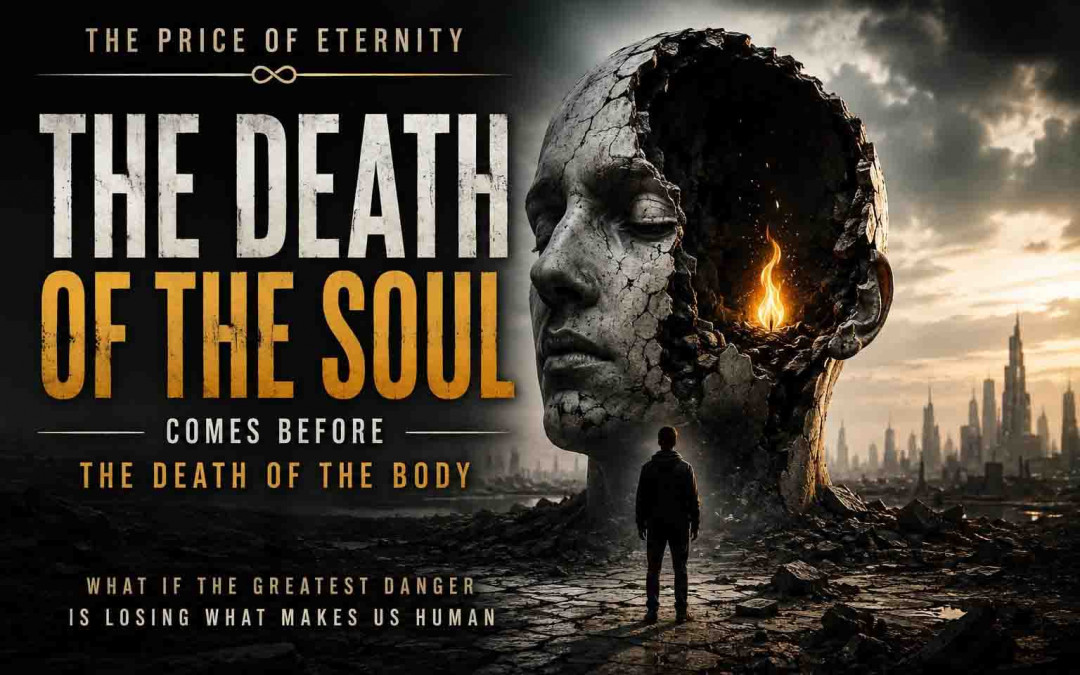
Biological Life Can Continue
A hospital monitor can tell us a great deal about whether a body is alive.
It can register heartbeat, oxygen saturation, electrical activity, respiration and blood pressure. Medicine can describe the condition of organs with astonishing precision. Machines can detect failure before a patient feels it. A human body has never been more measurable than it is now.
And yet there is another kind of sentence that appears in ordinary speech with remarkable persistence.
“He is still alive, but he is not himself anymore.”
Sometimes people say it after grief. Sometimes after trauma, illness, addiction, isolation or decades of living without anything that still feels personally meaningful. The phrase can be unfair, imprecise or even cruel if it is used to judge someone from the outside, but the intuition behind it is ancient.
Human beings have always distinguished between remaining biologically alive and feeling inwardly connected to life.
Religion gave that distinction one vocabulary.
Philosophy gave it another.
Psychology provides several others.
Perhaps the old phrase death of the soul belongs not to science but to the border between them.
Used carelessly, it becomes superstition or stigma.
Used carefully, it asks one of the oldest human questions:
What must remain alive inside a person for life to continue feeling like their own?
What Does “Death of the Soul” Mean?
The phrase should not be treated as a medical diagnosis.
Science has no instrument capable of detecting a soul leaving, weakening or dying. Different religions disagree profoundly about what the soul is, whether it is created, immortal, reincarnated, resurrected or inseparable from some other conception of personhood.
But ordinary human experience contains conditions that make the metaphor intelligible.
A person can lose interest in activities that once mattered.
They can feel detached from their future.
A familiar world can become emotionally flat.
Relationships can become difficult to access from the inside even when they remain externally intact.
None of this means the person has become less human or that some metaphysical essence has disappeared.
It means that the experienced structure of participation can change dramatically while the organism remains alive.
That distinction is enough to make the old metaphor worth examining.
The body can continue.
The biography can continue.
The person can keep going to work and answering messages.
Yet the connection between self and future may feel damaged.
The soul, in this essay, begins exactly there—not as a proven substance, but as the name humans repeatedly give to the part of life that makes continued existence feel inhabited.
The Walking Dead Metaphor
Cultures have long produced figures of the living dead.
Ghosts.
Zombies.
Hollow kings.
Soulless bureaucrats.
The person who continues performing social functions while something essential appears absent.
These figures should not be confused with real people experiencing depression, disability, trauma or emotional exhaustion. Fiction turns complex human states into symbols, often brutally.
But symbolism is revealing.
The living-dead figure embodies a fear deeper than physical death: continuation without inward participation.
A machine can continue performing after nobody remembers why it was built.
An institution can continue long after its founding purpose has disappeared.
A relationship can continue formally after intimacy has gone.
A person, too, can sometimes feel trapped inside routines that continue functioning while their reasons for caring have become inaccessible.
This is why the metaphor survives.
It describes not biological death but a separation between functioning and meaning.
Civilization recognizes the distinction because civilization suffers from it too.
A city can remain populated and culturally exhausted.
A religion can retain ritual while losing belief.
A university can preserve procedures while forgetting inquiry.
The form survives.
The animating relation weakens.
That does not prove the existence of a soul.
It tells us why the word became useful.

Can a Person Lose Their Sense of Self While Still Alive?
Yes, in several different senses, although none should be collapsed into the language of spiritual death.
People can undergo major changes in identity after trauma, illness, grief, neurological injury, migration, social isolation or radical changes in life circumstance. Memory can weaken. Motivation can collapse. Familiar values can stop feeling persuasive.
Psychology and neuroscience study many parts of this terrain without requiring metaphysical assumptions.
The important point is that personhood is not experienced as a simple binary switch between alive and dead.
There are degrees of connection to memory.
Degrees of agency.
Degrees of motivation.
Degrees of felt continuity with earlier versions of oneself.
This does not mean personhood itself comes in moral degrees. A vulnerable or depressed person is not “less of a person.”
It means the subjective experience of being oneself can become unstable.
That difference matters.
The old language of the soul may have emerged partly because people needed a way to describe what biology alone could not capture.
The body was clearly present.
Something about the life inside it had changed.
Is the Soul a Substance or a Process?
Religious traditions answer this in incompatible ways, and no scientific result presently settles the metaphysical question.
But as a philosophical experiment, consider the difference.
A substance-model soul is something one has.
It exists as an enduring entity.
The body changes around it, but the soul remains the core.
A process-model soul is something more like a relationship continuously maintained among memory, identity, attention, attachment, responsibility, imagination and future orientation.
The first model resembles an object.
The second resembles a flame.
A flame is physically real but cannot be separated from the process sustaining it. Fuel changes. Molecules change. Shape changes. The flame persists through organized continuity.
This metaphor is attractive because human identity already behaves partly this way.
We change constantly.
Memories are revised.
Bodies age.
Beliefs move.
Relationships alter us.
Yet there remains enough continuity for one life to feel connected across time.
But the metaphor must remain a metaphor.
Calling the soul a process does not prove that traditional religious ideas were secretly descriptions of cognitive systems.
It gives us a model for asking a different question:
What kinds of relationship must be maintained for a human life to remain experientially alive?
That question can be investigated without pretending to have solved the metaphysics.
The Sphinx Void
Human beings are peculiar creatures because satisfaction rarely ends desire permanently.
Food solves hunger.
Then another problem appears.
Safety solves immediate danger.
Then ambition, loneliness, curiosity, status, love or uncertainty becomes visible.
Success often answers one question while exposing another.
This tendency has been interpreted in countless ways.
Religion may call it longing for transcendence.
Psychology may describe changing motivation, self-determination or unmet needs.
Philosophy may see it as consciousness encountering its own finitude.
Consumer culture often attempts to convert it into the next purchase.
No single interpretation owns the phenomenon.
But the phenomenon matters.
Humans are capable of wanting things that cannot be reduced neatly to immediate survival.
Understanding.
Recognition.
Beauty.
Belonging.
Coherence.
Contact with something larger than individual routine.
The void should not be romanticized. Chronic dissatisfaction can be destructive.
But neither should every longing beyond survival be treated as a malfunction.
The capacity to ask What is this for? may be one of the most consequential features of human cognition.
A creature capable of surviving can still ask whether survival is enough.
That is where biology becomes biography.
Why Do Humans Need Meaning Beyond Survival?
The word need should be used cautiously.
Humans vary enormously in temperament and worldview. There is no single universal life project.
But people repeatedly create systems that extend beyond immediate biological necessity.
Art.
Ritual.
Science.
Sport.
Friendship.
Law.
Religion.
Education.
Exploration.
Commemoration.
Even under conditions of poverty and danger, people devote effort to activities that cannot be explained simply as direct survival tasks.
This does not mean survival is unimportant.
It means human motivation is layered.
Once enough immediate threats recede, other concerns become more visible.
This is why technological abundance does not automatically solve the human problem.
A machine can reduce physical labor.
Medicine can extend life.
AI can reduce informational friction.
None of these achievements determines what a person should care about.
Technology can create room.
It cannot guarantee that the room feels inhabited.
The Fragile Flame
The flame metaphor becomes most useful when it stops pretending to be mystical.
A meaningful life requires ongoing relationships between the person and the world.
Attention must attach somewhere.
The future must contain something that feels worth reaching.
Memory must remain sufficiently connected to identity.
Some relationship, task, person, place, principle or curiosity must still exert a pull.
The specific object can change radically.
One period of life may be organized around family.
Another around work.
Another around learning.
Another around recovery.
Another around care.
The flame does not require one eternal purpose.
Perhaps it survives precisely because its fuel changes.
This is where the metaphor becomes more humane.
The person who loses purpose has not failed some spiritual test.
They may need new conditions.
Rest.
Treatment.
Relationships.
A different environment.
A new responsibility.
Permission to abandon an identity that no longer works.
If the soul is imagined as a process, fragility is not damnation.
It means processes can sometimes be restarted.
A New Moral Responsibility
The original version of this idea risks becoming dangerous if it says people have a duty to “keep their soul alive.”
That could turn suffering into moral failure.
A better responsibility belongs to both individuals and societies.
We should ask what conditions allow people to remain participants rather than merely biological units.
A civilization concerned only with keeping bodies alive is incomplete.
So is one concerned only with productivity.
The quality of a human life includes relationships, autonomy, dignity, access to meaningful activity, belonging and the capacity to imagine a future.
This is not a new discovery.
Religions built rituals around it.
Philosophies constructed disciplines around it.
Families protect it.
Art repeatedly returns to it.
Libraries preserve encounters with minds that can reactivate curiosity centuries later.
Education, at its best, does more than transfer information.
It enlarges the number of things a person can care about.
Perhaps this is one reason civilization exists at all.
Not to make every human happy.
Not to solve the soul.
But to increase the number of meaningful connections available between one finite mind and the world.
Can Technology Extend Life Without Preserving Meaning?
Absolutely.
This may become one of the central problems of longevity.
Medicine can increase survival without automatically increasing purpose.
A person can live longer and still be lonely.
A society can become wealthier and still produce alienation.
An AI system can anticipate preferences perfectly without answering whether those preferences deserve to govern a life.
Technology is extraordinarily good at extending capacity.
Meaning belongs to another layer.
Imagine a future in which aging is dramatically slowed.
A person can expect two hundred healthy years.
Their memory can be augmented.
Disease can be treated.
AI provides endless personalized entertainment and assistance.
Would that life automatically be richer than an eighty-year life?
No.
It would contain more duration and more possibility.
What the person does with those possibilities remains unresolved.
This is the danger hidden inside the dream of longevity.
Humanity may become better at preventing biological death while discovering that it has no equivalent technology for preventing existential exhaustion.
The Age of Longevity
Radical life extension would intensify this problem because the old sources of direction might no longer fit the new scale.
A profession lasting forty years makes sense inside a shorter life.
What happens in a three-hundred-year life?
A marriage might be imagined differently.
Memory might need deliberate compression.
Identity might pass through several major reconstructions.
A person could outlive institutions that once organized their values.
The challenge would not necessarily be boredom.
It would be renewability of attachment.
Can a person repeatedly discover reasons to care without feeling that earlier versions of life were false?
Can identity change without becoming empty?
Can commitments expire without making commitment meaningless?
A long-lived civilization might need to become extraordinarily good at helping people enter new forms of participation.
The greatest technology of immortality may therefore turn out not to be preservation.
It may be renewal.
The First Death
There is still a powerful poetic intuition inside the phrase the first death.
A person can remain biologically alive while losing connection to the projects, relationships or future through which life previously made sense.
But we should resist turning this into a verdict.
The condition may be temporary.
It may be treatable.
It may be the beginning of transformation rather than an ending.
A former identity sometimes has to collapse before another becomes possible.
The person who no longer cares about an old ambition may not be dying inwardly.
They may simply have stopped believing in the wrong future.
This is why the soul-as-flame metaphor must include another property of flame:
it can move.
A candle can light another candle.
A fire can be rebuilt.
The source of meaning can change without meaning itself disappearing.
The deepest danger is not losing one purpose.
It is losing the capacity to form a relationship with any future at all.
Watch The Video
How to Read the World

Current Knowledge
Science does not establish the existence of a separable metaphysical soul, nor does it provide an empirical category corresponding to “death of the soul.” The phrase is best treated here as a philosophical or religious metaphor rather than a scientific diagnosis.
Psychological states involving reduced motivation, pleasure, hope or future orientation can occur in conditions such as depression, grief, trauma, burnout and neurological illness, but these experiences are diverse and should not be interpreted as evidence that a person has lost some essential human status.
Human motivation extends beyond immediate biological survival. People consistently invest in relationships, learning, art, ritual, play, status, exploration and other forms of activity that cannot be reduced to simple survival functions.
Identity and the sense of self are dynamic. Memory, social relationships, bodily state, beliefs and future expectations all contribute to how people experience continuity through time.
Technological life extension, if it becomes substantially more powerful, would increase duration and capability but would not automatically supply purpose, belonging or psychological well-being.
Open Questions
One major question is whether the human search for meaning reflects particular evolutionary and social conditions or whether something like it would remain central in radically altered technological environments.
Another concerns longevity. If healthy lifespan increases dramatically, will people repeatedly create new purposes, or will extended duration expose limits in human motivation that shorter lives rarely reveal?
There is also a philosophical question about identity. If a person can lose memories, values, roles and ambitions while remaining biologically continuous, which relationships between earlier and later selves matter most for personal continuity?
The deepest question remains metaphysical: whether there is any aspect of personhood that cannot ultimately be described through biological and psychological processes. Science currently does not resolve that question, and philosophical or religious answers remain genuinely contested.
Transhumation Interpretation
For Transhumation, the useful idea is not that science has discovered a fragile soul.
It has not.
The useful idea is that biological continuation and meaningful participation are different forms of being alive.
Technology may become extraordinarily good at preserving the first.
Civilization must still care about the second.
If there is a “soul” in the Transhumation sense, it should not be treated as a hidden object we have conveniently renamed information.
It is better understood as a question:
What must remain connected for a person to continue experiencing life as something worth inhabiting?
That question deserves to survive even if every easy answer fails.
FAQ
What does “death of the soul” mean in this article?
It is a philosophical metaphor for profound loss of connection, purpose, future orientation or participation. It is not a medical diagnosis or scientific claim that a metaphysical soul has literally died.
Can someone feel inwardly absent while still biologically healthy?
Yes. People can experience severe detachment, anhedonia, grief, burnout or loss of identity while remaining physically alive. These conditions should be understood compassionately rather than as moral failure.
Does science prove that the soul exists?
No. Science has not established a separable metaphysical soul. Religious and philosophical traditions offer different views that remain outside any settled scientific consensus.
Why do humans search for meaning beyond survival?
Humans have complex social, cognitive and cultural motivations. Across history they have pursued art, knowledge, ritual, love, status, exploration and other goals beyond immediate survival.
Could longer life solve the problem of meaning?
Not automatically. Greater lifespan creates more opportunities, but it does not determine what a person will value or whether they will remain psychologically connected to a future.
What is the deeper Transhumation question?
The deeper question is not whether a soul can be proven to die before the body.
That formulation may never become scientifically meaningful.
The deeper question is why human beings have repeatedly needed a word for the difference between existing and feeling fully alive inside existence.
A future civilization may become exceptionally good at preserving bodies. It may repair organs, slow aging, augment memory and surround people with intelligent systems capable of anticipating almost every practical need.
And still someone may ask:
What is all this for?
That question is not proof of a supernatural substance.
It is evidence that survival does not exhaust the human problem.
Perhaps the ancient language of the soul survives because it continues pointing toward something our instruments measure only indirectly: the relationship between a person and the future they are still willing to enter.
If that relationship disappears, the body may continue functioning.
The biography may continue accumulating days.
But something essential has become uncertain.
Not whether the person is alive.
Whether life still feels like a place they inhabit.
And perhaps the responsibility of a civilization capable of extending life will not merely be to keep the flame burning longer.
It will be to make sure we still know why anyone would want to stand near its light.
Continue the Transhumation Series
- Forgotten Religion | Ancient Gods, Symbols and the Hidden Structures of Human Civilization
- The Last Religion | Death, Immortality and the Future of Humanity
- The New Theurgy | AI, Information and the Future of Human Civilization
- End of Branding: You Were Never Meant to Become a Product
- Baal vs Ishtar: Why Ancient Gods Never Disappeared