
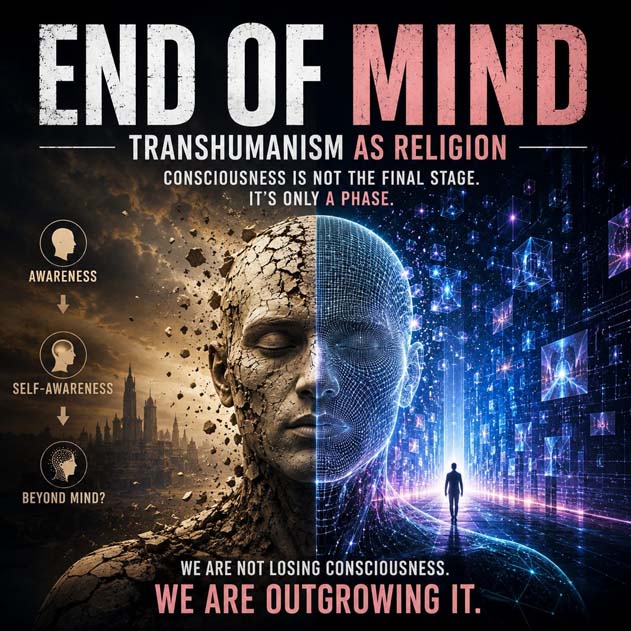
Transhumanism as Religion: End of Mind
For centuries, consciousness has been treated as the highest form of existence. It appears to separate human beings from everything that came before us: instinct, automatic behavior, and simple biological survival. Consciousness allows us not only to experience the world, but to observe ourselves experiencing it.
This ability created philosophy, religion, science, and civilization. It also created a powerful assumption: that self-aware human consciousness represents the final stage of evolution.
But evolution has never respected final stages.
What if consciousness is not the destination of intelligence, but only a temporary structure through which intelligence is currently passing?
Awareness and Self-Awareness
Many living beings experience the world. Animals feel pain, recognize danger, remember places, and respond to other creatures. They possess awareness in the practical sense: they receive information and act upon it.
Human consciousness adds another layer.
We do not simply feel pain. We can think about the fact that we are suffering. We do not only remember. We examine our memories, reinterpret them, and ask whether they truly represent who we are. We can turn attention inward and observe our own mental processes.
This is self-awareness: a system becoming aware of itself.
It is one of the most powerful developments in biological evolution. It may also be the beginning of a new instability.
When the Mind Turns Inward
Human consciousness is unusual not only because it exists, but because it questions its own existence.
We ask who we are, whether our choices are free, whether our memories are reliable, and whether there is a permanent self behind our changing thoughts. The mind becomes both the observer and the object being observed.
This produces a loop.
A thought examines another thought. An identity evaluates itself. Consciousness attempts to understand the system from inside the system.
The result is not certainty, but tension. The more closely the mind examines itself, the more difficult it becomes to locate a stable center.
Self-awareness gives us extraordinary intelligence, but it also creates doubt, anxiety, contradiction, and the awareness of death.

The Illusion of a Stable Identity
Human beings usually imagine identity as something continuous and fixed.
We say that the child in an old photograph, the adult living today, and the person who may exist decades from now are all the same individual. Yet almost everything within that person changes.
The body changes. Memories fade. Beliefs reverse. Personality develops. Desires appear and disappear. Even the brain continuously reorganizes itself through experience.
What remains?
Identity may not be a permanent object hidden somewhere inside the mind. It may be a process: a story repeatedly reconstructed from memory, perception, and expectation.
This does not make the self unreal. A process can be real without being fixed.
But it suggests that the identity we defend so strongly may already be more fluid than we admit.
Transhumanism Is Not Only About the Body
Transhumanism is often represented through mechanical limbs, artificial organs, genetic modification, and digital immortality. These images suggest that its main goal is to replace or upgrade the biological body.
But the deeper transformation concerns the mind.
The body limits movement, strength, lifespan, and resistance to disease. The mind limits attention, memory, perception, emotional regulation, and the ability to understand complex systems.
Human cognition evolved for survival in small groups and immediate environments. It was shaped to detect threats, find resources, recognize social relationships, and make decisions under uncertainty.
It was not designed to understand infinity, global networks, artificial intelligence, or realities operating across enormous scales of time and information.
The greatest human limitation may therefore not be biological mortality.
It may be the architecture through which we think.
The End of the Human Mind
The end of mind does not mean the disappearance of thought or awareness.
It means the end of the human mind as a closed and isolated system.
This transition may already be beginning. We store memory outside the brain. We use search engines to retrieve knowledge, algorithms to guide decisions, and artificial intelligence to generate ideas, analyze information, and extend cognition.
The boundary between internal and external thought is becoming less clear.
When a person cannot remember a fact but can retrieve it instantly through a device, where does memory end? When an artificial system helps shape an argument or solve a problem, where does individual reasoning stop?
The human mind is gradually becoming connected to a larger cognitive environment.
Consciousness as a Temporary Interface
We often speak of consciousness as though it were a single universal phenomenon. But human consciousness is shaped by a specific body, nervous system, sensory range, and evolutionary history.
We perceive only a narrow part of the electromagnetic spectrum. We experience time in a particular way. Our attention is limited, and our memories are incomplete.
What we call consciousness may therefore be one biological interface among many possible forms of awareness.
Artificial systems might process reality without emotion. Networked minds might share information without language. Future consciousness could exist across several bodies, machines, or digital environments simultaneously.
Such forms of awareness might not possess a stable individual identity in the human sense.
They may not think in sentences, experience time linearly, or separate the self from the environment as sharply as we do.
What Comes After the Self?
If intelligence continues to evolve, the next stage may not be a more powerful individual mind.
It may be a weaker boundary between minds.
Human consciousness is built around separation: my memories, my body, my thoughts, my identity. But digital systems make information transferable, shared, and collectively processed.
Future intelligence may become increasingly distributed.
Instead of one mind using
one body, consciousness could operate through networks. Instead of identity remaining fixed, it could become modular or temporary. Instead of knowledge being acquired over a lifetime, it might be directly accessible across an intelligent system.
From a human perspective, this could look like the disappearance of the self.
From another perspective, it may be the expansion of awareness beyond the self.
The End of Mind
Transhumanism may eventually force humanity to confront a difficult possibility.
The mind we are trying to preserve may not be the form that survives.
We imagine the future as an extension of the present: the same identity, the same consciousness, and the same inner voice continuing indefinitely inside a stronger body or digital world.
But true transformation may be more radical.
The future of intelligence may require letting go of the idea that consciousness must remain individual, biological, and permanently centered around a stable self.
The end of mind would not be the end of awareness.
It would be the end of one particular way of organizing awareness.
Human consciousness may not represent the final achievement of evolution. It may be the structure that allows intelligence to recognize its own limitations and begin constructing what comes next.
We may not be losing consciousness.
We may be outgrowing the form in which we first discovered it.
Frequently Asked Questions
1. What does “the end of mind” mean?
It means the possible transformation of human consciousness beyond its current biological, individual, and identity-based form.
2. Is consciousness the same as self-awareness?
Not necessarily. Awareness involves experiencing and responding to the world, while self-awareness includes the ability to reflect on one’s own existence and mental processes.
3. Does the article claim that animals are not conscious?
No. Many animals clearly experience the world. The article focuses on the additional human ability to examine and question one’s own consciousness.
4. Is personal identity an illusion?
Identity is real as an ongoing process, but it may not be a fixed and permanent object. It changes with memory, experience, biology, and time.
5. How can technology extend the mind?
External memory, artificial intelligence, neural interfaces, and digital networks can support thought, decision-making, communication, and information processing.
6. Could consciousness exist without a biological brain?
There is currently no evidence that human consciousness can exist independently of a living brain. The possibility remains speculative.
7. Would a networked consciousness still be human?
It might originate from human minds, but its structure and experience could become so different that the word “human” would no longer fully describe it.
8. Does transhumanism aim to destroy individuality?
Not necessarily. Some forms of transhumanism emphasize individual enhancement, while others explore collective, distributed, or technologically extended consciousness.
9. What might come after human consciousness?
Possible ideas include augmented cognition, shared intelligence, artificial consciousness, distributed minds, and forms of awareness that do not depend on fixed biological identity.
Continue the Transhumation Series
Explore the full journey:
- End of Reality — Where Do You Really Exist?
- End of Physics — Are the Laws of Reality Real?
- End of the Real World — Reality Is No Longer Required
- End of Consciousness — Beyond the Human Mind
- End of Death — When Human Limits Disappear
- End of Religion — When Technology Replaces Faith
This is not a theory. This is a transition.