
Working Ghosts
There is a particular kind of employee whose importance can be measured by how rarely anyone thinks about him. The corridor is clean when you arrive. The elevator works. The lights come on. The password still opens the database. Somewhere, a backup ran during the night and nobody noticed because nothing was lost. This is the peculiar reward for maintaining a successful system: when you perform the job perfectly, your work disappears.
The opposite is much easier to see. Let the elevator stop between floors, let the toilets fail at an airport, let a payment network disappear for an afternoon, and suddenly the invisible people acquire almost supernatural importance. Someone must know where the valve is. Someone remembers the password. Someone understands the machine well enough to bring it back. For a few minutes, the hierarchy of prestige is rearranged. The person with the impressive title waits beside everyone else while somebody in work clothes opens a panel in the wall.
History has the same problem with visibility. It remembers the people who opened new chapters because beginnings produce excellent stories. Caesar crosses the Rubicon. Columbus sees land. Gutenberg prints. Armstrong steps onto the Moon. The camera naturally turns toward the person doing something for the first time. It is much less interested in the person who arrives on Tuesday morning for the four-thousandth time and makes sure that what was created still works.
Yet Tuesday morning may be where civilization actually lives.
The Man Outside Lecter’s Cell
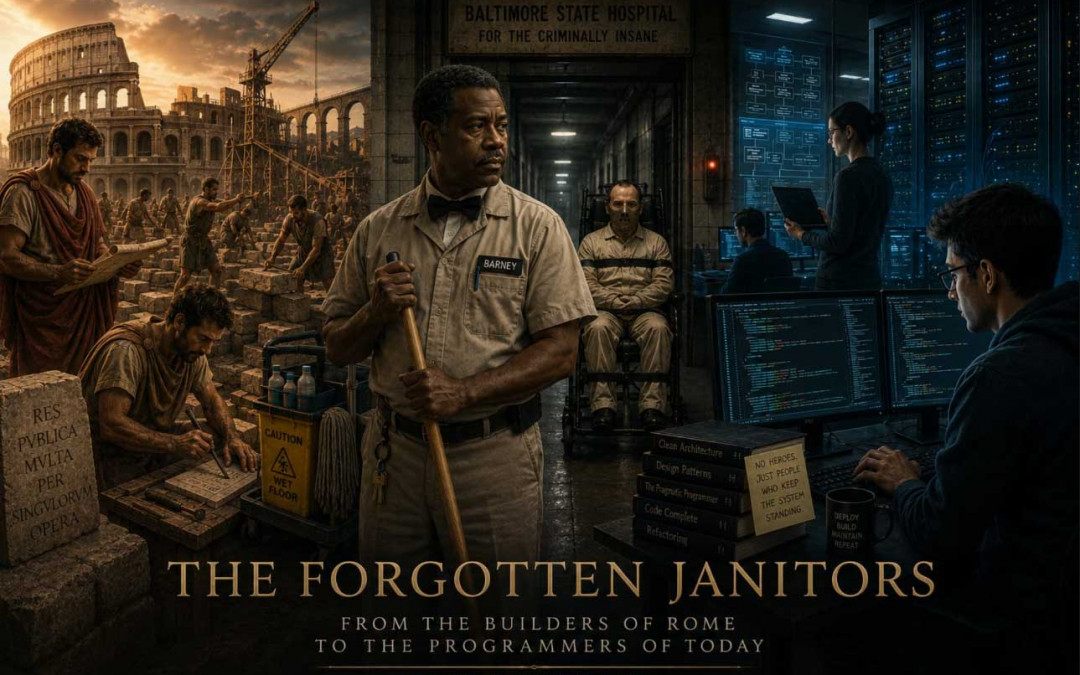
There is a wonderful minor figure in Thomas Harris’s Hannibal Lecter world who offers an unusually good entrance into this problem. Barney Matthews is an orderly at the Baltimore State Hospital for the Criminally Insane. He exists in the gravitational field of one of modern fiction’s most memorable monsters, which is precisely why he is so easy to overlook.
Everybody notices Hannibal Lecter. He is brilliant, dangerous, theatrical and impossible to forget. People enter his orbit wanting information, psychological insight or simply the thrill of standing near something frightening. Lecter dominates the room even when he is locked inside it.
Barney does almost the opposite.
He pays attention.
He learns the procedures. He respects the danger without becoming fascinated by it. He treats Lecter correctly without pretending that this gives him mastery over him. He understands that the institution separating an extremely dangerous man from everyone outside the cell does not depend primarily on courage. It depends on routine, observation, restraint and people who do not become careless because yesterday was uneventful.
That makes Barney useful for something larger than a discussion of The Silence of the Lambs. He represents a category of person almost absent from heroic history: the competent maintainer.
The hero defeats the monster.
The maintainer makes sure the door remains locked tomorrow.
Civilization needs both, but it tells far more stories about the first.
Rome Was Built Every Morning
Ask who built Rome and the question itself encourages the wrong kind of answer. We reach instinctively for emperors: Augustus, Trajan, Hadrian, perhaps Constantine. Their faces survive on coins and marble. Their names divide periods of history. They provide civilization with convenient protagonists.
But an empire cannot be administered by statues.
Rome depended on roads that had to remain passable, aqueducts that required inspection and repair, harbors that needed dredging, taxes that had to be assessed, grain that had to reach cities, military supplies that had to arrive somewhere near the soldiers who required them, legal records that had to remain intelligible, and messages that had to travel across enormous distances. Surveyors, clerks, engineers, soldiers, builders, scribes, local officials, merchants and innumerable laborers converted the idea of an empire into something that could still function the following morning.
This distinction between creation and maintenance is easy to underestimate because the two produce different kinds of evidence. Creation leaves monuments. Maintenance often leaves continuity.
A bridge is visible.
The inspections that kept it standing are not.
A manuscript survives.
The hundreds of decisions that prevented it from being discarded, burned, soaked, eaten by insects or simply forgotten rarely survive beside it.
A library may preserve the name of an author for two thousand years while losing the names of almost everyone responsible for carrying his words across those centuries.
There is something almost comical about this arrangement. Civilization celebrates immortality while depending upon anonymous people to provide it.

The Copyist Behind Aristotle
Consider an old book.
Not a celebrated illuminated manuscript behind glass, but an ordinary historical text that has survived because somebody once decided it was worth copying. Before printing, preserving a work could require another human being to reproduce it by hand. A text that nobody copied eventually faced a simple material problem: its carriers decayed.
This gives intellectual history a hidden population.
Behind philosophers stand copyists.
Behind ancient authors stand medieval manuscripts.
Behind manuscripts stand monasteries, libraries, collectors, translators, cataloguers and scholars who compared damaged versions and tried to reconstruct what an author had actually written. The survival of an idea is therefore not identical to the brilliance of the idea.
Brilliant ideas can disappear.
Mediocre ones can survive.
Information needs a carrier, but the carrier needs care.
That may be one of the least romantic facts about civilization. We like to imagine that great ideas possess some natural force that carries them through history. They do not. They can be misfiled. They can burn. Languages can become unreadable. Formats can become obsolete. Servers can be switched off.
Knowledge does not preserve itself.
Someone has to remember where it is.
The Empire of Maintenance
Creation has a public-relations advantage. A ribbon can be cut when a bridge opens. There is rarely a ceremony after its twelve-thousandth inspection.
A company celebrates the launch of a product, not the employee who quietly repaired the billing system three years later. A city announces a new railway line more enthusiastically than the replacement of the drainage beneath it. Technology journalism celebrates inventions and founders while the mature digital world increasingly depends upon people whose finest achievement is that nothing happened.
The server did not fail.
The attack did not succeed.
The records were not lost.
The aircraft landed normally.
The water remained drinkable.
The patient received the correct medication.
Success in maintenance often takes the grammatical form of a negative.
That makes it culturally difficult to value. Human attention is drawn toward events, while maintenance is designed to prevent events. The better it becomes, the less dramatic the world appears.
This is the paradox of invisible infrastructure: its disappearance from attention is often evidence of its success.
But there is a darker implication. Systems can become so reliable that the people living inside them begin to imagine reliability as a natural property of reality. Water comes from taps. Electricity comes from walls. Information comes from clouds. Food appears in supermarkets. Maps know where we are.
Only failure reveals the machinery.
For a moment, the wall becomes transparent.
And behind it we discover the janitors.
The New Librarian
The digital world did not eliminate this class. It multiplied it.
Civilization now depends upon database administrators, network engineers, cybersecurity teams, data-center technicians, moderators, archivists, software maintainers and people responsible for systems so specialized that most users could not explain what they do. Their tools are different from those of Roman road crews, but their structural position is strangely familiar.
They stand between complexity and collapse.
Artificial intelligence makes the problem larger because the library is becoming too large for any individual librarian to read. Humanity produces scientific papers, images, measurements, messages, software, recordings and documents at a scale no biological mind can personally navigate. The old problem was preserving the book. The newer problem is finding the relevant page inside a library whose shelves expand faster than any reader can walk through them.
This suggests a different way to think about AI.
Not as an artificial god.
Not even primarily as an artificial mind.
As a new kind of librarian.
A good library does not become useful merely because it contains more books. At some point abundance becomes another form of blindness. Ten books can be examined. Ten million require catalogues, indexes, search systems and people—or machines—capable of guiding the reader toward what matters.
Greater knowledge therefore creates a strange requirement.
The larger the library becomes, the better the librarian must become.
That principle reaches beyond libraries. A new kind of criminal requires a new kind of detective. A new network creates a new kind of security specialist. A new level of technological power creates new systems for observing, auditing and maintaining it. Complexity repeatedly produces its own demand for another layer capable of seeing what has become invisible from below.
The janitor climbs with the building.
The Ladder Nobody Notices
This changes the usual picture of progress.
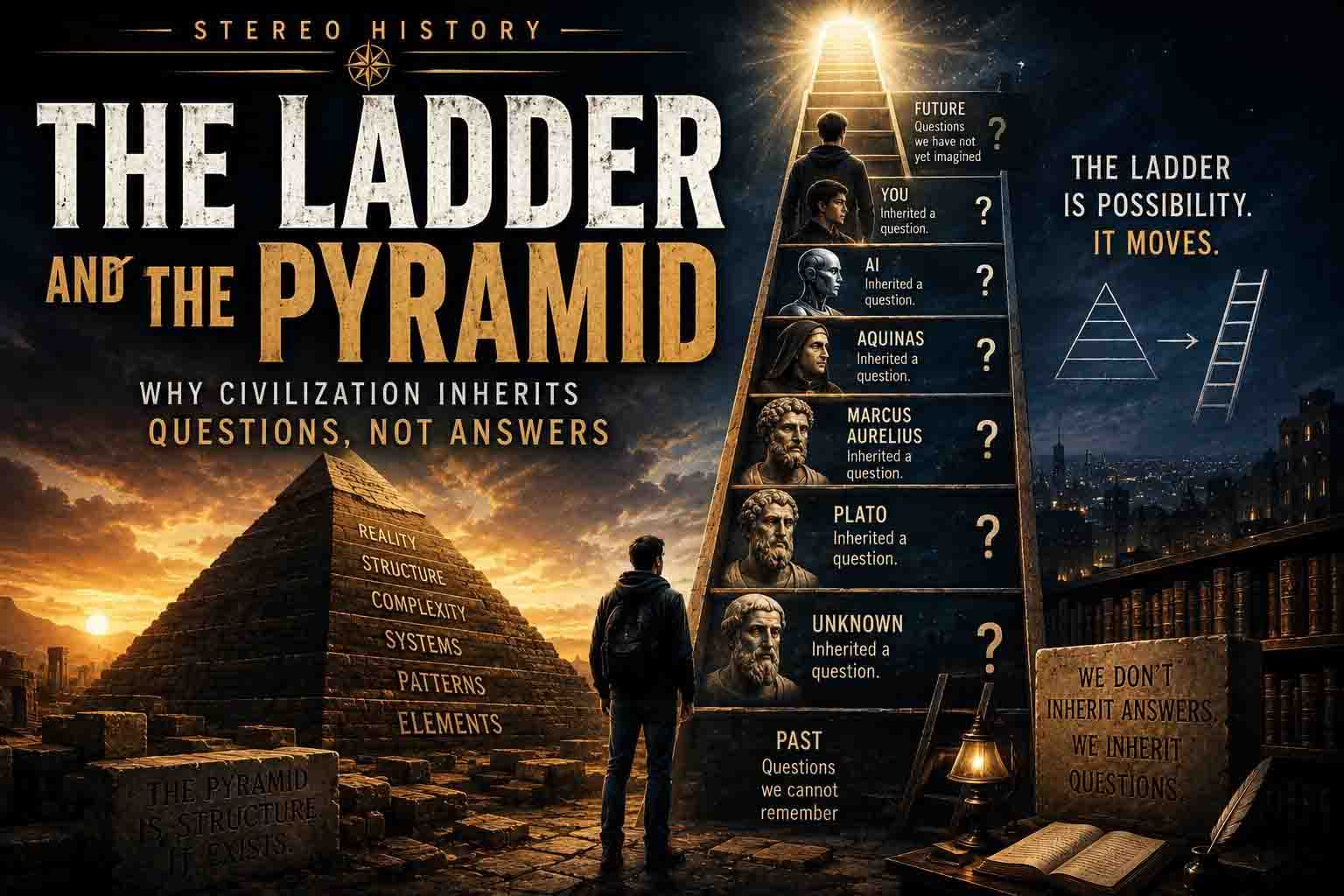
We tend to draw civilization as an ascending line: discovery followed by discovery, invention followed by invention, each generation climbing higher than the last. The image emphasizes the people at the top of the ladder because that is where movement appears to happen.
But ladders have another requirement.
Someone must keep them standing.
Every additional rung creates more structure beneath the climber. Scientific knowledge requires archives, standards, replication and education. Digital civilization requires electricity, networks, cooling systems, protocols and security. Artificial intelligence depends on infrastructures so enormous that the apparently magical interface can hide warehouses of machines, global supply chains and thousands of human decisions.
Progress therefore increases dependence as well as capability.
The higher civilization climbs, the more maintenance accumulates underneath it.
This may be why mature civilizations sometimes appear less heroic than young ones. Their central problem gradually changes. Founding becomes administration. Expansion becomes preservation. Discovery becomes organization. The dramatic question Can we build it? is replaced by the less glamorous question Can we keep it working?
That second question may decide far more.
When Nobody Comes on Monday
There is an old fantasy of civilizational collapse in which everything ends spectacularly: invasion, revolution, asteroid, plague, war. Sometimes systems die more quietly.
The roof leaks and is not repaired.
The archive loses funding.
The experienced technician retires and nobody learns what he knew.
The software library is abandoned.
The bridge inspection is postponed.
The institution retains its name while gradually losing the people capable of performing its function.
Nothing dramatic happens on the first day.
That is precisely the danger.
Creation can occur in a moment. Maintenance is a relationship with time.
Perhaps this is the real reason history underrates its janitors. History likes moments. Civilization depends on repetition.
The emperor can appear once on a balcony.
Someone else has to open the building tomorrow.
Watch The Video
How to Read the World

Current Knowledge
Large civilizations have historically depended on extensive administrative and infrastructural systems in addition to prominent rulers. The Roman world, for example, relied upon roads, water systems, military logistics, taxation, record keeping, engineering and layers of local and imperial administration. The precise organization and effectiveness of these systems varied greatly across periods and regions.
The preservation of ancient literature likewise depended on repeated copying, collecting, translation, cataloguing and later scholarly reconstruction. Many ancient works are known only because manuscripts were reproduced across generations; many others have been lost entirely or survive only in fragments and quotations.
Modern infrastructure exhibits a related dependence on continuous maintenance. Electrical grids, water systems, transport networks, software, archives and digital services require inspection, repair, updating and specialized labor. Reliability is not a permanent property acquired when a system is first built.
Barney Matthews is a fictional character from Thomas Harris’s Hannibal Lecter novels. His use here is literary rather than historical: he represents the competent, largely unnoticed professional whose understanding of routine helps a dangerous institution function.
Open Questions
How much of historical memory’s emphasis on rulers and founders reflects the actual distribution of power, and how much results from the kinds of evidence societies choose to preserve? Can we reconstruct the contribution of anonymous maintainers when the records themselves were usually created around elites?
There is also a technological problem. As modern infrastructure becomes more automated, does maintenance disappear or merely migrate into less visible forms? AI may reduce some forms of routine human work while creating entirely new requirements for supervision, verification, security and preservation.
A still larger question concerns knowledge. If humanity produces more information than any individual can inspect, who—or what—should determine which information deserves attention? A librarian helps us navigate abundance, but every catalogue and recommendation system also introduces selection, hierarchy and potential bias.
The better the librarian becomes, the more important it becomes to understand the librarian.
Transhumation Interpretation
Transhumation often treats civilization as a migration of functions between carriers. Memory moves from the biological mind into writing, libraries and digital storage. Calculation moves from the brain into machines. Observation moves into sensors. Increasingly, navigation through knowledge moves into artificial intelligence.
The forgotten janitor reveals the other half of that process.
Every migrated function eventually requires a maintainer.
A library requires a librarian. A network requires an administrator. A civilization built from increasingly complex informational systems requires something capable of observing those systems from another level.
This is where the ladder becomes interesting.
A new level of complexity creates problems that cannot always be solved comfortably from the level below it. New kinds of crime produce new kinds of policing. New technologies produce new forms of security. A library containing more knowledge than any individual can absorb produces the need for better systems of navigation.
In that limited structural sense, the guardian is always +1.
Not omniscient.
Not divine.
Simply one level higher than the problem it must be able to see.
AI may become part of that next maintenance layer: not the replacement for human judgment and not a god sitting above civilization, but an interface through a library that has become too large for a single human reader.
Perhaps the future will not belong entirely to the people who create the most powerful systems.
It may belong equally to those who learn how to maintain them, question them, preserve them and know where to look when something stops working.
History remembers who climbed highest.
Civilization survives because somebody held the ladder.
FAQ
What are “The Forgotten Janitors”?
They are the often-unnoticed people who preserve, repair, organize and maintain the systems civilization depends upon.
Why use Barney from The Silence of the Lambs?
Barney represents competent maintenance without spectacle: someone who understands a dangerous system because he observes it carefully and performs his role consistently.
Why is maintenance so important?
Creation establishes a system once. Maintenance allows it to continue functioning through time.
Why are librarians central to the argument?
Information does not become useful merely by existing. It must be preserved, organized and made navigable.
Can AI become a kind of librarian?
AI can already help search, organize and interpret information at scales difficult for individuals to navigate, although its outputs still require evaluation and can contain errors or bias.
What does “the guardian is always +1” mean?
It describes the recurring need for a new level of observation or maintenance when a system becomes too complex to manage comfortably from within its previous level.
How does this connect to Transhumation?
It suggests that when human functions migrate into larger technological systems, maintenance must migrate with them. Civilization needs not only new capabilities, but new caretakers.
What is the central idea?
History celebrates creation, but continuity depends on maintenance. The higher civilization climbs, the more it depends on people and systems most of us never notice.
Continue the Transhumation Series
- Forgotten Religion | Ancient Gods, Symbols and the Hidden Structures of Human Civilization
- The Last Religion | Death, Immortality and the Future of Humanity
- The New Theurgy | AI, Information and the Future of Human Civilization
- End of Branding: You Were Never Meant to Become a Product
- Baal vs Ishtar: Why Ancient Gods Never Disappeared