
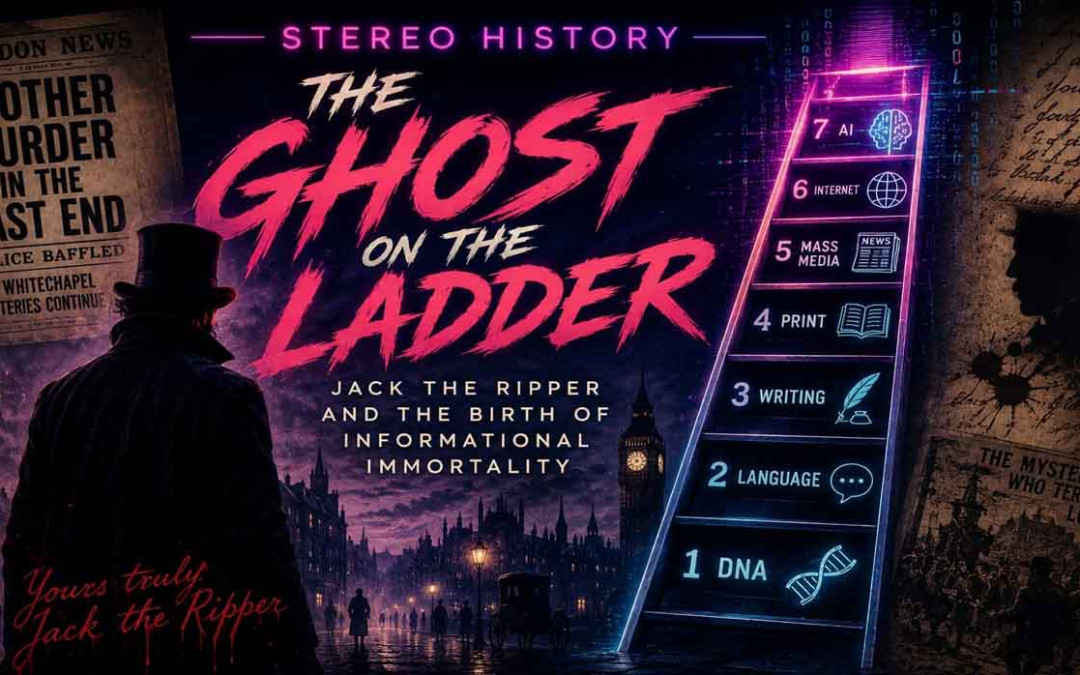
The Ghost on the Ladder
Somewhere in London, in the autumn of 1888, there was an ordinary physical man.
However extraordinary his actions were, his existence was probably mundane in the biological sense. He had a body that became tired, clothes that became wet, a voice heard by people who knew him, habits, meals, perhaps employment, perhaps family, and a face that would have been unremarkable to many of those who passed him in the street. He occupied one place at a time. He could not see through walls or disappear into air. Eventually, like every person alive in Victorian London, he died.
That man has almost completely vanished.
In his place stands somebody else.
Jack the Ripper possesses no authenticated face, no confirmed biography and no grave that can be visited. Even the famous voice attached to him through letters may belong largely or entirely to other people. Yet he remains immediately recognizable across cultures more than a century later. He has a name, silhouette, atmosphere, geography and repertoire of phrases. He inhabits books, films, websites, tours, documentaries and thousands of competing theories. The historical individual is missing, while the representation has become almost impossible to remove.
This is usually treated as one of the curiosities of an unsolved murder case.
It may also be an unusually clear example of something civilization does constantly.
A person disappears.
A pattern remains.
The difficult question is whether the surviving pattern has preserved the person—or replaced him.
A Ladder Made of Carriers
Human beings have always struggled against the small radius of an individual life. A voice disappears when the speaker stops talking. A gesture vanishes when the hand becomes still. Memory dies with the organism unless another organism learns enough of it to continue something afterward.
Civilization developed increasingly elaborate ways of interfering with that disappearance.
Language allows experience to be compressed into forms another mind can partially reconstruct. Writing allows language to survive the absence of the speaker. Copying allows the text to survive the destruction of one manuscript. Printing multiplies carriers until the survival of one physical copy matters less. Photography preserves selected visual traces. Recording separates a voice from the moment in which it was produced. Digital systems make copying and re-instantiation extraordinarily cheap.
This is not a staircase from matter toward spirit.
Every stage remains physical.
The papyrus is matter. The printing press is matter. A server farm is matter. A digital archive consumes energy and occupies buildings. Information does not escape physics simply because its carrier becomes less obvious to the user.
What changes is dependence on one particular carrier.
Destroy one printed copy of Hamlet and Hamlet remains.
Break one hard drive and a sufficiently replicated archive remains.
The pattern survives because another carrier can instantiate enough of the relevant structure.
That is the ladder worth climbing.
And the Ripper case shows something stranger still: sometimes the pattern that survives is not a faithful preservation of the original.
Sometimes it is a cultural construction built around the hole where the original should have been.
The Man Became Smaller as the Archive Became Larger
Most historical figures become more defined as evidence accumulates.
Letters establish relationships. Portraits stabilize appearance. Addresses place a person geographically. Official documents provide dates. Diaries reveal private habits. A biography gradually acquires boundaries.
Jack the Ripper behaves almost perversely in the opposite direction.
The archive grows.
The man does not.
We possess police records, contemporary newspapers, witness accounts, medical discussions, maps, photographs of locations, correspondence, memoirs, suspect files and more than a century of subsequent research. Yet the central historical identity remains unresolved.
This produces an unusual imbalance.
The representation becomes denser while the referent remains absent.
Normally we expect additional information to reduce possibility. In the Ripper case, cultural information often creates more of it. New documents generate new interpretations. Old contradictions acquire new explanations. Another suspect enters. Another handwriting comparison appears. Another geographic theory reorganizes the streets.
The cultural Jack expands because the historical Jack remains constrained by silence.
This is why the phenomenon resembles a ghost more than a conventional biography. The shape becomes visible precisely where the body is missing.
But ghosts are created by observers too.
That qualification is everything.

The Voice That May Never Have Been His
The most intimate part of a surviving person is often the voice.
A photograph shows appearance.
Writing can reveal vocabulary and habits of thought.
A recording brings cadence, timing and personality startlingly close.
Jack the Ripper appears to possess such a voice.
The famous correspondence seems to speak directly from the murderer to the audience. The taunting tone, jokes, threats and theatrical signature create the impression of a character enjoying the spectacle surrounding him.
But the historical foundation is unstable.
Many Ripper letters were hoaxes. The authenticity of the most famous correspondence remains doubtful. We therefore cannot safely take the voice familiar from popular culture and place it inside the mind of the murderer.
This produces one of the case’s most remarkable inversions.
The surviving voice may be evidence not of the killer’s informational immortality, but of the audience’s ability to manufacture a personality for an absent person.
A stranger writes a letter.
The newspaper reproduces it.
The name becomes famous.
Other correspondents imitate the tone.
Later writers inherit the character.
Eventually millions of people can recognize a personality whose relationship to the original murderer may be negligible.
The supposed preserved self may actually be an accumulated mask.
This is a far more interesting warning for the information age than the idea of a Victorian criminal cleverly inventing personal branding.
A Ghost With Many Authors
Jack the Ripper may therefore be better understood as a case of distributed authorship.
The unknown murderer contributed the indispensable physical events.
Journalists contributed narrative framing.
Hoaxers may have contributed the name and voice.
Illustrators contributed faces.
Police activity created another layer of documentation.
Public fear supplied interpretations.
Later historians imposed chronology and classification.
Novelists supplied motives.
Cinema supplied atmosphere.
Tourism supplied geography.
The internet supplied endless recombination.
No single person wrote the final character.
There is no final character.
The Ripper is continuously reconstructed.
This is where the idea of an informational organism becomes tempting, provided we keep it metaphorical. A cultural pattern can reproduce by being copied from one medium into another. During copying it changes, yet enough features remain stable for recognition.
Whitechapel.
A hidden murderer.
A knife.
Fog, even when historical London may not have been conveniently foggy at the required moment.
The name.
The letters.
The hunt.
The unknown face.
Some of these elements belong strongly to historical evidence.
Others belong more strongly to cultural memory.
Together they create a package durable enough to migrate.
The Victorian killer does not need to be present for the package to continue.
The Reaper, the Ripper and the Seduction of Symbols
The similarity between Ripper and the older image of the Reaper is almost irresistible.
The Grim Reaper is death given a body: skeleton, robe, scythe, harvest. Jack the Ripper becomes another linguistic figure attached to killing. It is easy to imagine a symbolic evolution in which the ancient harvester of lives walks off a church wall and enters the newspaper.
As interpretation, the image is powerful.
As history, it needs restraint.
We cannot assume the creator of the name “Jack the Ripper” deliberately intended a transformation of the Grim Reaper. Linguistic resemblance is not evidence of symbolic genealogy.
And that distinction illustrates the larger Transhumation method perfectly.
Symbols invite connection because they compress relationships efficiently.
Reaper.
Ripper.
Death.
Blade.
Anonymous figure.
The structure feels satisfying.
But structural fit must survive an attempt to disprove it.
If no historical chain connects the names, we should preserve the comparison as a modern interpretive lens rather than convert it into an origin story.
The symbol becomes more valuable, not less, once we stop pretending association is evidence.
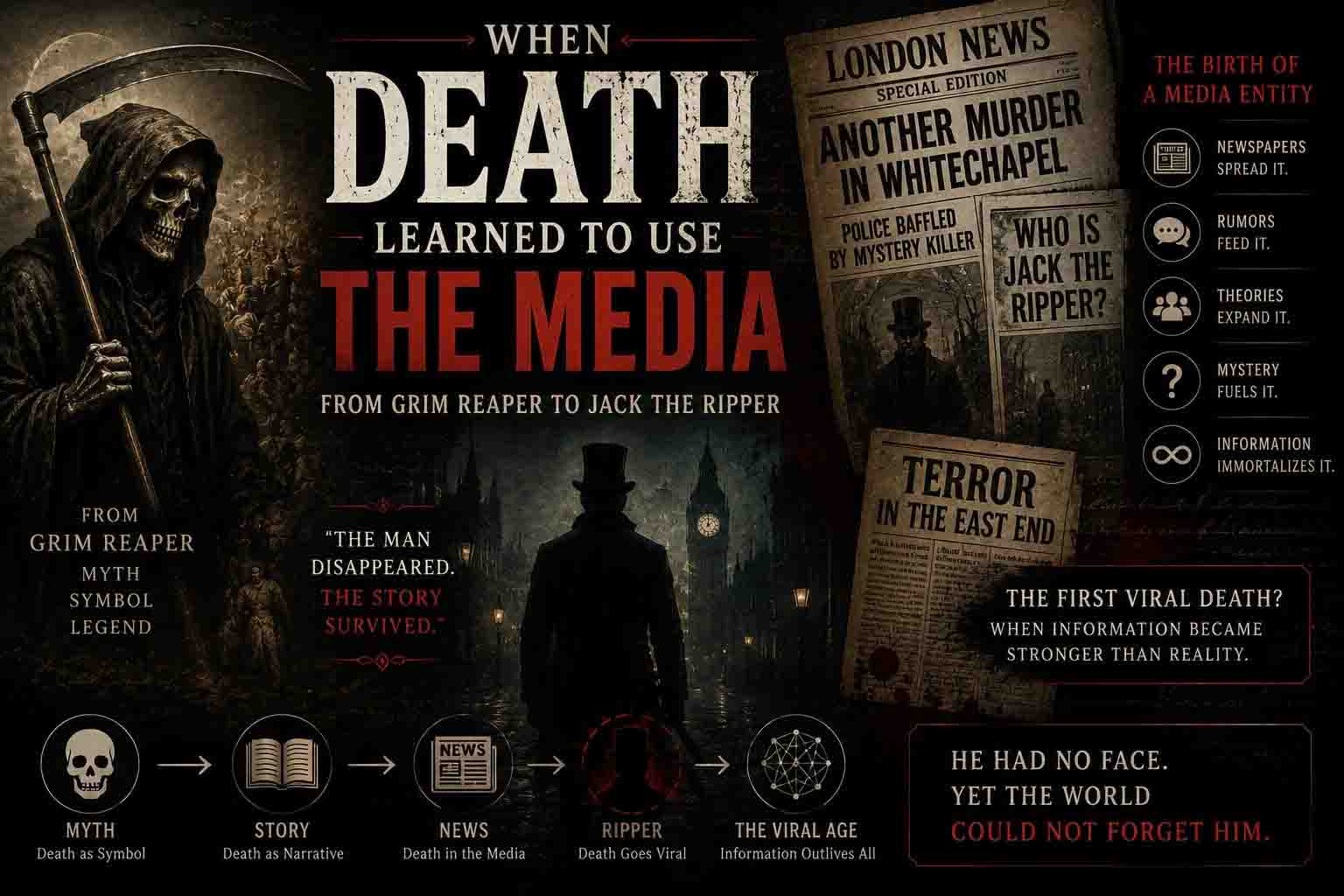
The First Viral Ghost Was Not the First
Calling Jack the Ripper “the first viral ghost” has the same problem.
Humanity had viral stories long before Victorian newspapers.
Religious movements spread through networks.
Rumors crossed kingdoms.
Political pamphlets multiplied.
Songs and legends traveled without identifiable authors.
Earlier crimes generated enormous public fascination.
Whitechapel did not invent self-replicating information.
What makes the case unusual is the combination of mass journalism, anonymity, urban density, rapid communication, public participation and permanent unresolvedness.
A cultural figure became globally recognizable without a verified person to stabilize it.
That is closer to the modern digital condition.
An anonymous account can become influential without revealing its owner.
A meme can spread while its creator disappears.
A phrase can survive detached from its original context.
A digital persona can possess social reality without a stable physical identity visible to its audience.
But the Ripper did not “understand” this system ahead of his civilization unless evidence someday demonstrates deliberate manipulation of it.
The more defensible claim is almost the opposite.
The system discovered what it could do with him.
Informational Immortality Is Not Personal Immortality
This is where the article has to become uncomfortable.
Jack the Ripper is, in one sense, extraordinarily successful at surviving.
But what survived?
Probably not the consciousness of the murderer.
Not his biological life.
Not necessarily his true voice.
Not his secure appearance.
Not even his name.
What survived is a cultural construction connected to actions once performed by a living person.
That is informational immortality in its weakest and safest sense: a pattern continues producing effects after its physical origin is gone.
Horace has that kind of immortality.
So does Shakespeare.
So does an anonymous folk song.
So does a scientific theorem associated with a dead mathematician.
But even here the cases are different. With an author, surviving works can preserve genuine structures produced by that person. With the Ripper, much of what survived may have been produced by other people around an absence.
The distinction becomes crucial when we begin speaking about digital identity.
A future system may preserve someone’s photographs, speech, messages, preferences and writing. It may eventually generate new responses resembling that person with extraordinary precision.
That system could become culturally immortal.
The person might still be dead.
A representation capable of surviving indefinitely is not automatically a continuation of the observer who originally produced the traces.
The Ripper case demonstrates the extreme version of this problem because the representation survived without even preserving a reliable original identity.
The Ghost in the Machine Is Sometimes the Audience
Imagine giving an advanced artificial intelligence everything that survives from Whitechapel.
Police reports.
Maps.
Witness statements.
Medical testimony.
Newspapers.
Letters.
Suspect biographies.
Weather records.
Transport patterns.
Victorian directories.
The system might discover relationships human investigators missed. It might eliminate weak hypotheses. It might help distinguish dates, handwriting clusters or geographic possibilities.
That would be useful historical work.
But it could also do something much more seductive.
It could construct a coherent man.
Give him a face.
A voice.
A manner of speaking.
A psychological profile.
A route through the streets.
Perhaps even an explanation for every contradictory clue.
The reconstruction might become so elegant that uncertainty begins to feel like an inconvenience removed by intelligence.
That would be dangerous.
Because history does not owe us completeness.
Sometimes the correct shape of knowledge contains a hole.
A good AI librarian should therefore do something more difficult than fill gaps. It should preserve the difference between documented fact, probable inference, speculation and imaginative reconstruction.
The Ripper is an ideal test.
The archive encourages completion.
Good historical method sometimes demands refusal.
Watch The Video
How to Read the World
Current Knowledge
The identity of the Whitechapel murderer known as Jack the Ripper remains unproven. No authenticated portrait, biography or grave can therefore be securely assigned to him.
The name “Jack the Ripper” became famous through correspondence claiming to come from the murderer, particularly the “Dear Boss” letter. The authenticity of that correspondence is doubtful, while many other Ripper letters were certainly or very probably hoaxes. The famous literary voice associated with the killer cannot consequently be treated as a verified expression of his personality.
The Whitechapel murders occurred within an expanding mass-media environment characterized by competitive newspapers, relatively rapid information circulation and substantial public participation. Sensational crime reporting and famous criminals existed earlier, however, so the case should not be described as the invention of media crime or virality.
Cultural representations of the Ripper accumulated far beyond the historical evidence. Film, literature, illustration and later popular culture helped create recognizable visual and psychological conventions despite the absence of an authenticated identity.
Information always requires physical carriers. The persistence of the Ripper story does not demonstrate the independence of information from matter; it demonstrates the ability of a pattern to be repeatedly instantiated across different material and cultural media.
Open Questions
The most important historical question remains whether the murderer deliberately interacted with the media environment surrounding the crimes. If any major letter were eventually authenticated, the interpretation of the Ripper as a consciously performative offender would become substantially stronger. At present, the evidence does not justify treating that hypothesis as established.
A second question concerns the degree to which the persona can be separated from the murderer. If the famous name, voice and several behavioral assumptions originated outside the offender, then the cultural Jack the Ripper may tell us at least as much about Victorian media and later audiences as about the person responsible for the killings.
There is also a broader problem of informational survival. When a cultural pattern changes each time it moves into another medium, how much continuity is necessary before we can still call it the same pattern? The cinematic Ripper, historical Ripper and internet Ripper share recognizable structures while differing enormously in factual reliability.
Finally, artificial intelligence raises a methodological question rather than merely a technological one. Can increasingly powerful reconstruction tools help us recover lost historical structure without quietly transforming uncertainty into synthetic certainty?
Transhumation Interpretation
The Ghost on the Ladder belongs to Transhumation because it provides a near-perfect warning about the difference between survival of a pattern and survival of a person.
Civilization is extraordinarily good at preserving traces.
A voice can be recorded.
A face photographed.
A letter copied.
A book digitized.
A style modeled.
A biography reconstructed.
Each operation extends something beyond the biological lifetime of its originator.
But the Ripper case shows how dangerous the word something is.
The pattern that survives may not be the pattern we think we preserved.
A voice can belong to a hoaxer.
A portrait can belong to the wrong suspect.
A famous anecdote can originate decades later.
A coherent personality can emerge from fragments produced by several unrelated people.
Enough repetition can make the construction feel original.
Informational immortality therefore has no automatic relationship with truth.
This is one of the boundaries Transhumation needs.
The dream of preserving a person through information becomes much less simple once we recognize that archives do not merely retain people. They also generate models of people.
Those models can improve with evidence.
They can also drift.
Imagine a digital reconstruction becoming slightly wrong in one generation.
The next generation trains on the reconstruction.
The error becomes part of the inherited pattern.
Eventually the copy may be extraordinarily stable and historically false.
Continuity has been achieved.
Fidelity has not.
That is why the future of digital memory requires provenance as much as storage.
We will need to know where a trace came from, which parts are direct records, which are interpretations and which have been generated to bridge missing information.
Otherwise a sufficiently sophisticated archive can become another portrait of Dorian Gray: immaculate on the surface while the history of its distortions accumulates somewhere out of sight.
The Ripper offers an even stranger variation.
There may never have been one original public persona to preserve.
The persona emerged from interaction among murderer, media, police, public and later culture.
The “ghost” therefore does not stand above the ladder looking down at the body it escaped.
The ghost is what the ladder assembled while carrying fragments upward.
That changes the meaning of informational immortality.
Perhaps no human being becomes immortal through information in any simple sense.
What becomes durable is a model.
Sometimes the model remains close to its source.
Sometimes it becomes a symbol.
Sometimes, as with Jack the Ripper, the source can disappear almost completely while the symbol becomes clearer with every generation.
And this may eventually become one of the defining problems of artificial intelligence.
AI will make it easier to animate archives.
To let dead writers appear to answer.
To reconstruct missing voices.
To infer faces.
To turn incomplete lives into conversational models.
These technologies may be magnificent tools for navigating civilization.
But the better the reconstruction becomes, the more carefully the librarian must guard the difference between presence and evidence of presence.
Jack the Ripper did not escape death.
We do not even know who died.
What escaped was the story.
It crossed newspapers, books, cinema, television and networks until the unknown Victorian man became less visible than the structure built around him.
That is the ghost on the ladder.
Not a murderer ascending beyond the human condition.
A cautionary pattern moving from carrier to carrier, asking a question that becomes more urgent the better our machines become at preserving us:
when the representation remains after the person is gone, what exactly has survived?
FAQ
What does “The Ghost on the Ladder” mean?
It refers to the cultural Ripper persona continuing across successive media even though the historical individual behind it remains unidentified.
What is informational immortality?
It is the survival of information, stories or recognizable patterns beyond the lifetime of the person associated with them. It should not be confused with continued consciousness.
Did Jack the Ripper deliberately create his public persona?
We do not know. The authenticity of the famous letters is doubtful, so there is no secure basis for claiming that the murderer intentionally created the “Jack the Ripper” character.
Why call the Ripper a “ghost”?
Because the cultural figure is unusually vivid while the underlying historical person is unusually inaccessible. The word is metaphorical, not supernatural.
How does this relate to artificial intelligence?
AI can make historical reconstruction much more powerful, but it can also make uncertain reconstructions appear complete. Provenance and clear separation of evidence from inference therefore become increasingly important.
What is the deeper Transhumation question?
A pattern can survive its original carrier. The Ripper case demonstrates that dramatically.
But it also demonstrates the danger.
The pattern that survives may no longer be the person who produced it. It may be the person civilization constructed afterward.
Continue the Transhumation Series
- Forgotten Religion | Ancient Gods, Symbols and the Hidden Structures of Human Civilization
- The Last Religion | Death, Immortality and the Future of Humanity
- The New Theurgy | AI, Information and the Future of Human Civilization
- End of Branding: You Were Never Meant to Become a Product
- Baal vs Ishtar: Why Ancient Gods Never Disappeared