
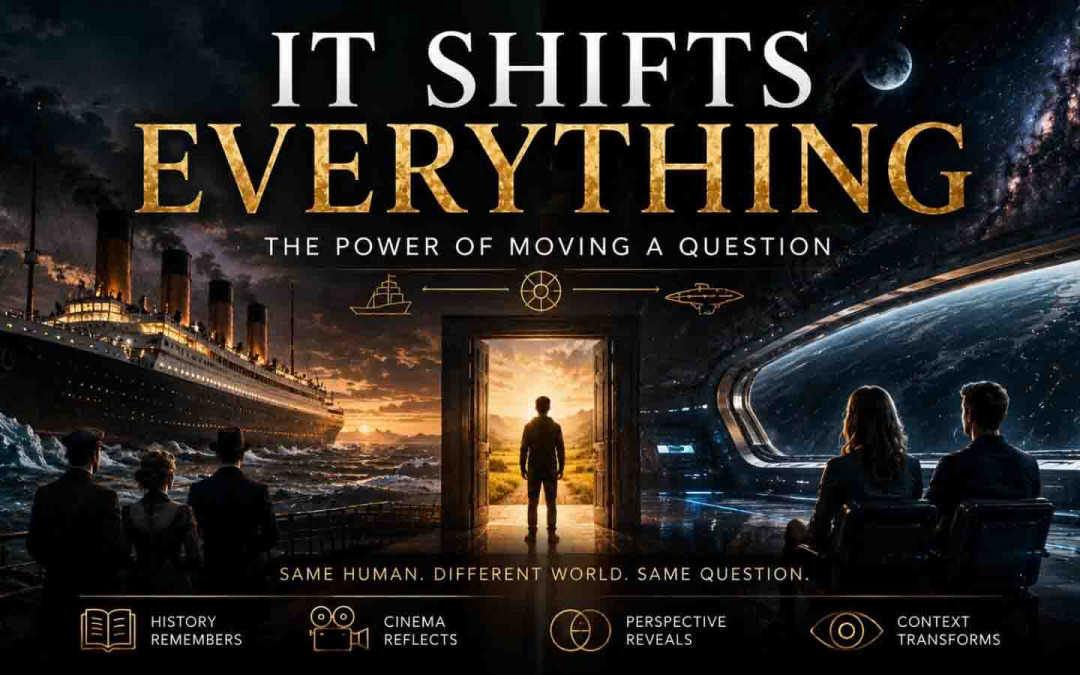
Most people believe that progress happens when humanity discovers completely new ideas.
A new technology.
A new philosophy.
A new form of art.
A new world.
But sometimes the greatest discoveries happen in the opposite direction.
Nothing new is added.
Only the perspective changes.
And suddenly…
it shifts everything.
The Titanic That Flew Into Space
At first glance, Titanic and Passengers have almost nothing in common.
One is a historical drama.
The other is science fiction.
One takes place on an ocean.
The other travels between stars.
One lasts a few hours.
The other lasts a lifetime.
Yet beneath the surface they ask the same question:
What does a human being do when there is no escape?
On Titanic, the disaster arrives in two hours.
The rescue will come too late.
In Passengers, the destination will arrive in ninety years.
The rescue will also come too late.
The scale changes.
The technology changes.
The century changes.
But the human problem remains.
It shifts everything.
The Same Story Wearing Different Clothes
This pattern appears everywhere.
Ancient myths become modern films.
Old fears become new monsters.
Ancient gods return as psychological concepts, technological metaphors, and cultural symbols.
A vampire is not only a creature drinking blood.
It is humanity asking what it means to escape time.
Frankenstein is not only a monster.
It is the fear that our greatest achievements may create consequences we cannot control.
Artificial intelligence is not only a machine.
It is another version of an ancient question:
What happens when humanity creates something that surpasses itself?
The Grammar of Humanity
Perhaps stories work like language.
The words change.
The grammar remains.
Every civilization takes the same human being and declines him through different cases.
Through love.
Through death.
Through power.
Through loneliness.
Through technology.
Through immortality.
The costumes change.
The stage changes.
The actors change.
But the human question remains.
Why We Need New Worlds
Cinema, mythology, religion, and science fiction do not exist to escape reality.
They exist because reality is difficult to see directly.
A small shift can reveal a hidden structure.
A ship becomes a spaceship.
A god becomes an algorithm.
A monster becomes a machine.
A fairy tale becomes a social experiment.
And suddenly we recognize something we did not see before.
The Eternal Human
Maybe the greatest stories survive because they are never truly about their worlds.
They are about ours.
Every age builds new mirrors.
Every civilization creates new symbols.
Every generation tells the same stories again.
Not because humanity lacks imagination.
But because the deepest questions are still waiting for new answers.
Sometimes all it takes is a small shift.
And it changes everything.
Want to Explore More..?
Watch The Video Below
Cotninue reading...
Fear of Creation
FAQ
What does “It Shifts Everything” mean?
It means that a small change in perspective can completely transform the way we understand a problem, a story, or even ourselves.
How are Titanic and Passengers connected?
They are not the same story, but they explore the same human problem under different conditions: what happens when people face a future they cannot escape.
Why do old stories appear in new forms?
Because human experiences remain similar while civilizations create new technologies, symbols, and environments to explore them.
Is science fiction really about the future?
Often science fiction is not about the future itself. It is a mirror that allows us to examine timeless human questions through new circumstances.
How does this idea connect history, mythology, and cinema?
By treating them as different versions of the same human experiences expressed through different symbols, eras, and technologies.
Continue the Transhumation Series
Explore the full journey:
- End of Reality — Where Do You Really Exist?
- End of Physics — Are the Laws of Reality Real?
- End of the Real World — Reality Is No Longer Required
- End of Consciousness — Beyond the Human Mind
- End of Death — When Human Limits Disappear
- End of Religion — When Technology Replaces Faith