
Imagine writing a letter.
Not to your children.
Not to your friends.
Not even to your descendants.
Imagine writing a letter to someone who may live a thousand years from now.
Someone whose language you do not know.
Someone whose world you cannot imagine.
Someone who may not even be human.
Why would you do it?
The answer reveals something strange about humanity.
We constantly communicate with people we will never meet.
And we have been doing so for thousands of years.
Horace's Impossible Prediction
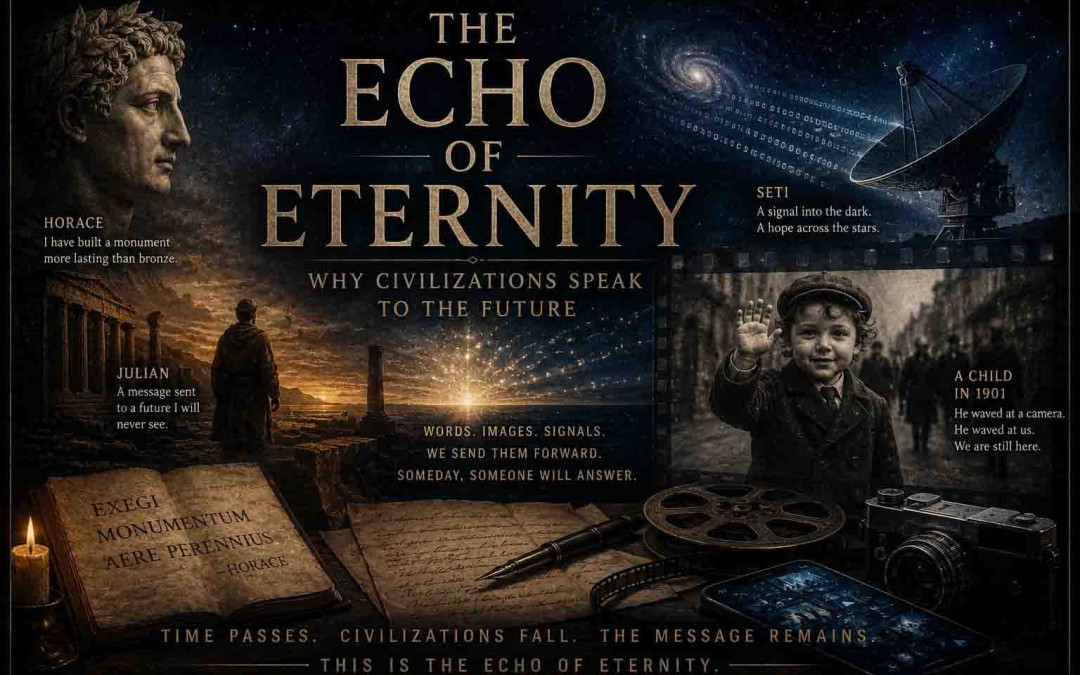
More than two thousand years ago, the Roman poet Horace made a remarkable claim.
He believed his work would survive.
Not for decades.
Not for centuries.
For ages.
At the time, this seemed absurd.
Rome appeared eternal.
Its armies ruled the Mediterranean.
Its institutions seemed indestructible.
Yet Horace understood something deeper.
Empires survive through matter.
Ideas survive through information.
Today the empire is gone.
The poet remains.
His words crossed a bridge that bronze and marble could not.
Julian's Audience
When Emperor Julian attempted to revive the ancient world, he believed he was speaking to his own generation.
History proved otherwise.
Most people today know Julian not because he succeeded.
But because he failed.
His story became a message.
A signal.
A warning.
A question.
His audience was not Rome.
His audience was the future.
Like many historical figures, he spent his life talking to one world and ended up speaking to another.

The Strange Nature of Communication
Communication is usually imagined as something immediate.
One person speaks.
Another person listens.
The exchange happens now.
But history suggests another possibility.
Messages can travel through centuries.
A book is delayed communication.
A monument is delayed communication.
A painting is delayed communication.
A film is delayed communication.
The people who created them may be gone.
The conversation continues anyway.
Nietzsche's Abyss
Nietzsche famously warned that when you gaze into the abyss, the abyss gazes back.
Most people interpret this psychologically.
But technology gives the metaphor another meaning.
When we look into the past, the past looks back.
Old photographs.
Ancient texts.
Forgotten films.
Letters.
Voices.
Faces.
They continue influencing us long after their creators disappear.
The abyss is not empty.
It is filled with echoes.
The Largest Message Ever Sent
Perhaps the most ambitious version of this idea is SETI.
The Search for Extraterrestrial Intelligence is often described as a scientific project.
It is also something else.
It is humanity attempting to communicate beyond history itself.
The distances involved are almost incomprehensible.
A message may require centuries to arrive.
A response may require centuries more.
The original sender may be long gone before an answer appears.
Yet we send the message anyway.
Why?
Because communication is not merely practical.
It is existential.
The act itself matters.
Children Waving at the Future
Old films often reveal something unexpected.
Children wave.
Workers smile.
Pedestrians stare into the camera.
Most never imagined that people from another century would watch them.
Yet we do.
Their faces survive.
Their gestures survive.
Their emotions survive.
The signal arrived.
The future answered.
Not with words.
But with attention.
The Internet and the New Echo
The internet transformed this process.
For most of history, only a few people could send messages across time.
Poets.
Kings.
Artists.
Religious leaders.
Today billions participate.
Every photograph.
Every video.
Every article.
Every comment.
Every uploaded memory.
Each becomes part of a growing archive.
Humanity is constructing the largest echo chamber in history.
Not an echo chamber of opinions.
An echo chamber of presence.
The Real Meaning of Eternity
Perhaps eternity is not endless life.
Perhaps eternity is influence.
A sentence that changes someone.
A photograph that survives.
A voice that remains audible.
A film that continues to inspire.
A civilization that still speaks after disappearing.
Maybe immortality was never the point.
Maybe the goal was always communication.
The desire to remain present.
The desire to leave a trace.
The desire to send one more message into the darkness.
And hope that someday, somewhere, someone hears it.
That is the echo of eternity.
Want To Explore More?
Watch The Video Below
Continue reading...
End of Death
FAQ
What is the Echo of Eternity?
The Echo of Eternity is the human attempt to communicate beyond its own lifespan through stories, monuments, art, technology, and information.
Why do people leave messages for the future?
Humans naturally seek continuity. Messages, books, films, and monuments allow ideas to survive longer than individuals.
How does Horace relate to modern technology?
Horace understood that information can outlive physical structures. The same principle powers books, photography, film, the internet, and AI.
Is SETI connected to the Echo of Eternity?
Yes. SETI is an attempt to send or receive messages across immense distances and timescales, extending humanity's desire for communication beyond Earth.
Can information become immortal?
Information can survive much longer than biological life, although whether this constitutes immortality remains an open question.

Continue the Transhumation Series
Explore the full journey:
- End of Reality — Where Do You Really Exist?
- End of Physics — Are the Laws of Reality Real?
- End of the Real World — Reality Is No Longer Required
- End of Consciousness — Beyond the Human Mind
- End of Death — When Human Limits Disappear
- End of Religion — When Technology Replaces Faith