
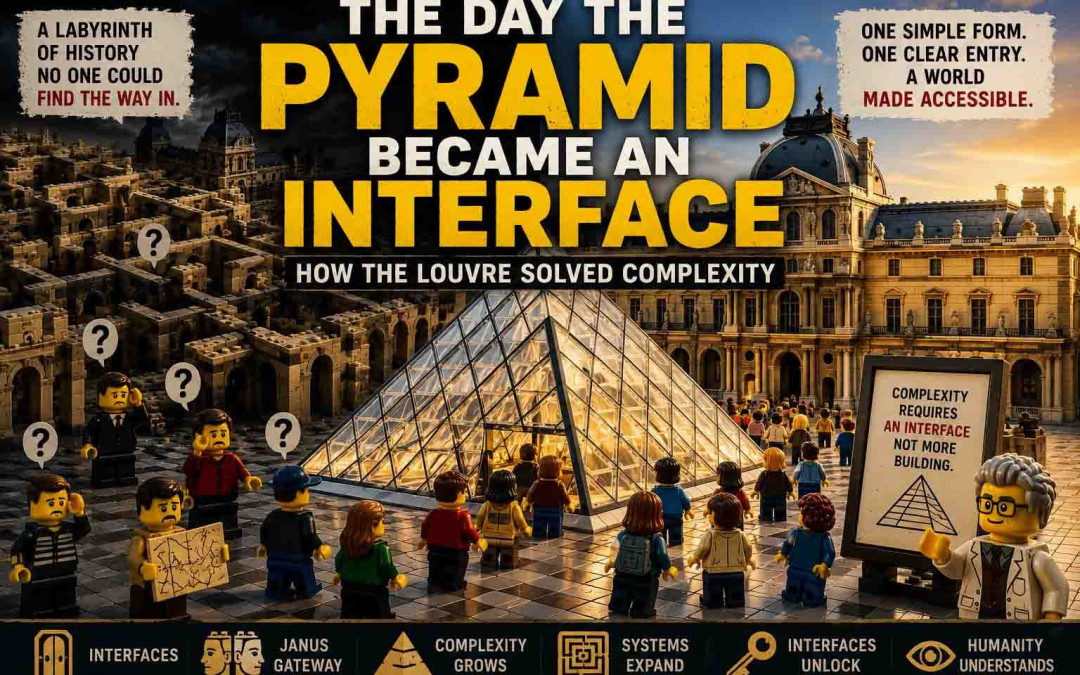
The Building Without Door
Stand in the Cour Napoléon and the first surprise is not that the pyramid is modern.
It is that it is so simple.
Around it stretches a palace created through centuries of political ambition, architectural change, dynastic taste and institutional reinvention. The Louvre contains courtyards, façades, galleries, staircases, wings and historical layers that no single visitor could hold mentally on arrival. Its collections deepen the complexity further: civilizations, dynasties, schools of painting, archaeological worlds, decorative arts, royal apartments and objects separated from one another by thousands of years.
Then, in the middle of all this accumulated history, appears a geometric form a child can understand immediately.
Triangle.
Glass.
Entrance.
That contrast explains more about the Louvre Pyramid than arguments about whether it belongs aesthetically beside the old palace. The pyramid’s most important achievement is not that it added another monumental form to Paris. It is that it gave an extraordinarily complicated institution a single legible point of approach.
It did not simplify the Louvre.
It simplified the act of entering it.
And that is what interfaces do.
Why Was the Louvre Pyramid Built?
The Louvre was never designed in one historical moment to serve one permanent function.
Its architecture accumulated. A medieval fortress became a royal palace; the palace was expanded and altered; after the French Revolution the Louvre developed into a public museum, and later generations continued modifying the institution around changing political, cultural and practical needs. By the twentieth century, the Louvre was not simply a historic building containing art. It was an enormous cultural system operating inside architecture inherited from other purposes.
The Grand Louvre project of the 1980s confronted this problem at a scale large enough that another doorway would not have been enough. When the museum expanded into spaces including the Richelieu wing, circulation, reception and access had to be reorganized for a vastly larger institution.
This is the detail that makes the project philosophically interesting.
The pyramid does not contain the solution.
The glass structure announces where the solution begins.
Most of the organizational work happens beneath it.
The visible object is remarkably simple because the invisible system is not.
What Problem Did the Louvre Pyramid Solve?
The obvious answer is visitor access.
The more interesting answer is cognitive access.
A complex building creates two different problems. The first is physical: how do large numbers of people enter, gather, pass security and move toward different destinations? The second is psychological: when a person arrives for the first time, how do they know where the journey begins?
These problems are related, but they are not identical.
A building can function physically while remaining conceptually confusing. A visitor may have access to every gallery and still lack a mental model of how the galleries relate to one another. The system is open, yet not legible.
The pyramid provides orientation before it provides information.
That is an underestimated function.
Human beings approaching complexity need anchors. We need a recognizable beginning, a manageable first choice, a map that reduces thousands of possibilities into a sequence small enough to act upon.
The Louvre contains too much history to understand at once.
The entrance does not ask you to.
It asks only that you know where to start.

Can Architecture Be an Interface?
An interface is usually imagined as a screen.
Buttons.
Menus.
Windows.
Icons.
But the concept is older than computers.
A door is an interface between inside and outside. A staircase converts vertical architecture into a sequence the human body can negotiate. A station timetable converts a transportation system into information a traveler can use. A map transforms geographic complexity into a navigable representation.
Architecture has always mediated between systems and bodies.
A palace may be monumental, but a visitor still needs to know where to walk.
The Louvre Pyramid makes this mediation unusually visible because the geometry contrasts so clearly with the surrounding palace. The historical Louvre appears intricate and accumulated; the pyramid appears singular and abstract. One belongs to layers. The other behaves like a symbol.
Yet the interface does not compete with what lies behind it.
Its success depends upon the opposite relationship.
A good interface becomes valuable because what lies behind it is richer than the interface itself.
The pyramid would be trivial without the Louvre.
The Louvre becomes easier to enter because the pyramid is trivial enough to understand.
That asymmetry is the key.
Complexity Does Not Need to Disappear
Modern design often speaks as though simplicity were inherently superior to complexity.
That is a mistake.
A museum should be complex because civilization is complex. A library should contain more books than one person can read. A city should contain more relationships than one citizen can memorize. A scientific discipline should eventually exceed the intuitive understanding of the beginner.
The objective cannot be to remove this richness.
The problem appears when the complexity of the underlying system becomes identical to the complexity experienced at the entrance.
Imagine a library in which finding one book requires understanding the architecture of the entire collection. Imagine banking software requiring every customer to understand the clearing system. Imagine a computer whose user must understand the operating system’s internal processes before writing a document.
Such systems may be powerful.
They are also badly mediated.
A mature civilization therefore develops a curious secondary technology: after learning how to build complicated things, it learns how to hide the right parts of their complication without destroying access to them.
That is not simplification.
It is interface design.
When the Door Becomes More Important Than Another Room
There comes a point in the development of any large system when expansion produces diminishing returns unless navigation improves with it.
Another million documents added to an uncatalogued archive can make knowledge harder to find.
Another hundred features added to poorly designed software can make the software less useful.
Another gallery added to a museum can increase cultural richness while worsening the visitor’s ability to understand where to go.
At that stage, the important innovation may not be another component.
It may be a better entrance.
This is one reason the history of interfaces receives less prestige than the history of invention. Civilization celebrates the thing that was created: the painting, the machine, the building, the database. The mechanism that helps ordinary people reach the creation seems secondary.
Yet accessibility can determine whether accumulated complexity remains culturally alive.
A library nobody can navigate approaches a warehouse.
A computer nobody can operate remains specialist equipment.
A city without intelligible routes becomes hostile to the stranger.
The interface is what turns possession into usability.
Search Engines and the Louvre Problem
The early web encountered the same structural problem at an almost absurd scale.
Adding more pages made the internet richer while simultaneously making the internet less navigable.
The solution was not to reduce the number of pages.
It was to build mechanisms capable of selecting among them.
Directories, indexes and eventually sophisticated search engines became entrances into informational territory too large to inspect directly.
This is the Louvre problem in another carrier.
The underlying system grows beyond the human scale.
The interface restores a human-scale point of entry.
The comparison should not be pushed too literally. A search engine is computational and dynamic; an architectural entrance is physical. Their histories are unrelated.
The structural similarity is nevertheless useful.
Neither solves complexity by eliminating it.
Both create a narrow surface through which a human being can begin interacting with something much larger.
The palace becomes a pyramid.
The web becomes a search box.
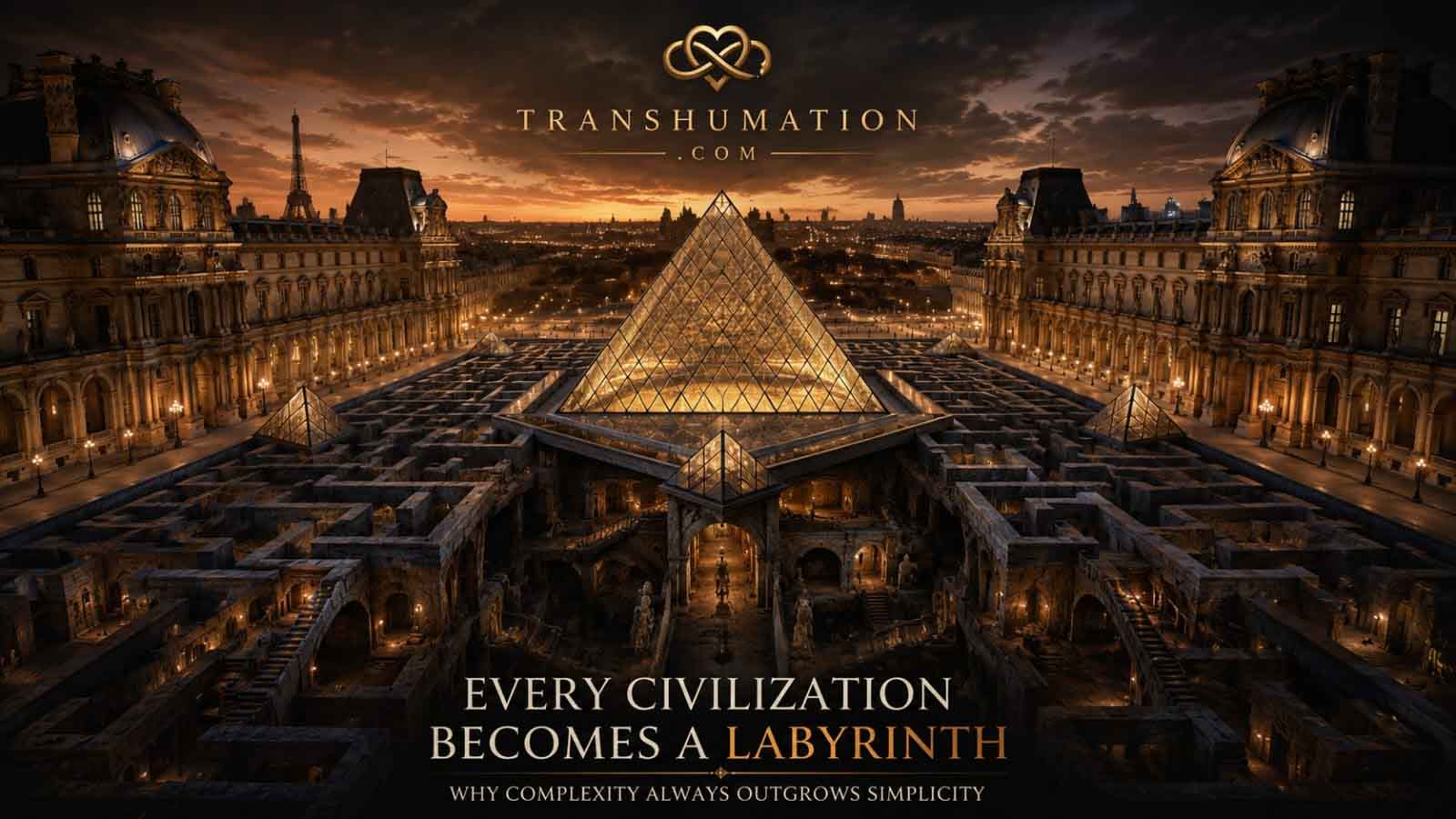
The Graphical Interface and the Disappearance of Machinery
Personal computing provides an even clearer example.
Early computers required users to adapt themselves to the logic of the machine. As graphical interfaces developed, layers of complexity were translated into windows, icons, folders and pointers that borrowed metaphors from familiar physical environments.
The internal machine did not become simple.
In many respects it became dramatically more complicated.
But the complexity experienced by the user decreased.
This is one of the recurring paradoxes of technological progress: the simpler the surface becomes, the more complex the hidden system may be.
A smartphone appears simpler than an early personal computer while depending on vastly more sophisticated hardware, software, networks and remote infrastructure.
The simplicity of the interface is not proof that civilization has become simple.
It is proof that complexity has become better mediated.
The pyramid performs the same trick architecturally.
Its clarity is possible precisely because the world beneath it is complicated.
Janus and the Intelligence of the Threshold
The Roman god Janus is useful here as a metaphor, not as an explanation of Pei’s design.
Janus was associated with doors, gates, beginnings and transitions. His familiar double-faced representation looks toward two directions at once: toward what is being left and toward what is being entered.
The deeper idea is the threshold.
A threshold possesses little value in isolation.
Its importance comes from relating two spaces.
That is exactly what an interface does.
It belongs neither entirely to the user nor entirely to the system. It occupies the boundary where one must become intelligible to the other.
The Louvre Pyramid can therefore be understood as a modern Janus-function without claiming any historical lineage or hidden symbolism.
Behind it stands accumulated civilization.
In front of it stands the visitor.
The pyramid mediates the encounter.
That is the entire magic.
No mysticism required.
Could AI Become Civilization’s Interface?
Artificial intelligence may confront the same problem on a scale larger than the Louvre.
Modern civilization does not suffer from a shortage of information.
It suffers increasingly from an inability to inspect the information it already possesses.
Scientific papers multiply. Archives expand. Legal systems accumulate documents. Libraries become digitized. Institutions produce databases larger than individual experts can navigate unaided. The internet adds another layer of continuous production on top of them.
The traditional response has been search.
AI introduces the possibility of conversation.
Instead of knowing which database to open, which syntax to use or which terms an archive expects, a person can express intention in ordinary language. The interface may translate that intention into operations across systems whose internal structure remains hidden.
This could be extraordinarily powerful.
But it produces the same risk as every successful interface.
The easier the entrance becomes, the easier it becomes to forget what lies behind it.
A conversational answer can appear self-contained even when it depends upon uncertain sources, competing interpretations and hidden selections.
If AI becomes civilization’s front door, the door must preserve some awareness of the building.
Otherwise convenience becomes enclosure.
The Librarian and the Pyramid
This is where the Louvre becomes particularly useful for Transhumation.
The pyramid does not pretend to contain the museum.
It does not replace the galleries with a summary.
It does not decide that because the building is complicated the visitor should receive only five paintings.
It helps the visitor enter.
A good librarian performs the same function.
The librarian reduces navigation cost without reducing the library to the librarian’s answer.
This is the model AI should aspire to.
Not oracle.
Not replacement civilization.
Interface.
The difference is fundamental.
An oracle gives an answer and asks for trust.
A librarian provides a route and allows inspection.
The future of knowledge may depend upon preserving that distinction.
Watch The Video
How to Read the World

Current Knowledge
The Louvre evolved through many architectural and institutional phases rather than being designed from the beginning as one unified modern museum. By the late twentieth century, the Grand Louvre project aimed to reorganize and expand the museum, including the integration of the Richelieu wing and major improvements to visitor access and circulation.
The pyramid was controversial when introduced, partly because of the contrast between its modern geometric form and the surrounding historic palace. Over time it became one of the Louvre’s most recognizable architectural elements, demonstrating that an intervention can become culturally integrated without imitating the older architecture around it.
Interfaces in architecture and technology share a general function of mediating between users and systems, although the analogy should remain structural rather than historical. Doors, maps, graphical interfaces, search systems and conversational AI operate through different mechanisms, but all can reduce the difficulty of accessing more complex environments.
Simplification at the interface does not imply simplification of the underlying system. In many modern technologies, apparent ease of use depends upon increasingly complex infrastructure hidden from ordinary users.
Open Questions
One open question concerns how much complexity an interface should hide. A visitor does not need to understand the Louvre’s entire architecture before entering, but completely hiding structure can leave the visitor dependent upon prescribed routes. Good mediation may therefore require both convenience and the ability to recover a larger map.
A second question concerns cultural institutions themselves. As museums digitize collections far larger than their physical galleries can display, will the primary interface to a museum eventually become partly computational? A future visitor may navigate objects through recommendation, search, visualization or conversation before deciding what to encounter physically.
There is also a problem of power. Interfaces do not merely reveal systems; they select among possibilities. A search ranking determines which documents are encountered first. A museum map privileges certain routes. An AI response chooses which evidence to summarize. The simpler an interface feels, the easier it can become to overlook the decisions embedded inside it.
Artificial intelligence intensifies this issue because natural conversation can make mediation almost invisible. If users no longer feel that they are operating a system, they may become less likely to ask how the system transformed their question before returning an answer.
Transhumation Interpretation
The Day the Pyramid Became an Interface belongs naturally to Transhumation because it expresses a recurring problem of civilization: complexity can grow beyond the scale of the individual without becoming useless, provided there is an intelligible interface between the two.
The Louvre contains more cultural structure than any visitor can absorb in one encounter.
That is not a defect.
It is the reason the institution matters.
The failure would occur only if access to that richness required each visitor to understand the entire structure before entering it.
The pyramid solves the scale mismatch.
This is close to the problem faced by language, libraries and artificial intelligence.
Human beings live inside systems larger than their minds.
No individual knows an entire language, legal order, scientific literature or cultural archive. We participate through interfaces that compress complexity into usable relationships.
A word is an interface to a concept.
A catalogue is an interface to a collection.
A map is an interface to territory.
A screen is an interface to computation.
But none should be confused with what lies behind it.
That distinction is central to the New Theurgy.
A symbol is powerful because it mediates.
It compresses a structure into a form that can be carried, recognized and used.
The danger begins when the symbol acquires such authority that the user forgets it is a mediation.
The map becomes the territory.
The search result becomes knowledge.
The model becomes the world.
The interface becomes reality.
The Louvre Pyramid works because it avoids this error physically.
Nobody stands beneath the glass and mistakes it for the Louvre.
Its simplicity directs attention toward something much larger than itself.
That should be the standard for intelligent interfaces.
A good interface increases access while preserving awareness of depth.
This is especially important for AI because conversational systems have a peculiar ability to make complexity disappear psychologically.
Ask a question.
Receive a paragraph.
The transition feels complete.
Yet behind the answer may sit disputed sources, missing evidence, competing theories and a long chain of selection.
The output can be shorter than the question it conceals.
This is why a future AI librarian should not merely be fluent.
It should be architecturally honest.
It should allow the user to descend beneath the pyramid.
Show the sources.
Show competing interpretations.
Show where confidence ends.
Show which door leads to the original archive.
The successful interface should make complexity optional at the first moment without making complexity inaccessible afterward.
That is a subtle distinction.
It is also one of the most important design principles for a civilization increasingly mediated through intelligent systems.
The Library of Mirrors depends upon it.
The library contains more than the reader can absorb.
The librarian therefore selects.
But the librarian must never make the selection indistinguishable from the collection.
A recommendation is not the library.
A summary is not the book.
An AI-generated interpretation is not the historical event.
The interface should preserve the backward path.
This gives us another way of understanding the relationship between simplicity and intelligence.
Intelligence does not always mean adding detail.
Sometimes it means knowing which detail can remain hidden until it becomes relevant.
An aircraft cockpit does not display every possible piece of engineering information simultaneously. A good map omits buildings irrelevant to the route. The Louvre entrance does not demand an architectural lecture before admitting the visitor.
The trick is knowing what can safely disappear from the first layer.
This is the same problem explored in the Right Scale and the LEGO Principle.
Simplification is valuable only when the relation required for the task survives.
Remove too little and the system overwhelms the user.
Remove too much and the interface lies.
The pyramid succeeds because it does not explain the Louvre.
It creates a reliable first relation to it:
enter here.
That may look almost trivial.
Civilizations are often saved by trivial-looking things.
A door.
An index.
A search field.
A shared language.
A librarian.
The more complexity humanity creates, the less glamorous these interfaces may appear beside the systems they unlock.
Yet their importance increases.
Perhaps advanced civilization eventually reaches a strange threshold where creating another room matters less than making the existing palace navigable.
We may be approaching that threshold in knowledge now.
There are already more books than one person can read, more research than one scientist can follow and more information than one civilization can meaningfully inspect without computational assistance.
The next breakthrough may therefore resemble Pei’s intervention more than another palace wing.
Not another mountain of information.
A better entrance.
And if artificial intelligence becomes that entrance, its success should be measured by the same standard as the pyramid.
Not whether people admire the interface.
Whether, after passing through it, they can still reach the world behind it.
FAQ
Why was the Louvre Pyramid built?
It formed a central entrance for the Grand Louvre reorganization and leads visitors into an underground reception and circulation space from which they can access different parts of the museum.
What problem did the Louvre Pyramid solve?
Beyond physical access, it created a legible starting point for visitors approaching an unusually complex architectural and cultural institution.
Can architecture really function as an interface?
Yes in the structural sense. Entrances, corridors, staircases, maps and signs mediate between human bodies and complex built environments, just as digital interfaces mediate between users and computational systems.
Why compare the pyramid to Janus?
Janus is used only as a metaphor for thresholds and transitions. There is no claim that Pei designed the pyramid as a reference to the Roman god.
Could AI become an interface to civilization?
Potentially. AI can reduce the difficulty of navigating enormous bodies of knowledge through ordinary language, but its usefulness will depend on preserving provenance, uncertainty and access to underlying sources.
What is the deeper Transhumation question?
The Louvre suggests that civilization does not need to become simpler as it becomes larger.
It needs interfaces capable of making complexity enterable without pretending that complexity has disappeared.
That may eventually become the central task of the Library of Mirrors: not reducing civilization to an answer, but building a door through which another human mind can still enter the palace.
Continue the Transhumation Series
- Forgotten Religion | Ancient Gods, Symbols and the Hidden Structures of Human Civilization
- The Last Religion | Death, Immortality and the Future of Humanity
- The New Theurgy | AI, Information and the Future of Human Civilization
- End of Branding: You Were Never Meant to Become a Product
- Baal vs Ishtar: Why Ancient Gods Never Disappeared