
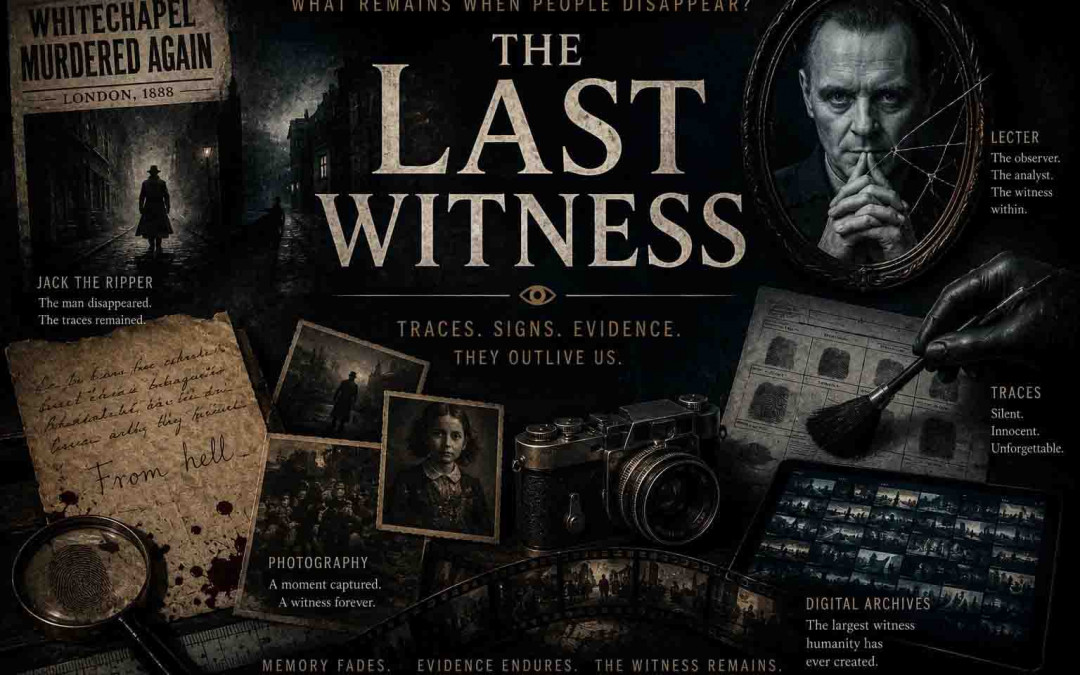
Imagine arriving at a crime scene.
The people are gone.
The voices are silent.
The event is over.
Yet something remains.
A footprint.
A fingerprint.
A photograph.
A letter.
A stain.
A recording.
A witness.
Civilization itself works the same way.
History is not built from living people.
History is built from traces.
And traces are witnesses.
The Strange Survival of Evidence
Most things disappear.
Bodies decay.
Buildings collapse.
Memories fade.
Entire civilizations vanish.
Yet some fragments remain.
A coin.
A document.
A name carved into stone.
A face captured by a camera.
These fragments become representatives of worlds that no longer exist.
The witness survives after the event.
The trace survives after the person.
The evidence survives after the civilization.
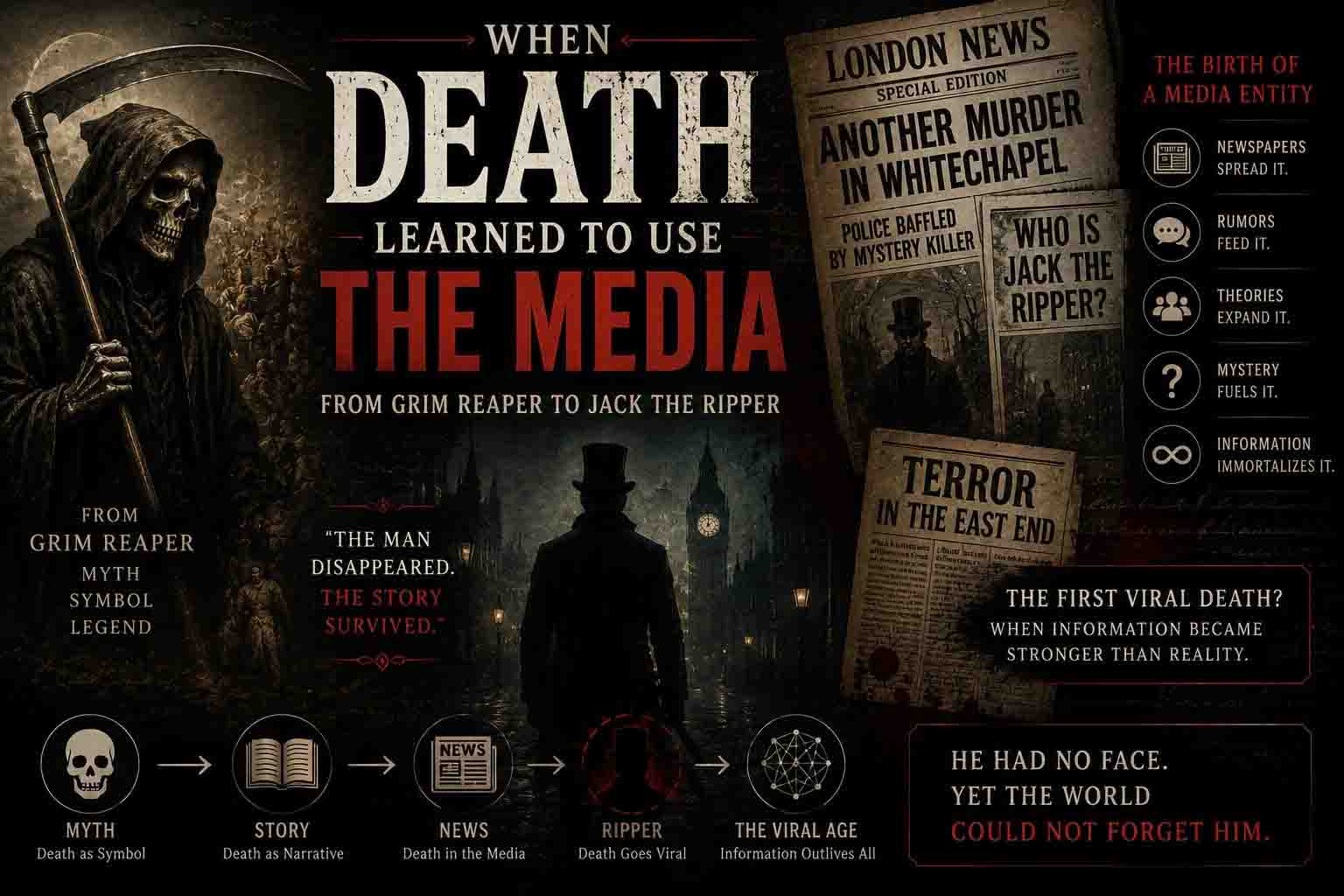
Jack the Ripper's Real Immortality
One of the strangest examples is Jack the Ripper.
The man disappeared.
Perhaps he died.
Perhaps he escaped.
Perhaps his identity was never discovered.
Yet something survived.
Not the person.
The pattern.
The letters.
The headlines.
The mythology.
The questions.
More than a century later, people still discuss him.
Not because he remained.
Because the traces remained.
Jack the Ripper became one of the first modern informational ghosts.
The witness outlived the suspect.
The Camera as Witness
Photography changed history.
Before photography, most witnesses were human.
After photography, reality gained a new observer.
A camera does not forget.
A camera does not become confused.
A camera preserves.
Sometimes it records triumph.
Sometimes suffering.
Sometimes joy.
Sometimes horror.
The photograph becomes a witness capable of speaking long after every living observer is gone.
The Eyes of History
There is something unusual about old photographs.
People often say they feel alive.
Why?
Because eyes are more than appearance.
Eyes contain attention.
Emotion.
Fear.
Hope.
Expectation.
When we look into old photographs, we are not simply looking at faces.
We are encountering perspectives.
Ways of seeing.
Fragments of consciousness preserved in time.
The witness continues watching.
Lecter and the Mirror
Perhaps this is why Hannibal Lecter remains such a fascinating character.
He is obsessed with observation.
He studies people.
Reads them.
Sees through masks.
Yet one of the most interesting questions is whether he needs a mirror at all.
Most people use mirrors to discover who they are.
Lecter appears to have passed beyond that stage.
He already knows.
Or believes he knows.
The mirror becomes unnecessary.
The witness has turned inward.
He observes himself.
This may be why Clarice's question unsettles him.
What happens when the observer becomes the observed?
The Last Witness
Every civilization leaves behind witnesses.
Books.
Paintings.
Photographs.
Monuments.
Films.
Digital archives.
The internet itself may become the largest witness humanity has ever created.
Future generations may know us through traces we leave behind.
Not through our intentions.
Not through our explanations.
But through evidence.
Exactly as we know ancient civilizations today.
Beyond Memory
Memory is fragile.
Witnesses are stronger.
A memory exists inside a mind.
A witness exists outside it.
That difference changes everything.
A letter can survive centuries.
A photograph can survive generations.
A recording can cross time.
A digital archive can span the planet.
Humanity increasingly externalizes memory.
We are building witnesses everywhere.
The Final Question
When people think about immortality, they usually imagine survival.
Living forever.
Escaping death.
Remaining conscious.
But perhaps another question matters more.
What remains after we are gone?
The answer may not be the body.
It may not even be the name.
It may be the witness.
The trace.
The mark left behind.
The evidence that says:
Someone was here.
Someone saw this.
Someone lived.
And somehow, across the distance of time, that witness is still speaking.
Want To Explore More?
Watch The Video Below
Continue reading...
What Defines a Human?
FAQ
What is The Last Witness?
The Last Witness is the idea that after people disappear, traces remain. These traces become witnesses that continue speaking long after their creators are gone.
How is photography a witness?
A photograph preserves a moment, expression, gesture, or event that can continue affecting future generations.
Why is Jack the Ripper discussed in this article?
Jack the Ripper represents a person who largely vanished while the informational structure surrounding him survived.
How does Hannibal Lecter relate to the theme?
Lecter symbolizes radical self-awareness and observation. He functions as both observer and witness.
Why do traces matter?
Because history is reconstructed through traces. Much of what we know about the past comes from surviving evidence rather than direct experience.
Continue the Transhumation Series
Explore the full journey:
- End of Reality — Where Do You Really Exist?
- End of Physics — Are the Laws of Reality Real?
- End of the Real World — Reality Is No Longer Required
- End of Consciousness — Beyond the Human Mind
- End of Death — When Human Limits Disappear
- End of Religion — When Technology Replaces Faith