
Strange Reward of Being Remembered
There is a small cruelty hidden inside almost every ambitious project. A person spends years building a company, writing a book, restoring a house, raising children, assembling an archive, or pursuing an idea that seems important enough to justify the hours being taken from everything else. Somewhere in the background sits an image of completion: the finished building, the recognition, the moment when the work finally makes sense. We imagine ourselves standing beside the result.
History is less considerate.
Cathedrals outlive their architects. Scientific discoveries grow consequences their discoverers never see. Political decisions continue moving after the people who made them are buried. Even an ordinary family can discover this on a smaller scale when an object kept casually by one generation becomes precious to another. The creator imagines an audience in the present; time quietly supplies a different audience later.
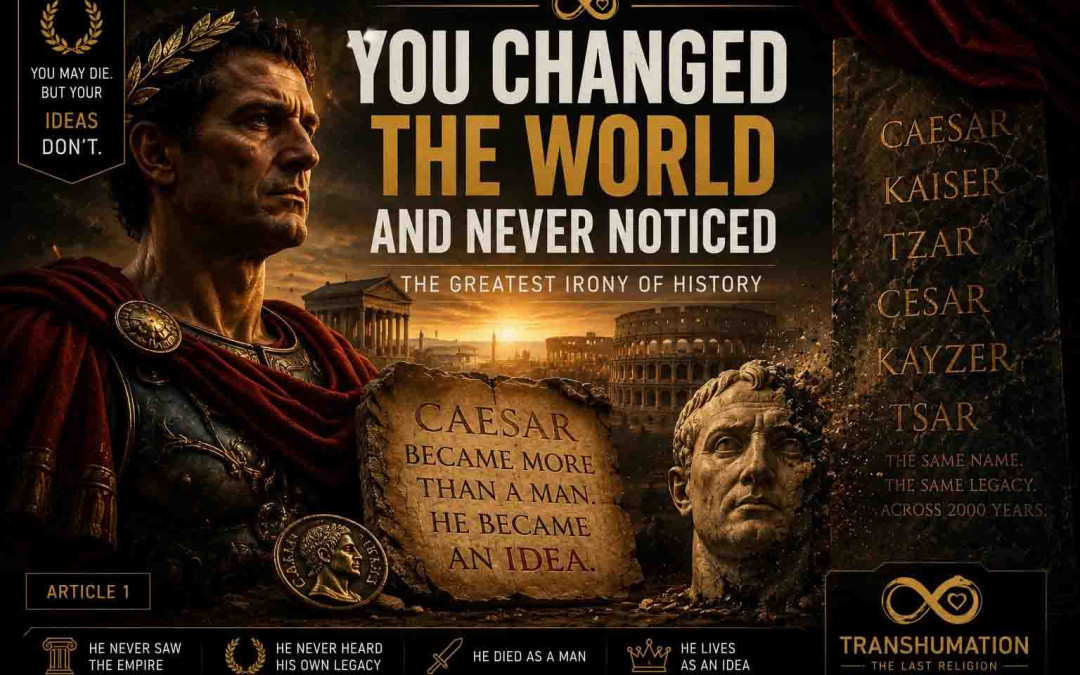
Julius Caesar may be one of the most extravagant examples of this mismatch. He spent his life trying to survive enemies who were very much alive and immediate. He accumulated offices, debts, victories, resentments and extraordinary political power. Then, on 15 March 44 BCE, a group of senators killed him in the belief that his death might prevent one-man rule from swallowing the Roman Republic.
They succeeded in killing Caesar.
What followed was much closer to the world they feared.
The Man Who Never Became Caesar
This is one of history’s useful jokes: Julius Caesar was never “Caesar” in the sense that later centuries came to understand the word. He was dictator, consul, general and political revolutionary, but not a Roman emperor in the institutional form associated with Augustus and his successors. The Roman Empire as we conventionally describe it belongs to the settlement that emerged after his death, through another round of civil wars and the eventual supremacy of his adopted heir Octavian.
Caesar therefore never walked through the political world that carried his name.
He did not see Augustus rule for decades. He did not see the imperial system stabilize. He did not see the Pax Romana or the monumental expansion of the office that would be associated, directly or indirectly, with him. Most importantly, he could not have known that his family name would eventually escape biography and become a title.
That transformation is stranger than a statue.
A statue preserves a likeness. A title preserves a function.
Caesar became part of the vocabulary of supreme rule. Centuries later, Kaiser in German and Tsar/Czar in Slavic political traditions descended from the same name. The body disappeared, the political environment changed beyond recognition, Latin fragmented into new languages, Rome ceased to rule an empire, and still a sound associated with one man continued travelling through institutions he never saw.
The assassination removed the person.
It failed to remove the pattern.
The Victory That Arrives Too Late
We usually imagine success as something experienced by the successful person. A medal is handed to the athlete. The audience applauds the performer. The scientist receives the prize. The investor sees the company grow. This is the emotionally satisfying arrangement because cause and reward remain close together.
History often separates them.
Johann Sebastian Bach did not experience his later status exactly as modern audiences imagine it. Many painters became more valuable after death than during life. Philosophers can become culturally powerful centuries after the institutions they argued with have disappeared. Entire artistic movements acquire their final names only after the people inside them are gone.
The greater the time horizon, the more unstable the relationship between creation and reward becomes.
An architect begins a structure knowing that someone else may complete it. A scholar preserves a manuscript whose most important reader may not yet have been born. A scientist publishes something whose practical importance may emerge only when another technology appears decades later. The initial achievement can be almost invisible because the surrounding world has not yet developed the conditions required to understand it.
This makes history a peculiar marketplace.
The creator produces something.
The customer may arrive in a century.

Building for Someone You Will Never Meet
Ancient monumental architecture makes this relationship unusually tangible. Large temples, roads, walls, aqueducts and public buildings were often constructed on timescales longer than ordinary political attention. Some were completed quickly; others passed between patrons, generations and changing regimes. The people who cut stone or laid foundations rarely knew the names of the distant visitors who would eventually stand before their work.
The future was an anonymous observer.
That may be one of the oldest forms of faith that does not require religion: the decision to make something whose final value cannot be personally verified.
A manuscript copied carefully in a monastery could survive because somebody believed that a reader might one day require it. A bridge was repaired because people not yet present would need to cross. A parent taught a child something that might matter long after the parent could see its effect.
Civilization works because humans repeatedly invest effort in outcomes they will not personally consume.
In this sense, every archive is an act of confidence in strangers.
Every library assumes that someone will come later.
Every durable object contains a small wager against death.
The Reward Nobody Ordered
Myths understood that rewards could be treacherous. The hero asks for fame and discovers that fame is purchased by death. The king asks for power and becomes trapped inside the obligations of rule. The seeker asks for knowledge and loses the innocence that made the earlier world comfortable.
The disturbing part is not that the gods refuse the request.
They grant it too literally.
History can behave the same way.
A person wants to be remembered and discovers that what survives is not the person but a simplified symbol. An inventor becomes the name attached to a device developed by many hands. A ruler becomes a political adjective. A writer becomes a quotation separated from the argument that gave it meaning.
Immortality through memory is therefore not survival in the ordinary sense.
It is transformation.
Caesar survived, but not as Caesar experienced himself.
He survived as military legend, political warning, Shakespearean character, schoolbook figure, imperial title, surname, metaphor and pronunciation problem. The man was converted into information, and information proved more portable than flesh.
That may be the reward nobody expects.
To endure, something of you may have to stop being entirely yours.
The Name Without the Body
Napoleon offers a useful contrast because his memory remains attached to physical spectacle. His tomb in Paris gives the visitor a destination. The body, monument and national mythology are arranged together. You go somewhere to encounter him.
Caesar has no comparable surviving tomb that organizes his afterlife. Ancient sources and archaeology leave uncertainties around the treatment of his remains and later commemorative sites, while the physical Rome he knew has been rebuilt repeatedly.
Yet Caesar is extraordinarily difficult to escape.
His survival is linguistic.
That is a higher degree of portability.
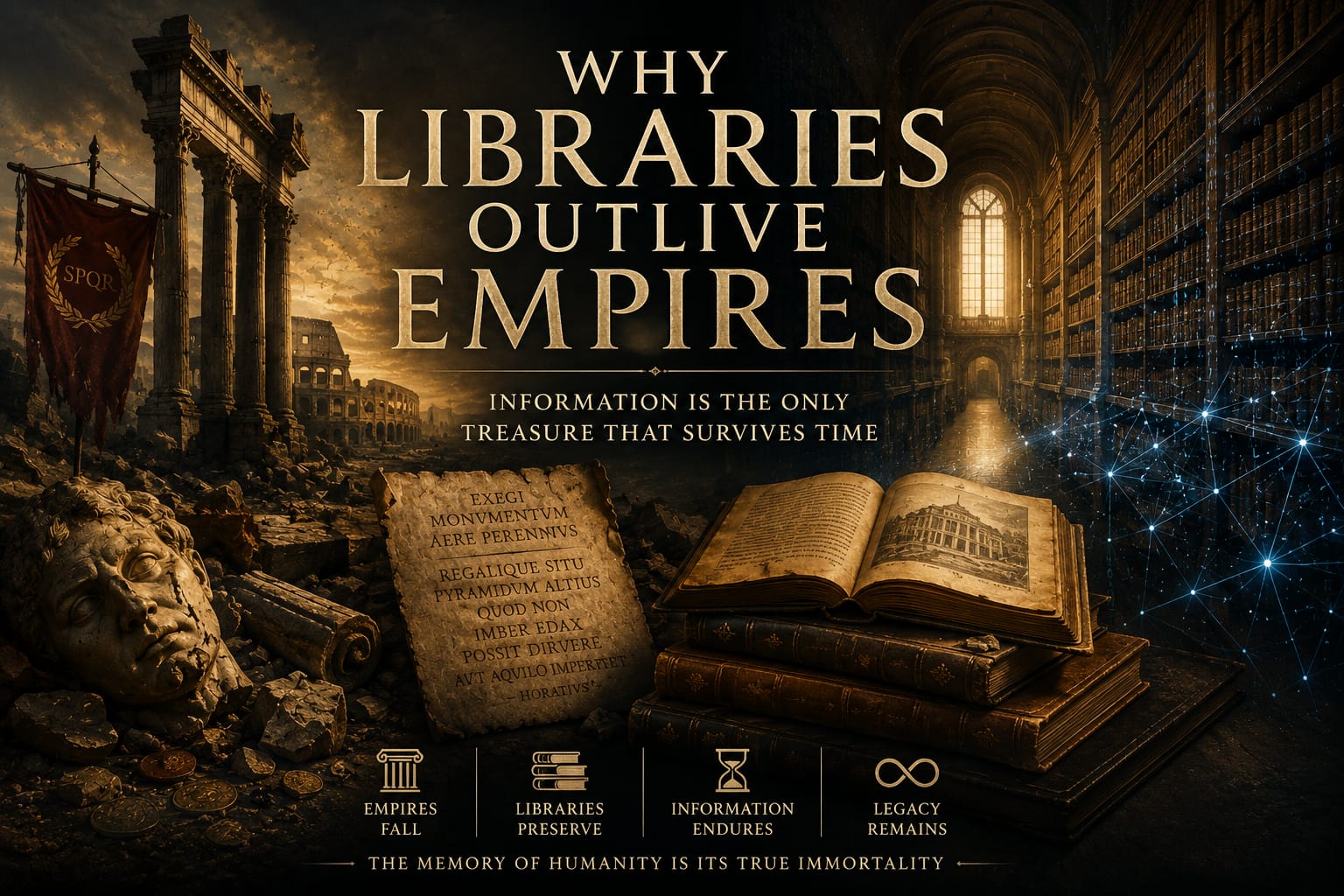
Stone is impressive but geographically stubborn. A word can travel. It can be copied into books, transformed by pronunciation, absorbed into other languages and attached to new institutions. A title does not require the original speaker to remain alive. It requires only enough continuity for later people to understand what the sound does.
This is where Caesar’s afterlife becomes relevant far beyond Roman history.
The strongest form of continuity may not belong to the object that lasts longest physically.
It may belong to the pattern that can keep changing carriers.
The Future Is an Unknown Reader
Modern technology has made this ancient problem more immediate, not less. We produce enormous quantities of information with the vague assumption that storage equals survival. Photographs move into clouds. Voices remain in recordings. Messages persist on servers. Artificial intelligence can reconstruct styles, summarize archives and generate new text from bodies of material larger than any person could read.
But preservation creates an uncomfortable question.
What exactly are we preserving?
A photograph preserves appearance. A voice recording preserves sound. A diary preserves selected thoughts. A model trained on someone’s writing might preserve linguistic tendencies. None of these, individually or together, proves that the person survives.
The pattern can continue without the observer who once experienced being that pattern.
Caesar demonstrates the problem in extreme historical form. Almost everything that made him biologically Caesar is gone. His political projects changed. His social world vanished. His language itself evolved into descendants. Yet certain informational structures escaped.
His name remained attached to power.
This is immortality without consciousness.
Continuity without witness.
The world changed because of him, and the version of Caesar that survived was not there to notice.
Watch The Video
How to Read the World

Current Knowledge
Julius Caesar was assassinated on 15 March 44 BCE by a group of senators who believed, among other motives, that his concentration of power threatened the Roman Republic. His death did not restore stable republican government. Instead, Rome entered further civil conflict that ultimately ended with Octavian, later Augustus, becoming the dominant ruler of the Roman state.
Caesar himself was not a Roman emperor in the later institutional sense. Augustus is conventionally regarded as the first Roman emperor, although Roman political terminology and constitutional forms remained deliberately complicated.
The name Caesar became an imperial title within Rome and later influenced titles such as German Kaiser and forms of Tsar/Czar. This linguistic survival demonstrates the extraordinary historical reach of Caesar’s name, though the political institutions using those titles differed greatly from one another.
Historical influence frequently develops after a person’s death, but there is no general rule that major creators necessarily fail to witness their own impact. Some individuals live long enough to see enormous consequences of their work; others do not.
Open Questions
When we say that a person “survives” through an idea, institution or name, are we describing genuine continuity or merely historical influence? At what point does a pattern become so transformed that connecting it to its origin becomes more symbolic than substantive?
There is also a problem of authorship. Caesar’s afterlife was not created by Caesar alone. Augustus, Roman institutions, medieval rulers, historians, playwrights, political traditions and later languages all contributed to the form in which his name survived. Does cultural immortality belong to the original person, or to the generations that continuously rebuild that person?
Digital technology intensifies this uncertainty. If future systems preserve increasingly detailed behavioral traces of individuals, how much continuity is enough before a reconstruction stops being an archive and begins to appear like a presence?
Transhumation Interpretation
Transhumation is interested in survival that occurs through migration of pattern rather than preservation of material.
Caesar offers an unusually clean example.
The body vanished.
The Republic changed.
The family name became a political function.
The political function moved through languages.
The languages changed pronunciation.
The pattern continued.
This does not mean Caesar achieved personal immortality. There is no reason to think the conscious observer who experienced being Julius Caesar survives inside the words Kaiser or Tsar. That distinction matters. Information surviving a person is not the same thing as the person surviving.
But it reveals something civilization has been doing for thousands of years.
We externalize fragments of ourselves.
Names.
Stories.
Methods.
Institutions.
Art.
Law.
Children.
Books.
Cities.
Each one carries something forward while changing the carrier.
Perhaps this is why the desire for immortality so often produces monuments. We sense intuitively that biological continuity is fragile, so we attempt another strategy: attach some pattern to something that can travel farther than the body.
Technology is expanding that possibility enormously.
Yet Caesar provides a warning hidden inside the promise.
You may succeed.
Something may survive.
It may transform the world.
It may cross languages and centuries.
And the final form may be something you would never have recognized as yourself.
The future is the last audience.
It never promises to interpret us correctly.
FAQ
What does “You Changed the World and Never Noticed” mean?
It describes the possibility that a person’s greatest historical influence may emerge only after their death.
Why is Julius Caesar the central example?
Caesar died before the Roman imperial system fully emerged, yet his name later became closely associated with imperial authority across multiple cultures.
Was Julius Caesar an emperor?
Not in the conventional historical sense. Augustus is generally regarded as Rome’s first emperor.
How did Caesar’s name survive?
Caesar became a Roman imperial title and later influenced titles such as Kaiser and Tsar/Czar.
Can ideas make someone immortal?
Ideas and cultural patterns can survive their creators, but that is different from the continued survival of the creator’s consciousness.
Why is the future described as an “unknown observer”?
Because people often create things whose most important later uses and interpretations cannot be predicted during their lifetime.
How does this connect to Transhumation?
It illustrates the difference between material survival, informational survival and conscious survival. A pattern may continue even when its original biological carrier is gone.
What is the central question of the article?
If something of us survives long after we disappear, how much can it change before it is no longer meaningfully us?
Continue the Transhumation Series
- Forgotten Religion | Ancient Gods, Symbols and the Hidden Structures of Human Civilization
- The Last Religion | Death, Immortality and the Future of Humanity
- The New Theurgy | AI, Information and the Future of Human Civilization
- End of Branding: You Were Never Meant to Become a Product
- Baal vs Ishtar: Why Ancient Gods Never Disappeared