
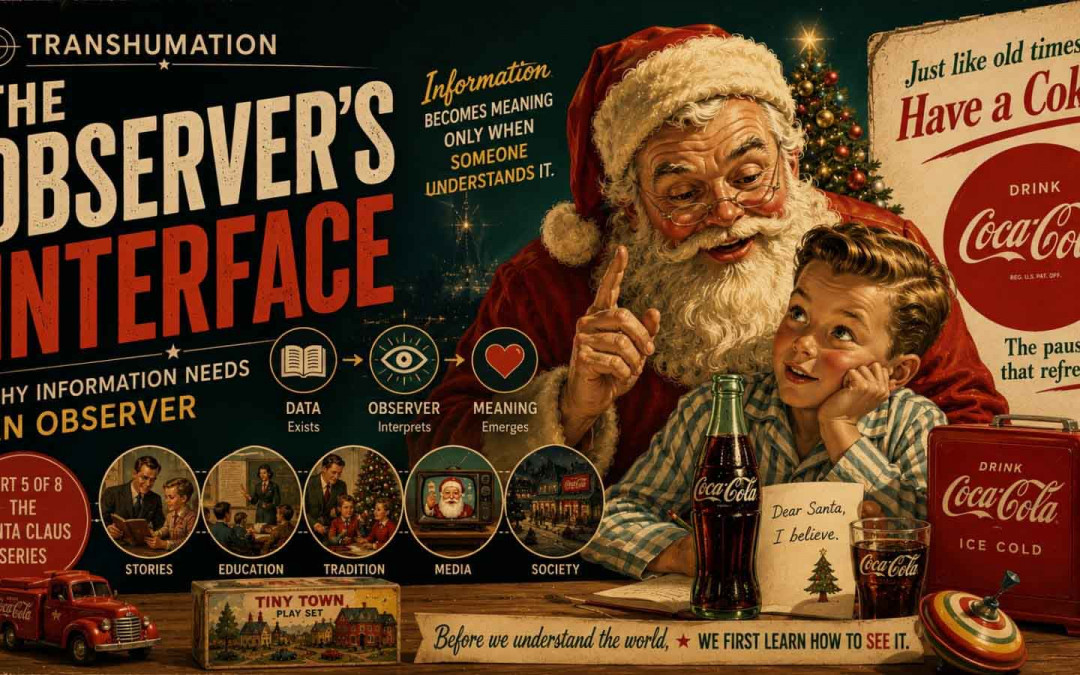
Why Information Needs Someone Who Can Read It
Imagine opening a sealed room beneath the desert and finding a library. Not the ruins of one, but a library preserved with almost absurd completeness: shelves still standing, bindings intact, pages dry, ink legible. Nothing has burned, nothing has been looted, nothing appears to have been lost. For an archaeologist, it would seem close to perfection.
There is only one problem. Nobody can read the language.
At first this seems almost incidental. The information is still there, after all. The books remain, the symbols remain, the sentences are waiting patiently on the page. Yet waiting for what? A library without readers is not empty; it is something stranger—a room filled with inaccessible possibility. The distinction matters because we casually speak as though preserving information and preserving knowledge were the same achievement. They are not. A book can survive perfectly while the world required to understand it disappears.
The fragile part of a library is not always the paper. Sometimes it is the reader.
The Book That Cannot Open Itself
We call libraries containers of knowledge because the phrase is convenient. Strictly speaking, however, a library preserves encoded structures from which knowledge can be reconstructed. A map does not navigate itself; a musical score does not perform itself; a dictionary cannot teach itself how to read. A mathematical proof can sit undisturbed for five hundred years without proving anything to anyone until a mind capable of following the argument encounters it.
This is why education is more important than the simple transfer of information. Education creates interpreters. When a child learns to read, we are not merely giving that child access to a collection of books. We are installing, through years of practice, an interface capable of turning marks on paper into voices, places, arguments and memories. Once that interface exists, a person can enter into conversation with people who died centuries before they were born. Without it, Shakespeare is ink.
Civilizations therefore preserve themselves twice. First they preserve the carrier: the manuscript, inscription, recording, database or image. Then they must preserve the ability to decode it. The second task is less visible and sometimes more difficult, because interpretation cannot always be stored as neatly as an object. It lives in language, education, habits of thought and chains of teachers who show new observers what previous observers learned to see.
This is why the disappearance of a language can be more serious than the disappearance of a particular dictionary. The dictionary can be copied. An interpretive tradition may have required generations to construct.
Santa Claus and the Same Room
There is a simpler way to see the problem, and it requires no archaeological expedition.
A child walks into a living room on Christmas morning. Lights glow on the tree, presents have appeared underneath it, a red hat has been left near the fireplace and perhaps a suspiciously half-eaten cookie remains on a plate. The room contains a surprisingly elaborate system of evidence. To the child, these objects point toward Santa Claus. To the parent standing a few metres away, the identical objects point backward—to shopping, wrapping paper, hidden packages and several hours of logistics after bedtime.
Nothing physical has changed. The observer has.
This does not mean that reality is arbitrary. The presents are real. The cookie is real. The hat cannot mean literally anything we wish it to mean. But objects enter human life through interpretive frameworks, and those frameworks can transform while the objects remain stable. Twenty years later, the same child may reproduce the scene for someone else. The red hat now means neither proof of Santa Claus nor merely parental logistics. It may mean inheritance, nostalgia, generosity or the responsibility of preserving a particular childhood experience.
The symbol survived every transformation. What changed was the interface through which it was read.
Civilization does this constantly. Children wave before they understand etiquette, celebrate birthdays before they understand calendars, and hear stories before they learn history. We tend to imagine education as a movement from explanation toward practice, but much of culture travels in the opposite direction. First we participate, then we recognize, and only much later do we understand the machinery behind what we have inherited.
A civilization cannot wait until every six-year-old has reconstructed mathematics, language, law and social convention from first principles. It hands the child a functioning interface and allows explanation to arrive gradually.

When a Stone Learns to Speak
The Rosetta Stone offers a more serious version of the same problem. Its inscriptions did not suddenly acquire information when nineteenth-century scholars began making progress in deciphering Egyptian hieroglyphs. The marks had been there all along. What changed was the interpretive architecture surrounding them.
Because the stone contained related inscriptions in multiple scripts—including Greek, which scholars could read—it became part of the bridge between an accessible language and scripts that had become inaccessible. The achievement was not that an ancient object suddenly began transmitting. It was that human beings reconstructed enough of the missing interface to receive what had been waiting there.
This complicates the familiar phrase lost knowledge. Sometimes the carrier has not been lost at all. What disappeared was the key.
History is full of these half-silent objects: undeciphered texts, symbols whose significance is disputed, buildings whose functions remain uncertain, images detached from the cultural grammar that once made them obvious. Their creators may have believed they were communicating clearly. They simply could not guarantee the survival of the observer capable of understanding them.
The problem is therefore larger than archaeology. Every act of preservation contains an assumption about the future reader.
The Librarian and the Flood
The modern world has almost reversed the ancient problem. We are not suffering from a shortage of preserved information. We are producing it faster than any individual human being could possibly inspect it. Scientific papers, photographs, government documents, books, messages, videos, datasets and archives accumulate continuously. A person with an internet connection can reach informational collections that would have appeared supernatural to almost every scholar who lived before the twentieth century.
And yet abundance can produce its own form of ignorance.
A library containing ten books needs a shelf. A library containing ten million needs an architecture of retrieval. Once the collection becomes sufficiently large, possession matters less than navigation. The question is no longer merely Do we have the book? It becomes How would anyone know which book to open?
This is where the librarian becomes philosophically interesting. A good librarian does not replace the library and does not need to have written the books. The librarian creates paths through a territory too large for the visitor to inspect alone. Catalogues, indexes, bibliographies and search engines have always performed variations of this function. Artificial intelligence introduces another version of it because it can potentially translate, compare, summarize and connect material across informational spaces too large to fit inside a single human working memory.
That makes AI interesting not because it has to become an oracle, but because civilization may have created another kind of librarian.
And a good library needs a good librarian.

The Power of the Guide
The metaphor becomes dangerous if we make it too comfortable. A librarian can recommend the wrong book. A translator can flatten an ambiguity. A catalogue can classify something incorrectly. An AI model can hallucinate, omit context or present a plausible synthesis that the underlying evidence does not support.
The usefulness of the interface actually creates the danger. We employ it precisely because we cannot independently inspect everything behind it. The more successfully it reduces complexity, the easier it becomes to forget how much selection occurred between the library and the answer.
Trust follows usefulness, and power follows trust.
The central problem of an information civilization may therefore be shifting. For centuries we worried about whether knowledge could be stored. Then we worried about whether it could be distributed. Increasingly we may have to worry about who—or what—performs the interpretation between storage and observer.
The question is not whether AI should become the library. It should not.
The more interesting possibility is that AI becomes part of the interface through which the library becomes readable.
That distinction is small enough to miss and important enough to define an era.
The Library of Mirrors
There is a tempting phrase that should be handled carefully: the observer changes reality. In physics, observation has technical meanings that should not be casually converted into claims that human consciousness creates the external universe. Psychology, art and language offer a less sensational and more useful lesson. Reality can remain stable while what becomes visible within it changes with the observer.
A painting does not physically transform when an art historian enters the room. Yet the historian may notice references invisible to a tourist. A sentence remains printed in exactly the same type after a reader learns the historical context that reverses its apparent meaning. The Rosetta Stone did not change when hieroglyphs became readable. The Christmas room is materially the same for parent and child.
This is the beginning of what Transhumation calls the Library of Mirrors.
A library exists for readers, not books. Information enters it from one world and an observer enters later from another. The observer brings a question, and the question determines which connections become visible. An answer then changes the observer, who returns to the same collection carrying a slightly different question. The shelves may not have moved at all, yet the library is no longer quite the same place.
Civilization, viewed this way, does not merely accumulate information. It accumulates ways of seeing. Writing is one. Mathematics is another. Scientific method, historical criticism, musical notation, maps, microscopes and classification systems are all interfaces that allow an observer to perceive structures that would otherwise remain unavailable.
Artificial intelligence may become another layer in this architecture. Not a replacement for the observer, and certainly not a guarantee of truth, but a guide through a library that has grown beyond the scale at which any single reader can navigate it unaided.
The greatest danger would not be that the librarian exists.
It would be forgetting that the librarian is standing between us and the shelves.
Watch The Video
How to Read the World
Current Knowledge
Written information can physically survive while becoming functionally inaccessible when its language, script or interpretive context disappears. Historical decipherments demonstrate that preservation of a carrier does not guarantee preservation of understanding. The Rosetta Stone was especially important because related inscriptions appeared in multiple scripts, including Greek; decipherment of Egyptian hieroglyphs nevertheless required extended comparative scholarship rather than a simple one-step translation.
Research in psychology and cognitive science also shows that perception and memory are affected by prior knowledge, expectation and context. This does not establish that an observer freely creates external reality. It does establish something more modest: conscious interpretation is not simply a neutral copy of sensory input.
Modern AI systems already perform useful functions in search, translation, summarization and synthesis across large collections of information. They can also produce factual errors, remove context and generate unsupported claims. Treating them as interfaces therefore makes human verification and awareness of their limitations more important, not less.
Open Questions
If every person capable of reading a language disappears while millions of texts remain intact, what exactly has survived: knowledge, information, or merely the physical possibility of reconstructing both? The distinction becomes even more difficult when interpretation depends not only on vocabulary but on cultural assumptions that were never written down.
AI introduces a second version of the same question. Could a sufficiently sophisticated system preserve not merely documents but the interpretive traditions necessary to understand them? And if future readers increasingly encounter civilization through automated intermediaries, how can they distinguish the structure of the original library from the structure imposed by the librarian?
There is finally the philosophical question beneath all of them: how much meaning belongs to the object, and how much emerges from the encounter between object and observer? Reality constrains interpretation, but the object does not necessarily complete it. Somewhere between “meaning is entirely discovered” and “meaning is entirely invented” lies the much stranger territory in which civilization actually operates.
Transhumation Interpretation
The Observer’s Interface adds a condition to one of Transhumation’s central questions about information surviving changes of carrier. It is not enough for the pattern to survive materially. Something must remain capable of recognizing the pattern.
The chain is therefore longer than it first appears:
information → interface → observer → interpretation → meaning
Break the carrier and the information can disappear. But break the interpretive chain and something almost equally strange occurs: the information remains while becoming silent.
This is why the librarian matters. The librarian is not greater than the library and does not replace the reader. The librarian occupies the crucial space between an overwhelming collection and the person trying to understand it. AI may increasingly occupy part of that space, giving humanity a new way to navigate a library of civilization that no individual could ever read in full.
But the interface must remain visible as an interface.
The final achievement is therefore not a civilization that stores everything, nor even one that can retrieve everything instantly. It is a civilization capable of preserving the chain between information and understanding while knowing where interpretation enters that chain.
The library exists for readers, not books.
And perhaps the most valuable thing one generation can leave another is not merely a larger library, but better ways of learning how to read it.
FAQ
What is the Observer’s Interface?
It is the idea that preserving information and preserving access to its meaning are different achievements. Information becomes usable when an observer possesses an adequate linguistic, cultural or conceptual interface for interpreting it.
Can information exist without an observer?
A physical carrier and encoded structure can remain without a current reader. The harder philosophical question is whether we should call that preserved knowledge or preserved information with the potential to become knowledge again.
Why is the Rosetta Stone important to the argument?
Because it illustrates the difference between preservation and readability. The inscriptions survived for centuries, but recovering their meaning required scholars to reconstruct an interpretive bridge.
Why use Santa Claus as an example?
Because the example makes the mechanism visible in ordinary life. A child, parent and later adult can encounter essentially the same symbols while reading them through different interpretive frameworks.
Why is the librarian more important in the age of information?
Because scarcity is no longer the only problem. When collections become too large for an individual to inspect, navigation, selection and context become increasingly valuable.
Is AI a new kind of librarian?
Potentially. AI can help people navigate, translate and connect large informational spaces. The analogy has limits, however, because AI can also distort or invent information and therefore requires judgment and verification.
Does the observer create reality?
Not in the broad mystical sense proposed by some popular interpretations of physics. External reality constrains what can reasonably be inferred from it. The observer nevertheless participates in producing meaning by bringing language, knowledge, expectations and questions to what is observed.
What is the Library of Mirrors?
It is the Transhumation idea that a library does more than preserve information. Every reader approaches the collection with a particular set of questions, receives something from it, and may leave as a changed observer. The library becomes a meeting place between preserved civilization and the minds interpreting it.
How does this connect to Transhumation?
Transhumation asks which structures can survive changes of carrier. The Observer’s Interface adds a necessary complication: a pattern can survive perfectly and still become inaccessible if the civilization loses the means to recognize what it is.
What is the central idea?
Libraries can preserve information for thousands of years. Civilizations survive only if they also preserve someone capable of reading it.
Continue the Transhumation Series
- Forgotten Religion | Ancient Gods, Symbols and the Hidden Structures of Human Civilization
- The Last Religion | Death, Immortality and the Future of Humanity
- The New Theurgy | AI, Information and the Future of Human Civilization
- End of Branding: You Were Never Meant to Become a Product
- Baal vs Ishtar: Why Ancient Gods Never Disappeared