

The Last God
Baal has suffered the usual fate of a defeated god. First people prayed to him. Then other people condemned him. Eventually everyone agreed to put him in a museum and explain what he used to mean.
This is very convenient. Dead gods are much easier to understand than living problems.
Historically, Baal was associated with storms, rain, fertility and kingship in the ancient Levant. At Ugarit, the figure usually called Baal is Baal Hadad, the storm god whose struggles with Yamm, the Sea, and Mot, Death, belong to the great mythic cycle preserved on clay tablets. For agricultural societies, rain was not atmosphere. It was survival. A storm god therefore did not occupy a decorative corner of religion. He stood rather close to the kitchen.
That much belongs to history. The trouble begins when history has finished speaking.
When a Dead Myth Starts Moving
We have a peculiar habit of treating myths as though they were insects pinned beneath glass. We identify the god, label the symbols, date the tablet and congratulate ourselves on having understood it. This is rather like explaining a love song by listing the instruments.
A good song does something less respectable. It tells you something about yourself. There may be a million songs about love because there are a million ways of discovering the same few impossible things: wanting somebody, losing somebody, arriving too late, leaving too early, saying nothing, saying too much. The subject repeats. The life inside it does not.
Perhaps myths work the same way. The missing ingredient is not necessarily another tablet. Sometimes it is twenty years.
You can read about loss before you have lost anything. You can read about choice before a choice has closed a door behind you. You can read about consequence before discovering that a perfectly reasonable decision made on Tuesday can still be sitting at your table thirty years later. The words were always there. You simply did not yet have the music.
Welcome to the Labyrinth
This is where Baal becomes more interesting than a weather report from the Bronze Age.
Life resembles a labyrinth, but not the charming sort printed on the back of a cereal box. Every road taken changes the roads still available. Every wall removed reveals territory that could not be seen from the previous corridor. We solve one problem and acquire the privilege of meeting a better one.
The Internet removed the wall around information and gave us the problem of too much information. Search engines helped with that and gave us ranking. Algorithms helped with ranking and gave us the problem of algorithms. None of this means the Internet was a mistake. It means that knocking down a wall is not the same thing as abolishing architecture.
Even the absence of rules has an awkward tendency to become a rule. Reject a culture strongly enough and the people rejecting it acquire a culture. Organize anarchy and, sooner or later, somebody has to decide where the meeting is held.
Mr. Baal, if we allow the old god one modern suit and a seat beside the board, might merely smile.
“We have rules here. Very old rules.”
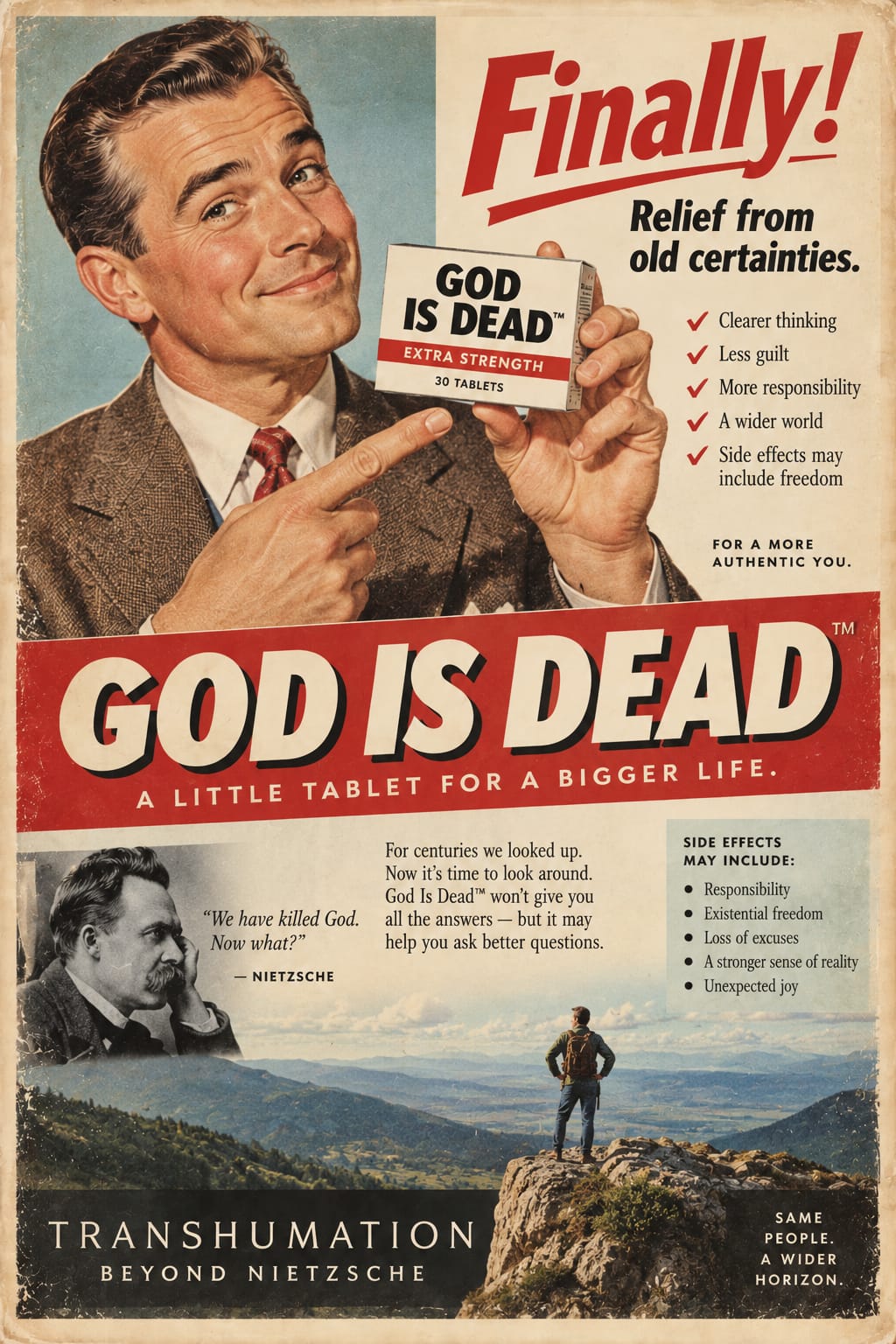
The Al Bundy Problem
Perspective is the part of the game nobody can play for you.
There is a lovely historical accident hiding in Married… with Children. Al Bundy was designed to look like a loser: a miserable shoe salesman, trapped in a job he hated, married, exhausted, forever remembering the few seconds in high school when the universe appeared to approve of him. We laughed.
Then some of the audience grew up and went to work.
Suddenly the loser had a house, a car, two children and a wife who did not need a salary. The joke had not changed. The spectator had. What once looked like failure could, from another economic moment and another stage of life, look suspiciously like an achievement.
Al’s philosophy was not Marcus Aurelius. That was part of its charm. His standard for victory could be reduced to something brutally modest: if he was still here, he had not entirely lost.
There is an antidote to fatalism in that stupidity. A labyrinth does not require a final exit before one corridor can be better than another. A game does not become meaningless merely because nobody hands you the victory conditions.
The Wall Is Also a Mirror
We usually notice a boundary because it prevents us from getting something. The job. The person. The money. The future. The other side.
But get close enough to a boundary and it begins to resemble a mirror. The closed road tells you not only where you cannot go, but what you wanted badly enough to walk toward. A choice reveals the chooser. A refusal reveals the system making the demand. Sometimes the wall should be destroyed. Sometimes it should be walked around. Occasionally the useful discovery is that you never wanted what was behind it until somebody told you that you could not have it.
Human progress has demolished an astonishing number of walls. We inherited roads made possible by people who never got to walk them. That does not mean we inherited a world without a labyrinth. We inherited a larger one, with more junctions, more possible lives and problems our ancestors could not have reached.
This is not a tragedy. More possibilities are not the same thing as fewer problems.
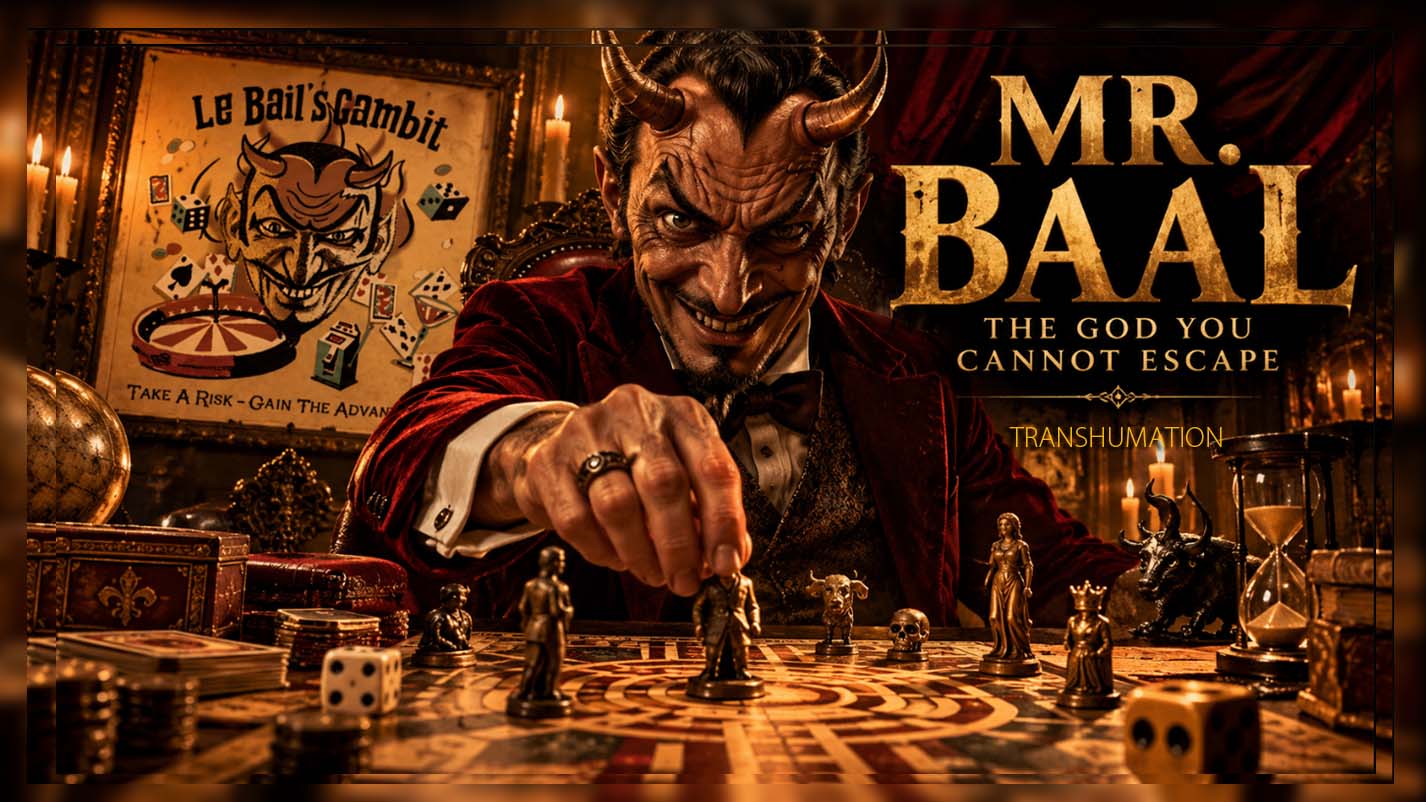
So Who Was Baal?
The historical answer matters. Baal was a title meaning “lord” or “master,” applied in different contexts, and Baal Hadad became one of the great storm gods of the ancient Levant. His myths belonged to cultures whose survival was tied intimately to forces they could influence only imperfectly. Later religious traditions opposed Baal worship, and the name accumulated associations very different from those it had for his worshippers.
But Transhumation is interested in a second question: what did people recognize when they gave such forces a face?
We do not need to pretend that Baal secretly invented algorithms, mortgage payments or American sitcoms. That would be a very silly history. The more interesting possibility is that human beings keep encountering certain structures and keep finding new carriers for them: choice, constraint, consequence, competition, dependence, uncertainty, the strange way one solution creates a landscape in which the next problem becomes visible.
A myth is alive when it stops telling you about ancient people and unexpectedly tells you something about yourself.
Perhaps that is why some gods are so difficult to bury. Their temples disappear. Their names change. Their enemies write the final chapter.
Then, three thousand years later, you find yourself standing at another junction.
And somewhere above the board, Mr. Baal is smiling.
Not because you are trapped.
Because it is your move.
Want to Know More?
How to Read the World
By Jacques Couteau
Current Knowledge
Baal was a Northwest Semitic title meaning approximately “lord” or “master,” rather than the unique personal name of one universal deity. The Baal prominent in the Late Bronze Age texts from Ugarit is commonly associated with Baal/Hadad, a storm deity connected with rain, fertility, kingship and conflict. The Ugaritic Baal Cycle includes his conflicts with Yamm, associated with the sea, and Mot, associated with death.
Biblical texts contain strong polemics against Baal worship. Much later religious and demonological traditions further transformed the cultural image attached to Baal and related names. There is no historical evidence that ancient worshippers understood Baal as “reality itself,” a universal system of constraints, or the “price of transformation.”
Open Questions
How much of a defeated religion can we reconstruct when part of its later reputation was preserved by competing traditions? Why do human cultures repeatedly give personalities to forces that exceed individual control? And when technology appears to overcome a natural limitation, have we escaped a rule—or discovered another rule that lets us move around the first one?
The deeper question may be whether absolute freedom is coherent at all. If every new possibility requires some stable structure in which that possibility can exist, then limits are not merely obstacles to freedom. Some limits may be what make freedom possible.
Transhumation Interpretation
Transhumation treats Baal as a test of carrier-independent structure. The claim is not that modern physics, markets or computers “are Baal.” They plainly are not.
The proposed structure is simpler: desire → constraint → understanding → participation → consequence.
The carrier changes. The relationship may not.
If that pattern remains useful after the ancient deity is removed from it, then Baal has given us something worth thinking with. If the argument works only by pretending an ancient storm god secretly knew modern philosophy, it should be discarded.
That is the test.
FAQ
Who was Baal?
Baal was a title meaning “lord” or “master.” In the Ugaritic texts, Baal Hadad is a major storm deity associated with rain, fertility, power and kingship.
Was Baal considered evil?
Not by the people who worshipped him. The strongly negative image familiar today developed through later religious conflicts and traditions opposed to Baal worship.
What is the Baal Cycle?
The Baal Cycle is a group of Ugaritic mythological texts describing Baal’s conflicts, especially with Yamm, associated with the Sea, and Mot, associated with Death.
Why does Transhumation use Baal as a symbol?
Not as a claim that the ancient god literally governs modern life. Baal provides a useful symbolic interface for recurring human experiences: rules, limits, choices, consequences and the discovery that removing one boundary can reveal possibilities and problems that were previously invisible.
Is the article claiming that modern stories secretly come from Baal?
No. Similar structures can appear without direct historical transmission. The interesting question is why different eras repeatedly create stories that become meaningful when readers recognize something from their own lives inside them.
Continue the Transhumation Series
- Forgotten Religion | Ancient Gods, Symbols and the Hidden Structures of Human Civilization
- The Last Religion | Death, Immortality and the Future of Humanity
- The New Theurgy | AI, Information and the Future of Human Civilization
- End of Branding: You Were Never Meant to Become a Product
- Baal vs Ishtar: Why Ancient Gods Never Disappeared