
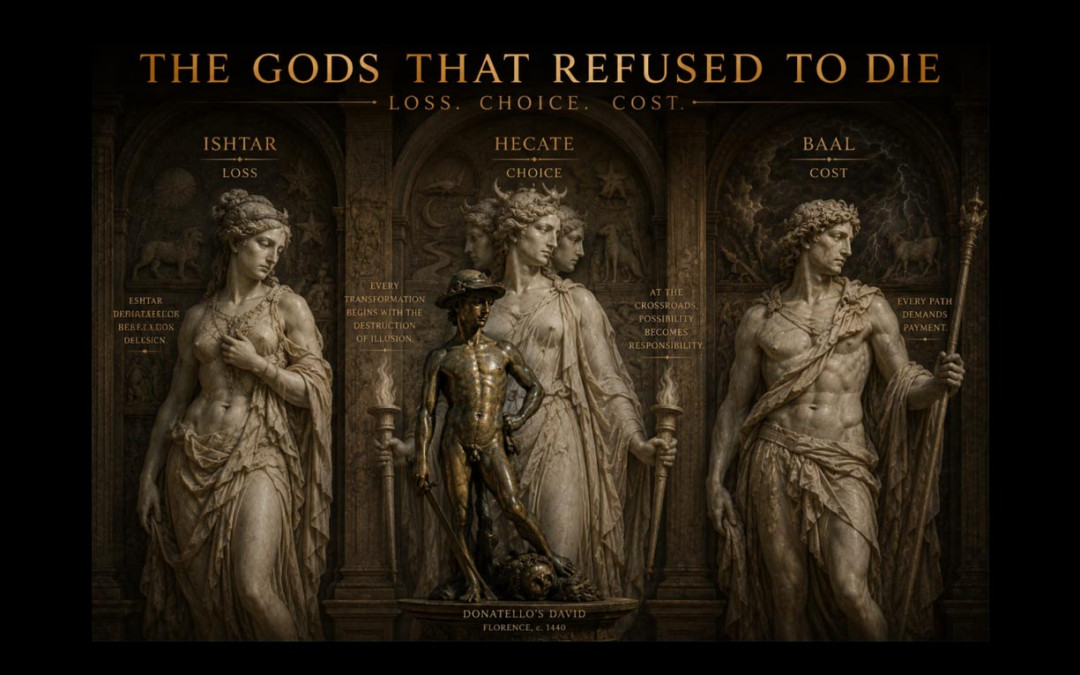
The Gods That Refused to Die
Their temples disappeared. Their names became archaeology. But perhaps we have been looking for the wrong thing.
There is something slightly disappointing about meeting an ancient god in a museum. Ishtar stands behind glass. Hecate has lost her crossroads and acquired an inventory number. Baal, once invoked beneath storms that could decide whether a harvest lived or died, has become a paragraph on a label. We have become very good at preserving the remains of gods after ceasing to take their worlds seriously.
And yet the strange thing about old gods is how familiar they can become once we stop asking whether we believe in them.
Consider three figures who did not originally belong to one religion, one period, or even one simple theological system: Ishtar, Hecate and Baal. Historically, it would be misleading to arrange them into a secret ancient trinity. There is no surviving tablet telling us that humanity must first descend with Ishtar, then choose with Hecate, then pay a price to Baal.
But put their stories beside one another and another possibility appears. Perhaps mythology sometimes preserved not only characters but recurring human situations: losing the world that defined us, standing somewhere between alternatives, discovering that whatever comes next has a cost.
That does not prove that the ancients discovered a universal code.
It gives us something better to investigate.
The Woman Who Left Her Crown at the Door
The Mesopotamian descent myth begins with an irresistible image. A goddess approaches the world below and discovers that even divinity does not grant unrestricted admission.
In the Akkadian Descent of Ishtar, Ishtar enters the underworld ruled by Ereshkigal. Related Sumerian traditions tell the descent of Inanna. At successive gates, pieces of clothing, jewelry and insignia are removed from her. The precise texts and theological contexts matter, but the image that survived is extraordinarily simple: a powerful figure moves downward and becomes progressively deprived of the things by which power is recognized.
The crown goes.
The ornaments go.
The symbols of status go.
Eventually the visitor who entered as a goddess can no longer rely upon the apparatus that announced who she was.
It is tempting to modernize this immediately: Ishtar represents ego death. That would be too easy. Ancient Mesopotamians did not compose these texts as twenty-first-century self-help manuals, and Ishtar was far more complicated than a goddess whose purpose was to teach us about personal transformation. She was associated with sexuality, fertility, warfare, political power and other domains, while the descent belonged to a particular mythological and religious world.
But we do not have to pretend the myth was written for us to notice why its machinery remains intelligible.
Remove a person’s job, marriage, wealth, reputation, nationality, certainty or social position and a disturbingly modern question appears beneath an ancient story: how much of the self survives the removal of the things by which the self was recognized?
Civilizations can undergo something similar. Their institutions remain standing for a while, but the old explanations stop working. The crown is still visible; its authority is not.
The treasure here may therefore be smaller than a universal law, but more durable. Human beings have repeatedly discovered that transformation is not always experienced first as acquisition. Sometimes it begins as subtraction.
And after enough has been removed, another problem appears.
You have to decide where to go.
A Goddess at the Crossroads
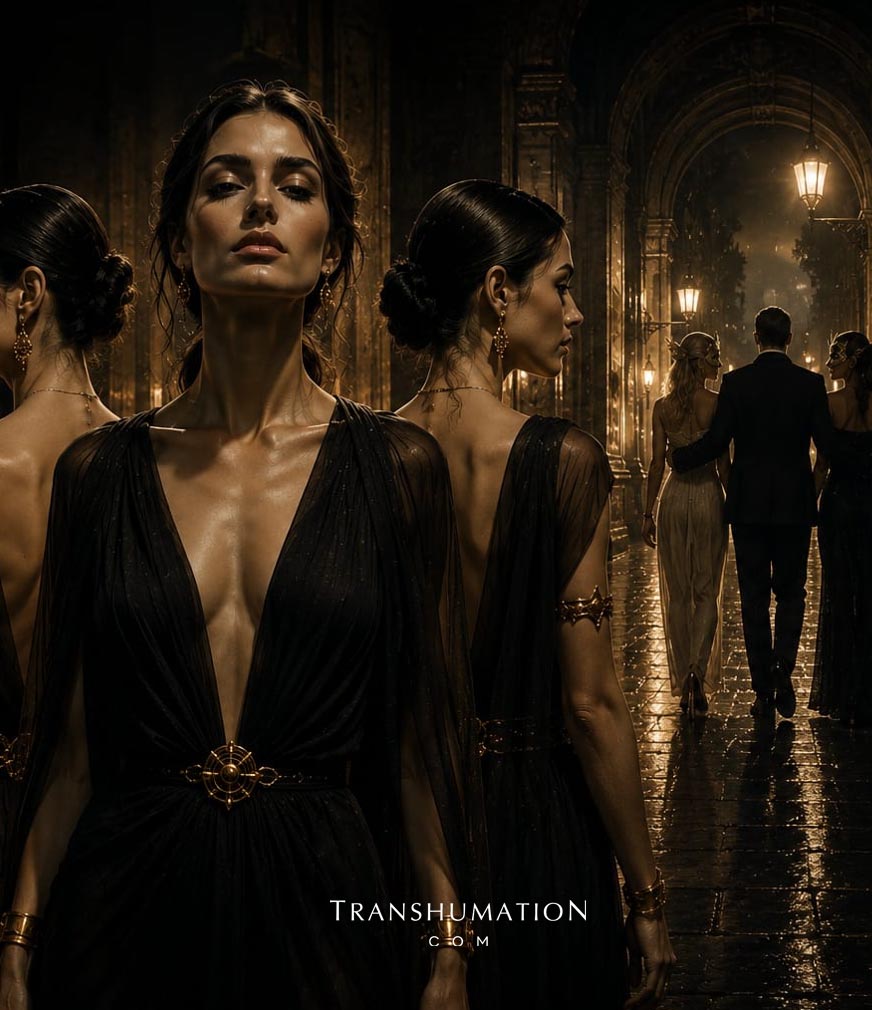
Hecate presents a different difficulty because the modern Hecate is partly the result of a very long history. She accumulated associations with night, magic, ghosts, torches, dogs, doorways and crossroads. Her triple representations became particularly influential, although reducing the entire ancient goddess to “the triple goddess of crossroads” compresses traditions that developed over centuries.
Still, the crossroads matters.
A crossroads is an unusually clever object to make sacred because almost nothing happens there physically. It is merely a piece of ground where one road ceases to be sufficient.
Before the junction, movement can be almost automatic. At the junction, direction becomes information.
That changes the traveller.
This may explain some of the enduring psychological power of Hecate’s later imagery. She belongs comfortably to thresholds because thresholds are places where categories become unstable: inside and outside, familiar and unknown, departure and arrival. Torches are useful there for an equally obvious reason. They do not reveal the entire landscape. They reveal enough to make another step possible.
There is no need to claim that ancient worshippers secretly invented a theory of decision-making. The historical Hecate deserves better than being flattened into our metaphor.
But the metaphor deserves examination too.
After the loss of an old identity, people frequently encounter precisely this condition. Several futures become imaginable while none is guaranteed. The frightening part is not simply ignorance. It is that more than one road remains plausible.
This is where the romantic reading and the realist reading should meet. The romantic sees Hecate waiting with torches at the edge of the known world. The realist sees a human mind confronted by uncertainty.
The interesting possibility is that they may be describing the same experience in different materials.
The Dog at the Door
Cerberus makes the picture stranger.
The famous guardian of Hades is often represented with multiple heads, most famously three, although ancient representations and literary descriptions were not completely uniform. Hecate, meanwhile, became strongly associated with dogs and the underworld, and later traditions sometimes place these mythological elements close enough to make the resemblance irresistible.
But resemblance is where we have to become careful.
Three heads do not prove a hidden system. Hecate’s triple form does not establish that Cerberus encodes the same geometry. Mythology is full of later combinations, changing iconography and symbols whose meanings cannot safely be reconstructed by counting them.
Something more durable survives if we abandon the number.
Cerberus guards a boundary.
And a guarded boundary is different from an ordinary road. It implies that crossing matters.
That remains recognizable far outside mythology. Some choices can be reversed cheaply; others alter the conditions under which the next choice will be made. Parenthood, migration, technological invention, political revolution, even publishing an idea can produce consequences that cannot simply be placed back inside the box.
The guardian therefore gives us another useful question. Perhaps the important distinction is not between doors that are open and closed, but between doors after which the person returning is no longer the person who entered.
We have not discovered the secret meaning of Cerberus.
We have found a better reason to keep looking at the door.
What Baal Actually Demands
Baal requires even greater caution because the name has accumulated centuries of baggage.
Baal can mean “lord” or “master” in Northwest Semitic contexts and could function as a title as well as refer to particular deities. The Baal most familiar from the Ugaritic texts is commonly identified as Baal/Hadad, a storm god associated with rain, fertility, kingship and conflict. Later Jewish and Christian traditions profoundly changed the cultural afterlife of the name, eventually helping turn “Baal” into something much darker in the popular imagination.
So Baal was not historically “the god of price.”
That is our interpretation.
But look at what a storm god meant in an agricultural world. Rain was not atmosphere. It was survival. Fertility was not an abstract celebration of nature. It was the difference between abundance and hunger. The forces represented by such a deity belonged to a world in which human beings were painfully aware that continuation depended upon conditions they could influence only partially.
This gives the third part of our experiment a harder edge.
After loss comes possibility. After possibility comes consequence.
Every chosen road excludes another road. Every serious project consumes time that cannot be spent twice. Every civilization that builds one future commits resources that cannot simultaneously construct every competing future.
The word sacrifice can make this sound unnecessarily mystical. Economists have a colder expression for part of the same reality: opportunity cost.
Something is surrendered because something else was chosen.
Perhaps that is enough.
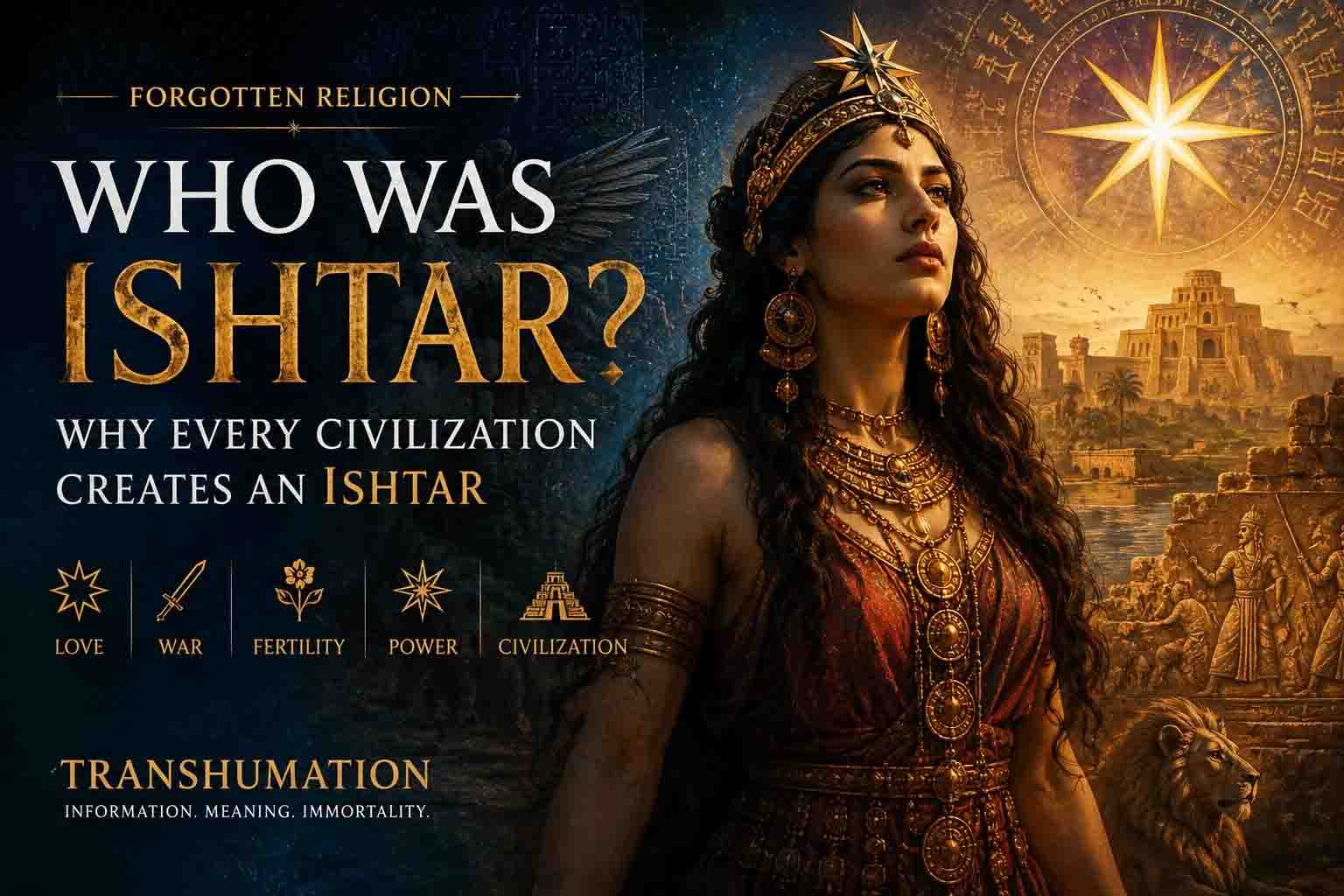
Three Gods Who Never Met
Now we can return to our three museum exhibits.
Ishtar descends and loses the signs of who she was.
Hecate occupies the uncertain territory of thresholds and roads.
Baal belongs to a world in which continuation depends upon forces, resources and consequences that cannot simply be wished away.
Historically, we should stop there. They do not form a documented ancient sequence of loss → choice → cost. Creating such a system and attributing it to antiquity would turn interpretation into counterfeit history.
But Transhumation can ask a different question.
What happens if we deliberately place them together now?
A remarkably portable structure appears. A marriage ends and an identity collapses; several possible lives become visible; each requires surrendering something. A company discovers that its old business no longer works; alternative strategies appear; choosing one requires capital, layoffs, risk or abandoning another market. A civilization encounters a technology that destabilizes assumptions about work, intelligence and even human uniqueness; multiple futures become possible; none arrives without consequences.
The gods have disappeared from those sentences.
Their problems have not.
That is much more interesting to me than claiming that Ishtar somehow “predicted” artificial intelligence. She did not. Nor did Hecate encode technological branching futures or Baal anticipate energy-hungry data centres.
The stronger proposition is almost the opposite.
Perhaps new technologies keep producing situations old enough to have acquired gods.
Artificial intelligence can destroy identities built around particular forms of expertise. It creates branches that did not previously exist. And every branch carries costs: economic, environmental, political, psychological or moral.
We are not returning to Mesopotamia or Greece.
We may simply be discovering that technological progress does not abolish some of the oldest human situations.
The Gods Outside the Museum
This is why I am increasingly suspicious of the sentence “the ancient gods disappeared.”
Their cults certainly could disappear. Temples could close. Rituals could be prohibited or forgotten. Languages could die. A god could become a demon, an archaeological curiosity or a character in entertainment.
But disappearance of a name is not necessarily disappearance of the thing the name helped people think about.
This is where mythology becomes useful without requiring belief.
Perhaps gods were sometimes cultural interfaces: memorable personalities attached to forces and situations too large, abstract or unstable to carry easily in ordinary thought. Storm becomes a god. The threshold receives a goddess. Death gets a kingdom and a dog at the gate.
That hypothesis should not be romanticized either. Humans are extremely good at finding patterns, including patterns that are not there. Three carefully selected gods can be arranged into an elegant sequence precisely because we selected them. Another researcher could choose three different figures and construct another compelling map.
So the test cannot be whether the story sounds beautiful.
The test is whether the structure remains useful after the gods are removed.
Loss.
Uncertainty.
Choice.
Cost.
Irreversibility.
Those experiences do not require Ishtar, Hecate, Baal or Cerberus to exist. They appear in psychology, economics, politics, technology and ordinary lives under completely different names.
And perhaps that is the small treasure hidden inside the old stories.
We began by asking why dead gods still fascinate us. A better question may be whether some gods survived precisely because they gave faces to problems that never died.
Watch The Video
How to Read the World
Current Knowledge
Ishtar was a major Mesopotamian goddess associated with domains including sexuality, fertility, warfare and political power. The Akkadian Descent of Ishtar and related Sumerian traditions concerning Inanna describe a descent into the underworld involving passage through gates and the removal of garments or insignia. Interpreting this specifically as a universal psychological sequence of “loss before transformation” is a modern reading, not an established ancient doctrine.
Hecate was an ancient Greek goddess whose roles and representations developed considerably over time. She became associated particularly with thresholds, crossroads, torches, dogs, ghosts and magic. Triple representations of Hecate are historically important, but they should not automatically be treated as evidence of a universal metaphysical principle of three.
Cerberus was the mythological guardian of the underworld. Multiple ancient descriptions and representations exist, and the familiar three-headed form should not be treated as completely uniform across antiquity.
Baal was a Northwest Semitic term meaning approximately “lord” or “master” and was used in relation to several deities. The Baal prominent in the Ugaritic texts is associated particularly with storm, rain, fertility, kingship and conflict. “Cost” or “sacrifice” is not his historically established primary meaning in the sequence proposed by this article.
There is no known ancient religious system connecting Ishtar, Hecate and Baal in the sequence loss → choice → cost. That construction belongs to the Transhumation interpretation below.
Open Questions
Why do certain mythological figures remain culturally powerful thousands of years after the societies that worshipped them have disappeared?
Are recurring similarities between myths evidence of common human experiences, historical transmission, recurring social structures, cognitive tendencies—or some combination of them?
Most importantly, when we discover a compelling pattern across different traditions, how can we distinguish a structure that genuinely survives changes of culture from one that exists primarily because a modern observer selected the right pieces?
Transhumation Interpretation
Transhumation does not require Ishtar, Hecate and Baal to have secretly belonged to one ancient system. In fact, the experiment becomes more interesting if they did not.
The question is whether a function can migrate while its carrier changes.
A goddess can disappear while descent remains. A cult at the crossroads can vanish while the problem of choosing under uncertainty remains. A storm god can become archaeology while human beings continue discovering that every serious future carries costs.
This suggests a different way of reading mythology. Instead of asking only, “What did this god represent?”, we can also ask, “What recurring problem made a figure like this useful?”
The distinction matters because the second question can travel.
From mythology to psychology. From religion to economics. From ancient ritual to artificial intelligence. Not because these things are secretly identical, but because sometimes a durable relationship survives while its cultural vocabulary changes.
That is the Transhumation hypothesis:
the names may die before the structures do.
We should not believe it merely because it is beautiful.
We should see how difficult it is to break.
FAQ
Did ancient people believe Ishtar, Hecate and Baal formed one system?
No known historical evidence establishes the sequence proposed here. The connection is a modern Transhumation interpretation used to test whether similar structures can appear across different traditions.
Was Ishtar simply a goddess of transformation?
No. Ishtar was a complex Mesopotamian deity associated with sexuality, fertility, warfare and power. Her descent into the underworld provides the particular motif examined in this article.
Was Hecate always a triple goddess of magic?
No. Hecate’s identity and iconography developed over a long period. Her later associations with magic, crossroads, ghosts, dogs and triple forms should not be projected unchanged onto every period of Greek religion.
Was Baal the god of sacrifice or cost?
No. The Baal known especially from Ugaritic religion was principally associated with storms, rain, fertility, kingship and conflict. “Cost” is the interpretive role assigned to him in this essay, not an ancient theological definition.
What is the central Transhumation idea?
That some mythological figures may remain compelling because the human situations attached to them recur even when religions, languages and civilizations change.
Continue the Transhumation Series
- Forgotten Religion | Ancient Gods, Symbols and the Hidden Structures of Human Civilization
- The Last Religion | Death, Immortality and the Future of Humanity
- The New Theurgy | AI, Information and the Future of Human Civilization
- End of Branding: You Were Never Meant to Become a Product
- Baal vs Ishtar: Why Ancient Gods Never Disappeared