
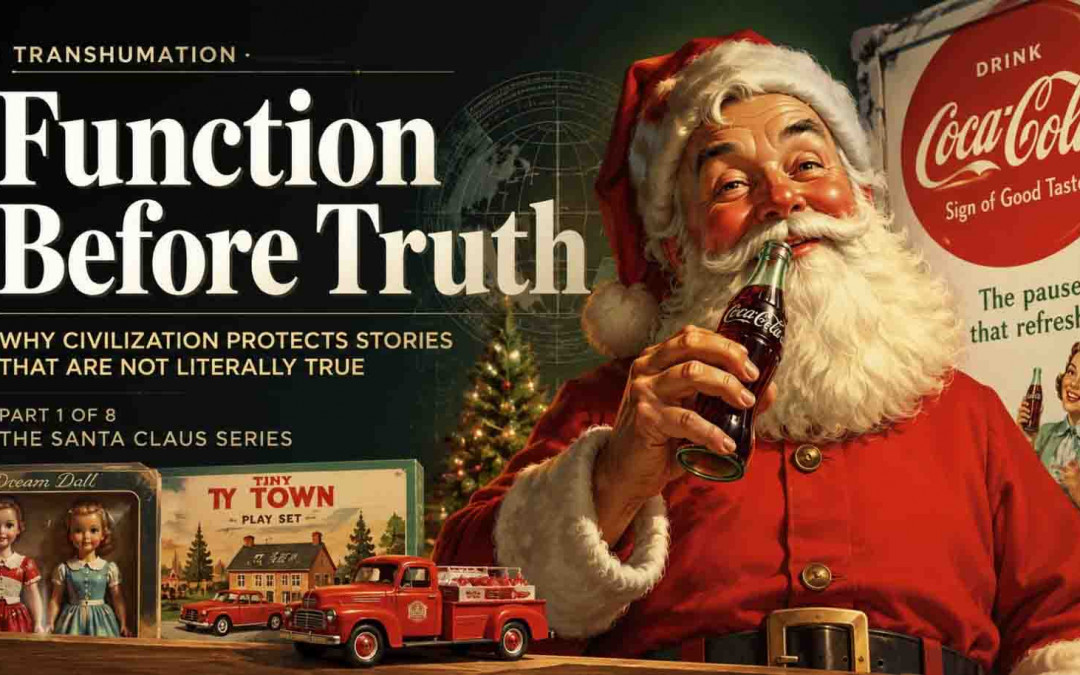
Why Civilization Keeps Rebuilding Santa Claus
Every December, millions of adults participate in an elaborate conspiracy for the benefit of children. Presents are hidden. Handwriting is disguised. Cookies disappear overnight. Footprints may appear by the fireplace. Parents who spend the rest of the year teaching honesty temporarily collaborate in a fiction so widely accepted that almost nobody treats it as a moral emergency.
That is already strange enough to deserve attention.
The obvious question is whether Santa Claus exists. Adults know how to answer that. But the interesting question begins only after the answer is settled. If modern civilization values truth so highly, why does it repeatedly preserve a story whose literal mechanism almost nobody over the age of ten believes? Why do parents who would reject false medical claims, bad history or fabricated evidence still protect this particular fiction for a few carefully chosen years?
Perhaps because the story is doing something.
That possibility sounds trivial until it is taken seriously. Human beings often use things before they understand them. Fire cooked food long before thermodynamics. Farmers selected crops long before genetics. Sailors navigated by stars without astrophysics. Function did not wait politely for explanation.
Stories may have evolved in much the same way.
The Lie Nobody Treats Like a Lie
Santa Claus is useful precisely because everybody eventually knows what sort of thing he is.
A child may initially treat the story literally. Adults usually do not. Yet the ritual survives because the transition from belief to recognition does not necessarily destroy the structure. The child who later learns that parents bought the presents may eventually become the parent placing them beneath another tree.
That is an unusual form of cultural continuity.
The belief disappears.
The behavior survives.
The adult does not normally say, “I discovered Santa was false, therefore the system failed.” Instead, many adults join the system. They inherit the role once occupied by the invisible figure.
This is where the story becomes more interesting than a simple deception. Santa Claus is not merely a proposition about a man living near the North Pole. He is an interface through which several things become easier to stage at once: generosity, anticipation, secrecy, wonder, family ritual, reward, the passage of time and the peculiar intensity childhood gives to expectation.
Remove the literal character and those functions do not automatically disappear.
But the character makes them easier to hold together.
Civilization has always been good at this.
It gives abstractions a face.
The Banknote on the Table
Put a banknote beside a wedding ring and a flag.
Materially, none is particularly impressive. Paper, metal, cloth.
Now try to remove the meaning.
The banknote matters because other people recognize it as money. The ring can carry obligations and memories that are not physically contained in gold. The flag can produce loyalty, anger, sacrifice or belonging in ways impossible to explain by fabric alone.
The object is real.
The power is relational.
This does not mean money, marriage or nations are “fake.” That word is too crude. A shared system can produce very real consequences even when its meaning does not reside inside the material object itself.
A passport is paper until a border recognizes it.
A degree is paper until an institution, employer and society recognize what it certifies.
A word is sound until speakers agree on what it means.
Human beings live inside enormous networks of shared interpretation.
Santa Claus belongs somewhere in this territory.
Not because he is equivalent to currency or law, but because the mechanism is familiar: a symbol becomes powerful when enough people understand how to participate in it.
The important question is therefore not merely whether the symbol corresponds literally to an external being.
It is what the symbol allows people to coordinate.

The Man Coca-Cola Did Not Invent
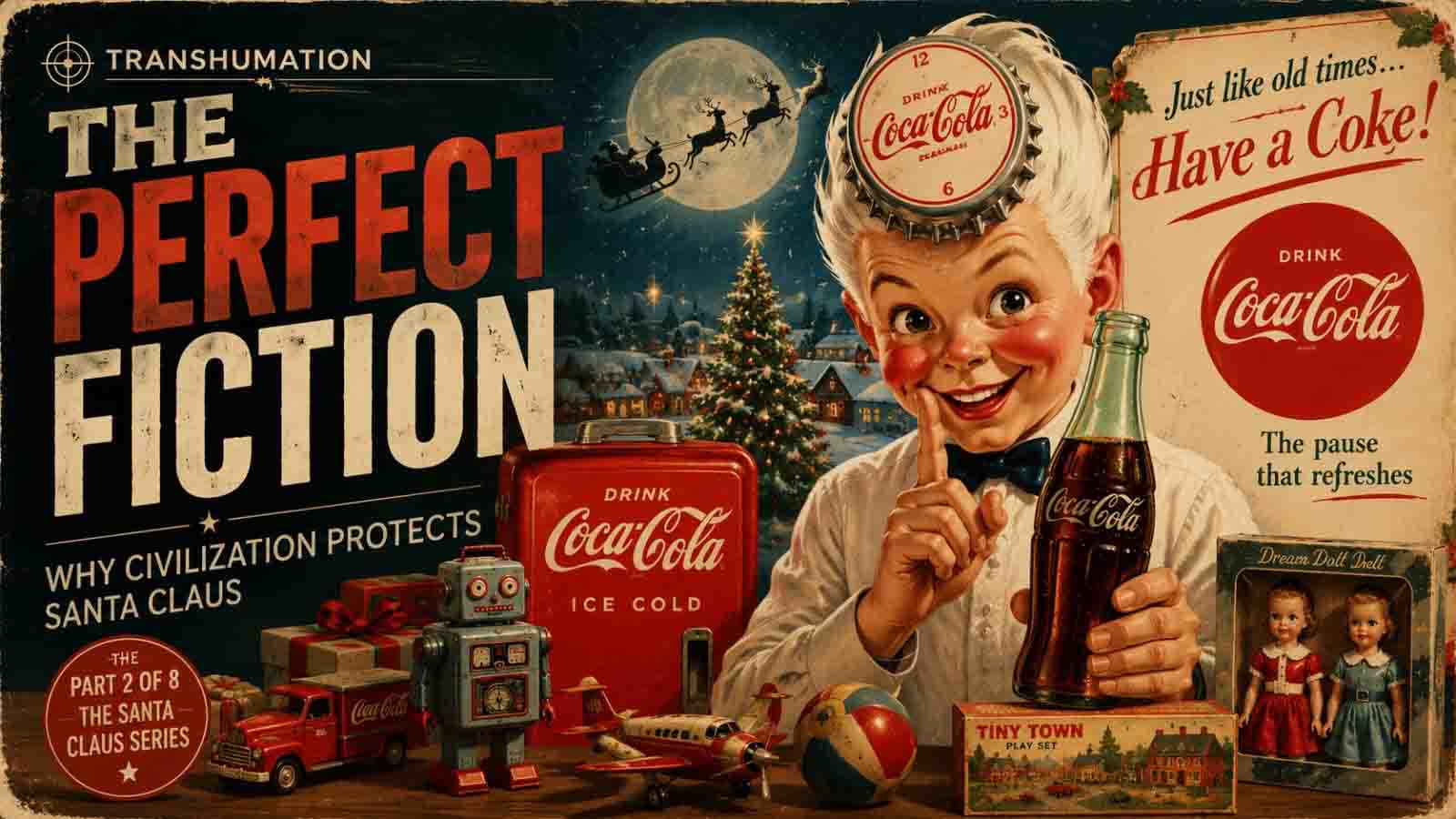
The modern image of Santa Claus is often credited entirely to Coca-Cola, which is wrong in the simple historical sense. The figure had already developed through a long mixture of Saint Nicholas traditions, Dutch Sinterklaas customs, English Christmas traditions, nineteenth-century American literature and illustration. Thomas Nast had already helped shape the visual Santa decades before Coca-Cola began its famous advertising campaigns.
What Coca-Cola did remarkably well was something subtler.
It stabilized an interface.
Beginning in the 1930s, Haddon Sundblom’s advertising illustrations helped spread a warm, red-suited, white-bearded Santa whose appearance became globally familiar. The company did not invent the myth. It inherited a cultural figure and gave one version of him extraordinary visual consistency.
That is far more interesting than invention.
A corporation discovered that a symbol already carried emotional infrastructure. Then advertising strengthened the carrier.
The commercial image escaped the advertisement.
It entered memory.
That is the moment branding becomes culture—not because the audience is forced to accept the image, but because the image plugs successfully into something the audience already wants to preserve.
Santa survived Coca-Cola because Santa did not belong to Coca-Cola.
The company improved one of his interfaces.
Why Some Stories Die
Civilizations produce far more stories than they preserve.
Most vanish.
Minor gods disappear. Heroes are forgotten. Rituals collapse. Proverbs stop making sense. Entire cosmologies survive only in fragments because the culture that carried them no longer requires them.
Why do some survive?
Accuracy cannot be the only answer.
Some historically inaccurate stories remain culturally powerful. Some true events disappear almost completely from collective memory. Survival depends on transmission, institutions, usefulness, emotional force, identity, repetition, adaptability and chance.
A story that cannot move between carriers becomes fragile.
A story that can migrate from oral tradition to ritual, from ritual to book, from book to illustration, from illustration to film, from film to advertising and from advertising back into family ritual becomes much harder to kill.
Santa Claus is a master of carrier migration.
Saint.
Folklore figure.
Poem.
Illustration.
Advertisement.
Film character.
Shopping-mall performer.
Parent in disguise.
The costume changes.
The function remains recognizable.
This begins to resemble evolution, although the comparison should not be pushed too literally. Stories do not reproduce biologically. But cultures do select, repeat and modify them. Some forms travel better than others.
The myth survives because each generation finds a reason to hand it forward.
Children Learn the Function First
Children expose another layer of the problem because they often encounter meaning before explanation.
A child learns language long before grammar.
Fairness before moral philosophy.
Rhythm before music theory.
Family ritual before anthropology.
Stories before hermeneutics.
This sequence is not a defect. It is how learning often works.
Understanding begins with participation.
The child does not need a lecture on the anthropology of gift exchange in order to understand that Christmas morning feels different from an ordinary Tuesday. The ritual teaches before the theory arrives. Emotion marks the event as significant. Repetition gives it structure. Later, explanation can dismantle, refine or reinterpret what was learned.
This is why the phrase “children believe in Santa” can be slightly misleading.
Children participate in a system whose full architecture they do not yet understand.
Adults do this too.
We use money without understanding monetary policy.
Technology without understanding semiconductor fabrication.
Language without understanding linguistics.
Institutions without understanding their historical formation.
Meaning frequently precedes theory.
The problem begins only when participation becomes immune to correction.
The Question Religion Usually Gets First
Modern discussions of religion often begin with ontology.
Did the god exist?
Did the miracle occur?
Was the revelation supernatural?
Did the ritual correspond to anything outside the believers?
These are legitimate questions. Some are historical. Some are scientific. Some may remain inaccessible.
But they are not the only questions available.
A civilization can preserve a religious structure partly because it performs social, psychological or political functions independent of whether every metaphysical claim can be established.
A ritual can organize grief.
A calendar can coordinate community.
A myth can encode identity.
A pilgrimage can turn geography into memory.
A deity can personify forces that otherwise remain difficult to discuss.
None of this proves the theology true.
None of it proves the theology false.
It changes the order of inquiry.
Instead of beginning with “Were these people foolish to believe this?” we can begin with “What problem did this structure solve well enough to survive?”
That question is especially valuable because it works equally well for believers and skeptics.
It does not require mocking faith.
It does not require affirming it.
It asks what the system did.
Function Before Truth Is Not Truth Instead of Truth
This distinction matters because “function before truth” can sound like an invitation to relativism.
It is not.
A bridge must obey physics regardless of how meaningful people find it. Medicine cannot excuse false claims merely because a belief comforts patients. History becomes useless if evidence is discarded whenever a better story appears.
Truth remains indispensable wherever correspondence with reality matters.
But function answers a different question.
A map can be inaccurate and still reveal why people used it.
A myth can be historically false and still organize a civilization.
A ritual can produce social cohesion without proving its cosmology.
A currency can depend on shared confidence without becoming imaginary in its effects.
Human life operates simultaneously in material and symbolic systems.
Confusing them causes problems in both directions. Treat every symbol as literal fact and mythology becomes bad science. Treat every nonliteral structure as worthless fiction and much of civilization becomes unintelligible.
The more interesting task is learning which question belongs to which level.
The Story That Survives Its Disproof
Santa Claus gives us an unusually gentle model because the transition is visible.
The child discovers the literal mechanism is false.
The story survives.
Not unchanged. Its status changes.
Santa becomes memory, ritual, performance, generosity, nostalgia, cultural shorthand. The proposition dissolves while the structure remains useful.
This is a remarkable informational event.
A story survives its own disproof by moving to another level.
That may be one reason ancient religious symbols continue to return even in secular societies. A figure can lose literal authority while retaining interpretive power. Janus can become a symbol of thresholds. Proteus can become an adjective for transformation. Charon can remain a metaphor for passage.
The historical religion ends.
The pattern migrates.
Santa performs the same trick every December on a smaller scale.
The child stops believing.
The adult becomes Santa.
Watch The Video
How to Read the World
Current Knowledge
The modern Santa Claus developed from multiple historical traditions, including Saint Nicholas, Dutch Sinterklaas customs, English Christmas figures and nineteenth-century American literary and visual culture. Coca-Cola did not invent Santa Claus, though its advertising campaigns beginning in the 1930s helped popularize a highly recognizable modern visual form.
Children’s engagement with fictional characters and rituals is developmentally complex. Participation in fantasy does not always map neatly onto adult categories of literal belief, and children can hold imaginative and factual frameworks simultaneously in different contexts.
Social institutions such as money, law, education and ritual depend partly on shared recognition and coordinated behavior. Their effects are real even when part of their power comes from collectively maintained symbolic meaning.
Anthropology, sociology, psychology and religious studies all examine ways in which myths, rituals and symbols can perform social or psychological functions. Demonstrating such a function does not establish or disprove the metaphysical truth of a religious claim.
Open Questions
Why do some stories remain useful after literal belief weakens while others disappear completely? Is survival determined mainly by emotional resonance, institutional repetition, adaptability, social function or the ability to migrate between media?
There is also a boundary problem. When does a useful fiction become harmful deception? Santa Claus is generally treated as benign because the cultural script includes eventual disclosure. Other myths, ideologies or institutions may resist correction even when evidence contradicts them.
A deeper question concerns religion. Can functional analysis explain why a belief survives without reducing the believer’s experience to mere social utility? And can believers and skeptics examine the same structure without requiring the inquiry to settle the metaphysical question first?
Transhumation Interpretation
Transhumation treats Function Before Truth as a method of investigation, not as a ranking of values.
The method asks:
Before deciding what a symbol ultimately is, identify what it does.
This protects us from a common mistake. We see an ancient god, ritual or myth and immediately translate the problem into a modern courtroom: true or false, real or invented, enlightened or primitive. The verdict may matter, but it can arrive too early.
A structure can perform a function before anyone understands the mechanism.
Stories can carry ethical memory.
Rituals can carry identity.
Symbols can compress social knowledge.
Libraries can preserve questions long after the culture that first asked them disappears.
Santa Claus offers an almost laboratory-clean example because modern society allows us to watch the carrier change in real time. The child receives a literal story. Later the literal story breaks. Then, strangely, the adult often chooses to rebuild it for someone else.
The truth status changed.
The function survived.
That is the clue.
Perhaps many cultural structures should be investigated in the same order. First ask what survived. Then ask what function survived with it. Only afterward ask whether the original explanation remains necessary.
The danger is obvious: usefulness does not make falsehood true.
But the opposite mistake is equally costly.
Falsehood does not automatically make function meaningless.
Civilization is not built from facts alone. It is built from facts, symbols, rituals, memory, coordination and shared interpretation.
The sophisticated civilization is not the one that chooses truth or meaning.
It is the one capable of knowing the difference.
FAQ
What does “Function Before Truth” mean?
It means that when studying a cultural symbol or tradition, it can be useful to ask what function it performs before debating its ultimate truth.
Does the article argue that truth is unimportant?
No. Truth remains essential in science, history, medicine and other domains where factual accuracy matters.
Why use Santa Claus as the example?
Because many adults stop believing in Santa literally yet continue the ritual, showing how a structure can survive after its original belief status changes.
Did Coca-Cola invent Santa Claus?
No. Santa developed from older traditions. Coca-Cola helped popularize a particularly influential twentieth-century visual version.
How is Santa similar to money or wedding rings?
The comparison concerns shared meaning. The physical object alone does not contain the full social significance assigned to it.
Does this mean religion is merely useful fiction?
No. Functional analysis does not settle whether religious claims are metaphysically true or false. It examines another layer of the phenomenon.
Why do civilizations preserve stories?
Stories can carry identity, values, memory, ritual and social coordination across generations.
How does this connect to Transhumation?
Transhumation looks for functions that survive changes of carrier. A story can lose one interpretation and continue because the structure it performs remains useful.
What is the central idea?
Sometimes the most revealing question is not simply “Is this true?” but “What does this do, and why did civilization decide it was worth carrying forward?”
Continue the Transhumation Series
- Forgotten Religion | Ancient Gods, Symbols and the Hidden Structures of Human Civilization
- The Last Religion | Death, Immortality and the Future of Humanity
- The New Theurgy | AI, Information and the Future of Human Civilization
- End of Branding: You Were Never Meant to Become a Product
- Baal vs Ishtar: Why Ancient Gods Never Disappeared