
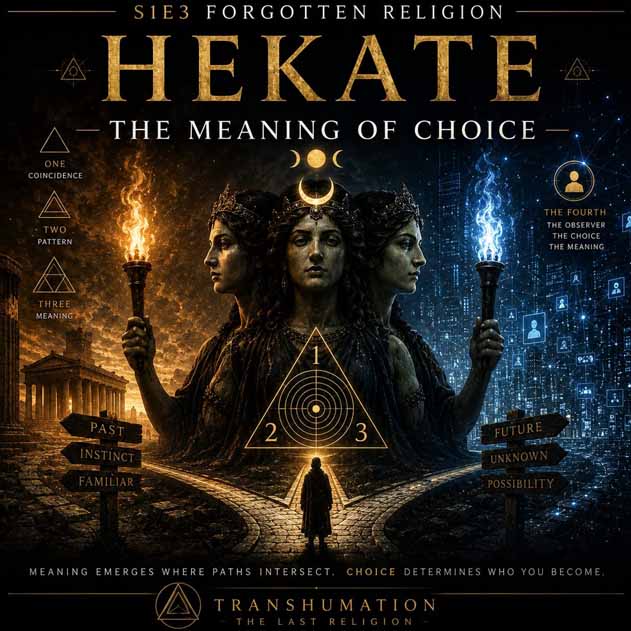
Hekate: Three Paths Create Meaning
For thousands of years, civilizations have returned to one mysterious figure standing at the edge of the unknown.
A goddess with three faces.
A guardian of crossroads.
A guide through darkness.
Her name was Hekate.
Modern culture often remembers Hekate as the goddess of witchcraft or magic. Yet this interpretation barely scratches the surface. Ancient symbols rarely survived because they described supernatural beings. They survived because they described patterns that human beings continued to recognize throughout history.
Perhaps Hekate was never simply a goddess.
Perhaps she was one of humanity's earliest models of consciousness.
Why Three?
One event is coincidence.
Two repeated events become a pattern.
Three events create meaning.
This simple progression appears everywhere in human civilization.
Past. Present. Future.
Birth. Life. Death.
Three Fates.
Three Graces.
Stories built in three acts.
The triangle—the first stable geometric structure.
Perhaps this is not accidental.
The moment three independent possibilities appear, consciousness is forced to compare them. Meaning no longer exists inside a single event. It emerges from relationships between multiple paths.
This may explain why Hekate was almost always depicted with three faces standing at a crossroads.
She does not merely watch the roads.
She represents the moment choice becomes possible.
The Crossroads of Consciousness
Crossroads have always held symbolic importance.
Not because roads are magical.
But because every crossroads forces a decision.
Every decision creates a future while abandoning countless alternatives.
Perhaps consciousness itself evolved through this process.
The ability to stop.
Compare.
Interpret.
Choose.
Seen this way, Hekate becomes less a supernatural figure and more a symbolic interface between uncertainty and understanding.
Ancient Symbols, Modern Technology
The world has changed.
Human cognition has not.
Artificial intelligence searches through probabilities.
Algorithms compare possibilities.
The Internet connects billions of paths simultaneously.
Modern civilization increasingly behaves like a giant crossroads.
In many ways, AI performs operations remarkably similar to symbolic navigation:
recognition,
comparison,
prediction,
selection.
Ancient myths and modern computation may speak different languages while exploring surprisingly similar structures.
Forgotten Religion
The Forgotten Religion series asks an unusual question.
What if ancient religions were never primitive attempts to explain nature?
What if they were symbolic maps designed to help human beings navigate increasingly complex realities?
Perhaps gods did not disappear.
Perhaps civilization simply replaced one symbolic vocabulary with another.
Today we say:
"The algorithm knows."
"The cloud remembers."
"Artificial intelligence learns."
Thousands of years ago people expressed similar ideas through gods and myths.
Different words.
The same human questions.
The Fourth Path
Three paths create meaning.
But there is one more element.
Someone must decide what that meaning becomes.
The observer.
The witness.
The interpreter.
Perhaps this is the hidden fourth path.
Not another road.
But the consciousness choosing between them.
That may be Hekate's deepest lesson.
Not that the future is predetermined.
But that every civilization eventually reaches a crossroads where meaning depends less on the world itself—and more on the mind interpreting it.
Watch the previous Episodes
Episode 1
Episode 2
Discover why one of the oldest symbols in human history may still explain the age of artificial intelligence.
Want to Explore More..?
Watch The Video Below
Read more
Three Forces That Control Your Life
FAQ
Who was Hekate?
Hekate was an ancient Greek goddess associated with crossroads, transitions, thresholds, hidden knowledge, and choice. She is often depicted with three faces, symbolizing multiple perspectives.
Why is Hekate shown with three faces?
The three faces represent different directions, possibilities, and perspectives. In symbolic interpretation, they illustrate how meaning emerges when consciousness compares multiple paths.
What do crossroads symbolize?
Crossroads represent moments of decision, uncertainty, and transformation. They remind us that every choice creates one future while leaving others behind.
What does Hekate have to do with artificial intelligence?
Both Hekate's symbolism and modern AI involve recognizing patterns, comparing possibilities, and navigating complexity. The connection is symbolic rather than historical.
What is Forgotten Religion?
Forgotten Religion is a Transhumation series exploring ancient myths, symbols, and religions as cognitive and philosophical structures rather than literal supernatural stories.
Why do triangles appear so often in religion and mythology?
Triangles are the first stable geometric structure. Across cultures they symbolize balance, meaning, and the emergence of order from multiple possibilities, making them one of humanity's most universal symbols.
Continue the Transhumation Series
Explore the full journey:
- End of Reality — Where Do You Really Exist?
- End of Physics — Are the Laws of Reality Real?
- End of the Real World — Reality Is No Longer Required
- End of Consciousness — Beyond the Human Mind
- End of Death — When Human Limits Disappear
- End of Religion — When Technology Replaces Faith