
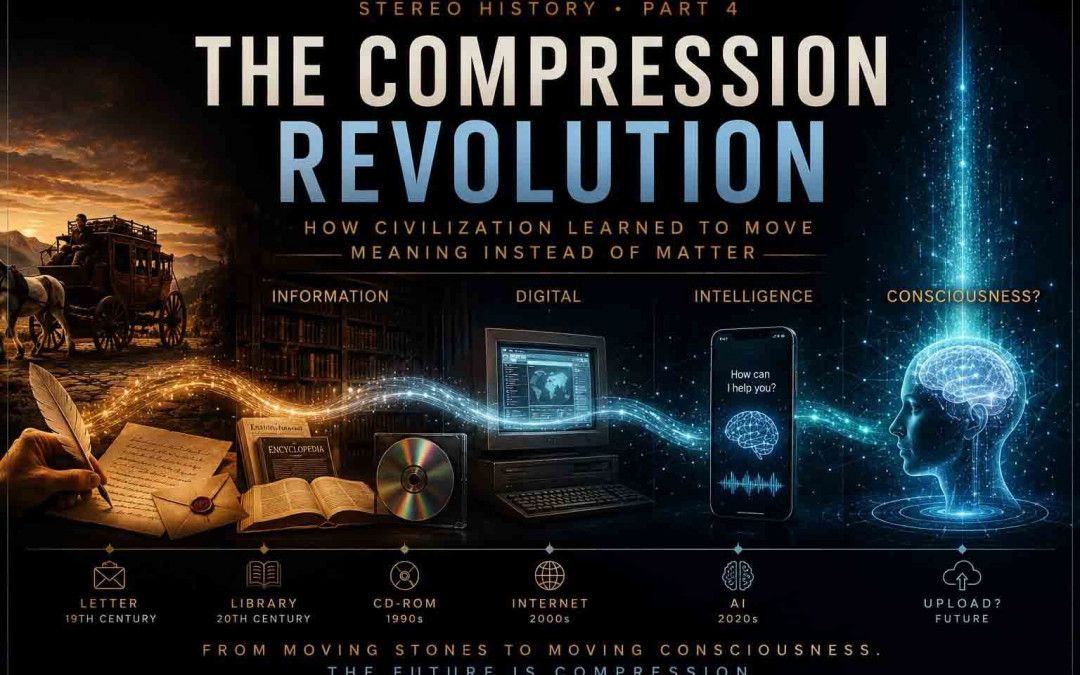
The Compression Revolution
In the middle of the 1990s, an ordinary plastic disc could produce a peculiar feeling.
You placed it into a beige computer, waited for the drive to spin, and suddenly an encyclopedia appeared. Maps, photographs, biographies, diagrams, recordings and thousands of pages of text emerged from an object small enough to hold between two fingers. The disc itself seemed almost offensively insignificant compared with the intellectual space it opened.
There had always been small objects containing large meanings. A book could carry an empire’s law. A letter could end a marriage. A mathematical formula could describe a relationship extending far beyond the page on which it was written.
Yet the CD-ROM made the disproportion unusually visible.
The carrier had become tiny.
The represented world had become enormous.
That relationship now defines so much of modern life that we barely notice it. A phone can contain access to libraries that no palace could physically house. A memory card can hold more photographs than a family might once have accumulated across several generations. A few coordinates can reconstruct a complex geometric object. A short algorithm can generate millions of outputs.
Modern civilization has become extraordinarily good at finding smaller descriptions for larger structures.
That is the Compression Revolution.
It is not the disappearance of matter.
It is the discovery that matter does not always need to move in the same form as the thing we want to preserve.
The Letter That Did Not Need to Cross the Ocean
Consider an ordinary nineteenth-century letter sent from London to Bombay.
The message and its carrier were tightly coupled. A particular piece of paper had to move from one place to another. The ink crossed the sea because the page crossed the sea. The recipient obtained the message only when the physical artifact arrived.
The process could be improved through faster ships, better roads and more efficient postal systems, but the basic architecture remained the same.
Move the object.
Deliver the message.
Electronic communication altered that relationship.
An email does not send one particular sheet of paper across the world. It transforms a message into encoded states that can be transmitted through physical systems, reconstructed elsewhere and displayed through another carrier entirely.
The information still depends on matter.
Electric currents, electromagnetic radiation, storage media, network equipment and energy are all physical.
But the message no longer depends upon the journey of one specific material object.
That distinction is enormous.
The paper does not travel.
Enough structure does.
A message can be reconstructed thousands of kilometers away because sender and receiver share a system capable of interpreting the representation.
This is not teleportation.
It is something more practical.
Civilization learned how to send the pattern instead of transporting the original carrier.
Compression Is Older Than Computers
Digital technology did not invent this principle.
Language is already a form of compression.
A person lives through an afternoon containing thousands of sensations, movements, sounds, memories and emotional changes, then says:
“It was a difficult day.”
Four words replace an experience that could never be transmitted in full.
The compression is brutal.
It is also useful.
Writing performs another operation. A voice that exists temporarily in air becomes a sequence of marks capable of being reproduced later. A map removes almost everything present in a landscape in order to preserve relationships useful for navigation. Musical notation omits the physical event of a particular performance while preserving enough structure for another musician to produce something recognizably connected to it.
Mathematics may be one of civilization’s most powerful compression systems.
A formula can summarize a relation that applies across indefinitely many particular cases. The equation does not contain every example. Its usefulness comes precisely from refusing to.
This is why compression should not be understood simply as making files smaller.
It is a much older intellectual operation.
Remove information while preserving the relation that matters.
That sentence contains both the power and the danger.
Remove too little and the representation remains cumbersome.
Remove too much and the representation becomes false.
Civilization advances partly by learning the difference.

A Library Is Not Smaller Than Civilization
The original temptation is to say that libraries compressed civilizations into buildings.
That is beautiful but slightly misleading.
A library does not contain civilization.
It contains traces selected from it.
Books.
Documents.
Maps.
Arguments.
Accounts.
Images.
Catalogues.
Much of what happened outside those traces is lost.
The voices of ordinary people disappear disproportionately. Gesture disappears. Smell disappears. Private conversation disappears. Entire social worlds can leave only fragments.
The library is therefore not civilization in miniature.
It is a compression with losses.
That may make the institution more rather than less extraordinary. A library does not need to preserve everything in order to preserve enough for another mind to reconstruct questions, conflicts and ways of seeing that would otherwise vanish completely.
The mistake is thinking that more compression always means progress.
A thousand-page archive can become a ten-page history.
The ten-page history can become a paragraph.
The paragraph can become a headline.
The headline can become a slogan.
At every stage access becomes easier.
At every stage something disappears.
The Compression Revolution therefore contains a permanent trade-off between legibility and fidelity.
The shorter route is useful only if it still leads somewhere real.
When the World Fit on a Disc
The CD-ROM moment made this trade-off tangible for a mass audience.
Encyclopedias that once occupied shelves could be distributed as data. Photographs, text, indexes, sound and simple animation could share the same carrier. Searching could replace physically turning through volumes.
The important change was not that knowledge suddenly became weightless.
The disc was physical.
The computer was physical.
The information required manufacturing, electricity and storage.
What changed was the relationship between physical scale and informational capacity.
A large library no longer required a proportionally large object at the point of access.
Digital encoding made copying and reconstruction extraordinarily cheap.
Then networks altered the relationship again.
The disc disappeared.
The content no longer needed to arrive in one complete physical package.
The machine could request portions from elsewhere.
This changed the intuitive meaning of possession.
You could access something without physically owning the carrier on which its master copy existed.
Modern cloud systems extend that logic dramatically.
The interface becomes smaller while the infrastructure behind it becomes larger.
The smartphone looks like radical miniaturization.
The data center reminds us that nothing has actually escaped physics.
The End of Miniaturization Was Never the Point
Technology histories often look like stories about shrinking objects.
The room-sized computer becomes the desktop.
The desktop becomes the laptop.
The stereo becomes the Walkman.
The camera becomes part of the phone.
The phone absorbs the map, notebook, music player, calculator, television and increasingly the interface to artificial intelligence.
But miniaturization eventually reveals that physical size was never the most important variable.
A phone cannot shrink indefinitely because hands and eyes remain roughly human-sized. A keyboard can become so small that typing becomes worse. A display can become so compact that information becomes unreadable.
The deeper transformation lies elsewhere.
The distance between intention and result keeps shrinking.
A photographer once needed film, development, printing and distribution before an image reached an audience.
Now:
take.
send.
The physical systems behind those actions are immensely complicated.
The user’s experience is compressed into a gesture.
That may be one of the defining characteristics of mature technology.
Complexity does not disappear. It moves behind the interface.
The result can feel almost magical precisely because the machinery doing the work has been hidden.
From Search to Conversation
This is where artificial intelligence becomes interesting.
A traditional library requires the reader to know something about how information is organized.
A catalogue reduces the search space.
A search engine reduces it further by allowing the user to begin with keywords rather than shelf locations or bibliographic expertise.
Conversational AI changes the interface again.
The user can increasingly begin not with the structure of the archive but with the structure of the question.
That is a significant reduction in friction.
But calling AI a compression of all knowledge would be wrong.
A language model is not a library containing tiny copies of every document it encountered. Nor is a generated answer equivalent to retrieving a verified source. Models learn statistical structure from training data and can generate useful representations, explanations and connections, but they can also omit provenance, flatten disagreement and produce convincing errors.
The very thing that makes the interface powerful creates the danger.
Conversation compresses complexity.
It can also hide complexity.
A good answer may save the reader hours.
A bad answer may save the reader from discovering that the question had no simple answer.
This is why the best future role for AI resembles a librarian more than an oracle.
The librarian does not abolish the library.
The librarian helps the reader move through it.
Compression Produces Power by Hiding Work
There is a recurring feature in every mature interface.
The easier the action becomes, the harder it is to see the systems that make the action possible.
Tap a button and a photograph crosses the world.
Ask a question and a system produces an answer.
Enter a destination and software calculates a route through a city.
The visible effort approaches zero.
The invisible machinery can be enormous.
This creates a strange inversion.
The user experiences increasing simplicity while civilization underneath becomes increasingly complicated.
The map looks cleaner.
The infrastructure becomes denser.
This matters politically and philosophically because hidden complexity can create hidden dependency. A person using GPS does not need to understand orbital mechanics, radio transmission or map databases. That is a triumph of interface design.
But if the interface becomes the only route to understanding, the user may lose the ability to inspect what has been compressed away.
The same applies to AI.
An elegant summary can preserve the argument.
It can also erase the uncertainty.
Compression gives power because it reduces cognitive cost.
It demands responsibility because somebody has to decide what remains.
The Most Important Question Is What Was Removed
This is why compression belongs beside the LEGO Principle.
A simplified model becomes useful when it preserves the relation relevant to the question.
A subway map does not need trees.
It does need the stations.
An anatomical diagram may remove skin texture because skin texture is irrelevant to the relationship being explained.
Remove the wrong detail and simplification becomes distortion.
The same problem appears in history.
A century can be compressed into a sentence.
“The Roman Empire fell.”
The sentence is convenient.
It also hides chronology, geography, institutional survival, eastern continuity, local variation and the fact that historical processes do not obey the grammatical neatness of a single verb.
Every compression contains a theory about importance.
What survives has been judged relevant.
What disappears has been judged expendable.
Sometimes the judgment is explicit.
Often it is invisible.
This may be one of the most consequential features of information technology: as civilization becomes better at compressing knowledge, the politics of what gets removed becomes increasingly important.
Could a Human Being Be Compressed?
Eventually the thought experiment reaches the dangerous object.
A person.
Suppose we preserve someone’s photographs, voice, writing, correspondence, preferences, medical history, movements and memories. Add detailed recordings of behavior. Add biological information. Perhaps one day add neural measurements.
The archive becomes enormous.
Now compress it.
A model begins speaking in that person’s style.
It remembers events.
Recognizes family.
Makes jokes the original might plausibly have made.
Predicts preferences.
At first glance this seems like the ultimate extension of the Compression Revolution.
A life becomes a model.
But something has changed.
A book can tolerate enormous compression because we know approximately what function we expect the summary to preserve.
For a person, we do not yet know the invariant.
Which information can disappear while the same person survives?
Memories?
Body?
Emotional tendencies?
Neural dynamics?
Causal continuity?
First-person consciousness?
The problem cannot be solved simply by collecting more data because the unresolved issue is not only informational quantity.
It is identity.
A compressed representation can become extraordinarily accurate while still being another representation.
The portrait can improve forever without becoming the sitter.
Watch The Video
How to Read the World
Current Knowledge
Information theory provides formal ways of understanding how signals can be encoded, transmitted and compressed, including distinctions between lossless compression, in which original data can be reconstructed exactly, and lossy compression, in which selected information is discarded to reduce size or complexity.
Human communication also relies heavily on forms of abstraction and compression that are not identical to technical data compression. Language, maps, mathematical models and summaries preserve selected relationships while omitting enormous amounts of underlying detail.
Digital communication does not move information independently of physics. Data must always be physically represented, stored and transmitted. What digital systems permit is reconstruction of the same encoded structure across different physical carriers without transporting one original material object.
Artificial intelligence systems can reduce the effort required to navigate large informational spaces by generating summaries, explanations, classifications and responses. They do not automatically preserve provenance or guarantee factual accuracy, making source access and verification important.
There is currently no scientific evidence that a sufficiently detailed informational model of a person would establish continuation of that person’s subjective consciousness.
Open Questions
One major question is whether there is a general measure of “sufficient structure” outside narrowly defined technical problems. In a JPEG image, designers can specify tolerable information loss. In history, culture or identity, deciding what may safely disappear is far more difficult because relevance depends upon the question being asked.
Another question concerns dependence on interfaces. As access becomes easier, do people gain more intellectual freedom, or does invisible compression increasingly determine which parts of reality they ever encounter? A system that reduces complexity may empower the user while also silently narrowing the world.
AI raises a related problem of provenance. If a conversational answer accurately compresses hundreds of sources into one explanation, the interface is extraordinarily useful. But if the path back to those sources disappears, how can the reader distinguish careful synthesis from confident fabrication?
The deepest open question concerns human identity. Even if future science could represent a person’s memories, behavior and neural organization with extraordinary precision, we do not know whether those are sufficient conditions for preserving first-person continuity rather than creating another system with the same informational history.
Transhumation Interpretation
The Compression Revolution matters to Transhumation because it exposes one of civilization’s oldest techniques for crossing the limits of individual minds.
We cannot carry an entire landscape.
We draw a map.
We cannot replay an experience inside another consciousness.
We tell a story.
We cannot hold a civilization in one lifetime.
We build libraries.
The pattern is ancient.
What technology changes is the scale and speed at which the operation can occur.
Digital systems allow representations to be copied with extraordinary fidelity across carriers. Networks reduce geographic distance. Search reduces navigational distance. AI may reduce the distance between an enormous archive and the question a reader actually wants to ask.
This is not a march toward immaterial existence.
It is a history of increasingly sophisticated re-instantiation.
A structure appears in one carrier, is encoded according to selected invariants and later reconstructed elsewhere.
That description fits text extremely well.
It fits geometry.
It fits software under appropriate conditions.
It begins to fail when we assume that every meaningful thing must work the same way.
That is where Transhumation needs its boundary test.
Some things survive compression because their identity is defined by relatively clear relations.
A triangle does not care which pixels display it.
A text can survive a change of font.
A melody can survive a change of instrument while remaining recognizably the same melody.
A human being appears much harder.
A person has not only structure but history, embodiment, dynamic biological processes and subjective continuity. We do not yet know which of these are essential and which are replaceable.
That means the most ambitious version of the Compression Revolution should not say:
Civilization began by moving stones and will end by moving consciousness.
We have no basis for the second half.
The stronger claim is more interesting.
Civilization has repeatedly learned that preserving the right relationships can matter more than preserving one particular material instance.
Books taught us this.
Digital files made it obvious.
Software made it executable.
AI makes the compressed structure increasingly conversational.
The unresolved question is where that principle stops.
That boundary matters because successful compression produces a powerful illusion of completeness.
A summary can feel like the book.
A map can feel like the territory.
A model can feel like the person.
The better the compression becomes, the more carefully we must remember what it was designed to preserve.
This is why the future librarian matters.
The task is not merely to shorten the path between question and answer.
It is to preserve the ability to travel backward from answer to evidence, from representation to source, from elegant structure to the messy reality that constrained it.
Otherwise civilization risks achieving the ultimate compression:
an answer so convenient that nobody remembers the world was larger than it.
Perhaps that is the real revolution.
Not making information smaller.
Not making matter disappear.
Not abolishing distance.
It is learning how much of reality can be removed while still allowing something meaningful to arrive.
And then learning when to stop.
FAQ
What is the Compression Revolution?
It is the idea that civilization repeatedly reduces the amount of material, time or cognitive effort required to preserve, transmit and reconstruct useful structures.
Does information really travel without matter?
No. Information always requires a physical implementation. Digital communication reduces dependence on transporting one specific material carrier, not dependence on physics itself.
Why can language be described as compression?
Because a small number of words can represent experiences or structures containing vastly more detail than the words themselves preserve. The comparison is conceptual rather than identical to technical data compression.
How does AI fit into the process?
AI can compress the path between a complex informational environment and a human question by generating explanations, summaries and connections. The danger is that this convenience may also conceal sources, uncertainty or missing information.
Is more compression always better?
No. Compression is useful only while the structure relevant to the task survives. Remove the wrong information and simplification becomes distortion.
Could a human mind eventually be compressed?
We may eventually build extremely detailed models of human memory, behavior or neural organization. That would not by itself establish that subjective consciousness or personal continuity had been transferred.
The deepest question is therefore not how much information we can compress.
It is which things remain the same after compression—and which only look as though they do.
Continue the Transhumation Series
- Forgotten Religion | Ancient Gods, Symbols and the Hidden Structures of Human Civilization
- The Last Religion | Death, Immortality and the Future of Humanity
- The New Theurgy | AI, Information and the Future of Human Civilization
- End of Branding: You Were Never Meant to Become a Product
- Baal vs Ishtar: Why Ancient Gods Never Disappeared