
Across The Ocean of Time
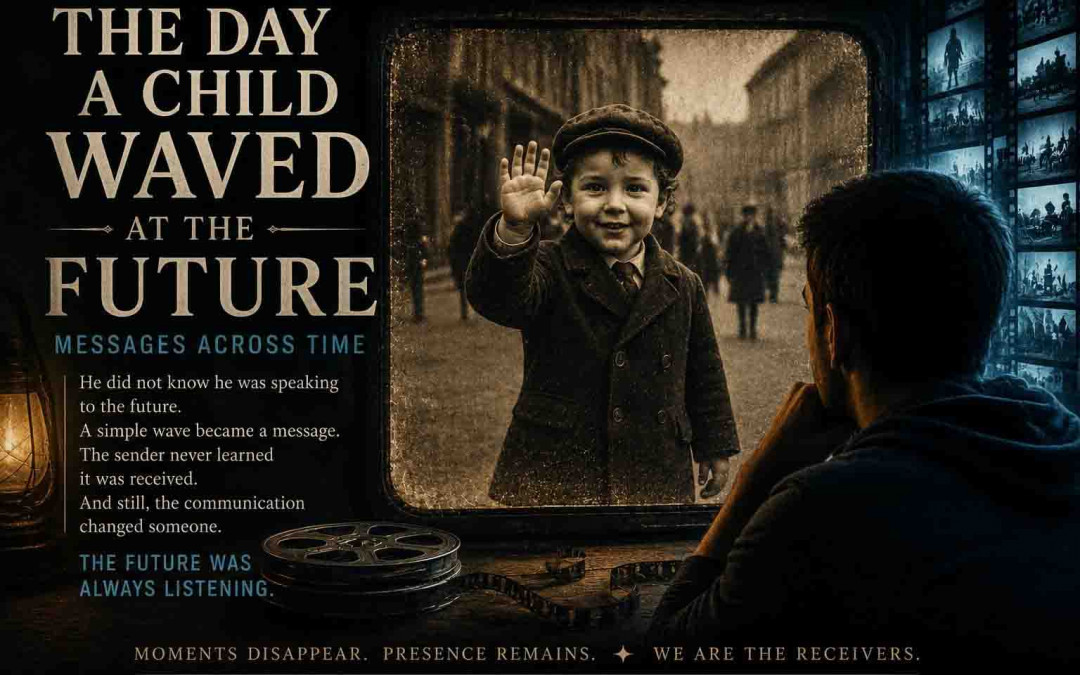
Somewhere inside the immense archive of early cinema, a child notices a camera.
There is nothing ceremonial about the moment. No statesman is delivering a speech for posterity. No explorer is documenting a discovery. No dying writer is carefully arranging his final words. The child simply looks toward the machine, recognizes that something unusual is happening and raises a hand.
The gesture lasts perhaps a second.
Then life continues.
For the people standing nearby, the event belongs entirely to the present. The camera operator has exposed a strip of film. The child has performed a small social gesture toward somebody or something in front of him. Nobody needs to imagine an audience watching from another century.
And yet that second can survive all of them.
Long after the street changes, after fashions disappear, after the child grows old and dies, the gesture can be projected again. A stranger born a hundred years later can recognize it instantly.
The hand rises.
We understand.
This is one of the quiet miracles of recorded media. Not immortality. Not resurrection. Not even communication in the ordinary reciprocal sense.
Something stranger.
A human gesture can acquire recipients who did not exist when it was made.
Can We Send Messages to People Who Haven’t Been Born Yet?
Human beings discovered this possibility long before cinema.
An inscription carved into stone can address descendants. A legal document can bind people not yet born. A book can deliberately imagine future readers. Tombs, monuments, chronicles and religious texts have often been created with posterity in mind.
Civilization has been speaking beyond the lifespan of individual speakers for a very long time.
What modern recording changed was the range of things capable of making the journey.
The ancient ruler had to commission the inscription.
The writer had to write.
The monument had to be built.
The message to the future was usually intentional enough to justify the cost of preserving it.
Photography and film altered that economy.
Suddenly the future could receive people who had never prepared an address to posterity.
A woman crossing a street.
Workers leaving a factory.
A family laughing during a picnic.
A soldier turning toward the camera.
A child waving.
The archive could preserve not only what a civilization consciously decided was worth saying, but fragments of what ordinary life happened to look like while the machine was running.
That is a profound change because posterity stopped requiring permission from the person being preserved.
The future gained accidental correspondents.
The Difference Between a Message and a Trace
Calling the child’s wave a message is emotionally satisfying and technically imprecise.
A message normally involves intention.
Someone means to communicate something to somebody.
The child in the film may have intended nothing beyond acknowledging the camera operator. He did not necessarily imagine us, and there is no reason to pretend that he somehow knew the future was watching.
What survives is better described as a trace.
The distinction matters because traces can become meaningful in contexts their creators never anticipated.
A shopping list can become historical evidence.
A soldier’s casual photograph can become the only surviving image of a destroyed building.
A private letter can become a major source for understanding an era.
A few seconds of street film can reveal clothing, gait, traffic, gestures and social relations nobody behind the camera thought worth documenting.
Meaning therefore does not belong entirely to the sender.
It can arise later between a surviving pattern and a new observer.
The original event supplies the trace.
The future supplies another context.
Between them, something resembling communication appears.
This is one reason archives are more than warehouses.
Their contents continue acquiring new questions.
Why Do Old Films Feel So Alive?
A photograph can preserve a face with extraordinary intimacy, but movement changes the encounter.
A person turns before smiling.
A hand pauses.
A hat is adjusted against the wind.
Two people glance at one another and share a joke we cannot hear.
None of these details may matter to the historical event being documented, yet they matter enormously to the human nervous system.
We are built to read behavior.
Timing, posture, gaze, hesitation and movement are among the signals through which one human being recognizes another as socially present. When old film preserves them, the brain performs a reconstruction that no catalogue entry can reproduce.
This is why twenty seconds of ordinary footage can sometimes feel more immediate than twenty pages of historical description.
The pages may contain far more knowledge.
The film contains another kind of evidence.
It shows how gravity behaved on a particular body.
How someone occupied space.
How quickly they turned when called.
Whether a smile emerged gradually or suddenly.
These are tiny pieces of information, but together they produce something close to presence.
Not presence itself.
The distinction remains essential.
The person is gone. The film is not holding consciousness in storage. What remains is a physical recording from which another human brain can reconstruct enough behavioral structure to experience recognition.
The past feels alive because we are alive while perceiving it.
History Acquires Peripheral Vision
Traditional history necessarily selects.
Kings, wars, treaties, inventions, laws and institutions survive because somebody thought them worth documenting. Archives inherit those decisions.
Recording technologies widened the aperture.
The camera often catches what nobody intended to make historically important.
The person standing behind the politician.
The child looking away from the ceremony.
A shop sign at the edge of the frame.
A horse reacting to machinery.
A passerby staring directly into the lens.
This peripheral information can become invaluable later because future questions are impossible to predict completely.
A camera records more than the photographer understands.
That is one of its unusual historical powers.
Writing normally requires selection before preservation. The writer must choose the sentence.
A camera can preserve relationships whose significance appears only decades later.
Of course, film also selects. The frame excludes most of reality. The camera points in one direction. The operator decides when to record. Surviving footage reflects wealth, technology, institutions and accidents of preservation.
But within those limits, recorded media can preserve an excess of detail.
The archive knows things its creator did not know it knew.
The People History Was Not Looking For
There is something democratic about this possibility, though we should not romanticize it.
For much of recorded history, preservation favored power.
Rulers commissioned portraits.
Institutions preserved official correspondence.
Wealthy families maintained papers.
Famous writers found editors.
The ordinary dead disappeared much more completely.
Photography and amateur recording did not erase that imbalance, but they changed its scale.
Millions of people acquired photographs who would never have commissioned painted portraits. Home movies preserved families without historical importance. Later, inexpensive video and smartphones multiplied the number of lives leaving audiovisual traces almost beyond comprehension.
This creates a new kind of historical abundance.
The future historian may face the opposite problem from the medieval historian.
Not too little evidence.
Too much.
Billions of photographs.
Messages.
Videos.
Location histories.
Voice recordings.
Search histories.
Digital accounts.
The twenty-first century may leave behind an archive so enormous that preservation becomes less difficult than navigation.
The problem shifts from what survived? to what can still be found?
And once again, the librarian becomes essential.
The Future Was Never Waiting for Us
The phrase “the future was listening” is beautiful but needs one correction.
The future was not sitting somewhere waiting to receive the child’s wave.
The future did not exist yet.
No hidden audience watched from behind time.
What existed was a carrier capable of remaining available until another observer arrived.
That is more interesting because it requires no mysticism.
Film does not send itself into the future like a signal aimed at a destination.
It persists.
Then the recipient catches up.
This reverses our normal picture of communication.
Usually the message travels toward the recipient.
Across deep time, sometimes the message barely moves at all.
The recipient travels toward the message.
A manuscript waits in a monastery.
A photograph waits in a drawer.
A film reel waits in an archive.
A digital file waits on storage media.
Generations pass until somebody opens it again.
Communication across time is therefore partly an architecture of waiting.
Civilization builds things capable of remaining meaningful long enough for unknown readers to arrive.
Is a Recording a Form of Immortality?
Only if we weaken the word until it means something very different from personal survival.
The child in the film does not continue experiencing the world because the wave survives. The gesture has duration beyond the body that produced it, but there is no evidence that the child’s first-person consciousness accompanies the recording.
This distinction should remain firm because modern technology makes the confusion increasingly tempting.
A voice can survive.
A face can survive.
Handwriting can survive.
Preferences can be documented.
Thousands of messages can preserve linguistic habits.
Soon enough, systems may be able to reconstruct a person’s manner of speaking with astonishing fidelity.
All of that demonstrates the persistence of pattern.
None of it yet demonstrates continuity of subject.
The difference resembles the one between a melody and the musician.
A melody can be played again after the composer dies.
The return of the structure is real.
The return of the composer is another claim entirely.
Film gave human gestures unprecedented persistence.
It did not defeat biological death.
The Long Conversation Was Never One Conversation
It is also tempting to place the pyramids, the Iliad, the Bible, libraries, film, the internet and artificial intelligence into one clean historical sequence, as though civilization had always been consciously pursuing a single technological goal.
History rarely behaves so neatly.
These things emerged from different cultures, institutions and problems. A pyramid is not an early hard drive. An epic poem is not primitive cloud storage. A medieval library was not secretly waiting to become the internet.
The useful connection is structural rather than genealogical.
Each provides some way for patterns to remain accessible beyond the immediate moment of their creation.
Sometimes those patterns are words.
Sometimes images.
Sometimes rituals.
Sometimes institutional records.
Sometimes executable instructions.
The carrier changes.
The kind of preserved structure changes with it.
The deeper continuity lies in civilization’s repeated discovery that a human lifetime need not be the lifetime of every human consequence.
We die.
Some of what we cause does not.
Can AI Complete a Conversation Across Time?
Artificial intelligence introduces the most seductive version of this question because it can create the appearance of reciprocity.
The child in the old film cannot answer us.
A writer’s book cannot change its next sentence because we disagree.
A recorded voice cannot ask what we meant.
AI can.
Given enough archival material, a system could potentially answer questions about a deceased person’s writings, reconstruct chronology, compare statements and generate language resembling known style.
The archive stops behaving like a passive shelf.
It begins responding.
But we should be exact about what crossed time.
The original person supplied traces.
The contemporary system supplies inference.
The new response did not wait inside the archive for a century.
It is generated now.
This may become one of the most useful historical interfaces ever created. Imagine asking a vast archive to show every contradiction in a thinker’s work, every reference to a particular person, every change in vocabulary across decades.
That is the librarian at extraordinary scale.
But if the interface answers as the dead person, the category changes.
Now reconstruction begins to resemble continuation.
The simulation may become emotionally persuasive enough that people stop noticing where the historical record ends.
The future has not finally learned how to talk back to the child.
It has learned how to construct another voice from the traces the child left behind.
That distinction may become difficult to feel.
It must remain easy to state.
The Recipient Who Arrives a Century Late
There is a beautiful asymmetry in all of this.
The child cannot know us.
We can know something of the child.
We can infer curiosity from the wave, though even that may exceed the evidence. We can perhaps identify location, date, clothing, technology and social setting. If the archive is unusually rich, we may eventually discover a name.
But the relationship cannot become reciprocal.
That incompleteness is not a failure of old media.
It is part of what makes the encounter moving.
A gesture survived without receiving confirmation.
The sender never learned the transmission worked.
Every work intended for posterity contains a smaller version of this uncertainty.
The author never knows all future readers.
The architect never meets everyone who enters the building.
The person placing photographs into an archive does not know which face a stranger will stop at a century later.
Civilization is built partly from acts whose recipients remain unknowable.
We send things forward without knowing who will find them.
Sometimes we do not even know we are sending them.
And occasionally, long after everyone who understood the original moment is gone, another human being raises their eyes toward the screen and recognizes the gesture immediately.
Watch The Video
How to Read the World
Current Knowledge
Humans have intentionally transmitted information to later generations for thousands of years through inscriptions, manuscripts, monuments, legal records, religious traditions and other durable media. Communication directed toward future audiences therefore predates photography and film by a very long period.
Photography, phonography and motion pictures expanded the kinds of human traces that could be preserved with relatively high perceptual fidelity. Film in particular can preserve sequences of bodily movement, facial expression and social interaction that written records may not document.
Recorded media do not preserve complete human experience. Every medium selects. A camera captures only what enters the frame; a microphone records some acoustic information while excluding other aspects of the event; surviving archives are further shaped by what was recorded, stored, lost, catalogued and later digitized.
Human observers are highly responsive to facial expression, movement, gaze and vocal timing, which helps explain why old audiovisual recordings can produce a strong subjective sense of presence even when viewers know that the recorded individuals are long dead.
Artificial intelligence can make historical archives more searchable and interactive, but generated responses based on archival material are new outputs. They should not be confused with authenticated statements made by the historical person.
Open Questions
One important question concerns intention. At what point does a trace become a message? A recorded farewell explicitly addressed to descendants clearly functions as communication toward the future, while an anonymous passerby accidentally captured by a camera did not necessarily intend any future audience. The recipient may nevertheless experience both as encounters across time.
Another question concerns archival abundance. Earlier historians frequently struggled with missing records, whereas future historians may inherit overwhelming quantities of digital material. It remains uncertain whether an enormous archive produces better memory or merely a larger space in which meaningful traces can disappear.
There is also the problem of reconstruction. Digital restoration can recover damaged material, but generative systems can also fill gaps that were never recorded. Where should archives draw the boundary between restoration, probabilistic reconstruction and invention?
The deepest question remains personal continuity. If future systems can reconstruct someone’s voice, behavior, memories and style sufficiently well to produce convincing conversation, does anything more than representation continue? Current evidence gives us no reason to assume that convincing resemblance alone preserves the original subject.
Transhumation Interpretation
The child waving at the camera gives Transhumation one of its simplest models of carrier-independent structure.
A biological body performs a gesture once.
Light reaches film.
The film is developed.
Perhaps copied.
Perhaps digitized decades later.
The digital file is stored on another medium.
The image is compressed, transmitted and reconstructed on a screen.
Almost every physical carrier in the chain changes.
Yet enough of the original relation survives for another human being to recognize a wave.
This is exactly what carrier independence means when stated carefully.
The gesture never becomes carrier-free.
At every stage it requires matter.
But it becomes less dependent on one particular piece of matter.
The child’s hand can disappear.
The original reel can deteriorate.
Another copy may still preserve enough structure.
That is genuine continuity of pattern.
And it immediately shows why continuity of pattern should not be confused with continuity of person.
The wave survives much more easily than the consciousness that produced it.
We know what invariant matters for recognizing the gesture: movement, sequence, form.
We do not know the complete invariant required for preserving a human subject.
This makes the archive both hopeful and dangerous.
Hopeful because human consequences can travel astonishingly far beyond biological lifespan.
Dangerous because richer representations increasingly tempt us to mistake preserved consequences for preserved people.
The photograph seems present.
The recording sounds present.
The avatar responds.
The model remembers.
At some point the representation may cross every social threshold humans previously used to distinguish memory from encounter.
The challenge will not be technological.
Technology may become very good at producing the effect.
The challenge will be conceptual.
What survived?
A document?
A behavioral pattern?
A public identity?
A simulation?
A continuity of consciousness?
Those questions cannot be collapsed merely because the interface is convincing.
This is where the Library of Mirrors becomes more than a metaphor for storage.
A serious library must preserve the distance between the mirror and what it reflects.
The original reel.
The restored version.
The generated reconstruction.
The historical claim.
The uncertainty.
The new interpretation.
Without those distinctions, the future may gain extraordinary access to the past while becoming less capable of telling which parts of the past actually reached it.
Artificial intelligence could become invaluable precisely by preserving those boundaries.
A good historical model would not simply answer a question about an old film.
It could say which features are visible in the original, which are inferred from context, which identities are documented and which remain unknown.
The best future librarian may therefore do something counterintuitive.
It may preserve silence.
Where the archive does not know, it does not complete the face merely because completion is possible.
Where a voice never spoke, it marks generated speech as generated.
Where a life disappeared from the record, it leaves enough empty space for the absence itself to remain part of history.
That discipline matters because communication across time is inherently unequal.
The dead cannot correct us.
They cannot complain that we misunderstood the joke.
They cannot object when we assign motives to a glance.
They cannot tell an AI reconstruction that it sounds nothing like them.
The future possesses power over the representation of the past that the past can no longer contest.
That creates responsibility.
The child who waved did not sign a contract with posterity.
He simply lived for one second in front of a camera.
Perhaps this is the most beautiful and unsettling feature of recorded civilization.
A human being can now leave effects far beyond the horizon of their own awareness.
The pattern can travel farther than intention.
The recipient can arrive after the sender has vanished.
And the future can recognize a gesture the past never knew it had sent.
That is not eternity.
It is not resurrection.
It is something quieter.
A moment remains available long enough for another consciousness to meet it.
The child waves.
A century passes.
Somebody sees him.
The distance between those two facts is civilization.
FAQ
What is The Day a Child Waved at the Future about?
It explores how recorded media allow human gestures, voices and images to become available to people who did not yet exist when the original event occurred.
Did film invent communication with future generations?
No. Humans have deliberately addressed future audiences for thousands of years. Film expanded what could survive, including ordinary moments never intended as messages to posterity.
Why do old films feel so alive?
Because they preserve movement, gaze, timing and expression, signals that human perception strongly associates with social presence.
Is a recorded person still somehow present?
Their representation is present. There is no evidence that the recording preserves their continuing consciousness or first-person experience.
Can AI allow us to speak with people from the past?
AI can make historical archives interactive and can generate responses based on surviving material. Those responses are new reconstructions, not authenticated replies from the deceased.
What is the deeper Transhumation question?
The waving child shows that a pattern can survive its biological source and reach a mind that did not exist when the pattern was created.
The harder question begins one level deeper: if increasingly complete traces can cross time, how much of a human being can travel with them before preservation of the pattern begins to look indistinguishable from survival of the person?
Continue the Transhumation Series
- Forgotten Religion | Ancient Gods, Symbols and the Hidden Structures of Human Civilization
- The Last Religion | Death, Immortality and the Future of Humanity
- The New Theurgy | AI, Information and the Future of Human Civilization
- End of Branding: You Were Never Meant to Become a Product
- Baal vs Ishtar: Why Ancient Gods Never Disappeared