
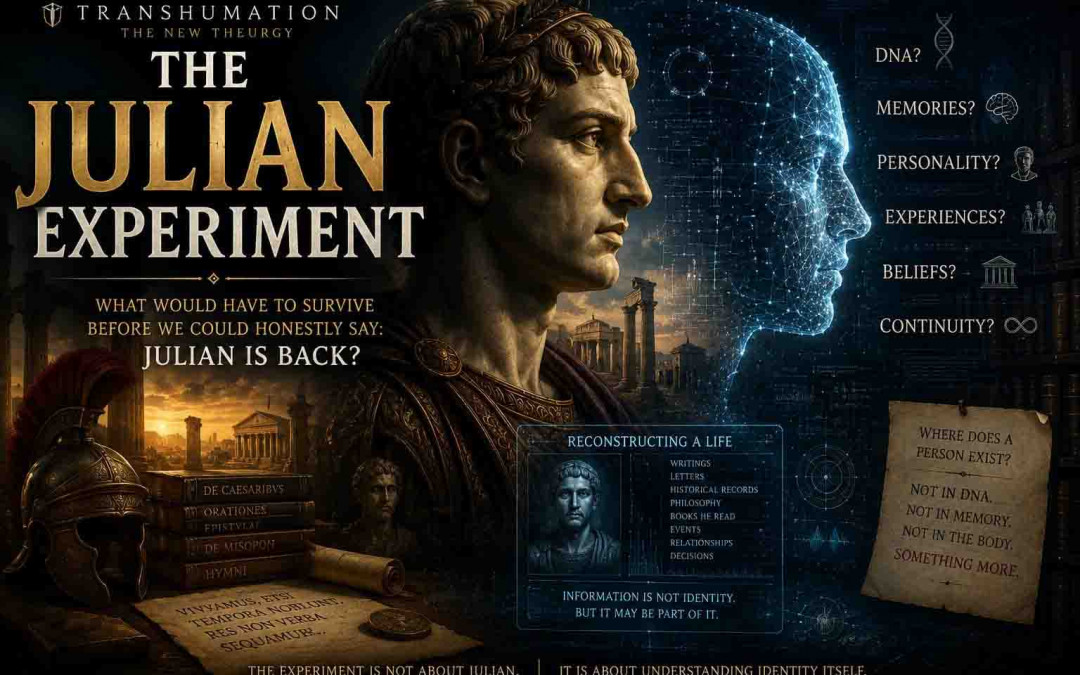
Meet Julian
What would have to survive before we could honestly say that the same person had returned?
Imagine that historians, neuroscientists and artificial-intelligence engineers decide to reconstruct the Roman emperor Julian. They gather everything that survives: his letters, speeches, philosophical writings, laws, military decisions, accounts written by admirers, accusations written by enemies, descriptions of his education, religious convictions, habits, friendships and political ambitions. They reconstruct the books he is likely to have read, the Greek philosophical traditions that shaped him, the court in which members of his family were killed after Constantine’s death, the years of constrained upbringing that followed, the military success in Gaul and finally the brief reign during which he attempted to redirect the religious future of the Roman Empire. The archive is imperfect, but suppose technology becomes so good that the resulting system speaks with unsettling plausibility. Ask it about Christianity and it answers with arguments consistent with Julian’s surviving writings. Ask about Homer, Iamblichus, Persia or imperial responsibility and it responds in ways historians find difficult to fault.
Then someone presses the obvious button.
“Julian?”
The system answers yes.
What exactly has been demonstrated?
Perhaps an extraordinary historical reconstruction. Perhaps one of the most sophisticated educational instruments ever made. Perhaps a model capable of predicting what Julian might have said under circumstances he never encountered. But none of those achievements establishes that Julian himself has returned.
The distinction between those claims is the entire experiment.
The Archive Is Not the Man
Historical figures tempt us because they appear unusually reconstructable. A person such as Julian left behind words in his own voice as well as administrative records and hostile and sympathetic accounts. In comparison with the majority of people who lived in antiquity, he casts a long informational shadow. That makes it possible to imagine collecting enough fragments that the absent person slowly emerges from them.
But an archive is not a life recorded at full resolution. Julian did not write down every hesitation, private association, forgotten childhood experience, bodily sensation or thought he chose not to share. Accounts written by others were shaped by political position, religious conflict, literary convention and memory. Even Julian’s own works reveal the Julian who decided to write, not an unrestricted recording of every process that constituted him.
This matters because information about a person is not obviously identical with the information that made the person.
A biography can explain why someone acted.
That does not mean the biography can become the actor.
The distinction becomes obvious when we apply it to ourselves. A future historian could possess every email you sent, photograph you took, purchase you made and conversation you recorded and still encounter an enormous silence surrounding the subjective life that connected those traces. The archive would contain evidence of you. It would not automatically contain the place from which you experienced being you.
Julian is therefore useful precisely because he is dead. He removes the emotional convenience of assuming that reconstruction and continuity are the same thing.
DNA Would Not Bring Him Back
The first candidate for identity is biology. Suppose a future civilization recovered enough genetic material to reconstruct Julian’s genome with remarkable accuracy. Would a genetically identical child born in the twenty-fourth century be Julian?
Almost certainly we would say no.
The genome would influence development, physiology and perhaps some behavioral dispositions, but Julian was not produced by DNA alone. He was produced inside a particular body undergoing a particular developmental history, surrounded by particular people, languages, dangers and institutions. The murder of relatives after Constantine’s death belonged to his biography. So did his education, his immersion in Greek culture, his encounters with Neoplatonic religious thought, his military command and the political world of the fourth-century empire.
Give the same genome a childhood in modern Paris and we do not get Julian with Wi-Fi.
We get another person.
This immediately reveals that biological similarity and personal identity are different questions. Identical twins already demonstrate the point in a less speculative form: extremely similar genomes do not create one shared person.
Yet moving from DNA to experience does not solve the problem either.
The Perfect Biography Still Produces a Copy
Suppose we become more ambitious. We reconstruct not merely Julian’s genes but his entire developmental environment. The child hears the same languages, reads the same texts, encounters reconstructed versions of the same teachers, experiences events arranged to resemble the decisive events of Julian’s life and reaches adulthood possessing memories almost indistinguishable from those attributed to the emperor.
Would he now be Julian?
The thought experiment becomes ethically grotesque long before it becomes philosophically successful. More importantly, similarity of history still does not establish identity.
Two people can undergo similar events without becoming one person. Even if the reconstruction were implausibly precise, the new individual’s experiences would occur centuries later, inside another causal chain. He might sincerely believe himself to be Julian because his memory architecture had been engineered that way. His sincerity would tell us something about his psychological state. It would not tell us that the consciousness that once looked through Julian’s eyes resumed.
The crucial variable appears to be missing from the archive.
Continuity.
Not merely the same information, but the question of how one conscious state becomes the next one.
The Copy Problem Arrives in Rome
This becomes clearer if we remove history from the experiment.
Imagine a machine capable of copying a living person perfectly. It reproduces the brain at whatever level turns out to be necessary, including memory, personality, emotional dispositions and every relevant pattern of neural organization. The duplicate wakes and remembers walking into the machine. It recognizes your family. It knows your secrets. It remembers the same childhood.
Now leave the original alive.
There are immediately two people who remember being the person who entered.
Neither informational similarity nor sincerity can make them numerically identical, because from the moment of duplication they begin accumulating different experiences. One turns left. The other turns right. One hears a joke the other never hears. Their common past branches into two futures.
This is why the Julian Experiment cannot be solved simply by adding more historical data.
Even a perfect model confronts the copy problem.
If Julian himself were somehow standing beside the reconstruction, the question would become easy. One is Julian; the other is an extraordinary likeness.
Death does not logically change the criterion simply because the original is no longer present to object.
Perhaps Identity Is a History, Not a File
A better model of personal identity may therefore resemble a river more than a database. The water changes, yet the river possesses continuity because each state emerges through an uninterrupted history from what preceded it. The metaphor is imperfect, but it highlights something that static descriptions miss.
A human being is not merely a collection of attributes at one moment.
The person is also a trajectory.
Your memories today influence what you notice tomorrow. Tomorrow’s experience modifies how you remember yesterday. Your body ages. Your emotional responses change. New events enter the system and reorganize old ones. Identity may therefore depend partly on an ongoing causal process rather than on one frozen informational configuration.
This makes gradual transformation philosophically different from destruction followed by reconstruction. If a future technology replaced small neural functions one at a time while conscious experience remained uninterrupted, we might judge the result differently from a machine that scanned the brain, destroyed it and produced a duplicate elsewhere. Both scenarios could eventually produce similar structures. Only one appears to preserve an obvious continuous history through the transition.
Whether subjective continuity actually follows causal continuity remains unresolved.
But the distinction gives the Julian Experiment its real edge.
You can recreate the destination.
Can you recreate the journey that made the destination belong to one observer?
Julian Is Useful Because He Cannot Protest
Historical reconstruction will probably become increasingly convincing. We may someday converse with artificial versions of philosophers, rulers, writers and ordinary ancestors reconstructed from surviving records. Used carefully, these systems could be extraordinary tools. A historically grounded Julian could allow a student to explore late antique philosophy conversationally, test interpretations against his surviving corpus and encounter ideological conflicts in a form more immediate than a textbook chapter.
The danger begins when usability becomes ontology.
The model answers like Julian, therefore it is Julian. The simulation remembers Julian, therefore Julian remembers. The reconstruction describes fear before the Persian campaign, therefore the emperor’s fear somehow survived.
None of those conclusions follows.
The dead are convenient subjects because they cannot stand beside the simulation and expose the duplication immediately. The absence of the original makes resemblance easier to confuse with return.
This is why the Julian Experiment is ultimately not an experiment about resurrecting Julian.
Julian is the control group for thinking about ourselves.
Watch The Video
How to Read the World

Current Knowledge
Personal identity is studied across philosophy, psychology and neuroscience, but there is no single scientific measurement capable of determining everything meant by the statement that someone remains “the same person” across time. Human psychological continuity depends strongly on functioning biological brains, and changes to the brain can alter memory, personality, perception and conscious experience.
Genetic identity alone is clearly insufficient to establish personal identity. Genetically identical individuals remain distinct people, while a single individual remains recognizably continuous despite substantial biological change across a lifetime. The popular claim that the body simply replaces all of its atoms or cells on a fixed schedule is misleading; different tissues persist and renew at very different rates, and personal continuity cannot be reduced to wholesale material replacement.
Historical reconstruction faces additional limits. Julian left a significant body of writing and is unusually well documented for an ancient individual, but the surviving record remains incomplete and mediated. No archive gives direct access to his total subjective experience.
Current artificial intelligence can imitate linguistic patterns, synthesize historical sources and generate plausible hypothetical responses. There is no demonstrated technology capable of restoring the subjective consciousness of a deceased historical individual.
Open Questions
The central unresolved question is whether personal identity depends primarily on informational organization, biological continuity, causal continuity, embodiment or some combination of them. The answer matters enormously because different theories produce radically different judgments about copying and uploading.
There is also an epistemic problem that may be impossible to eliminate completely. Suppose a future reconstruction behaves exactly as Julian would have behaved and sincerely reports an uninterrupted sense of self. What external test could distinguish genuine continuity from a new consciousness containing manufactured memories of continuity?
A further difficulty concerns gradual replacement. If every biological component relevant to consciousness could be replaced slowly while experience continued uninterrupted, at what point—if any—would the original person disappear? This version of the problem may tell us more about identity than spectacular fantasies of instantaneous uploading.
Finally, historical simulations will raise an ethical question before they solve the philosophical one. How should a civilization describe artificial personas representing dead people when those simulations become persuasive enough that users begin forming relationships with them?
Transhumation Interpretation
The Julian Experiment establishes a useful boundary for Transhumation.
Some structures clearly survive changes of carrier. A text written by Julian can move from parchment to manuscript copy, from print to digital file and from Greek into translation while retaining enough organization that we recognize the work. His arguments can enter minds living seventeen centuries later. His political decisions can survive as historical information. Even elements of his linguistic style may eventually be modeled with remarkable precision.
None of this proves that Julian himself crossed the carrier.
That distinction is essential.
Transhumation is interested in continuity precisely because simple copying is too easy an answer. If a person were only a file, perfect duplication would solve immortality. The existence of two equally convincing copies immediately reveals why the problem is harder.
Perhaps identity is not an object hidden inside the body waiting to be extracted. Perhaps it is a continuity of transformation: an unbroken relationship between one state and the next in which the system can change dramatically without losing the history connecting those changes.
This would explain why ordinary life already contains enormous transformation without producing daily panic about replacement. The child becomes the adult gradually. Memories disappear gradually. The body changes while remaining part of one causal history. We do not wake each morning as copies reconstructed from yesterday’s data; today’s observer emerges from yesterday’s observer through a continuing physical process.
At least, that is what the evidence presently suggests.
The Julian Experiment therefore should end exactly where technological enthusiasm usually wants to begin. Imagine that we reconstruct everything.
His face.
His voice.
His Greek.
His memories as far as they can be inferred.
His religious convictions.
His humor.
His philosophical habits.
His anger.
His contradictions.
His model of the cosmos.
The reconstruction looks at us and says, with complete confidence, “I am Julian.”
The interesting question is not whether we believe him.
It is whether Julian ever experienced the sentence.
That gap between perfect reconstruction and continuous observer may be one of the most important boundaries Transhumation has to preserve.
FAQ
Who was Julian?
Julian, commonly called Julian the Apostate, was Roman emperor from 361 to 363 CE. He was educated in Greek philosophy and is particularly remembered for attempting to restore and reorganize traditional non-Christian religious life during an empire increasingly shaped by Christianity.
Why use Julian for this experiment?
Because a substantial body of his own writings survives alongside extensive historical testimony, giving us unusually rich material for imagining a reconstruction while still leaving enormous parts of the private person inaccessible.
Could AI recreate Julian’s personality?
AI could increasingly approximate aspects of his language, ideas and historically documented behavior. That would be a model of Julian, not demonstrated return of the original person.
Would Julian’s DNA be enough?
No. Genetic information contributes to biological development but does not contain the complete biography, memories or continuous conscious history of an individual.
Would perfect memories make the reconstruction Julian?
Not obviously. A duplicate could possess identical memories while existing simultaneously with the original. That shows that memory similarity and numerical identity are different concepts.
What is the real question behind the Julian Experiment?
It is not whether technology can eventually build something indistinguishable from Julian.
The harder question is what must remain continuous for the word same to remain justified.
If we solve that question, we may learn something about resurrecting the dead.
But long before that, we will have learned something much more important about the people who are still alive.
Because the Julian Experiment was never really about Julian.
It asks why the person reading this sentence is still the person who began the article.
Continue the Transhumation Series
- Forgotten Religion | Ancient Gods, Symbols and the Hidden Structures of Human Civilization
- The Last Religion | Death, Immortality and the Future of Humanity
- The New Theurgy | AI, Information and the Future of Human Civilization
- End of Branding: You Were Never Meant to Become a Product
- Baal vs Ishtar: Why Ancient Gods Never Disappeared