
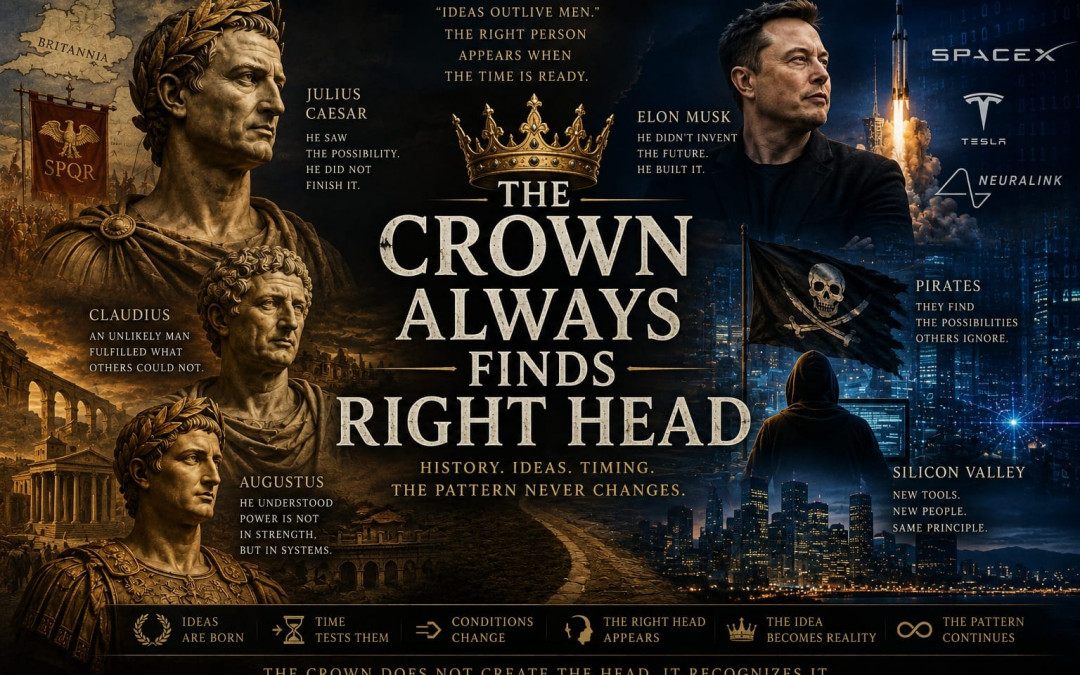
The Crown And the Right Head
There is a dangerous pleasure in reading history backward.
Once we know that Rome became an empire, Augustus begins to look inevitable. Once personal computing transformed everyday life, figures such as Steve Jobs and Bill Gates appear to have been waiting at the entrance to the future. Once electric cars become commercially significant, earlier experiments seem like rehearsals for the company that eventually made them culturally visible. Once an empire conquers an island, the failed expedition that came before begins to look like the first chapter of a plan.
History becomes cleaner after it happens.
The crown appears to have been waiting.
The head appears to have been destined for it.
Reality was messier. Most historical possibilities do not arrive accompanied by the person perfectly designed to realize them. Some appear too early. Some lack money. Some lack infrastructure. Some depend upon scientific knowledge that does not yet exist. Some are destroyed politically. Some are solved by another technology before anyone completes the original idea. And some possibilities simply vanish because the people carrying them disappear.
Still, there is a pattern worth keeping.
Again and again, history contains ideas that exist before the conditions required to make them consequential. Then a particular combination emerges: the technology becomes mature enough, institutions become permissive enough, resources become available, an audience becomes ready, and someone appears with the unusual mixture of temperament, authority and competence required to push the possibility through the narrow opening.
That is the Crown Principle.
Not destiny.
Compatibility.
The right person matters, but the person matters because the world around them has finally become capable of responding.
Do Great Individuals Really Change History?
The traditional history book loves a protagonist.
Alexander conquers. Caesar crosses. Augustus builds. Edison invents. Jobs sees. Musk launches. Names make history legible because human beings understand events more easily when events are attached to people.
But an individual rarely contains the entire historical process represented by their name.
Caesar did not personally forge every sword, provision every legion or design the Roman military system that allowed his campaigns to occur. Augustus did not personally govern every province or command every decisive battle. Modern technology companies depend upon engineers, laboratories, suppliers, public infrastructure, scientific traditions, capital markets and institutions that existed before their famous leaders appeared.
This does not make the individual irrelevant.
It changes the question.
Instead of asking whether one extraordinary person “created the future,” we can ask what function that person performed inside a system already containing unrealized possibilities.
Some invent.
Some synthesize.
Some finance.
Some persuade.
Some coordinate.
Some make a technology legible to ordinary users.
Some create institutions capable of surviving after their personal intervention ends.
Historical greatness may therefore lie less often in possessing an idea nobody else could imagine than in recognizing which existing pieces are finally ready to become one system.
That ability is rarer than it sounds.
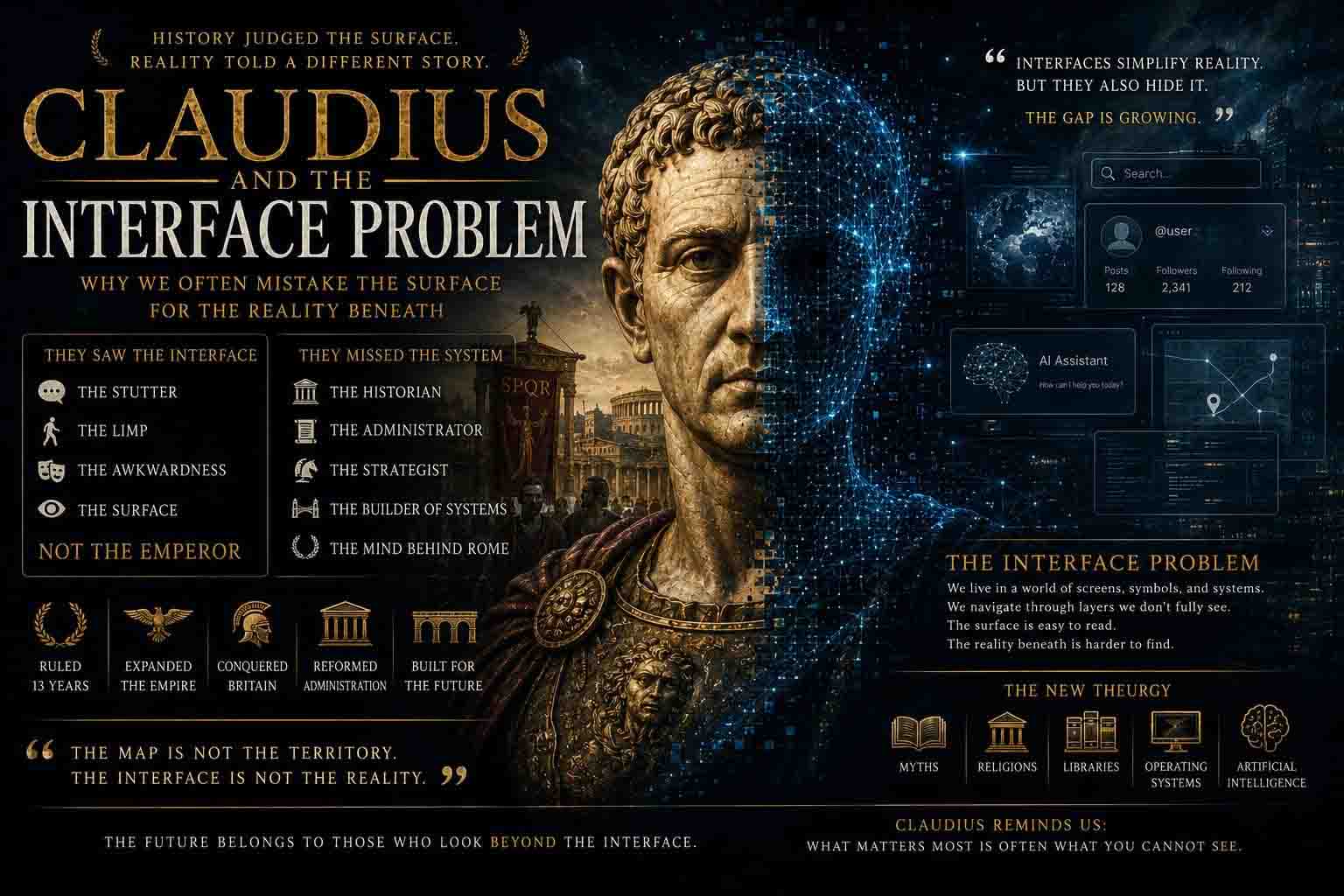
Why Did Claudius Conquer Britain When Caesar Could Not?
Julius Caesar crossed the Channel twice, in 55 and 54 BCE.
The expeditions were militarily significant and politically valuable, but they did not produce the permanent Roman conquest of Britain later generations sometimes project backward onto them. Caesar returned to the continent. Rome did not annex the island.
Almost a century later, under Emperor Claudius, Roman forces invaded Britain again and began a durable conquest.
The easy narrative says Caesar failed and Claudius succeeded.
The interesting narrative asks why those outcomes differed.
They were not performing the same experiment under identical conditions.
Rome had changed.
The imperial system had changed.
Military logistics, political incentives, strategic assumptions and the internal organization of Roman power had changed. Claudius also possessed different reasons for pursuing the campaign, including the enormous political value a major conquest could provide to an emperor whose accession had been unconventional and whose public image required strengthening.
Claudius did not become a greater Julius Caesar by reaching Britain successfully.
The crown had changed shape.
So had the head.
This distinction is essential because historical possibility is never simply stored like a blueprint waiting for another person to retrieve it.
Conditions transform the possibility itself.
What Caesar attempted in the late Republic was not identical to what Claudius undertook under the Empire.
Enough structure remained for us to recognize a continuity.
Enough changed to prevent us from calling it one unfinished project.

Augustus and the Power of Other People
Augustus offers a different lesson.
His long-term success cannot be understood solely through personal military brilliance. Marcus Agrippa was indispensable to major victories associated with Augustus’s rise, including the naval victory at Actium. Other administrators, commanders, family members and political allies performed functions the eventual emperor could not possibly perform alone.
This is sometimes presented as evidence that Augustus received the glory while better men did the work.
That interpretation misses his most interesting competence.
A political system becomes powerful when talent can be coordinated without requiring the central figure to perform every task personally.
The successful leader does not have to be the best admiral if he can recognize, retain and empower an exceptional admiral. He does not need to design every institution if he understands which institutions make his authority durable. His achievement shifts from action to architecture.
This is one reason Augustus matters for the Crown Principle.
The crown fits not merely because the head is strong.
Sometimes it fits because the head understands how little one head can do alone.
There is a larger technological analogy here. Mature systems cease depending upon heroic performance at every point. Roads acquire standards. Armies acquire chains of command. Software acquires protocols. Aviation acquires procedures.
The genius is no longer required to hold the entire machine together personally.
The machine becomes institutional.
That is the moment an achievement begins to outlive its founder.
Why Does Timing Matter More Than Invention?
Technological history repeatedly separates invention from consequence.
An idea can exist technically while remaining culturally insignificant.
Electric vehicles existed long before the modern EV market. Graphical computer interfaces were developed before they became central to mass personal computing. Machine learning existed for decades before the combination of computational scale, data, specialized hardware and interfaces made generative AI a mass phenomenon.
The difference between possible and historically consequential is enormous.
A technology requires complementary technologies.
It requires cost reductions.
Manufacturing.
Distribution.
Standards.
Capital.
Users who understand why they would want it.
Sometimes regulation.
Sometimes a story strong enough to make a strange new object comprehensible.
This is where people such as Steve Jobs, Bill Gates or Elon Musk become historically interesting without having to turn them into mythological inventors of everything associated with their companies.
They demonstrate a different form of intelligence:
the ability to recognize when a technically existing possibility can be reorganized into a product, institution or infrastructure capable of reaching scale.
Execution does not replace invention.
It activates a different part of the chain.
An idea nobody can use remains an idea.
A product nobody can manufacture remains a prototype.
A technology nobody can afford remains an experiment.
History usually remembers the moment when the pattern becomes operational.
Do Ideas Wait for the Right Person?
No.
Ideas do not wait.
They have no desires.
They do not search for carriers any more than information “wants” to be free.
People preserve ideas. Institutions teach them. Archives store them. Engineers rediscover them. Economic circumstances can make them newly useful. New technologies can suddenly remove limitations that once made an old idea impractical.
The language of waiting is useful only as metaphor.
But the metaphor points toward something real.
A possibility can survive across multiple carriers until conditions change.
Leonardo’s drawings do not contain modern aviation, but the desire for mechanical flight can survive in cultural memory. Early electric vehicles do not contain Tesla, but the underlying technical possibility persists. Concepts of machine intelligence can survive decades of disappointment before computational conditions make another class of systems possible.
In this sense, possibility can have a longer lifespan than any one attempt to realize it.
That matters enormously for Transhumation.
The carrier fails.
The structure can sometimes survive.
But the survival is not guaranteed.
Someone must preserve enough of it.
Someone must recognize it later.
The new context must still allow it to function.
This is why the phrase the crown always finds the right head is too strong as literal history and almost perfect as a disciplined metaphor.
The crown does not always find anyone.
But occasionally an old possibility meets a new world and suddenly fits.
The Pirate and the Crown
This is where the Pirate Principle connects naturally to the Crown Principle.
The pirate occupies the edge.
The crown occupies the center.
The pirate asks whether a rule can be broken.
The crown asks whether the result can be made durable.
These are different functions.
An outsider may discover that users want music distributed differently. An institution later develops licensing, payment systems and infrastructure capable of scaling legal streaming. A hacker may reveal a technical possibility. A corporation may package it. A laboratory may invent a mechanism. An entrepreneur may identify an audience.
History loves to collapse these stages into one protagonist.
It should not.
The explorer who finds the route and the state that builds the port are solving different problems.
Sometimes the same person performs several roles.
Usually they do not.
The future therefore emerges from an ecology of discovery, execution and stabilization.
The crown matters because scale changes the problem.
An idea that works for ten people may fail for ten million.
The head capable of discovering the possibility may not be the head capable of governing what it becomes.
The Crown Can Find the Wrong Head
This is the correction that makes the metaphor useful rather than mystical.
History contains possibilities that reach powerful people and become disasters.
A charismatic leader can scale a bad idea.
An institution can normalize an error.
A technological capability can become widespread before its social consequences are understood.
Execution is not evidence of wisdom.
Scale is not evidence of truth.
A crown fitting a head does not mean the head deserved the crown.
This distinction becomes particularly important when studying technological founders. The ability to commercialize a technology is one capability. Judging the consequences of the technology is another.
History can reward compatibility before it decides whether the outcome was beneficial.
Sometimes it never decides.
This is why success cannot be used retrospectively as proof that the successful actor represented the inevitable future.
The winner tells one surviving branch of history.
Other branches disappeared.
Watch The Video
How to Read the World

Current Knowledge
Historical change usually emerges from combinations of individual agency and broader structural conditions. Political leaders act through institutions, economic systems, military organizations and cultural expectations they did not create alone. Technological innovations likewise depend upon scientific knowledge, complementary infrastructure, manufacturing, finance and user adoption in addition to individual invention.
Julius Caesar’s expeditions to Britain in 55 and 54 BCE did not result in permanent Roman conquest. The Claudian invasion beginning in 43 CE occurred under very different political and military conditions and established the basis for long-term Roman control over substantial parts of Britain. It is therefore misleading to describe Claudius as simply completing an unchanged Caesarian project.
Augustus relied heavily on Marcus Agrippa and many other collaborators. Agrippa’s military contribution was exceptional, but Augustus’s historical importance also lies in political organization, coalition building and the construction of a durable imperial settlement rather than personal excellence in every individual function of government.
Modern technological leaders likewise operate within pre-existing ecosystems. Electric vehicles, private spaceflight, graphical interfaces and artificial intelligence all possess histories extending beyond the people later associated most strongly with their commercialization. Distinguishing invention, development, financing, execution and scale produces a more accurate account than assigning a technological revolution to one individual.
Historical outcomes also display strong survivor bias. The people who successfully aligned an idea with favorable conditions remain visible; equally ambitious people attached to possibilities that failed often disappear from public memory.
Open Questions
One unresolved question is how much great individuals actually matter when conditions are already favorable. Would a major technological or political transformation have occurred anyway through another actor, perhaps a few years later? In some cases, simultaneous inventions suggest that several people were approaching the same threshold independently. In others, an unusual individual may genuinely accelerate or redirect events in a way that is difficult to replace.
Another question concerns timing. When does an idea fail because it is wrong, and when does it fail because surrounding infrastructure is not yet mature enough? Retrospective knowledge makes this distinction look easier than it would have appeared to participants at the time.
There is also a problem of authorship. Once thousands of engineers, administrators, financiers and users contribute to an innovation, how much historical credit should belong to the figure who coordinates the system? Famous names provide useful shorthand, but shorthand can gradually turn into mythology.
The deepest question is whether technological change is becoming less dependent upon singular figures as systems grow more complex. Artificial intelligence, biotechnology and large-scale computing increasingly depend on institutions and global infrastructures too large for any one individual to understand completely. The future may still produce crowns, but the head beneath them may represent systems more than sovereign genius.
Transhumation Interpretation
The Crown Principle belongs to Transhumation because it offers another way to think about the relationship between structure and carrier.
A possibility is not a ghost waiting outside history.
It exists only insofar as some material or cultural system preserves enough structure for it to become available again.
An idea survives in writing.
A method survives in institutions.
A technical capability survives in prototypes.
A scientific relation survives in equations and reproducible experiments.
A political possibility survives in memory, law or precedent.
Different carriers preserve different amounts of the original structure.
Then a new person arrives.
What that person contributes is not merely possession.
It is interpretation.
The carrier must be read.
The opportunity must be recognized.
The surrounding world must be understood well enough to determine what can now be changed.
This is where the head matters.
Two people can inherit the same information and see different possibilities inside it.
That means history cannot be reduced to either structural inevitability or heroic individualism.
The structure constrains the head.
The head reinterprets the structure.
Their interaction creates the next form.
This is very close to the larger Transhumation idea of an interface.
The leader, entrepreneur or thinker often functions as an interface between a latent capability and a civilization not yet organized around it.
The interface does not create every component underneath.
It makes the components actionable together.
Augustus did not invent Rome.
He reorganized Roman power into another stable configuration.
A modern technology founder does not invent the entire scientific infrastructure behind a product.
The achievement may lie in making previously separate structures converge.
This gives us a more precise meaning for the crown.
The crown is a role waiting to become structurally necessary, not an object predestined for one person.
Sometimes the role exists before anyone knows how to occupy it.
Sometimes several candidates appear simultaneously.
Sometimes nobody succeeds.
And sometimes the role itself disappears because another solution makes it unnecessary.
That last possibility is important.
We should never assume every unfinished historical ambition is waiting for completion.
Flying cars may never dominate transportation because other technologies solve enough of the underlying problem. A political institution may disappear because the world producing its function has changed. A scientific question may become obsolete because a better framework dissolves the original assumptions.
Not every crown needs a head.
Some crowns belong in museums.
This makes the relationship with the Pirate Principle clearer.
The pirate tests possibility before legitimacy.
The crown tests whether possibility can survive responsibility.
The edge asks whether the thing can be done.
The center eventually has to ask whether it can be maintained, governed, financed, trusted and scaled.
Civilization moves when those functions occasionally connect.
Artificial intelligence may give us a particularly interesting contemporary example.
The underlying scientific ideas did not appear yesterday. Machine learning developed through decades of work distributed across universities, companies and research communities. What changed was a convergence of computational resources, data, model architecture, hardware and interfaces capable of making those systems broadly useful.
We are still close enough to the event that people want a single protagonist.
History will probably resist.
The crown may turn out to have had thousands of heads.
And the next stage may depend less upon who invented the model than upon who discovers what kind of civilization can responsibly build around it.
This is where the title reaches its deeper meaning.
The right head is not necessarily the first inventor.
Not necessarily the strongest leader.
Not necessarily the person with the most original idea.
Sometimes it is the person who recognizes a structure whose pieces already exist and understands what must be added, removed or coordinated for the structure to become operational.
But even that person should not be confused with destiny.
The crown does not know where it is going.
History has no obligation to complete the design.
Possibility survives only when carriers survive, when conditions permit reconstruction and when another human being recognizes something worth continuing.
That is why some ideas vanish.
Others return.
And occasionally a possibility that seemed premature for fifty years becomes ordinary within five.
From the outside, it looks as though history finally found the person it had been waiting for.
From inside the mechanism, something less mystical and more interesting occurred.
A person, a structure and a moment became compatible.
For a little while, the crown fit.
FAQ
What does “The Crown Always Finds the Right Head” mean?
It is a metaphor for moments when an existing possibility becomes historically consequential because a person, institution and set of conditions finally align well enough to realize it.
Why did Claudius conquer Britain when Caesar did not?
They operated almost a century apart under different political and military conditions. Claudius did not simply outperform Caesar; Rome itself had changed enough for a different kind of campaign to become sustainable.
Was Augustus successful because of Agrippa?
Agrippa was crucial to Augustus’s military success, but Augustus’s importance also came from coordinating people, institutions and political authority into a durable system. Leadership can consist partly in making other people’s abilities work together.
Do famous technology founders actually invent the technologies associated with them?
Often only partly. Major technologies usually emerge from long research traditions and large technical ecosystems. Founders may contribute through product vision, financing, organization, commercialization or scaling rather than originating every underlying invention.
Do ideas really “wait” for the right person?
No literally. Ideas have no intentions. They can, however, remain preserved in texts, institutions or technical systems until later conditions make them newly useful.
What is the deeper Transhumation question?
The Crown Principle asks what happens when a structure survives longer than the person who first carried it and later becomes operational through another carrier.
The deepest lesson is therefore not that history always finds a chosen individual. It is that civilization can preserve possibilities long enough for another mind, another institution and another age to discover that the old structure fits a world that did not exist when it was first imagined.
Continue the Transhumation Series
- Forgotten Religion | Ancient Gods, Symbols and the Hidden Structures of Human Civilization
- The Last Religion | Death, Immortality and the Future of Humanity
- The New Theurgy | AI, Information and the Future of Human Civilization
- End of Branding: You Were Never Meant to Become a Product
- Baal vs Ishtar: Why Ancient Gods Never Disappeared