
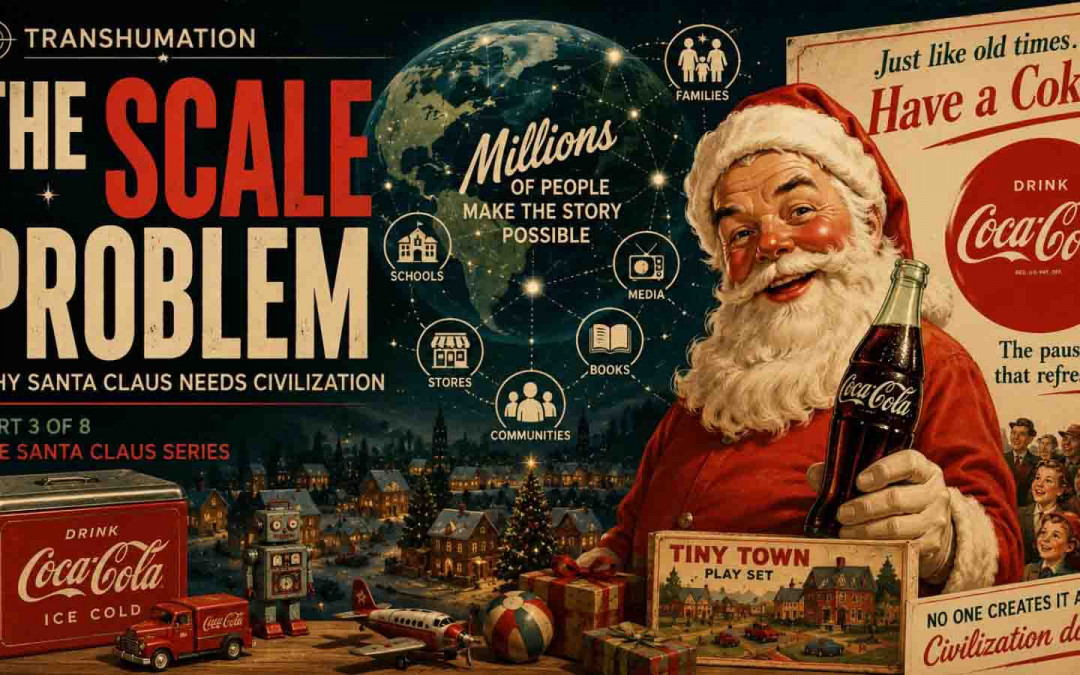
Story Becomes Larger Than People
Try creating Santa Claus entirely by yourself.
You buy the presents, hide them, wrap them in different paper, answer the letter, eat the cookies, perhaps leave a suspicious footprint near the fireplace. For a few years the operation can work beautifully because the audience is small and the stage is controlled. The child knows what happens inside the house and very little else.
Then Monday arrives.
The child goes to school. A teacher hangs decorations. Another child mentions reindeer. A television commercial uses the same red coat. A book repeats the same journey through the night. Shopping centres play the same songs. Neighbours put lights in their windows. Somewhere, a stranger dressed as Santa is sitting beneath an artificial chimney taking photographs with children he has never met.
At that point something important has changed.
The story no longer belongs to the family.
The family has become one participant inside a much larger system.
That is the Scale Problem.
One Parent Can Create a Morning
Small systems are easy to understand because their causes remain close to their effects. One parent can prepare Christmas morning. One teacher can run a classroom. One carpenter can build a table. If something goes wrong, the source can usually be identified without too much difficulty.
Civilization does not work like that.
No individual created English. No programmer created the internet. No editor wrote Wikipedia. No emperor personally built Rome. These systems emerge through the accumulation of enormous numbers of decisions made by people who often do not know one another and may not even understand the larger structure they are helping to produce.
Santa Claus becomes interesting precisely at the moment he crosses that threshold.
A parent does not invent Santa Claus for a child in the same sense that an author invents a fictional character. The parent enters a pre-existing cultural network. The colours, stories, expectations, songs, images and rituals are already waiting. The family customizes the performance, but civilization supplies most of the infrastructure.
This is why the illusion can feel much larger than any individual household could manufacture. The child encounters independent confirmation everywhere.
The story appears distributed.
Because it is.
Rome Was Built by People Caesar Never Met
History makes this difficult to see because memory prefers names.
Caesar.
Augustus.
Newton.
Einstein.
Jobs.
Musk.
Names are useful. They compress complicated histories into recognizable points. But they can also create the illusion that large systems are the products of singular minds.
Rome did not function because one extraordinary ruler woke each morning and personally coordinated roads, water, grain, taxation, law, military logistics, construction and administration across the Mediterranean. The empire depended on people whose names are mostly gone.
Modern science works the same way. Newton mattered enormously, but Newton did not create the mathematical, institutional and experimental infrastructure of modern science alone. Einstein did not build every laboratory, train every physicist or preserve every paper required for later work.
The internet makes the structure even harder to ignore. It emerged from governments, universities, engineers, standards bodies, private companies, programmers and users distributed across decades. No single person could explain every part of the system today even if the entire history were available.
Scale changes authorship.
At small scale, the creator may be obvious.
At large scale, the creator becomes a network.

Coca-Cola Did Not Build Christmas
The famous Santa Claus story attached to Coca-Cola is useful because it shows what successful cultural participation looks like.
Coca-Cola did not invent Santa Claus. The figure had already developed through Saint Nicholas traditions, Sinterklaas, English Christmas customs, nineteenth-century American literature and illustration. By the time Haddon Sundblom began producing his famous Santa images for Coca-Cola in the 1930s, the cultural system was already large.
What the company did was recognize a current and enter it effectively.
That is a different kind of power from invention.
A company can spend enormous amounts of money attempting to manufacture a cultural symbol and fail. Another can attach itself to a structure that already has emotional energy and become almost inseparable from it.
The important distinction is between creating a message and joining a system that can carry the message farther than you can.
Coca-Cola did not scale Santa from zero.
Santa already had scale.
The brand became one more node reinforcing a pattern millions of people were already maintaining.
This is one reason civilization is difficult to engineer from the top down. Large symbolic systems survive because participation is distributed. The authority of the central designer becomes weaker as the network becomes larger.
At some point, the story acquires its own inertia.
The Internet Is Full of People Nobody Knows
The internet provides an almost perfect modern illustration of emergent scale.
Nobody knows every server.
Nobody reads every website.
Nobody follows every conversation.
Nobody controls every protocol, company, government, user, archive and platform at once.
And yet the system functions well enough for billions of people to treat it as infrastructure.
Language is even stranger because it hides its scale completely. Every sentence you speak depends on words you did not invent, grammar nobody personally designed, historical changes no living speaker approved, and social agreement so distributed that there is no central office capable of issuing a final version.
You participate in English by using it.
Your use also changes it slightly.
That is the same paradox we see in culture more generally.
The system shapes the participant.
The participant also helps reproduce the system.
Santa Claus is therefore not interesting because children believe in one imaginary man.
He is interesting because he may be one of the first large-scale cultural systems a child experiences from the inside.
When Meaning Becomes Infrastructure
At first, Santa looks too fictional to belong beside institutions such as money, law or universities.
But the comparison becomes useful if we focus on scale rather than truth status.
A banknote has physical properties, but its economic value depends on a large network of institutions and expectations. A university has buildings, staff and legal existence, but its social meaning depends on recognition extending far beyond the campus. A national border can be physically marked or invisible, yet its effects depend on governments, databases, laws, documents and millions of people behaving as though the distinction matters.
These are not imaginary in the ordinary sense.
They are distributed realities.
Their power cannot be located in one object because the relevant structure is spread across many participants.
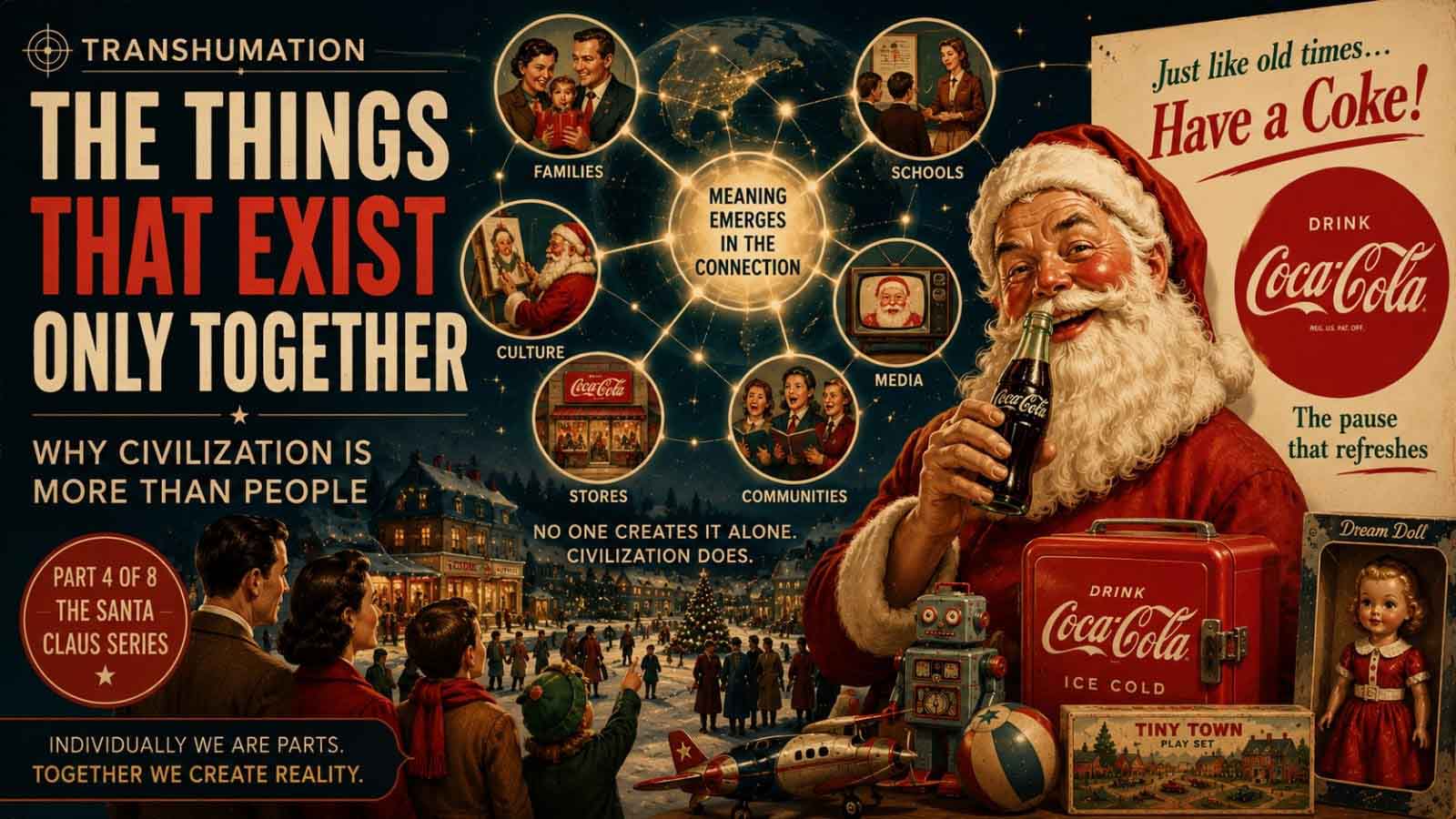
Santa belongs to a gentler version of the same architecture. The red suit, the sleigh, the songs and the presents matter because they are recognized across an enormous network of families, media, shops, schools and memories.
No single element is enough.
Scale completes the structure.
The System Starts Looking Alive
Large systems acquire a peculiar appearance because no one participant possesses the whole.
They adapt.
They reproduce.
They absorb new elements.
They resist some changes and accept others.
This can make civilization look almost alive.
The metaphor should not be taken literally. Culture is not an organism in the biological sense. But the ecosystem comparison is useful because both involve complex outcomes emerging from many local interactions.
No bird coordinates the forest.
No citizen coordinates civilization.
Order can arise without a single consciousness designing the whole.
This is one of the reasons large systems can be both powerful and difficult to control. The same distributed architecture that makes them resilient also makes them resistant to simple intervention.
A family tradition can be changed tonight.
A language cannot.
A company can change its logo.
A culture may ignore the new one.
A government can pass a law.
Millions of people determine how that law interacts with reality.
The larger the system becomes, the more the relationship between intention and outcome weakens.
Scale does not merely add more participants.
It changes the nature of the thing being built.
The Point Where the Author Disappears
This may be the most interesting threshold.
A story begins with an author.
Then other people repeat it.
They modify it.
Some elements disappear.
Others become standardized.
Institutions adopt it.
Commercial systems amplify it.
Children inherit it without knowing where it came from.
Eventually, asking “Who created this?” becomes almost impossible to answer with one name.
The story has become infrastructural.
That does not mean authorship disappears entirely. Historians can still identify important contributors. But the functioning object now depends less on origin than on continued participation.
This is the same reason language survives individual speakers and cities survive their founders.
The system becomes larger than the people who initiated it.
Then something strange happens.
The original creator can vanish without destroying the creation.
At scale, persistence migrates from person to network.
Watch The Video
How to Read the World

Current Knowledge
The modern Santa Claus tradition developed through many historical influences, including Saint Nicholas, Dutch Sinterklaas customs, English Christmas traditions and nineteenth-century American literature and illustration. Coca-Cola did not invent Santa Claus, though its twentieth-century advertising significantly influenced one globally recognizable visual form.
Large social systems such as languages, the internet, scientific institutions and cultural traditions are typically distributed across many individuals and organizations. Their development cannot be attributed accurately to a single creator.
Research in sociology, anthropology, economics and network science examines how large-scale order can emerge from local interactions without central planning. Such systems vary greatly in structure, and not all distributed systems are self-sustaining or equally resilient.
The analogy between Santa Claus, money, borders and institutions concerns shared participation and distributed meaning. These phenomena differ substantially in legal status, material consequences and historical function.
Open Questions
At what point does a cultural object become genuinely independent of its original creators? Is there a measurable threshold at which distributed participation matters more than authorship?
Another question concerns control. Does greater scale necessarily reduce the ability of any individual or institution to direct a system, or can certain network structures concentrate power even while participation remains distributed?
Artificial intelligence adds a new layer. If increasingly large cultural and informational systems are partially maintained, generated or filtered by AI, will scale become even more autonomous from individual human intention?
And how do we distinguish healthy emergence from collective reinforcement of bad ideas? Scale can stabilize useful systems, but it can also amplify errors, prejudice or misinformation.
Transhumation Interpretation
The Scale Problem extends the Transhumation question of carrier-independent structure.
A story begins in one carrier.
A family.
A poem.
A ritual.
An advertisement.
Then it moves.
As more participants join, the relevant structure no longer belongs to any single carrier. It becomes distributed across a network.
This suggests a sequence:
individual action → repetition → network → scale → emergent structure
Santa Claus offers a clean example because the process is visible. One parent can create one Christmas morning. Millions of parents, teachers, films, shops, songs and memories create something no single participant controls completely.
The story becomes larger than its authors.
That is the key transition.
Civilization works the same way in countless domains. Knowledge, language, religion, markets, science and technology all become difficult to understand once we insist on looking only for singular creators.
At small scale, causation can be personal.
At large scale, structure begins to matter more.
This is why Transhumation treats civilization less like a pyramid and more like a network of carriers transmitting functions across time.
The system survives because nobody owns all of it.
And perhaps that is the real meaning of scale.
Not simply more people.
A different kind of reality.
FAQ
What is the Scale Problem?
It is the idea that some cultural and social systems only become possible when enough independent participants reinforce the same structure.
Why is Santa Claus a good example?
Because no single parent creates the full tradition. Families join a cultural system already supported by schools, media, shops and other families.
Did Coca-Cola create Santa Claus?
No. It joined and amplified an existing tradition.
Why compare Santa Claus with the internet or language?
Because all three depend on large distributed participation rather than one controlling author.
Does scale always remove individual control?
Not completely, but larger systems often become harder for any one participant to direct.
What does it mean that civilization is emergent?
It means large patterns can arise from many local actions without one person designing the entire result.
Can bad ideas also scale?
Yes. Scale increases persistence and reach, not truth or moral value.
How does this connect to Transhumation?
It shows how a structure can move beyond individual carriers and become distributed across a civilization.
What is the central idea?
One person can create an event. A civilization emerges when millions of separate actions begin reinforcing the same pattern.
Continue the Transhumation Series
- Forgotten Religion | Ancient Gods, Symbols and the Hidden Structures of Human Civilization
- The Last Religion | Death, Immortality and the Future of Humanity
- The New Theurgy | AI, Information and the Future of Human Civilization
- End of Branding: You Were Never Meant to Become a Product
- Baal vs Ishtar: Why Ancient Gods Never Disappeared