
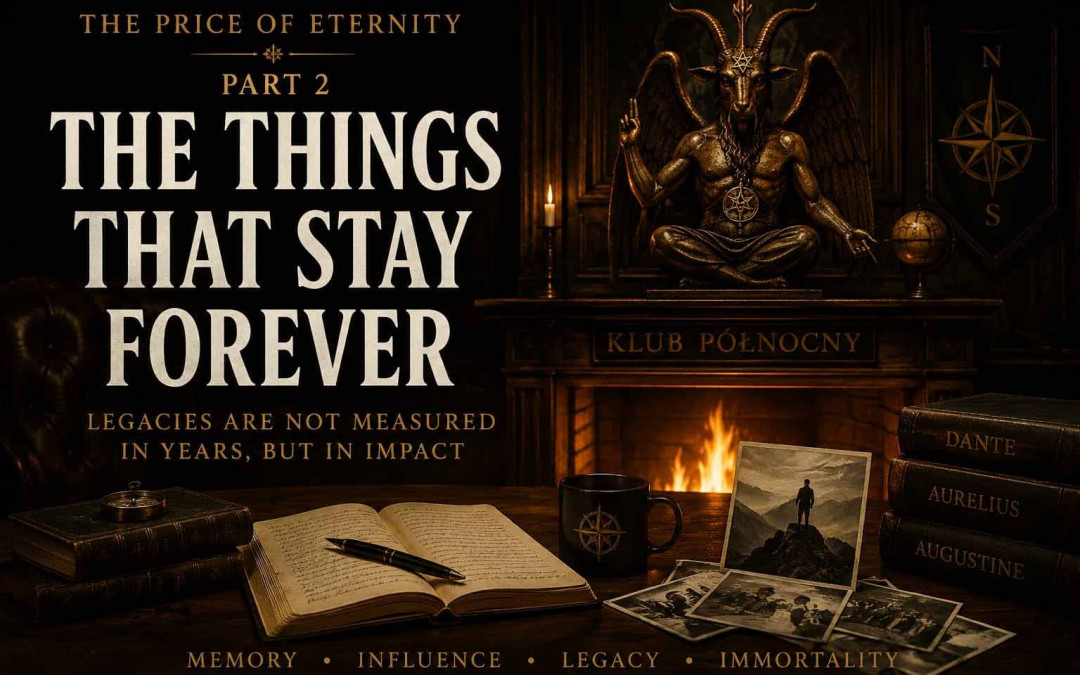
Nothing Human Lasts Forever
In Rome, stone appears to have won.
Columns still rise from places whose political systems vanished centuries ago. Inscriptions remain on walls after the people named in them have become historical problems. Broken marble lies in museums under controlled light while scholars reconstruct the lives of men whose bodies disappeared long before the buildings that carried their names.
Stone looks permanent.
Then open Horace.
A sequence of words composed more than two thousand years ago can still enter another human mind in the twenty-first century. The original papyrus is gone. The poet is gone. Ancient Rome is gone in every political sense that mattered to Horace. Yet the poem continues to be read.
This creates an easy temptation: perhaps information is more durable than matter.
But that is not quite what happened.
Horace’s words did not float through history without physical support. They moved from manuscript to manuscript, from one language community to another, from copied codices into print and eventually into digital storage. The individual carriers repeatedly disappeared. The pattern survived because civilization kept rebuilding it.
That distinction may be more important than the usual romance of immortality.
Nothing escaped matter.
Something learned how not to depend on one particular piece of matter.
Perhaps that is the first real secret of cultural eternity.
What Can Actually Survive After Death?
Many things survive a person, but they do not all survive in the same way.
Genes can continue through descendants. Property can remain inside legal systems. A house may still stand. A name can persist in records. A voice can remain in a recording. A sentence may continue changing people who never met its author. A decision can shape institutions for generations.
None of these continuities establishes that the original conscious subject survives.
This difference is easy to ignore because ordinary language uses one word — survival — for radically different phenomena.
Caesar survives in history.
Shakespeare survives through his works.
A grandmother survives in family memory.
A composer survives in music.
But these are forms of representation, consequence and cultural persistence.
They should not be confused with the first-person claim, I am still here.
That distinction is the foundation of The Price of Eternity.
Human civilization already knows how to make traces last far beyond biological life.
It does not yet know how to make the subject who created those traces continue experiencing them.
Why Do Stories Outlive People?
A story possesses one extraordinary advantage over a body.
It can be reconstructed.
The person telling a story around a fire disappears. Another person remembers enough to tell it again. Details change. A phrase is lost. A character acquires another motive. The story crosses into a different dialect. Eventually it may be written, copied, printed, filmed and translated.
At no stage is there one immortal physical object.
There is a chain.
That is why the history of stories is not the history of perfect preservation.
It is the history of change constrained by recognition.
Too little continuity and the story becomes something else.
Too little change and it may fail to survive the new culture carrying it.
This is why oral tradition should not be treated as primitive storage. It can contain sophisticated methods of preservation: repetition, rhythm, formula, communal correction and ritualized retelling. Human communities developed ways to stabilize important patterns long before modern archives existed.
A story survives by repeatedly becoming present again.
The carrier dies.
Another carrier continues the performance.
This is not immortality in the theological sense.
It is cultural relay.
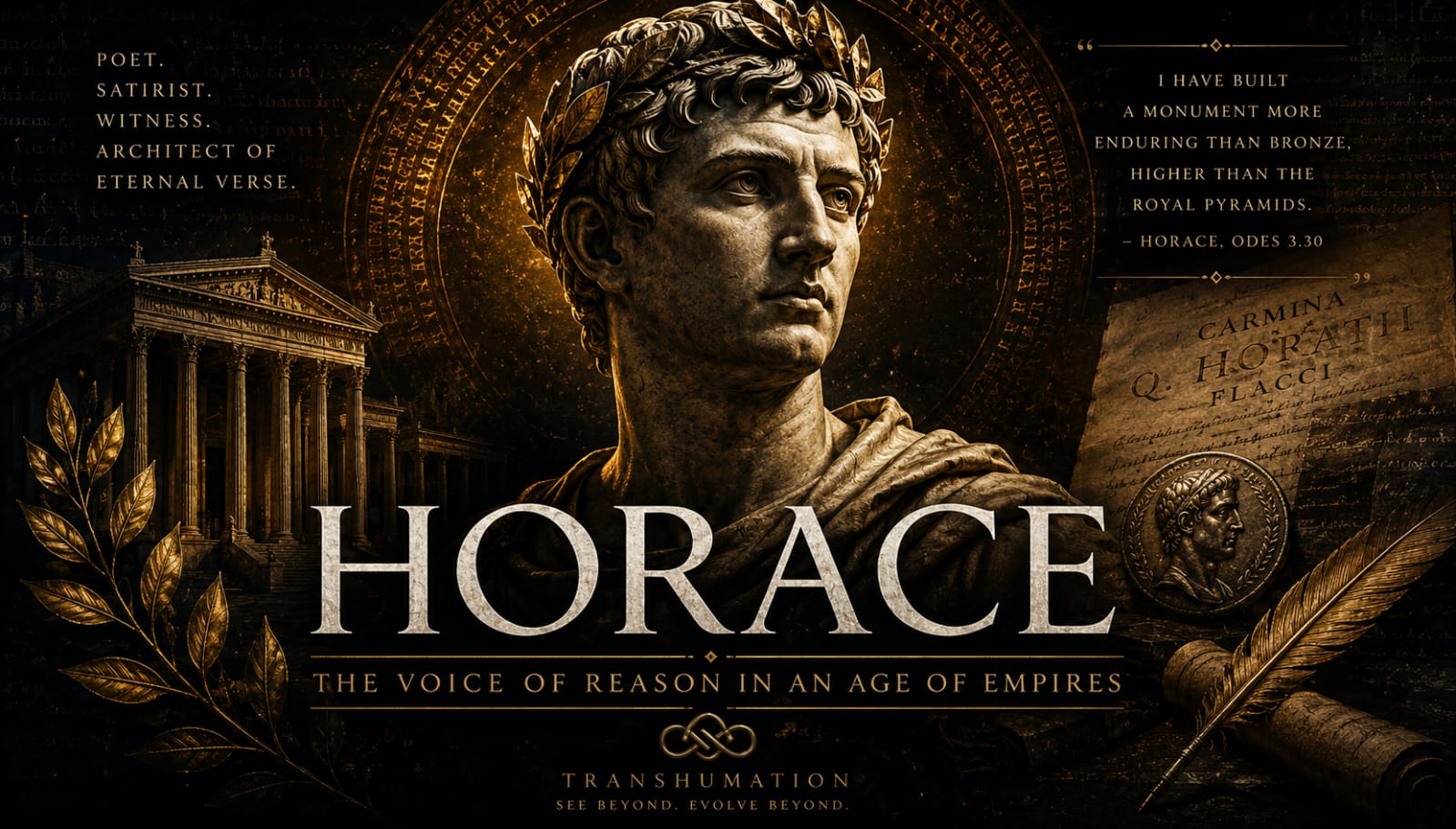
The Horace Paradox
Horace gave us one of the most elegant statements of this ambition.
In the famous ode beginning Exegi monumentum, he imagines having built through poetry a monument more durable than bronze. The boast is astonishing precisely because imperial Rome surrounded him with structures designed to embody material permanence.
Stone.
Bronze.
Temples.
Public works.
Political authority.
Poetry seems fragile beside them.
One wet manuscript can disappear.
One forgotten language can become unreadable.
One broken transmission chain can erase an entire work.
And yet Horace was right in a limited but extraordinary sense.
His words still circulate.
Not because language defeated matter, but because language found more carriers.
Stone is durable in one location.
A text can be copied.
The monument resists destruction through hardness.
The poem resists destruction through replication.
These are two entirely different survival strategies.
A temple needs the original structure to persist.
A poem can lose every original molecule and still remain recognizable if the relevant sequence continues to be reconstructed.
That is why Horace matters so much to the informational age.
He illustrates a distinction modern technology has made increasingly visible:
persistence can come from durability, or it can come from reproducibility.

Can Information Survive Without Matter?
Everything we know suggests that information requires physical realization.
A poem needs marks, memory, electromagnetic states or some other carrier.
A recording requires physical storage.
A digital archive requires hardware, energy and functioning infrastructure.
The cloud is not a metaphysical atmosphere. It is an industrial system.
So the claim that ideas are permanent because they are immaterial should be rejected.
But there is another property that makes information unusual.
The same pattern can sometimes be instantiated across radically different media.
Horace can exist in handwriting.
Print.
Braille.
Audio.
Digital text.
Memory.
Translation changes more, but enough structure can still survive for readers to recognize the work and its argument.
Information is therefore not carrier-free.
It can be carrier-flexible.
That may be the more important form of endurance.
A stone inscription is extremely durable but tied to one object.
A poem on paper is physically vulnerable but reproducible.
The strongest archives combine both strategies: durable storage and multiple copies across independent carriers.
Civilization learned very early that eternity is safer when it has backups.
What Did Beatrice Become in Dante’s Work?
Beatrice reveals another kind of survival.
Our historical knowledge of Beatrice Portinari and Dante’s actual relationship with her is limited. What we possess in abundance is Dante’s transformation of Beatrice into literature.
That transformation begins in memory and then exceeds biography.
In Vita Nuova, she becomes the center of an intensely stylized personal and poetic world. In the Divine Comedy, Beatrice acquires an even greater role, eventually functioning as a guide toward theological understanding.
The historical woman and Dante’s Beatrice cannot simply be treated as the same entity.
One lived.
The other became a cultural structure.
That distinction makes the case more interesting, not less.
A human being can enter another person’s memory.
Memory can be reorganized into art.
Art can enter a culture.
Culture can preserve the resulting pattern for people born centuries later.
The original person does not need to be accurately copied for the symbol to persist.
In fact, cultural persistence often depends upon transformation.
Beatrice did not become immortal in Dante.
Dante created something associated with Beatrice that became capable of traveling without her.
This is the difference between preserving a person and preserving what a person became inside another mind.
The Things That Stay Are Usually Changed Things
We often imagine preservation as resistance to change.
Museums place objects behind glass.
Archives regulate temperature.
Conservation seeks to halt deterioration.
But cultural survival often requires the opposite strategy.
Translation changes language.
Performance changes emphasis.
Adaptation changes medium.
Education selects.
Memory compresses.
Each generation reads old work through questions the original author did not know existed.
Shakespeare survives partly because Shakespeare is repeatedly re-performed.
Greek mythology survives partly because it has been reinterpreted.
Religious texts remain culturally active partly because communities continue arguing about them.
The perfectly frozen object can remain physically present while becoming culturally dead.
Meaning requires an interpreter.
That is why persistence is not enough.
An unread book survives materially but not actively.
A language preserved in a dictionary may survive descriptively while ceasing to live between speakers.
A ritual filmed in perfect detail is not therefore still practiced.
The things that stay longest are often the things capable of entering new contexts without losing every trace of what made them recognizable.
The Midnight Club Problem
There is a reason storytelling becomes especially powerful in fiction about people confronting death.
Christopher Pike’s The Midnight Club, and later adaptations of its premise, uses a group of terminally ill young people telling one another stories. The setting works because storytelling does something death cannot completely cancel.
It creates consequence outside the teller.
But we should be careful with the sentimental version of this idea.
Stories do not defeat death.
A young person does not become less dead because a story survives.
Narrative is not compensation for lost years.
What storytelling can do is prevent one particular form of disappearance.
It allows experience to leave the boundaries of the experiencing body.
Someone else can remember.
Someone else can repeat.
Someone else can interpret differently.
The story acquires another carrier.
This is a weaker claim than immortality.
It is also a real one.
And for most of human history, it was one of the few technologies available for allowing an individual life to continue producing effects after the individual was gone.
Does Meaning Last Longer Than Matter?
Sometimes.
Sometimes the reverse is true.
A clay pot can survive after nobody knows what its markings meant.
A monument can remain while the religion that built it becomes incomprehensible.
A hard drive may physically survive while its format becomes unreadable.
Matter can persist after meaning dies.
Meaning can persist after the original matter disappears.
The relationship is therefore not a competition in which information always wins.
Durability requires three things to align:
a pattern,
a carrier,
and an interpreter capable of reconstructing what the pattern means.
Remove the carrier and there is nothing to read.
Remove the pattern and there is nothing preserved.
Remove every possible interpreter and the structure may continue physically while its meaning disappears.
This is why libraries do more than store books.
They preserve pathways.
Catalogues.
Context.
Languages.
Cross-references.
Metadata.
Scholarship.
A pile of manuscripts is not yet a functioning civilization.
The archive needs a route back into meaning.
A good library requires a good librarian.
The Future of Memory
Digital technology has multiplied the number of traces an ordinary person can leave.
Previous generations might survive through a few letters and photographs.
A person today can leave decades of messages, videos, location records, voice recordings, photographs, search histories, documents and social interactions.
The archive can become enormous.
That does not mean the person has been better preserved.
Abundance creates its own form of forgetting.
A million photographs can become less navigable than one album.
Ten years of messages may contain a life and still be practically unreadable.
Future AI could change this.
It could search personal archives conversationally, reconstruct timelines, identify recurring themes and connect fragments separated by decades. A descendant might ask what an ancestor thought about marriage at thirty and receive a set of letters, recordings and diary entries that no human archivist had previously connected.
This could make cultural memory astonishingly responsive.
But another boundary immediately appears.
When AI begins generating answers the deceased never gave, preservation becomes reconstruction.
The system may sound exactly right.
It may still be inventing.
The more convincing the interface becomes, the more important provenance becomes.
The future librarian must know when to speak and when to say:
The archive does not answer this.
Can AI Preserve a Person or Only Their Traces?
At present, only traces.
Future systems may preserve far richer behavioral patterns than anything available today. They may reproduce voice, vocabulary, preferences, humor and biographical memory with extraordinary accuracy.
That still does not demonstrate continuity of the original conscious subject.
The distinction resembles the Dante problem at technological scale.
Dante preserved a cultural Beatrice.
AI may one day preserve a synthetic version of a person assembled from vastly more evidence.
The representation will be denser.
The philosophical problem remains.
A convincing reconstruction can continue a pattern.
It does not automatically continue the person who once generated it.
This is why digital immortality is an ambiguous phrase.
There may indeed be forms of digital persistence so powerful that descendants experience the dead as socially present.
That would be historically unprecedented.
It still might not be immortality from the perspective that matters most to the person approaching death.
The archive says: something of you will remain.
The subject asks: will I remain to experience it?
Those are different questions.
The Story Against Oblivion
The story remains valuable even after we remove immortality from the claim.
Perhaps more valuable.
Human beings tell stories because events without transmission disappear from collective access remarkably quickly.
A story selects.
It gives shape.
It establishes sequence.
It turns one private experience into something another mind can enter partially.
This is why stories have always belonged to civilization’s memory architecture.
But storytelling is lossy.
The story removes detail.
It exaggerates some relationships and ignores others.
The person who becomes a character is never identical to the living person.
This limitation is not merely a defect.
Compression makes transmission possible.
A complete recording of every second of one human life would be almost unusable.
Narrative tells the future where to look.
This is another reason the things that remain are not necessarily the things that existed longest.
They are often the things successfully compressed into transmissible form.
What Remains After the Moment?
Part I of The Price of Eternity asked whether a moment can become larger than its duration.
Part II asks what allows that moment to travel.
The answer is not eternity.
It is continuation through consequences and carriers.
A sentence changes a student.
The student repeats it thirty years later.
A poem enters another language.
A photograph changes how a family remembers someone.
A scientific method becomes standard practice until nobody remembers who first taught it to them.
The original event remains finite.
Its descendants multiply.
This is how a brief thing can become historically large.
Not by escaping time.
By entering other timelines.
The distinction is subtle enough to be missed and important enough to reorganize the entire discussion of immortality.
A life can end.
Its causal structure can remain active.
That is not nothing.
It is also not the same as surviving death.
Watch The Video
How to Read the World

Current Knowledge
Human cultural information can survive individual lives through repeated transmission across physical carriers, including oral memory, manuscripts, print, recordings and digital storage. Such persistence is never literally immaterial; known information requires physical implementation and social systems capable of preserving or reconstructing it.
Horace’s famous claim to have built through poetry a monument more lasting than bronze illustrates the difference between material durability and reproducibility. His works survived not through an original physical artifact but through repeated copying and transmission.
The historical relationship between Dante and Beatrice is incompletely documented, while Dante’s literary transformation of Beatrice is extensively preserved in his works. Historical person, memory and literary symbol should therefore be distinguished.
Stories and other cultural forms can preserve information, influence and aspects of identity after death, but there is no evidence that cultural or informational persistence constitutes survival of the deceased person’s first-person consciousness.
Digital archives dramatically increase the quantity of personal information that can be preserved, while also creating problems of discoverability, authenticity, format longevity and context. More stored data does not automatically produce better memory.
Open Questions
One major question is what amount of transformation a cultural pattern can tolerate before continuity becomes only nominal. A story can change while remaining recognizable, but there is no universal boundary separating adaptation from replacement.
Another concerns digital abundance. Future civilizations may preserve vastly more human traces than earlier societies, yet preserving everything could make meaningful retrieval harder. Selection may remain necessary even when storage becomes cheap.
AI creates a deeper uncertainty. Synthetic reconstructions may eventually reproduce historical voices and personalities with extraordinary plausibility. Society will need durable conventions distinguishing original sources, inferred content and generated continuation.
The deepest question concerns which kind of persistence people actually desire. Cultural memory, influence, biological inheritance, informational reconstruction and first-person survival answer different versions of the wish not to disappear. Technology may greatly improve several of them without ever solving the last.
Transhumation Interpretation
For Transhumation, the things that stay are not things that escaped matter.
They are patterns that successfully crossed from one carrier to another before the old carrier disappeared.
That distinction changes the meaning of immortality.
A poem can survive because another page receives it. A memory can survive because another mind carries it. Civilization persists because structures are repeatedly re-instantiated.
The Transhumation question is therefore not simply What lasts?
It is:
What must survive the transition for us to recognize that something meaningful has crossed?
And when the answer involves a human person, we must still ask whether the pattern crossed alone or whether the subject crossed with it.
FAQ
What are “the things that stay forever”?
“Forever” is metaphorical. Ideas, works, memories and influences can persist for very long periods by being transmitted across people and physical media.
Why can stories outlive people?
Because stories can be reconstructed by new carriers: other minds, writing, print, recordings or digital systems. The original storyteller is not required for the pattern to continue.
Why is Horace important to this argument?
Horace imagined poetry outlasting physical monuments. His survival illustrates reproducibility: the poem endured through repeated copying rather than through preservation of one original object.
What did Beatrice become in Dante’s work?
Dante transformed the historical Beatrice into a major literary and theological figure. That cultural figure should be distinguished from the historical woman herself.
Can AI preserve a dead person?
AI may preserve and reconstruct extensive patterns from a person’s surviving data, but this would not by itself demonstrate continuation of the original conscious subject.
What is the deeper question of The Price of Eternity?
The deeper question is not whether something can remain after us.
We already know that it can.
Horace knew it.
Dante knew it.
Every parent, teacher and storyteller discovers some version of it.
The harder question is what kind of survival has occurred.
A sentence can continue without the mouth that spoke it. A memory can move into another mind. A work can enter another century. A name can become more durable than the body that carried it.
Nothing supernatural is required.
Only a chain of carriers that does not break.
That may be the first form of eternity civilization ever learned to manufacture.
But it comes with a warning.
The thing that survives may become larger, stranger and more influential than the person who created it.
And still, somewhere behind all that persistence, the original question remains unanswered:
Did something of me survive, or did something from me survive?
That difference may eventually become the entire price of eternity.
Continue the Transhumation Series
- Forgotten Religion | Ancient Gods, Symbols and the Hidden Structures of Human Civilization
- The Last Religion | Death, Immortality and the Future of Humanity
- The New Theurgy | AI, Information and the Future of Human Civilization
- End of Branding: You Were Never Meant to Become a Product
- Baal vs Ishtar: Why Ancient Gods Never Disappeared