
The God in the Doorway
A door is one of those objects that becomes invisible the moment it works. You open it, walk through, and immediately begin thinking about the room on the other side. Almost nobody stops halfway across the threshold to consider what kind of place a doorway actually is. It belongs completely to neither room. For a fraction of a second, the person crossing it is no longer where he was and not yet where he is going. The object is banal; the condition it creates is not.
The Romans noticed this.
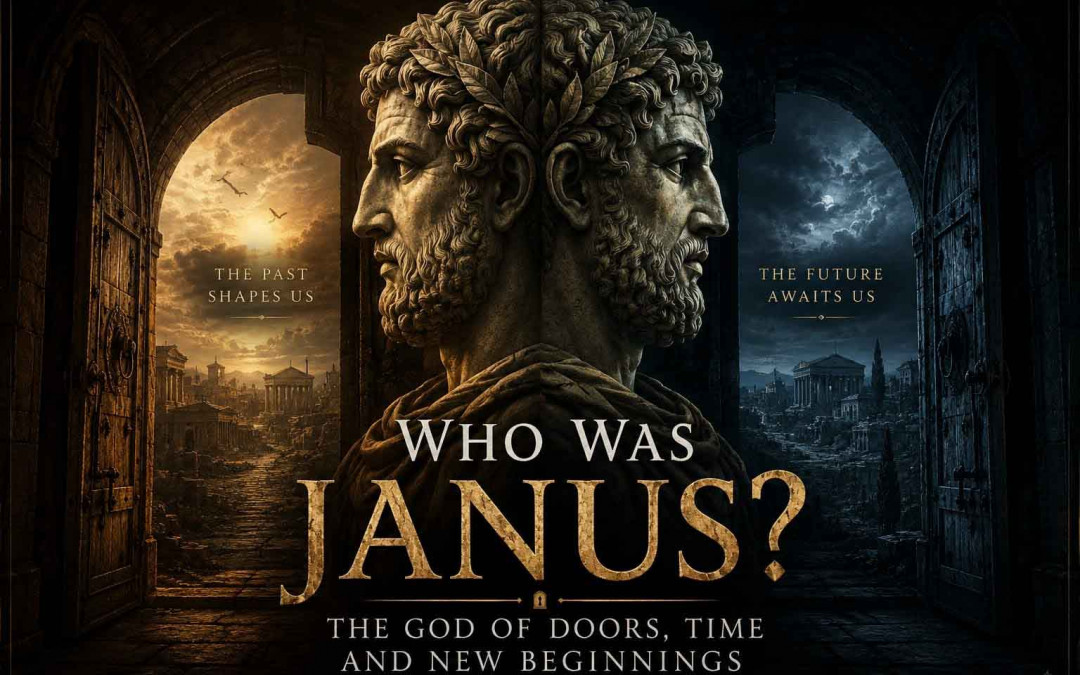
Among the crowded population of Roman gods, Janus occupied an unusually difficult territory. Jupiter possessed the sky, Mars war, Neptune the sea. Janus governed something less tangible and, in a sense, more universal: beginnings, passages, doors, gates and transitions. His familiar double face looks in two directions at once, not because he cannot decide where to go, but because a threshold always has two sides. Behind it is the world that has already acquired a shape. Ahead lies a world that has not.
This may explain why a god who seems modest beside thunderbolts and armies could occupy such an important place in Roman religious life. Janus did not need to control the destination. He controlled the moment in which one condition became another.
And civilization is made almost entirely from those moments.
The Strange Power of the First Step
Roman religion paid unusual attention to beginnings. Actions did not simply happen; they had openings, sequences and proper transitions. Janus was therefore invoked at the beginning of many rites, sometimes before other gods whose domains might appear more impressive. There was a structural logic to this. Before a journey could belong to Mercury, before war could belong to Mars, before the harvest could belong to agricultural deities, the action first had to begin.
Janus inhabited that first movement.
This gives his symbolism a precision that is easily lost when he is reduced to “the god with two faces.” His two directions were not merely past and future in the modern psychological sense. They belonged to the architecture of passage. A gate has an inside and an outside. A beginning emerges from something that existed before it. Departure contains the memory of the place being left and the uncertainty of the place not yet reached.
The threshold is therefore not empty space.
It is a temporary system with its own rules.
Anyone who has stood in an airport departure hall understands this better than the vocabulary suggests. For an hour or two, identity becomes strangely procedural. Passport, gate, security, border, boarding pass. You are still legally attached to one place while moving toward another. The journey consists almost entirely of controlled transitions.
The Romans built an entire divine function around that condition.
When a Door Described the Empire
One of the most famous traditions associated with Janus concerned the shrine often called the Janus Geminus in Rome. Ancient authors describe its gates as being open when Rome was at war and closed during peace. Because Rome spent so much of its history in conflict, later writers emphasized how rarely complete closure occurred.
Whether every later detail of the tradition should be taken literally is less interesting than the symbolic invention itself. A door had become a political instrument of representation.
The Roman state could be described without a speech.
Open.
Closed.
A person walking past did not need to read a decree explaining Rome’s military condition. The architecture itself carried information. The threshold had become a public interface between an enormous geopolitical reality and an ordinary citizen capable of seeing two doors.
That is a remarkably sophisticated piece of symbolic compression.
An empire containing legions, governors, treaties, roads, taxes and distant provinces could temporarily be represented by the position of a gate.
Modern civilization performs the same operation constantly. A red light means stop. A green dot means available. A padlock icon means restricted. A border crossing turns international law into a booth and a barrier. Vast systems become understandable because their complexity is compressed into thresholds.
Janus belonged to a civilization that understood this long before anyone used the word interface.

January Is Not Just a Month
His association with beginnings also survives in one of the most ordinary words in the modern calendar. January derives its name from Janus. The month stands at the entrance to the year, looking backward toward what has ended and forward toward what has not yet happened.
The symbolism is almost suspiciously neat, which is why it survives so easily in popular explanations. Yet the deeper idea is not simply that Janus “looks at the past and future.” It is that beginnings are unstable.
On the first morning of a new year, almost nothing in the physical world has changed. The same apartment, the same debts, the same body, the same unresolved conversations remain. Yet a line has been crossed because humans have agreed that one sequence has closed and another has begun. Calendars are machines for creating thresholds in time.
Birthdays do something similar.
Graduations.
Weddings.
Coronations.
Retirements.
Citizenship ceremonies.
We mark transitions because continuity alone is difficult to experience. A ceremony gives shape to the instant in which an old identity becomes insufficient and a new one has not yet become ordinary.
Janus is therefore not merely the god of change.
Change can be gradual and almost invisible.
Janus belongs to the boundary at which change becomes legible.
The God Who Returns Without Being Believed In
This is where Janus begins to feel unexpectedly modern.
We no longer require belief in a Roman deity to encounter the structure he represented. Modern life is saturated with thresholds, many of them more powerful than physical doors. A password determines whether someone may enter a system. A visa changes legal possibility. A medical diagnosis can divide a life into before and after. A software update moves millions of people from one technical environment to another while leaving the device in their hands apparently unchanged.
Technological revolutions create larger thresholds still. There was a world before widespread electricity and one after it; a world before the internet and one in which networked communication became an ordinary background condition. Artificial intelligence may become another such passage, although we do not yet know what the room on the other side will contain.
This is the peculiar condition of living during a transition: the old vocabulary remains useful because the new reality is not yet stable enough to produce its own.
People describe early cinema as photographed theatre.
Early automobiles as horseless carriages.
Early websites as pages.
Artificial intelligence as assistant, tool, agent, colleague, oracle, search engine or machine depending on which familiar category seems nearest.
At a threshold, language looks backward even while technology moves forward.
Janus would recognize the problem immediately.
The Moment Between Two Worlds
Modern culture often treats uncertainty as a defect. We want forecasts, road maps, investment models, predictions and strategic plans. We prefer to know which room we are entering before we release the handle of the door behind us.
But genuine transitions do not offer that luxury.
The industrial revolution did not arrive with an instruction manual describing its social consequences. The internet was not understood in the 1990s as the mature system it would later become. The invention of printing did not reveal in advance what mass literacy, scientific publishing or religious fragmentation would eventually do to Europe.
A threshold is important precisely because its outcome is incomplete.
That makes Janus less a symbol of prophecy than of navigation.
One face preserves enough of the past to remember where the traveller came from. The other accepts that the future cannot yet be seen clearly. The god does not abolish the uncertainty of the doorway. He gives the uncertainty a form.
Perhaps that is why the image of two faces has survived long after the religious system surrounding it disappeared.
Civilizations repeatedly find themselves standing in places where the old order still exists and the new one already exerts pressure.
The symbol remains useful because the structure remains.
Watch The Video
How to Read the World

Current Knowledge
Janus was a distinctively Roman deity associated with beginnings, gates, doorways, passages and transitions. Unlike several major Roman gods, he does not have a straightforward Greek equivalent, although comparisons with other deities and traditions can be made. He was commonly represented with two faces, a visual form connected with his association with entrances, exits and dual directions.
Ancient Roman religious practice frequently placed Janus at the beginning of ritual sequences. Literary sources also associate the Janus Geminus shrine with a tradition in which its gates stood open during war and closed during peace. Later Roman writers emphasized the rarity of prolonged peace and therefore the rarity of their closure.
The name January derives through Latin Ianuarius, associated with Janus. Roman calendars themselves changed over time, so modern interpretations that present January as a perfectly fixed ancient symbol of the first month should be understood within that historical development.
Janus was not simply an abstract philosophical personification of “past and future.” His ancient functions were more concretely tied to beginnings, entrances, passages and transitions, although later cultural interpretation has naturally expanded those meanings.
Open Questions
How much of Janus’s unusual prominence arose specifically from Roman religious practice, and how much reflected a deeper Roman fascination with order, boundary, movement and institutional transition? Because much of what survives comes through literary sources written across different periods, the meaning attached to Janus was not necessarily identical throughout Roman history.
A larger question concerns recurrent structures. Do human societies repeatedly create symbols of thresholds because transition is psychologically fundamental, or do later cultures selectively recognize ancient symbols that resemble modern concerns? The distinction matters. A useful pattern should not become evidence for a universal structure merely because it is attractive.
There is also a contemporary question. Are periods of technological transition fundamentally different from older political, religious or personal thresholds, or are we using an ancient metaphor to impose clarity on changes whose structure is actually new?
Transhumation Interpretation
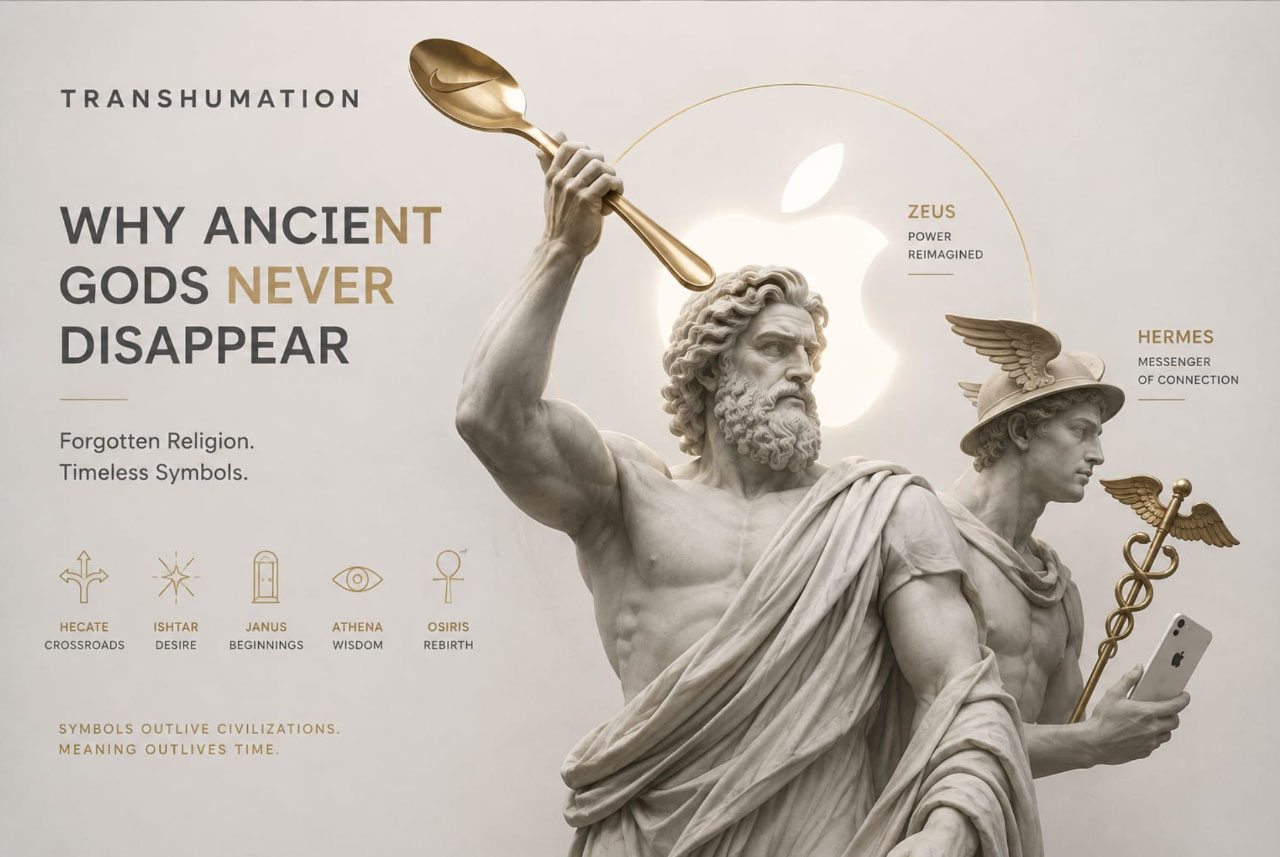
Transhumation is interested in Janus because almost nothing needs to be carried forward from the original religion for his function to survive.
The temple can disappear.
The rituals can disappear.
The Roman state can disappear.
Even belief in the god can disappear.
The threshold remains.
This is a clean example of a structure surviving its carrier.
A physical doorway can become a border checkpoint. The border checkpoint can become an account permission. The account permission can become an algorithmic decision determining whether someone enters a system at all. Each carrier is different, yet the underlying operation remains recognizable: one condition ends, another becomes possible, and something governs the passage between them.
That is why Janus may matter more to the future than a superficial revival of Roman mythology ever could.
He offers a way to think about civilizations when they are neither what they were nor yet what they will become.
Artificial intelligence, synthetic biology, digital identity and increasingly networked institutions may place humanity inside precisely such a period. We still use concepts inherited from the biological, industrial and nation-state world while constructing systems that may eventually require different categories.
We are standing in the doorway with vocabulary borrowed from the room behind us.
Janus does not tell us what lies ahead.
That was never his function.
His value is the recognition that the doorway itself is a real place — temporary, unstable, easy to overlook and sometimes more important than either room.
Perhaps this is why the god with two faces never needed to rule the sky.
The sky was only one domain.
Every future requires a threshold.
FAQ
Who was Janus in Roman mythology?
Janus was the Roman god associated especially with beginnings, gates, doorways and transitions.
Why did Janus have two faces?
The two faces represented his connection with passages and dual directions, commonly interpreted as looking toward what lies behind and what lies ahead.
Was Janus a Greek god?
No direct Greek equivalent exists for Janus. He is generally regarded as a characteristically Roman deity.
Why is January named after Janus?
The Latin name of January, Ianuarius, is associated with Janus and his connection with beginnings and transitions.
What happened at the shrine of Janus during war?
Roman literary tradition states that the gates of the Janus Geminus were opened during war and closed in times of peace.
Why does Janus still matter today?
His symbolism describes a condition that remains universal: the uncertain passage between an old state and a new one.
How does Janus connect to Transhumation?
Janus provides an example of a function surviving a change of carrier. The ancient god may disappear while the structure of the threshold continues in borders, institutions, interfaces and technological transitions.
What is the central idea of the article?
Janus matters not because he predicts the future, but because he represents the difficult space in which the past is no longer enough and the future has not yet acquired a stable form.
Continue the Transhumation Series
- Forgotten Religion | Ancient Gods, Symbols and the Hidden Structures of Human Civilization
- The Last Religion | Death, Immortality and the Future of Humanity
- The New Theurgy | AI, Information and the Future of Human Civilization
- End of Branding: You Were Never Meant to Become a Product
- Baal vs Ishtar: Why Ancient Gods Never Disappeared