
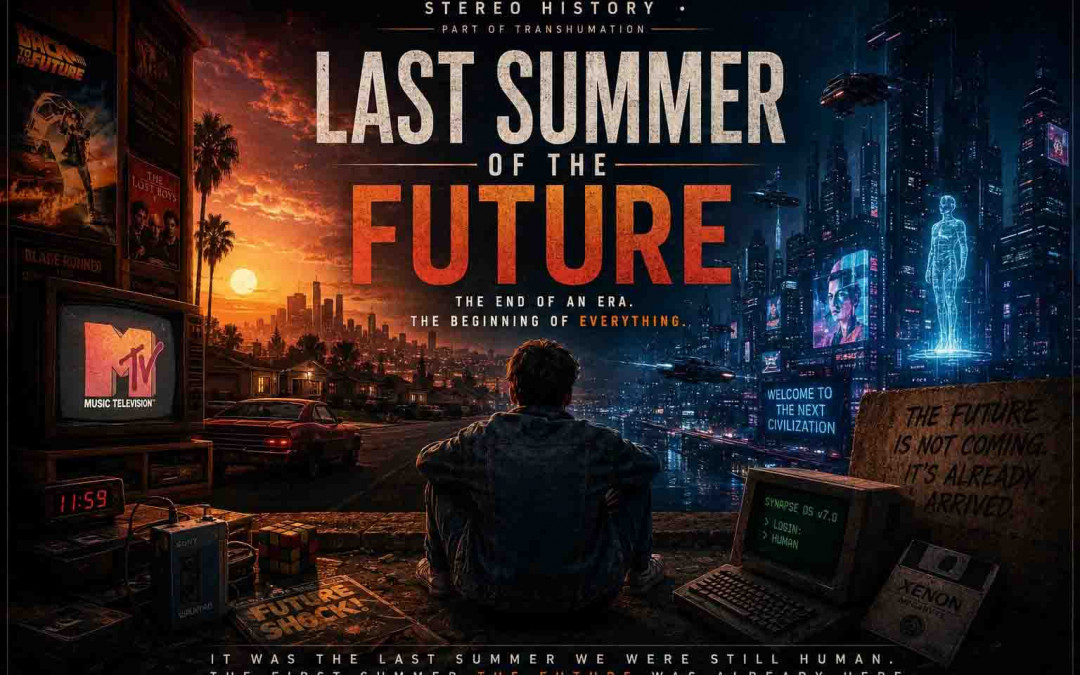
The Last Summer of the Future
There is a peculiar kind of nostalgia hidden in the music of the 1980s. It does not behave like the nostalgia attached to an old house, a childhood photograph or a summer holiday remembered after forty years. Those forms of nostalgia look backward toward something that has unquestionably ended. The nostalgia of the 1980s often seems to point in the opposite direction. A synthesizer opens, a drum enters with far too much space around it, a voice appears to be singing from somewhere beyond the visible horizon, and for a moment the feeling is not simply that we miss the past. It is that we miss a future.
That distinction explains more than the fashion revival, the return of analogue synthesizers or the endless reuse of neon, chrome and geometric typefaces. The decade preserved a surprisingly coherent emotional idea of tomorrow. The future seemed to have a location somewhere just beyond the present, and culture behaved as though the distance could eventually be crossed. It might be dangerous, dazzling, corporate, nuclear, computerized or strange, but it was visible enough to imagine. One could picture the machines that would inhabit it and hear, or at least believe one could hear, the sound they would make.
Today we possess technologies more extraordinary than most of those imagined worlds ever promised. We carry satellite navigation, instant global communication, enormous libraries, cameras, translators, financial systems and increasingly sophisticated artificial intelligence inside devices smaller than a paperback book. Yet the future itself has become strangely difficult to see. The miracle has entered the furniture of daily life. Perhaps that is why the 1980s still look like tomorrow: they belonged to a moment when tomorrow had not yet become ordinary.
When the Future Still Had a Shape
The 1980s did not invent futurism. The twentieth century had been imagining technological tomorrow for decades. Rocket ships, streamlined cities, nuclear power, robots, flying cars and electronic brains already populated magazines, exhibitions, novels and films long before MTV appeared. What changed was the distance between those fantasies and ordinary objects. The future was no longer confined to a science-fiction illustration. It was beginning to appear on desks, in arcades, in living rooms and on the bodies of people walking through cities.
The personal computer is a good example. By contemporary standards its capabilities were tiny, but this is precisely what made its symbolic presence so intense. A computer still looked unmistakably like a computer. The screen exposed its pixels. The keyboard seemed to belong to a new language of work. Starting the machine was an event rather than a background condition. It was difficult to forget that one was interacting with technology because the technology constantly announced itself.
The same was true of much of the decade’s consumer electronics. The Walkman placed a private acoustic environment onto the body. Video games turned calculation into visible worlds. The camcorder made moving images increasingly personal. Music television fused sound, fashion, choreography and identity into a new kind of mass experience. None of these devices possessed the seamless power of contemporary digital systems, but perhaps seamlessness is precisely what later technology lost. Their limitations left the border visible.
The future was still something one could point at.
Music Made the Distance Audible
This is where the sound of the decade becomes important. Electronic music had existed long before the 1980s, and reducing the period to synthesizers would erase enormous musical diversity. Yet electronic production entered mainstream culture with a particular confidence during those years. Drum machines, sequencers, digital reverberation and increasingly accessible synthesizers helped musicians construct acoustic spaces that did not need to correspond to a physical room.
A snare could suddenly sound as though it had been struck inside an aircraft hangar. A synthesizer pad could stretch behind a voice like weather over a landscape. A singer might feel intimately close while the surrounding production suggested an impossible distance. The resulting music often occupied a strange emotional territory between proximity and horizon, between the private and the enormous.
That artificial space matters because futures require distance. The future cannot feel like the room we are already standing in. It needs enough separation for desire, fear and projection to enter. Much of the music associated with the decade seems to contain precisely that separation. It does not merely describe another world; it creates room for one.
Perhaps that is why certain songs from the period continue to produce such a peculiar ache even in listeners who were not alive when they were released. The emotion does not depend entirely on autobiographical memory. The production itself has become a cultural shorthand for expectation, for the sensation of being on the near side of something not yet reached.
The Decade Was Never Innocent
Nostalgia has a habit of editing history until the edit becomes more convincing than the original. The 1980s are particularly vulnerable to this treatment. A few decades of retrospective culture can turn an enormously contradictory period into sports cars, aerobics, arcades, pastel sunsets and teenagers discovering freedom through cassette players.
The historical decade was far darker.
The Cold War had not become a harmless museum exhibit. Nuclear destruction remained a credible political and psychological possibility. The AIDS epidemic transformed communities and exposed deep cruelty in public institutions and cultural attitudes. Economic restructuring damaged industrial regions. Political violence, authoritarian regimes and wars continued across the world. Environmental anxiety was becoming harder to ignore. The future was not universally welcomed; it was frequently feared.
The cultural record shows this clearly. Blade Runner did not imagine technology as a clean staircase toward paradise. The Terminator transformed intelligent machinery into annihilation. Cyberpunk emerged from suspicion toward corporate power, networks and technological control. Even the brightest electronic surfaces often contained a strange melancholy, as though the lights were beautiful partly because darkness remained nearby.
This tension is one reason the decade continues to work so well as retro-futurism. Pure optimism ages badly because it becomes advertising. Pure pessimism becomes warning. The most durable imagined futures contain attraction and danger simultaneously. The door is open, the light beyond it is beautiful, and nobody is quite sure whether crossing the threshold is a good idea.
The Future Had Not Yet Become Infrastructure
There was another historical advantage to standing in the 1980s. Digital technology was close enough to generate expectation but distant enough that it had not yet colonized every ordinary activity. Computers existed without being permanently present in every pocket. Networks were developing without providing a continuous social environment for most people. Electronic media were powerful without yet becoming an uninterrupted personal stream stretching from the first moment after waking to the last moment before sleep.
The future could therefore remain an object of imagination because people still spent much of their lives outside it.
That distance matters. Permanent connectivity sounds different before permanent connectivity exists. It can mean access, liberation, instant knowledge, friendship across geography and the destruction of old barriers. Those promises were not false. Modern networks genuinely provide all of those things. But once the system becomes real, the terms of the bargain become visible as well: attention extraction, surveillance, algorithmic filtering, social comparison without closing hours, work that follows the employee home and an information environment so abundant that scarcity moves from knowledge to attention.
The dream did not fail because it arrived.
It became complicated by arriving.
This is one of the recurring ironies of technological history. A future is simplest when it is far away because imagination is allowed to omit the administrative details.
The Curse of the Successful Future
There is a particular cruelty in technological success. A technology becomes least futuristic when it becomes most successful.
Take the smartphone. To someone standing in 1983, an ordinary modern phone would resemble an object of absurd speculative fiction. It can locate itself through satellites, display almost any street on Earth, stream music and film, translate speech, record high-resolution video, access vast libraries, move money, publish globally and maintain live visual communication with another person across the planet. Increasingly, the same device provides access to machines capable of generating text, images, software and analysis through ordinary conversation.
Yet almost nobody wakes each morning astonished by the metaphysical absurdity of owning such a thing.
We become irritated because the battery is low.
That shift from wonder to annoyance is the fate of successful technology. Electric light experienced it. Air travel experienced it. Antibiotics experienced it. GPS experienced it. The extraordinary becomes dependable, and dependability gradually erases astonishment.
What was once tomorrow becomes an expectation about Tuesday.
The 1980s remain culturally potent partly because the objects had not yet crossed that threshold. A home computer could still look like a portal rather than office equipment. An arcade machine could feel like entrance into another order of space. Portable music could feel like an altered relationship between the individual and the city rather than a basic feature of commuting.
The future was visible because it had not yet become invisible.
The Machines Still Had Rituals
Older technology also asked more visibly for participation. A cassette had to be selected, inserted, rewound and eventually turned over. A photograph was taken without immediately knowing whether it had worked. A computer demanded waiting. A telephone required a place. A film required a cinema or a physical object brought into the home.
It would be foolish to romanticize these inconveniences simply because they are gone. Much of technological progress consists precisely in removing unnecessary friction, and few people genuinely want to spend twenty minutes searching for a telephone booth.
But friction performed another function.
It made the interface noticeable.
The device had edges. There was a before and an after. You entered the arcade. You put on the headphones. You placed the tape into the machine. The ritual announced that a mediation was about to begin.
Contemporary technology increasingly succeeds by doing the opposite. The best interface is often defined as the one the user does not notice. Music appears immediately. Photographs require no development. Search has almost no delay. Cloud storage removes the visible archive. Recommendation systems work without introducing themselves each time they reorder attention.
Artificial intelligence may push this tendency further still. Once intelligent systems become embedded across software, navigation, communication and information retrieval, they may cease to appear as special destinations and become part of the ordinary architecture of action.
The interface disappears at exactly the point when its influence becomes greatest.
The Future Was Also More Shared
Another difference separates the media environment of the 1980s from ours. Mass culture could produce genuinely large common reference points. Television channels, radio stations, cinema releases and popular music created moments in which millions of people encountered substantially the same images.
This shared culture was never universal. It excluded enormous numbers of voices and often flattened differences in order to build a dominant mainstream. The explosion of digital niches has provided access and creative freedom that older broadcast systems could not offer.
Still, fragmentation changes the experience of the future.
In the 1980s, a music video, film or advertisement could contribute to a relatively common visual grammar of what tomorrow looked like. Chrome, grid lines, electronic sound, space imagery, certain kinds of architecture and computer graphics accumulated into a recognizable cultural vocabulary.
Today people occupy more personalized media environments. Two neighbors can receive different music, different politics, different celebrities, different fears and entirely different ideas of which technologies matter. The future may therefore be technologically closer while culturally less unified.
We have more futures.
Perhaps that is why none of them possesses the clarity of the old one.
The Last Summer
Calling the 1980s the last summer of the future is not a historical claim. There have been hopeful technological periods since, and there will almost certainly be others. The phrase works as a metaphor because summer is difficult to understand while one is inside it.
Summer feels abundant while it lasts. The days extend. Evening seems reluctant to arrive. Only afterward does memory place a border around the season and recognize that the openness was temporary.
People living in 1984 did not experience themselves as figures standing heroically at the final frontier of technological innocence. They were paying bills, worrying about politics, failing relationships, commuting to work and complaining about ordinary machines just as people do now.
The summer belongs to retrospective vision.
And there is something almost unsettling about our position relative to it. We are looking backward at people who were looking forward toward us. Their tomorrow is our ordinary environment.
We know which dreams arrived.
We know which ones failed.
We know which inventions brought consequences nobody placed in the advertisement.
That creates the strange emotional double exposure at the heart of eighties nostalgia. We remember, or inherit the memory of, an expectation whose answer we already know.
The music still asks the question.
We live in the reply.
Watch The Video
How to Read the World
Current Knowledge
The 1980s were an important period of technological and cultural transition, but the developments associated with the decade had much older histories. Electronic music, computer networking, video games and personal computing all developed before the 1980s, while the decade helped bring many of them into wider public awareness and consumer culture.
The period combined technological enthusiasm with substantial social and political anxiety. Nuclear confrontation, AIDS, economic restructuring, environmental concerns and international conflict existed alongside excitement about computers, electronics, telecommunications and new forms of media.
Popular music increasingly incorporated synthesizers, drum machines, sequencers and digital production technologies, contributing to several distinctive sonic aesthetics. These technologies did not define all music of the era, but they became important components of the decade’s later cultural image.
Modern nostalgia for the 1980s is necessarily selective. Film, television, games, fashion and retrospective music culture have reconstructed the decade repeatedly, meaning that contemporary audiences often encounter a stylized cultural memory rather than the full historical period.
The technological world imagined in the 1980s partly arrived. Portable media, ubiquitous computing, global communication networks and interactive digital environments became ordinary, although their social and psychological consequences often differed substantially from earlier expectations.
Open Questions
The most interesting question is why the 1980s acquired such a powerful retro-futurist identity when other technologically transformative periods did not retain quite the same cultural atmosphere. Part of the answer may lie in the transition between analog and digital systems, but later media have also taught us how to remember the decade, repeatedly selecting certain sounds, colors and machines until they became more coherent than the historical reality itself.
There is also the puzzle of inherited nostalgia. A teenager born decades after the Walkman can experience genuine emotional attachment to an aesthetic world they never inhabited. That suggests nostalgia is not limited to autobiographical memory. Culture can construct an imagined past sufficiently coherent that people experience longing for an atmosphere rather than for a remembered event.
A third question concerns contemporary futurism. Perhaps we have not stopped imagining the future; perhaps the most transformative technologies have simply become harder to visualize. Software, algorithms, networks and machine learning do not necessarily possess the dramatic physical silhouette of rockets or robots. A civilization can therefore be undergoing enormous technological change while looking surprisingly ordinary.
Artificial intelligence may test that proposition. It currently carries some of the emotional charge once attached to personal computing: excitement, fear, exaggeration and a sense that the final social form remains unknown. Whether that feeling survives will depend partly on how quickly AI becomes infrastructure. If history is any guide, successful adoption may eventually make one of today’s strangest technologies seem as ordinary as search engines or GPS.
Transhumation Interpretation
The 1980s matter to Transhumation because they allow us to watch a future before it hardens into infrastructure.
That is an unusually valuable historical perspective.
Once a technology becomes ordinary, later generations tend to treat the world it created as though the arrangement were natural. Permanent connectivity seems inevitable after enough people have never known anything else. Searchable global information begins to feel like an ordinary property of reality rather than the result of enormous engineered systems. Portable computing stops looking like an extension of the human interface and starts looking simply like life.
The 1980s preserve the moment before that normalization.
The machine still stood apart from the person long enough to be examined.
A Walkman visibly changed the relation between private attention and public space. A personal computer visibly introduced a new way of manipulating symbolic structures. A video game visibly created an interactive environment that did not exist until the machine ran it.
Today the descendants of those systems are vastly more powerful and often much less noticeable.
That reversal is important.
Technology becomes culturally deepest not when it looks spectacular, but when people stop experiencing it as technology.
Language itself works that way. We do not normally notice grammar while speaking. A mature interface may eventually acquire the same transparency. It becomes part of the conditions under which thought and action occur.
That is why nostalgia for the future should not be dismissed as sentimentality.
It may contain useful historical information.
It reminds us that today’s ordinary systems were once strange enough to provoke philosophical imagination. Someone once had to ask whether carrying music through the city might change public experience. Someone once had to imagine what personal computing would mean before the machine had become a workplace expectation.
Our own technological environment will undergo the same transformation.
Artificial intelligence feels strange now because the relationship remains unsettled. We still notice the interface. We still argue about what it is, what it should become and where it belongs.
If AI succeeds broadly enough, future generations may find our astonishment quaint.
They may grow up surrounded by systems that interpret information, organize knowledge and mediate interaction without regarding those capacities as particularly artificial. The librarian becomes part of the library’s architecture.
At that point, another future will move to the horizon.
This is why the phrase last summer of the future should never mean that humanity has lost tomorrow.
Tomorrow cannot be lost in that sense.
The horizon simply moves.
What can disappear is the emotional distance that allows a particular future to remain a coherent object of imagination.
Many of the futures of the 1980s crossed that distance.
Portable media arrived.
Global networks arrived.
Interactive digital worlds arrived.
Computers moved into nearly every domain of life.
The objects succeeded.
The anticipation could not survive their success.
That may be what the music preserves better than the machines themselves. A surviving computer tells us what the hardware was capable of. A song can sometimes preserve something much harder to archive: the emotional relationship between a civilization and a possibility that had not yet become ordinary.
Stereo History is useful precisely here because both channels must remain audible.
One channel contains the dream of technological expansion.
The other contains nuclear fear, disease, inequality and suspicion about the systems arriving alongside it.
The period feels alive because neither channel completely defeats the other.
The future is exciting because it may save us.
The future is frightening because it may not.
We occupy the same contradiction now.
That is the real continuity.
Not neon.
Not cassettes.
Not synthesizers.
The sensation of standing close enough to a technological threshold to recognize that the world may change, while remaining far enough from the consequences that multiple futures are still possible.
The 1980s cannot give us their future back.
We already used it.
But they can remind us of something easily forgotten once innovation becomes infrastructure: there is always a short period in which tomorrow is neither fantasy nor ordinary life.
It is still negotiable.
Perhaps that is the summer worth missing.
Not because the past was better.
Because the future had not yet made up its mind.
FAQ
Why do the 1980s still look futuristic?
Because many technologies associated with digital culture were becoming publicly visible while still feeling unfamiliar. Computers, electronic instruments, portable media and computer graphics could therefore carry strong symbolic ideas about tomorrow.
Were the 1980s really optimistic about the future?
Only partly. Technological excitement existed beside nuclear anxiety, AIDS, economic disruption and political conflict. The mixture of promise and threat is one reason the decade’s imagined future remains emotionally powerful.
Why does so much 1980s music feel spacious or distant?
Certain production styles used synthesizers, electronic percussion and prominent reverberation to create deliberately artificial acoustic spaces. Later culture also selected those sounds as shorthand for the decade, strengthening their association with futurism.
Did the future imagined in the 1980s actually arrive?
Some important elements did: portable computing, global communication, digital media and interactive electronic environments became ordinary. Their social consequences, however, were more complicated than many earlier visions suggested.
Why can people feel nostalgic for the 1980s without having lived through them?
Because cultural nostalgia can attach to reconstructed atmospheres as well as personal memories. Music, cinema, games and fashion can transmit an imagined version of a period strongly enough for later generations to feel emotionally connected to it.
What is the deeper Transhumation idea?
The most interesting moment in technological change may be the brief interval when a new world has become plausible but has not yet become normal.
Once the invention succeeds, its strangeness disappears.
The 1980s still feel like tomorrow because they preserved that interval unusually well: the moment when the future was close enough to hear, but still far enough away to dream about.
Continue the Transhumation Series
- Forgotten Religion | Ancient Gods, Symbols and the Hidden Structures of Human Civilization
- The Last Religion | Death, Immortality and the Future of Humanity
- The New Theurgy | AI, Information and the Future of Human Civilization
- End of Branding: You Were Never Meant to Become a Product
- Baal vs Ishtar: Why Ancient Gods Never Disappeared