

The Last Job
There is a question that sounds innocent at a dinner table and surprisingly brutal when examined closely.
What do you do?
We rarely mean what a person is doing at that particular moment. We are asking for an occupation. Banker. Teacher. Architect. Driver. Doctor. Programmer. Hotelier. The answer is expected to compress education, income, social position, competence and a considerable portion of identity into a few words.
We could ask what someone loves, what they are trying to understand, whom they care for, what they build when nobody is paying them or what they would continue doing if money ceased to matter.
Usually we do not.
Modern societies have made paid work one of the principal interfaces through which adults become legible to one another. Employment pays for survival, but it also provides calendars, hierarchies, colleagues, prestige, humiliation, routine, goals and an answer to the uncomfortable question of where one is supposed to be on Monday morning.
Artificial intelligence threatens more than this month’s payroll.
It threatens the convenience of having so many existential questions answered by the same institution.
If machines eventually perform a large share of economically necessary work, humanity may discover that the most difficult thing employment provided was never the salary alone.
It was structure.
Will AI Take All Jobs?
Probably not in any simple sense.
Technology usually automates tasks before it eliminates entire occupations. A lawyer researches, negotiates, drafts, persuades, advises and assumes professional responsibility. A hotel employee answers questions, solves exceptions, reassures irritated guests and enters information into systems. A doctor recognizes patterns, communicates risk, makes decisions under uncertainty and participates in institutions with legal and ethical obligations.
Different parts of those occupations can be automated at different speeds.
That distinction matters because the phrase AI will take the jobs imagines an occupation as one indivisible object.
It rarely is.
ATMs automated parts of banking without making banking disappear. Spreadsheets transformed accounting without eliminating accountants. Industrial machinery dramatically reduced particular forms of manual labor while increasing demand for technicians, logistics, management, design and entire industries that had not existed in the same form beforehand.
But history should not be converted into reassurance.
Past transitions created winners and losers.
Skills became obsolete.
Regions declined.
Workers experienced unemployment and lower bargaining power.
New occupations often emerged somewhere else, required different education or appeared only after painful delays.
The fact that technological economies eventually found new uses for human labor does not prove that every future transition will repeat the pattern comfortably.
AI makes the question unusually serious because it can potentially enter not one narrow physical task but many forms of symbolic and cognitive work at once.
The First Liberation Was Never Simple
We like technological history after the dust has settled.
The steam engine appears, productivity rises, living standards eventually improve, and the story becomes a staircase.
Living inside the transition feels different.
Mechanization can turn an experienced craft into a machine-supervision job.
Factories can create enormous productive capacity while producing dangerous working conditions.
Agricultural productivity can free labor while also emptying rural communities.
The automobile creates mobility and destroys occupations built around horses.
Computers eliminate clerical routines while creating industries requiring entirely different capabilities.
Technology therefore does not simply “take work” or “create work.”
It rearranges the economic value of human capabilities.
Sometimes the rearrangement benefits the same person.
Sometimes it does not.
This is why AI cannot be understood only through aggregate numbers. A society can gain productivity while a particular thirty-year-old discovers that the skill around which they built a life has lost most of its market value.
Economic transformation is experienced individually.
History later averages it.
What Is the Difference Between Work and a Job?
This distinction may become one of the most important of the AI era.
A job is an institutional arrangement.
Work is broader.
A parent raising a child works.
Someone caring for an elderly relative works.
A person restoring an old boat, organizing a local football club, studying medieval manuscripts or maintaining a garden may be doing serious work even when no employer issues a payslip.
Industrial economies gradually made employment so central that paid labor became our dominant measurement of contribution.
GDP sees the nurse in the hospital.
It has more difficulty seeing the daughter providing similar care at home.
Markets are extremely useful for assigning prices.
They are not complete moral accounting systems.
An AI-rich future may expose this difference.
If automation removes the economic necessity for some categories of paid work, useful activity does not disappear with them.
We may simply discover how much human contribution was never fully captured by the job market in the first place.

Why Are People Afraid of Losing Work?
Money is the obvious answer and should not be romanticized away.
Losing employment can mean losing housing, healthcare, security, status and bargaining power. A philosophical lecture about “finding your purpose” is of limited value to someone whose rent is due on Friday.
But once material security is included, another layer becomes visible.
Work organizes time.
It provides repeated social contact.
It creates goals with deadlines.
It offers evidence of competence.
It places the individual inside a larger structure in which other people depend upon their performance.
That can be oppressive.
It can also be stabilizing.
Retirement already gives us a small preview of the problem. Some people flourish when formal work ends. Others struggle with lost routine, identity or social relevance even when their finances are adequate.
The fear of AI therefore contains at least two distinct anxieties.
How will I live?
And:
Why will I matter?
A future society could theoretically solve the first while leaving the second untouched.
Does Work Give Life Meaning?
Sometimes.
Not automatically.
A surgeon may experience vocation.
A teacher may feel responsible for students.
A craftsperson may take deep pride in mastery.
Someone else may spend thirty years performing work they would abandon tomorrow if financial survival allowed it.
The historical mistake is to confuse the fact that work can carry meaning with the claim that employment creates meaning by itself.
Humans found significance outside formal employment long before modern labor markets existed.
Religion.
Family.
Craft.
Exploration.
Art.
Competition.
Friendship.
Learning.
Care.
Political participation.
Play.
The eight-hour workday is not written into Homo sapiens.
It emerged from a particular history of industrial production, labor conflict, law and institutional organization.
A future with less paid labor would therefore not remove a timeless biological requirement.
It would remove one of the main modern structures that packages time, contribution and identity together.
What replaces that package matters.
The Luxury Problem
Imagine that AI and automation eventually provide food, housing, transport, administration and many services with relatively little human labor.
The first reaction should be relief.
For most people throughout history, escaping dangerous or exhausting work would have sounded like progress rather than crisis.
But once basic security becomes less dependent upon labor, the structure of motivation changes.
A person who must work has one answer to the question of what to do tomorrow.
A person who does not need to work receives freedom and a problem.
Freedom is not emptiness.
But freedom removes excuses.
If nobody requires you to become a physician, painter, parent, athlete, researcher, traveler or gardener, then choices begin revealing preference rather than necessity.
This is the Luxury Problem.
Not that people with abundant time inevitably become lazy.
History offers plenty of wealthy, retired or independently supported people who produced remarkable science, art, philanthropy and exploration.
The issue is that abundance transfers more responsibility for structure onto the individual and the culture around them.
A society that liberates people from labor but gives them nothing worth participating in has solved production while neglecting civilization.
What Would Humans Do If Survival No Longer Required Work?
Probably many of the things they already do when nobody forces them.
Compete.
Create.
Teach.
Build.
Travel.
Collect.
Study.
Care.
Argue.
Play.
Organize communities.
Fall in love.
Start absurdly ambitious projects.
Become obsessed with subjects that have no obvious economic value.
Humans are not machines powered exclusively by scarcity.
Children demonstrate this before they understand employment. Given sufficient freedom, they invent tasks. Adults do the same through hobbies, sport, volunteer organizations and creative work.
The harder issue is social valuation.
If an AI performs economically useful analysis better than a human, will the human still receive status for studying mathematics?
If synthetic media becomes abundant, what happens to the prestige of making art?
If robots provide excellent physical care, does human caregiving become less valuable or more precious?
Post-work civilization would not abolish hierarchy.
It would invent new currencies of status.
That may matter more than leisure itself.

AI Does Not Remove Responsibility
A common futuristic mistake imagines automation as the progressive disappearance of responsibility.
The machine drives.
The model diagnoses.
The software allocates.
The agent negotiates.
Eventually the human becomes a passenger.
But every automated system still contains objectives, permissions, boundaries and consequences.
Somebody decides which metric to optimize.
Somebody decides when the system is sufficiently reliable.
Somebody determines which trade-offs are acceptable.
Even if AI systems eventually participate in those decisions themselves, society will still face the question of which systems receive authority and under what conditions.
Automation therefore may reduce human execution without removing human governance.
This is the Responsibility Paradox.
The more capable the interface becomes, the easier it can be to forget that choices still exist behind it.
A human cashier visibly decides.
A ranking algorithm simply presents.
The decision has not vanished.
It has moved somewhere the user no longer sees.
The future may therefore require fewer people pushing buttons and more people capable of asking whether the button should exist.
The Last Job Is Not “Meaning”
There is a tempting formulation: machines do tasks; humans create meaning.
It is too clean.
Machines already participate in activities humans once treated as expressive: composing music, generating images, writing language, designing objects and suggesting interpretations. Humans, meanwhile, spend enormous parts of their lives performing repetitive optimization.
The meaningful distinction is elsewhere.
A system can optimize toward a goal.
It cannot make the goal legitimate merely by optimizing it well.
Suppose an AI can design the most efficient prison imaginable.
Efficiency does not tell us whether the prison should be built.
Suppose an algorithm can maximize engagement.
The achieved number does not tell us whether the resulting attention economy is desirable.
Suppose an autonomous system can allocate resources with breathtaking precision.
The mathematics cannot, by itself, establish what counts as fairness.
These are normative questions.
Humans may increasingly share the process of answering them with machines, philosophy, law and institutions.
But competence does not automatically confer moral authority.
The last human role may therefore not be “creating meaning.”
It may be remaining responsible for what civilization chooses to optimize.
Could AI Create a Post-Work Society?
Technically, perhaps partially.
Economically, the problem is much larger than automation.
A machine producing abundance does not automatically determine who owns the machine, who receives the output or how purchasing power is distributed.
Productivity can rise while inequality rises with it.
A society capable of producing almost everything with minimal labor could still require most people to work if access to resources remained tied to wages.
This is why “post-work” is as much an institutional question as a technological one.
Universal basic income is one proposed response.
Public ownership, shorter working weeks, expanded social services, worker ownership and other arrangements belong to the same broader debate.
AI does not select among them.
Technology changes the range of possible economic arrangements.
Politics determines which arrangement becomes real.
That distinction is critical because otherwise technological inevitability becomes a way of hiding social choice.
There is no algorithm stating how the gains from automation must be distributed.
The Historical Accident of the Career
Modern professional identity feels natural partly because we have lived inside it for generations.
Study.
Qualify.
Enter a profession.
Climb.
Retire.
The sequence organizes adulthood into recognizable chapters.
But it is historically specific.
Preindustrial lives were often organized around households, seasons, land, apprenticeships, guilds, military service, domestic production and informal economic arrangements that do not map neatly onto the modern career.
Future lives may fragment again.
People might alternate between paid employment, education, care, creative projects and long periods outside the labor market.
A career could become less like a ladder and more like a portfolio.
That would change identity.
Someone might no longer answer “What do you do?” with one occupation.
The question itself could begin sounding old-fashioned.
Perhaps society will eventually ask something closer to:
What are you working on?
That small grammatical change would matter.
A profession describes a category.
A project describes participation.
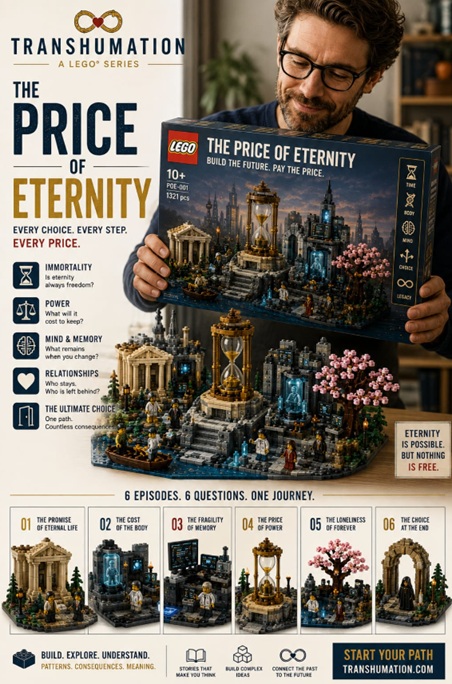
The Price of Eternity
This article belongs inside The Price of Eternity because extreme longevity makes the problem sharper.
Imagine a person who lives for five hundred healthy years.
Does one career remain sufficient?
Perhaps they spend fifty years in medicine, seventy studying architecture, thirty caring for children, a century exploring another planet and twenty doing almost nothing at all.
In a life of that length, the idea that one occupation should define the person begins looking absurd.
Longevity would loosen the connection between profession and biography.
AI could accelerate the same separation before radical life extension ever arrives.
If machines repeatedly make specific skills less economically necessary, identity built primarily around occupation becomes fragile.
The future self may therefore require something deeper than professional continuity.
Values.
Commitments.
Relationships.
Curiosity.
Projects.
A sense of what deserves care.
Those structures may travel across several careers and several technological eras.
The job changes.
The person requires another spine.
The Return of the Amateur
The word amateur comes from a history associated with love rather than professional necessity, although modern culture often uses it to mean inferior.
An AI-rich civilization may make the amateur newly important.
Someone studies astronomy without needing to become an astronomer.
Paints without needing to sell paintings.
Learns ancient Greek without expecting a salary.
Restores a forest because the forest matters.
Teaches because someone wants to learn.
Industrial society often asks whether such activities are economically productive.
A civilization of abundance may have the luxury of asking whether they are civilizationally valuable.
That would not eliminate professionals.
Expertise remains real.
Competence matters.
Some responsibilities require certification because mistakes carry enormous consequences.
But the boundary between productive life and employment could become less rigid.
The return of the amateur would not mean the death of excellence.
It might mean excellence no longer needs to justify itself entirely through a market.
Who Decides What Counts as Contribution?
This may become the political question hidden inside the philosophical one.
If employment declines, societies will still distribute status.
They always do.
Today income, occupation and professional prestige perform much of that function.
What replaces them?
Followers?
Reputation scores?
Educational achievement?
Community contribution?
Artistic recognition?
Physical beauty?
Control over computational resources?
A post-work society could become more humane.
It could also invent forms of status competition more psychologically invasive than employment ever was.
The removal of one hierarchy does not produce equality automatically.
It creates space in which another hierarchy can form.
This is why liberation from work is not the end of politics.
It may be the beginning of a new form of politics concerned less with production and more with recognition.
What does society honor when labor is no longer scarce?
The answer will reveal what that society actually values.
Watch The Video
How to Read the World
Current Knowledge
Automation has historically replaced particular tasks and occupations while also creating new industries, forms of employment and increases in productivity. These transitions have not been painless or evenly distributed, and historical precedent does not guarantee that future AI-driven changes will produce an equivalent number or quality of jobs on the same timescale.
Current AI systems are particularly capable in many information-processing tasks, including language generation, classification, coding assistance, search, summarization and pattern recognition. Their effects on employment are likely to vary by occupation because jobs contain combinations of tasks rather than one uniform activity.
Paid employment contributes more than income for many people. Research across psychology and sociology has linked work to routine, social contact, status, competence and identity, although meaningful lives clearly exist outside employment and many jobs themselves are experienced as alienating or meaningless.
Human societies have never derived all meaning from economic survival. Art, religion, play, intellectual inquiry, relationships and voluntary collective activity have persisted across very different economic conditions.
A technologically feasible reduction in necessary labor would not automatically create a post-work society. Distribution of income, ownership of productive systems, law and political institutions would determine whether productivity gains translate into broader leisure or simply different forms of inequality.
Open Questions
The most immediate uncertainty is economic: how quickly will AI complement workers, and where will it substitute for them? The answer may differ dramatically between industries, countries and skill levels, making simple global predictions unreliable.
A second problem is institutional. If fewer hours of human labor are required to produce a high standard of living, will societies distribute those gains through shorter working weeks, higher wages, public provision, transfers or concentrated ownership? Technology does not answer that question.
There is also a psychological uncertainty. We know humans can build meaningful lives outside paid work, but we have relatively little experience with entire societies in which employment is no longer the dominant organizer of adult time and status.
The deepest question concerns recognition. If machines outperform humans at many economically valuable tasks, what basis will people use to evaluate themselves and one another? A future without job scarcity may still contain an intense struggle for significance.
Transhumation Interpretation
For Transhumation, AI matters not because it will necessarily eliminate work, but because it exposes the fragile equation job = contribution = identity.
Those three things were never identical.
AI may force civilization to separate them.
A machine can perform the task.
A society still has to decide what deserves doing.
A person still has to decide what deserves participation.
That is enough for the Transhumation boundary.
The goal is not a civilization in which nobody works.
It is a civilization capable of distinguishing labor performed from necessity from activity chosen because something is worth maintaining, discovering or creating.
FAQ
Will AI take all human jobs?
Probably not. AI is more likely to automate different tasks at different rates, transforming many occupations and eliminating some while creating or expanding others.
Why is job loss psychologically difficult?
Because work often provides income, routine, social contact, status and a sense of competence. Losing employment can therefore disturb identity as well as financial security.
Is work necessary for a meaningful life?
No. People find meaning in relationships, creativity, care, learning, community, religion, play and exploration. Employment is one important structure for meaning, not its only source.
What would happen if survival no longer required much human labor?
People would gain more freedom over time, but societies would still need institutions for distributing resources, organizing participation and recognizing contribution.
Could AI actually create a post-work civilization?
AI could reduce the amount of labor required for many forms of production, but a post-work society would depend just as much on ownership, distribution and political decisions as on technology.
What is the deeper Transhumation question?
The deepest question is not whether AI will take the last job.
It is what remains of a person when a job no longer has to explain why they are useful.
For a few centuries, industrial civilization made employment extraordinarily good at bundling several problems together. It paid for survival. It structured time. It distributed status. It created obligations. It told strangers how to categorize us.
AI may begin pulling those functions apart.
That could be frightening.
It could also reveal something we should perhaps have noticed earlier.
A human life was never identical to its economic task.
If machines eventually take more of the necessary work, the remaining challenge will not be to invent artificial chores so that everyone can continue feeling employed.
It will be to build a culture in which contribution, mastery, care and participation remain visible even when they no longer arrive attached to a salary.
The last job, then, may not be the last thing humans do.
It may be the moment we finally discover how much of human life was never a job in the first place.
Continue the Transhumation Series
- Forgotten Religion | Ancient Gods, Symbols and the Hidden Structures of Human Civilization
- The Last Religion | Death, Immortality and the Future of Humanity
- The New Theurgy | AI, Information and the Future of Human Civilization
- End of Branding: You Were Never Meant to Become a Product
- Baal vs Ishtar: Why Ancient Gods Never Disappeared