
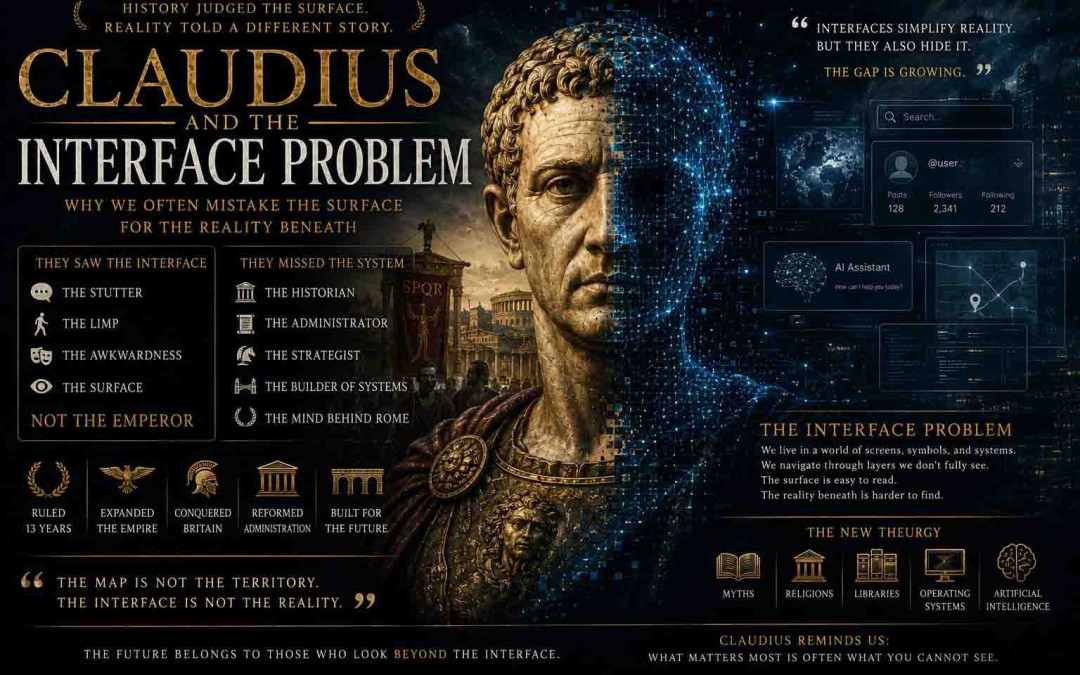
The Interface Problem
History remembers Claudius in a peculiar order. Before many accounts tell us what he governed, they tell us how he looked while trying to govern himself. He stuttered. He limped. His head and hands were said to move awkwardly. Ancient writers preserved stories of relatives who regarded him as weak, ridiculous, even unfit for public life. In the brutal visual culture of Rome, where authority had to be performed before it could be exercised, Claudius seemed to fail the audition long before he was ever given the role.
Then, in AD 41, Caligula was assassinated, the imperial household collapsed into panic, and Claudius emerged from the margins as emperor. The man who had looked so unsuitable would rule for thirteen years. His reign saw the conquest of Britain, major administrative reforms, ambitious public works, expansion of imperial bureaucracy, and a style of government far more competent than his earlier reputation had suggested. The contradiction is not merely biographical. It is structural. Rome had mistaken a visible interface for the system beneath it.
The Emperor Nobody Expected
Claudius is interesting because the error made about him was not irrational. Human beings need shortcuts. We cannot examine the full architecture of every person, institution, machine, or idea we encounter. We rely on signals: posture, speech, dress, confidence, fluency, reputation. These signals are not meaningless. A person who cannot speak clearly may indeed struggle in politics. Someone who appears uncertain may truly be uncertain. The problem begins when a useful signal is promoted into a complete theory.
Rome was especially vulnerable to this mistake because Roman public life rewarded performance. Oratory mattered. Bearing mattered. Confidence mattered. Political authority was theatrical in the literal sense: men were watched in the Forum, heard in the Senate, judged at banquets, ceremonies, trials, games and military triumphs. A ruler had to look like a ruler because looking like a ruler was part of the machinery of rule. Claudius, by those standards, was an interface failure.
Yet underneath that interface sat a different configuration. He had spent years studying history. He knew administration. He had watched imperial politics from unusually close range while being underestimated by many of the people around him. What looked like absence from the main stage may also have given him time to observe it. What looked like political insignificance may have helped him survive a family in which visibility could be fatal.
That does not turn every weakness into a hidden strength. It would be too easy to romanticize him. Claudius made poor decisions as well as good ones, and ancient accounts of his reign are tangled with senatorial hostility, court politics and later literary caricature. But the deeper point survives those complications. His contemporaries had access to information about him. What they lacked was the correct weighting of that information.
They saw the surface accurately.
They misunderstood what the surface meant.
When the Interface Becomes the Object
An interface exists because reality is too complicated to handle directly. A map reduces terrain. A dashboard reduces machinery. A menu reduces software. A face reduces a person into something another person can read quickly enough to respond. Every interface is therefore an act of compression.
Compression is useful because it makes action possible. Without it, civilization would stall under the burden of detail. A driver does not need to understand the combustion chemistry of an engine in order to turn a key. A reader does not need to reconstruct the history of typography every time a letter appears on a page. A citizen does not need to know the private life of every official before deciding whether that official appears trustworthy.
But compression always throws something away.
That missing material is where the danger begins.
Once an interface works reliably enough, we stop remembering that it is an interface. The map becomes the territory. The symbol becomes the thing. The profile becomes the person. We begin to confuse what is easiest to perceive with what is most important.
Claudius offers an unusually clean historical example because the mismatch was so visible in retrospect. His stutter was real. His limp was real. His awkward movements were real. But those traits were not equivalent to incompetence. Rome treated them as though they were.
The mistake was not that people saw badly.
The mistake was that they stopped looking too early.

Camouflage by Misreading
There is another layer to the Claudius story that makes the problem more interesting.
An interface does not only reveal.
It can conceal.
The same qualities that reduced Claudius’s prestige may have lowered the political threat he appeared to pose. In a dynasty shaped by paranoia, succession struggles and violence, being underestimated could be a form of protection. The man dismissed as harmless was less likely to be treated as a rival. A failure of appearance could become a survival advantage.
This is where the Interface Problem stops being merely a warning about prejudice and becomes something closer to a law of systems.
Observers do not respond to reality directly.
They respond to their model of reality.
If the model is wrong, the system can behave in ways the observer does not expect.
A weak-looking rival may be dangerous.
A simple-looking technology may contain enormous complexity.
A harmless-looking symbol may carry centuries of memory.
A polite-looking institution may possess immense coercive power.
The visible surface guides the response, but the hidden structure determines what the thing can actually do.
Claudius benefited from that gap because people mistook low apparent threat for low actual capacity.
The interface became camouflage.
The Modern Empire of Surfaces
The Roman version of this problem was constrained by flesh, voice, architecture and ritual. Ours is larger.
Modern civilization increasingly operates through interfaces.
A bank exists for many people as an app. A university exists as a website, login and dashboard. A friendship may exist partly as a thread of messages. A political figure becomes a stream of clips. A company becomes a logo. A person becomes a profile picture, a biography and a set of metrics. Even institutions of extraordinary physical complexity often reach us through a few rectangles of glass.
This is not superficiality in the trivial sense. It is infrastructure.
The more complex civilization becomes, the more dependent we become on compressed representations of that complexity. No ordinary user can inspect the entire supply chain behind a phone, the full network behind a search engine, the source code behind every application, the electrical grid behind a light switch or the institutional machinery behind a passport.
We live through abstractions because we have no alternative.
And that means the distance between visible layer and underlying system keeps increasing.
Artificial intelligence makes this especially obvious. The interface may be little more than a text box. Type a sentence. Receive an answer. The visible interaction is almost embarrassingly simple. Behind it sits an enormous stack of hardware, data, mathematical structures, engineering decisions, networks, training processes, safety systems and human institutions.
The simplicity of the interface is not evidence of simplicity underneath.
It is evidence that the interface is doing its job.
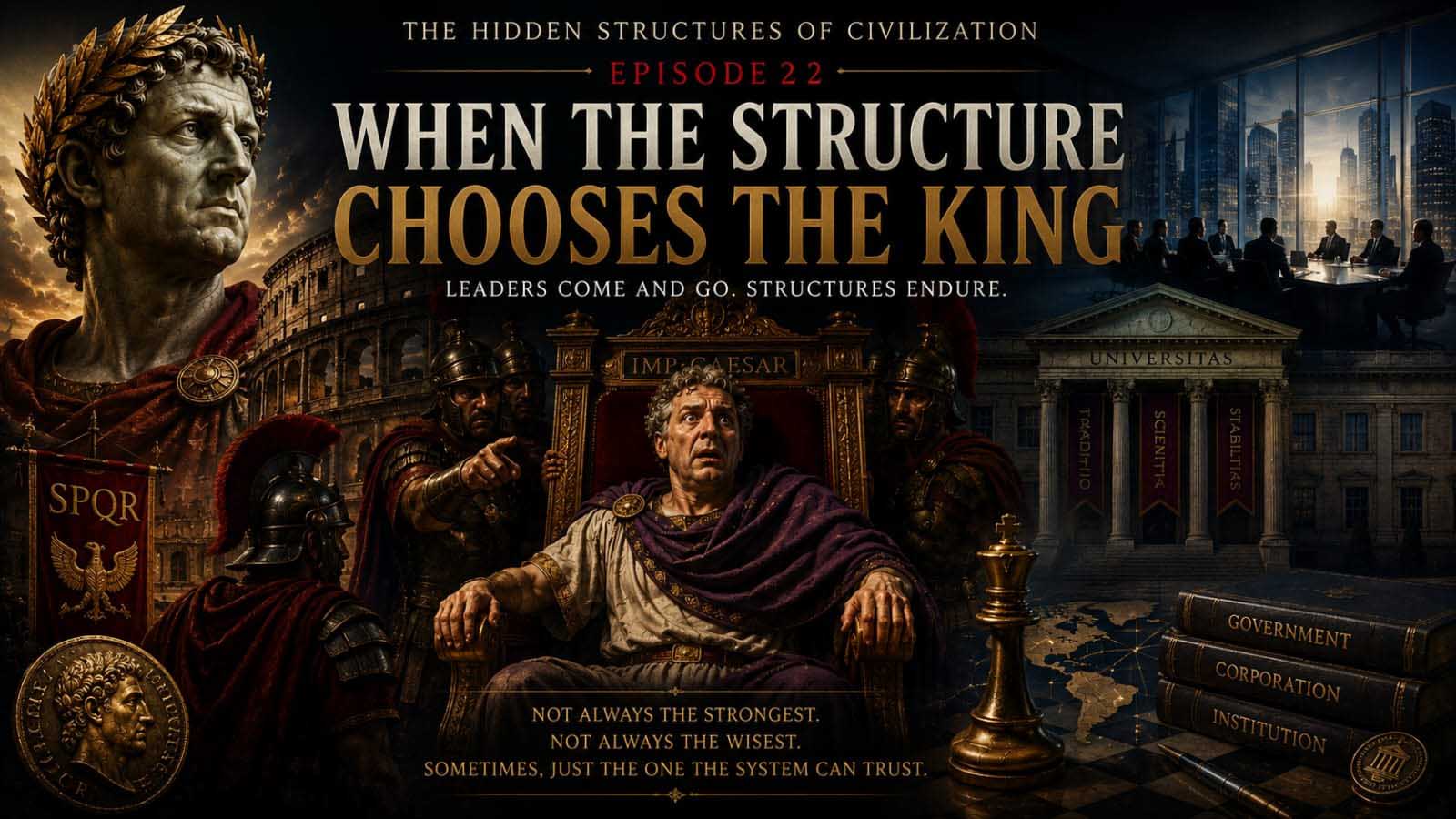
The Claudius Principle
The lesson is not to distrust appearances automatically. That would only replace one crude heuristic with another. Sometimes confidence reflects competence. Sometimes a polished interface sits on top of a polished system. Sometimes a poor presentation really does reveal deeper disorder.
The more useful principle is narrower:
The most visible property of a system is not necessarily the property doing the most work.
A bridge is seen as shape, but it survives because of engineering.
A library is seen as architecture, but its deeper function is the organization and transmission of information.
A government is seen through leaders, but much of its continuity depends on administrators, procedures and records.
A person is encountered through appearance, voice and manner, but those signals reveal only part of the structure capable of acting in the world.
Claudius was misread because observers treated the interface as a verdict.
The same error now scales far beyond individuals.
We judge software by design.
Companies by branding.
Ideas by presentation.
People by profiles.
Artificial intelligence by conversational surface.
Civilizations by monuments.
In each case, the interface contains information.
It simply does not contain all the information.
The New Theurgy
This is where the question enters Transhumation.
The New Theurgy does not need to claim that ancient religion and modern technology are secretly identical. The structural resemblance is more interesting than the metaphor.
Myths helped people navigate realities too large to hold directly in the mind.
Religions organized relationships between human beings and invisible orders.
Libraries compressed generations of knowledge into accessible forms.
Maps transformed geography into symbols.
Operating systems transform machine processes into buttons, windows and icons.
Artificial intelligence increasingly transforms enormous informational spaces into conversation.
Different carriers.
A recurring function.
An interface stands between a limited observer and a reality too complex to confront all at once.
That interface can be illuminating. It can also become dangerous when the observer forgets that mediation is taking place.
The god can be mistaken for the cosmos.
The map for the territory.
The dashboard for the economy.
The profile for the person.
The chatbot for the total system behind it.
The old mistake returns because the structure survives even when the material changes.
Claudius matters here because his body and manner became a crude human interface through which Rome attempted to read the deeper system called Claudius.
The reading failed.
Not because the surface was false.
Because it was incomplete.
Watch The Video
How to Read the World

Current Knowledge
Claudius became Roman emperor in AD 41 after the assassination of Caligula and ruled until AD 54. Ancient sources including Suetonius describe physical and speech impairments and report that members of the imperial family often regarded him as unsuitable for public life. Modern historians treat those sources cautiously because elite Roman writers could be hostile, moralizing and politically biased.
His reign included the Roman invasion of Britain beginning in AD 43, expansion of imperial administration, major infrastructure projects and reforms in areas of law and provincial governance. Modern assessments of Claudius are more mixed and generally more favorable than the caricature preserved by some ancient authors, although his reign was neither uniformly successful nor free of political brutality.
There is no historical basis for claiming that Claudius consciously used disability or awkwardness as a deliberate political disguise. The idea that being underestimated may have contributed to his survival is a plausible structural interpretation, not a demonstrated strategy.
Open Questions
How much of Claudius’s traditional image reflects genuine observation and how much reflects the hostility of senatorial writers toward an emperor who expanded the role of freedmen and imperial administration? To what extent did Roman political culture systematically confuse rhetorical performance with governing ability?
More broadly, when does an interface remain a useful summary, and when does it become a distortion? How can observers distinguish between a surface that accurately signals the system beneath it and one that hides, oversimplifies or misrepresents it?
And as modern civilization increasingly relies on digital interfaces, what forms of reality are becoming invisible precisely because the interface works so well?
Transhumation Interpretation
Claudius does not prove that appearances are deceptive.
He reveals something more precise.
Appearances are interfaces.
They are real.
They matter.
They shape decisions.
But they are never guaranteed to be complete descriptions of the systems beneath them.
That distinction becomes increasingly important in a civilization built from layers of mediation. We rarely touch the infrastructure we depend upon. We touch screens. We rarely inspect the knowledge system. We search it. We rarely encounter the full institution. We see its logo, form, account or dashboard.
The future may therefore demand a new literacy. Not merely the ability to use interfaces. The ability to remember that they are interfaces. To ask what has been compressed. What has been hidden. What assumptions the surface encourages. What deeper structure continues operating outside the frame. Rome looked at Claudius and saw a hesitation. History eventually saw an emperor.
The surface was not wrong.
It was simply too small for the system it was trying to describe
FAQ
Who was Claudius?
Claudius was a Roman emperor who ruled from 41 to 54 CE and is remembered for administrative reforms, public works, and the conquest of Britain.
Why is Claudius connected to the Interface Problem?
Many people judged Claudius by his speech, appearance, and physical limitations rather than by his abilities, demonstrating how interfaces can obscure reality.
What is the Interface Problem?
The Interface Problem is the tendency to mistake appearances, symbols, or representations for the deeper realities they are meant to represent.
Why did people underestimate Claudius?
Ancient Roman culture highly valued public speaking and visible confidence, making Claudius appear less capable than he truly was.
How does this relate to technology?
Modern technology increasingly operates through interfaces that simplify complex systems, making it easy to confuse the visible layer with the underlying reality.
What is the Claudius Principle?
The Claudius Principle suggests that the most important qualities of a person or system are often hidden beneath the surface.
How does AI relate to the Interface Problem?
AI presents simple interactions while concealing immense underlying complexity, making it another example of the gap between interface and reality.
What does this have to do with The New Theurgy?
The New Theurgy explores how humanity uses interfaces to navigate realities too large for direct understanding.
Why are interfaces necessary?
Interfaces allow humans to interact with complexity, but they always simplify reality and therefore risk creating misunderstandings.
What is the central idea of the article?
Claudius reminds us that appearances rarely tell the whole story, and that reality often exists far beneath the interface we first encounter.
Continue the Transhumation Series
- Forgotten Religion | Ancient Gods, Symbols and the Hidden Structures of Human Civilization
- The Last Religion | Death, Immortality and the Future of Humanity
- The New Theurgy | AI, Information and the Future of Human Civilization
- End of Branding: You Were Never Meant to Become a Product
- Baal vs Ishtar: Why Ancient Gods Never Disappeared