
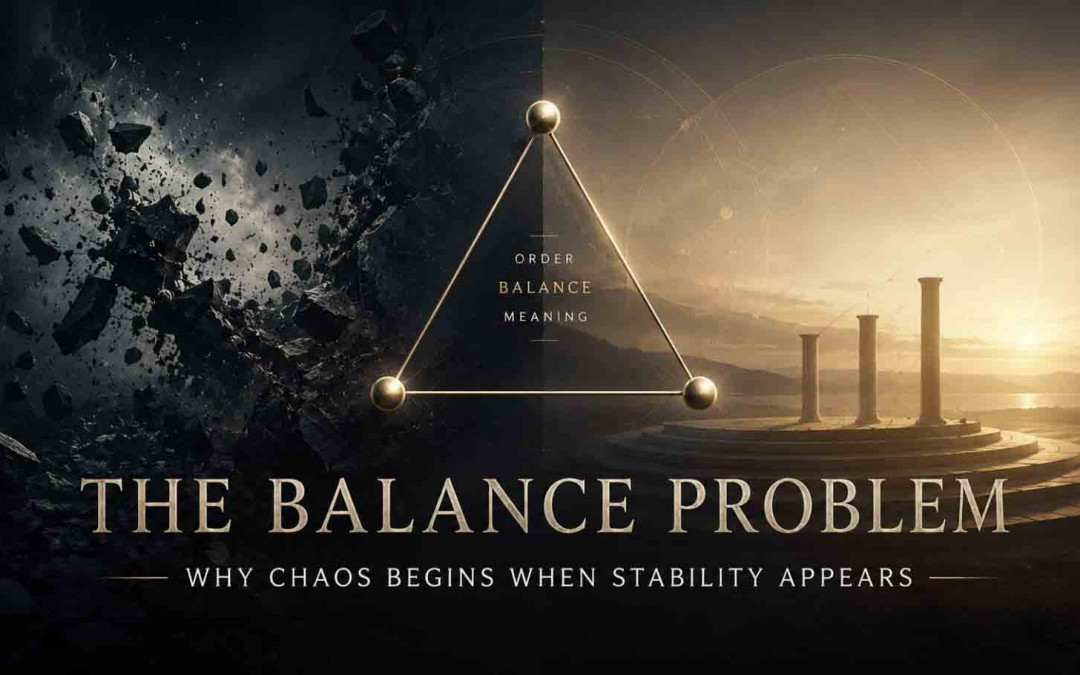
The Balance Problem
Inside a mechanical watch, one of the most important components is not still.
It oscillates.
The balance wheel swings back and forth thousands of times an hour, regulated by a hairspring so fine that the entire mechanism can fit beneath a sleeve. The watch keeps time not by eliminating movement but by controlling it. Perfect stillness would make it useless. Uncontrolled movement would make it inaccurate. Precision appears somewhere between the two.
This is a useful way to begin thinking about stability because stability is easily mistaken for immobility.
A living body is not stable because nothing changes inside it. Quite the opposite. Temperature is regulated, molecules are replaced, blood circulates, electrical gradients are maintained, damaged cells are repaired and energy constantly moves through the system. A city remains recognizable while inhabitants arrive and leave. A language persists while its vocabulary changes. A civilization survives not by freezing itself but by maintaining enough continuity through continual disturbance.
The important distinction is therefore not simply order versus chaos.
It is between a system capable of preserving relationships and a system in which those relationships no longer hold.
Once such relationships exist, something new becomes possible.
Failure.
What Is the Balance Problem?
Imagine a bridge before it has been built.
Steel exists.
Concrete exists.
Gravity exists.
Wind exists.
Nothing about those materials has yet failed as a bridge because there is no bridge to fail.
Then engineers arrange them.
A span crosses the river. Loads are distributed. Joints connect members. Foundations transfer forces into the ground. Each component now participates in a structure whose continued existence depends upon relationships among parts.
At that moment, the materials acquire new possibilities.
The bridge can carry traffic.
It can also collapse.
Organization creates capability and vulnerability simultaneously.
This is the Balance Problem.
The more precisely a system organizes matter, information or behavior toward some function, the more meaningful it becomes to ask whether that organization is being maintained.
Before the orchestra assembles, there can be noise.
After it assembles, there can also be a wrong note.
Before a legal system, there can be violence.
After a legal system, there can also be violation.
Before a library, there can be ignorance.
After a library, there can be censorship, fire, miscataloguing and forgetting.
Structure does not invent disorder.
It invents specific forms of disorder.
Does Stability Create New Forms of Failure?
Yes, and this may be the strongest version of the original intuition.
A stone can crack, but it cannot suffer institutional collapse.
A forest can burn, but it cannot experience a banking crisis.
A bacterium can die, but it cannot lose a constitution.
Each new level of organization generates new failure modes that did not exist at simpler levels.
This is not because complexity is cursed.
It is because functions depend upon relationships.
A railway system fails differently from a railway track. A financial network fails differently from a coin. A nervous system fails differently from an individual neuron. A marriage can fail in ways that neither person could fail alone because the relationship itself has properties requiring maintenance.
The same principle appears in technology.
A hammer has relatively few states in which it can become unusable. A modern aircraft possesses millions of components and dependencies, yet it is also vastly more capable. Its complexity creates failure modes while simultaneously allowing engineers to build redundancy, diagnostics and backup systems.
The correct relationship is therefore subtler than “more complexity equals more fragility.”
Complexity increases both possibility and maintenance burden.
It can create weakness.
It can also create resilience.

The Triangle That Can Collapse
The triangle remains an excellent image for this idea, provided we do not turn geometry into cosmology.
In a rigid framework, triangular arrangements possess useful mechanical stability because their shape cannot change without changing the lengths of their sides or deforming their members. This is why triangular bracing appears repeatedly in engineering.
But once a structure exists, we can ask whether its relationships remain intact.
A member can buckle.
A joint can fail.
A load can exceed the design limit.
The very concept of structural failure depends upon the prior existence of a structural relation.
This gives the triangle philosophical value without requiring any belief in sacred geometry.
Before the sides are connected, there are merely components.
Afterward, there is a whole.
The whole can do something.
And because it can do something, there is now a meaningful difference between working and no longer working.
That distinction scales astonishingly far.
A heart.
A family.
A bridge.
A government.
A computer network.
A civilization.
None fails in exactly the same way.
But all require some set of relationships to remain within tolerable boundaries.
What Is the Difference Between Stability and Resilience?
A perfectly stable system sounds ideal until the world changes.
Then stability can become a weakness.
A building rigid enough to resist ordinary forces may perform badly under an earthquake if it cannot flex. An ecosystem optimized for one narrow condition may collapse when climate changes. A corporation designed around one enormously successful product can become vulnerable precisely because its organization has become too efficient at yesterday’s problem.
Resilience is different.
It is the capacity to absorb disturbance and continue functioning, perhaps in altered form.
This matters because living systems are rarely maintained at one exact point.
The human body does not preserve one immutable internal state. It regulates ranges. Heart rate changes. Hormones change. Temperature moves within limits. Stress temporarily reallocates resources.
The goal is not stillness.
It is viable variation.
Civilizations face the same problem.
A political institution must preserve enough structure for continuity while changing enough to accommodate new conditions. A language survives because speakers alter it. A company that never changes may preserve its identity right up to the moment the market makes that identity irrelevant.
The paradox is elegant.
A system sometimes survives by allowing itself to change.
Too little flexibility and it breaks.
Too much flexibility and it may cease to be recognizable as the same system.
The difficult territory lies between them.
Why Do Complex Systems Fail?
Often because the relationships that make them powerful also allow disturbances to travel.
A tightly integrated supply chain can be extraordinarily efficient until one critical component disappears. A financial system can distribute risk widely and then discover that it has also distributed dependence. A digital platform can connect millions of people while allowing one software error to propagate instantly.
Complex systems often conceal their own fragility because normal operation makes dependencies invisible.
The elevator works, so nobody thinks about electricity.
Payment works, so nobody thinks about settlement systems.
Water emerges from a tap, so an entire network of reservoirs, pumps, treatment plants and maintenance crews disappears psychologically.
Civilization is full of this invisible competence.
Most of the time, that is a triumph.
The problem appears when convenience is mistaken for simplicity.
The system feels effortless precisely because enormous effort has been organized somewhere else.
Failure then appears sudden even when vulnerability accumulated slowly.
The lights go out in one second.
The maintenance problem may have been growing for years.
Civilization Is Maintenance
Ruins encourage the wrong intuition about civilizations.
We look at Rome, Angkor, abandoned industrial cities or broken fortifications and imagine collapse as an event: the dramatic day when order lost its battle with chaos.
Usually history is less theatrical.
Roads require repair.
Records require copying.
Officials require legitimacy.
Water systems require maintenance.
Armies require payment.
Trade routes require security.
Institutions require people willing to continue behaving as though their rules still matter.
A civilization is not a structure built once.
It is a structure repeatedly rebuilt while inhabited.
This is why the phrase civilization is maintenance matters.
Construction receives monuments.
Maintenance rarely does.
The emperor receives the statue; the person who cleaned the aqueduct does not.
Yet the second may have mattered more to whether water arrived the following morning.
The Balance Problem therefore alters our picture of collapse.
The central mystery is not simply why civilizations fall.
It is how extraordinarily difficult structures manage to keep standing for as long as they do.
Love Creates New Ways to Be Hurt
The same principle becomes uncomfortable when moved into private life.
A person can possess nothing and therefore have nothing stolen.
That does not make poverty desirable.
A person can avoid attachment and reduce certain forms of grief.
That does not make isolation superior.
Value creates vulnerability because value creates something whose absence matters.
Love expands the number of ways a life can be injured.
A child gives a parent forms of fear that did not exist before the child was born.
Friendship introduces the possibility of betrayal.
Trust introduces the possibility of deception.
Belonging introduces the possibility of exclusion.
This is not an argument that meaning requires suffering.
It is an argument that attachment creates stakes.
That difference matters.
We should resist romanticizing tragedy as necessary for depth. People do not need cancer to understand love, war to understand community or bereavement to deserve meaningful lives.
But once something becomes valuable, its preservation acquires significance.
The possibility of loss follows value like a shadow.
Not because suffering makes the value real.
Because the value makes the loss real.
Does Consciousness Depend on Homeostasis?
Here the argument reaches an interesting scientific boundary.
Living organisms actively maintain conditions compatible with continued existence. They regulate energy, temperature, water, chemical concentrations and countless other variables. This broad process of physiological regulation is commonly described through concepts such as homeostasis, while related frameworks examine anticipatory regulation and adaptation to changing demands.
The connection with consciousness is tempting.
A conscious organism does not merely respond mechanically. It can feel hunger, pain, thirst, fear and exhaustion. Many of these experiences relate directly to conditions relevant to bodily regulation.
This has led some scientific and philosophical approaches to explore close relationships among bodily regulation, emotion, selfhood and conscious experience.
But the stronger statement — that consciousness evolved because reality needed a guardian of balance — would go far beyond what we know.
Plenty of living regulation occurs without consciousness.
Plants regulate.
Bacteria regulate.
Cells maintain boundaries and chemical conditions.
Consciousness may provide certain organisms with extraordinarily flexible ways of navigating threats and opportunities, but it should not be turned into a metaphysical caretaker simply because the metaphor is attractive.
The safer and more interesting observation is that conscious experience is filled with the language of regulation.
Too hot.
Too cold.
Hungry.
Safe.
Afraid.
Enough.
More.
Stop.
The body does not experience existence as an abstract theorem.
It experiences departures from viable ranges.
The Observer’s Burden
A rock falling from a cliff has no known concern about its trajectory.
A person watching the rock fall toward a child does.
Consciousness introduces evaluation.
Events are not merely occurring.
They matter relative to goals, memories, attachments and anticipated futures.
This does not prove that awareness emerged from balance, but it reveals something remarkable about awareness: consciousness appears capable of representing not only what is but what should remain, what might happen, and what must be prevented.
A physician sees blood pressure not merely as a number but as a condition requiring response.
An engineer hears an unfamiliar vibration and imagines failure before failure occurs.
A parent notices silence in the next room and immediately constructs possibilities.
The observer can therefore become a guardian of structure because the observer can represent counterfactuals.
This bridge is cracked.
It could collapse.
This fever is rising.
It could become dangerous.
This institution still functions.
It may not always.
The ability to imagine loss before it occurs may be one of the great powers of intelligence.
It is also one of its burdens.
The Triangle and the Circle
Here we enter symbolism, so the rules change.
A circle has been associated in many traditions with cycles, continuity, celestial motion, perfection and eternity. Triangular forms have acquired many different religious, philosophical and political meanings.
There is no universal dictionary in which circle permanently means eternity and triangle permanently means stability.
Symbols are not equations.
Yet the two shapes can still be useful within this essay if their role remains explicit.
The circle can stand for recurrence because a path around it returns to its starting point.
The triangle can stand for structure because its sides mutually constrain one another.
Those are interpretations built upon formal properties.
They are not secret meanings embedded in geometry.
This distinction is essential to symbolic literacy.
A good symbol compresses a relation.
A bad interpretation pretends the compression is a law of the universe.
The symbol should open the question.
It should not close it.
The Architecture of Meaning
The deepest version of the Balance Problem may therefore have little to do with chaos.
It concerns stakes.
Meaning does not necessarily require danger, but much of human meaning involves structures whose continuation matters to somebody.
A promise matters because future behavior can honor or violate it.
A museum matters because objects and contexts can be preserved or lost.
A language matters because it can be transmitted or forgotten.
A person matters without needing to justify that value through mortality, but mortality changes the conditions under which attention, time and memory operate.
This suggests a better sequence than the original claim that stability creates responsibility, which creates purpose, which creates meaning.
Reality is not that linear.
But once an intelligent being values a structure, vulnerability can create responsibility toward its preservation.
The caretaker appears not because the universe demanded one.
The caretaker appears because something became worth maintaining.
That is enough.
Watch The Video
How to Read the World
Current Knowledge
Physical disorder, instability and entropy do not depend upon the prior existence of organized structures. It would therefore be inaccurate to say that chaos literally begins when stability appears. What organization creates are new system-specific possibilities of failure, degradation and loss.
Living organisms maintain internal conditions through regulatory processes including homeostasis and related forms of adaptive control. These processes are fundamental to life, but regulation does not by itself imply consciousness; extensive biological regulation occurs in organisms and systems without demonstrated subjective awareness.
Complexity can increase vulnerability because additional components and dependencies create additional failure modes. At the same time, complex systems can gain resilience through redundancy, modularity, repair, feedback and alternative pathways. Complexity is therefore neither inherently fragile nor inherently robust.
Human societies and technological systems depend heavily upon maintenance. Infrastructure, institutions, archives and networks require continuing investment of energy, attention, labor and coordination. Stability over time is usually an active process rather than simple persistence.
Symbols such as circles and triangles have accumulated different meanings across cultures and historical periods. Their geometric properties can motivate interpretations, but there is no single universal symbolic meaning scientifically attached to either shape.
Open Questions
One unresolved question concerns the relationship between complexity and resilience. At what point does additional interconnection increase adaptability, and when does it create dependencies capable of producing cascading failure? Different systems appear to occupy different answers to this problem.
Another concerns consciousness and regulation. Bodily states clearly influence subjective experience, and several theories connect selfhood and consciousness closely to embodied regulation, but the precise relationship between homeostasis, cognition and conscious awareness remains contested.
Civilization raises a similar problem at another scale. Highly developed societies can maintain infrastructures and institutions impossible for simpler societies, but doing so requires enormous flows of energy, specialization and coordination. Whether complexity eventually creates unavoidable maintenance burdens or merely different ones remains an open historical question.
The deepest question concerns value. Vulnerability clearly changes how conscious beings relate to things they care about, but it remains unclear how much meaning depends upon scarcity, mortality or the possibility of loss. A world with less suffering would not necessarily be a world with less meaning.
Transhumation Interpretation
For Transhumation, the Balance Problem is not the claim that order created chaos.
It is the recognition that every new structure creates a new distinction between preservation and failure.
A library creates the possibility of forgetting differently. A network creates the possibility of disconnection. A person who loves creates something worth protecting.
The lesson is therefore not to worship stability.
It is to understand maintenance.
The most important systems are rarely those that never change. They are the ones capable of changing without losing the relationships that make them what they are.
That may be the real work of the caretaker.
Not preventing change.
Knowing what must survive it.
FAQ
What is the Balance Problem?
It is the idea that once an organized system exists, new forms of failure become possible because there are now relationships and functions capable of being disrupted.
Does stability literally create chaos?
No. Physical disorder and instability existed before organized structures. Stability creates something more specific: the possibility of collapse, malfunction or loss relative to an existing organization.
Why can complex systems be fragile?
More components and dependencies can create more possible failure paths, although redundancy and modularity can also make complex systems highly resilient.
What is the difference between stability and resilience?
Stability emphasizes remaining within a functioning state, while resilience emphasizes the capacity to absorb disturbance, adapt and continue functioning.
Does consciousness exist to maintain balance?
There is no evidence establishing that as the origin or purpose of consciousness. However, conscious experience is deeply connected to bodily regulation, goals, prediction and the detection of conditions relevant to survival.
What is the deeper Transhumation question?
The deeper question is not why reality contains chaos.
It is what must be maintained for a changing system to remain recognizably itself.
A human body changes constantly.
A city replaces buildings and inhabitants.
A language loses words and gains others.
A civilization changes laws, technologies and beliefs.
Absolute stability would kill much of what makes these systems alive. Unlimited change would dissolve their identity.
Between those extremes lies the real problem.
Not standing still.
Not avoiding disturbance.
But preserving the relationships that matter while almost everything else continues moving.
A mechanical watch understands this without understanding anything at all. Its balance wheel survives by oscillating.
Perhaps civilization does something similar.
The great structures do not defeat change.
They learn how much movement they can survive.
Continue the Transhumation Series
- Forgotten Religion | Ancient Gods, Symbols and the Hidden Structures of Human Civilization
- The Last Religion | Death, Immortality and the Future of Humanity
- The New Theurgy | AI, Information and the Future of Human Civilization
- End of Branding: You Were Never Meant to Become a Product
- Baal vs Ishtar: Why Ancient Gods Never Disappeared