
The First Human Upload
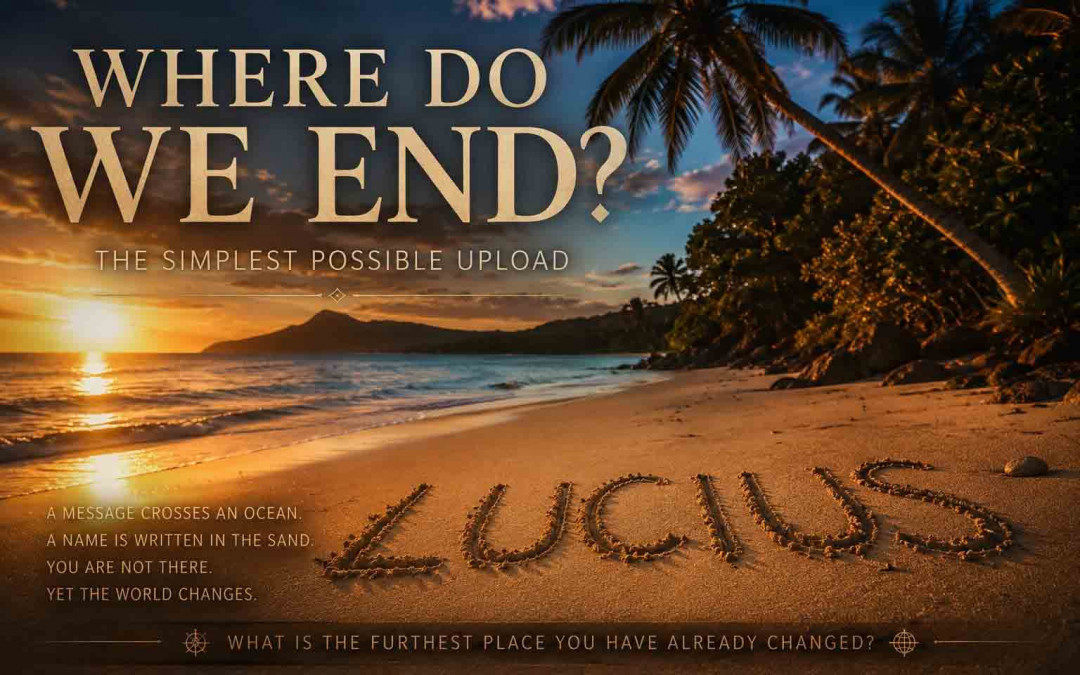
Somewhere on a beach in Haiti, a stranger kneels and writes your name into wet sand.
You have never stood on that beach. You do not know the temperature of the water, the color of the buildings beyond the shore or what the wind sounds like there in the late afternoon. Your skin has never touched the place. Your body may be thousands of kilometers away.
Yet the sand has changed because of an intention that began in you.
Perhaps you typed a message. Perhaps money changed hands. Perhaps someone sent you a photograph afterward. None of this is supernatural. The causal chain is ordinary enough to be boring.
And still there is something strange about it.
Your hand did not touch the beach.
Your body did not travel.
But a choice made inside one human life crossed an ocean, entered another person’s behavior and altered matter at a distant location.
The name will disappear with the tide.
The problem it reveals will not.
Where, exactly, does a human being end?
Where Does the Human Body End?
Biologically, the answer is less mysterious than philosophy sometimes makes it sound.
A human organism has boundaries.
Skin separates internal physiological processes from much of the surrounding environment. The nervous system is physically instantiated in a body. Metabolism, circulation and immune regulation belong to an organism whose location can usually be identified without difficulty.
But the boundary of the organism is not necessarily the boundary of everything the organism can do.
Pick up a walking stick and the geometry of action changes. A blind person using a cane does not merely feel the object in the hand; with practice, attention can become organized around what the far end of the cane encounters.
Drive a car and the practical space of action expands again. Experienced drivers often stop thinking continuously about the edge of the metal surrounding them. They learn to maneuver the vehicle almost as though its dimensions have been incorporated into the body’s working model of space.
Use a telescope and the eye remains in the skull while useful perception reaches objects no unaided human could inspect in the same way.
None of these examples proves that the body has physically expanded.
They show something subtler.
Human agency has a variable radius.
The body remains local.
What the body can successfully cause does not.
The Hammer Is Not the Hand
This distinction prevents a seductive mistake.
We often say that a hammer extends the hand, a telescope extends the eye and a book extends memory.
These are useful metaphors.
They should not become careless ontology.
A hammer does not literally become flesh. A telescope does not join the retina. A book does not remember in the neurological sense that a brain remembers an afternoon from childhood.
What changes is the functional system through which a person acts.
Without the hammer, one range of physical effects is possible.
With it, another becomes possible.
Without writing, a person’s words disappear quickly unless another mind preserves them.
With writing, a pattern of language can travel farther than the speaker’s voice and survive longer than the body that produced it.
Technology repeatedly inserts new carriers between intention and consequence.
That may be the important continuity in human history.
The hand remains biological.
The chain of action becomes increasingly technological.
The First Upload Was Not an Upload
The phrase mind upload encourages a particular image.
A brain is scanned.
A pattern is copied.
A digital consciousness opens its eyes somewhere else.
The biological original is either left behind or destroyed, and immediately the old problem appears: is the new being the same subject, or simply a new subject possessing the same remembered past?
A letter does nothing remotely comparable.
Neither does a telephone.
Neither does the internet.
A letter does not contain the writer’s consciousness. It contains marks capable of causing another person to reconstruct part of what the writer intended to communicate.
A telephone transmits signals that allow voice to be reconstructed elsewhere.
A video call creates reciprocal audiovisual presence without transporting the biological participants.
Calling these things early mind uploads would blur exactly the distinction we need.
But there is another sense in which they belong to the same history.
They progressively separate where intention originates from where its effects occur.
The letter made thought actionable beyond the range of speech.
The telegraph radically compressed delay.
The telephone allowed a distant voice to participate almost immediately.
Networked computing made remote action routine.
The trajectory is not body becoming data.
It is agency gaining new carriers.

What Is the Simplest Possible Upload?
If we keep the word upload, the smallest defensible version may be almost disappointingly modest.
An intention is encoded.
The encoding travels.
Another system interprets it.
Something changes.
You type an instruction in Poland.
Someone in Haiti receives it.
A name appears in sand.
The result is not you.
The message is not you.
The person receiving it does not contain your consciousness.
But a structure originating in your decision has survived a change of carrier and produced a distant consequence.
That is not personal upload.
It is causal portability.
And causal portability is one of civilization’s great inventions.
Writing made intention portable across time.
Money made claims portable across exchanges.
Maps made spatial relationships portable.
Software made procedures portable.
Networks made commands portable across distance.
Artificial intelligence may make goals increasingly portable because the user can sometimes specify an outcome without specifying each intermediate action.
We should resist making all of these things identical.
But they share one remarkable feature.
The distance between I want this to happen and my body must physically perform every step has been growing for a very long time.
The Name on the Beach
Return to the name.
Its importance lies precisely in how little of you arrived.
No memory was transferred.
No personality crossed the Atlantic.
No subjective point of view moved into the sand.
Only a very narrow structure survived:
these letters,
in this arrangement,
placed here,
because someone elsewhere wanted them there.
This is the LEGO Principle in miniature.
Almost everything about the originating person has been removed.
Enough remains to reconstruct the requested relation.
The sand does not need to know your childhood.
The person writing the name does not need access to your private thoughts.
The communication succeeds because only a tiny invariant matters.
That is why simple remote action can feel almost magical.
The causal chain is enormous compared with the information required to specify the result.
A small symbol organizes a distant event.
Civilization becomes powerful partly by discovering how little needs to travel for a useful structure to survive.
Is Telepresence a Form of Human Presence?
Now the problem becomes more difficult.
Telepresence systems allow a person to perceive, communicate and sometimes act through a machine located elsewhere. Remote-controlled robots have been used in workplaces, healthcare, education and social settings, including systems designed to allow people with serious physical disabilities to participate from a distance.
Suppose a person lies at home while controlling a mobile robot inside a café.
The robot moves when they decide to move.
Customers hear their voice through it.
Its camera supplies visual information.
Its body occupies social space the biological operator cannot physically enter.
Where is the worker?
The easiest answer is: biologically, at home.
But the socially relevant answer becomes more complicated.
Their presence is distributed across a system.
Customers address the robot because through it they can address the person.
The machine is not merely carrying a previously written message. It is participating in a live feedback loop.
The person sees.
Responds.
Adjusts.
Acts again.
Telepresence therefore differs from the name on the beach.
The beach example transmits an intention.
Telepresence can sustain a continuous sensorimotor relationship across distance.
Still, the robot is not automatically the person’s body in the biological sense.
It is an interface through which the person’s agency acquires another location.
That distinction may eventually become very important.
What Is the Extended Mind Theory?
Philosophy has already developed language for part of this territory.
The extended mind thesis, associated particularly with philosophers Andy Clark and David Chalmers, asks whether certain external resources can sometimes become genuine components of cognitive processes rather than merely tools used by a self-contained brain.
The classic intuition is straightforward.
Suppose one person remembers an address neurologically.
Another, because of impaired biological memory, relies constantly and reliably on a notebook in which the address is stored.
If the notebook participates in the second person’s practical cognition in a sufficiently integrated way, should we insist that cognition stops at the skull simply because part of the functional process occurs on paper?
The thesis is debated.
A notebook is obviously not conscious.
A smartphone does not become part of a person merely because it is expensive and always nearby.
Not every tool used in thinking should automatically be called part of the mind.
But the theory exposes a useful question.
Why should skin and skull automatically determine the functional boundary of cognition?
Perhaps sometimes they do.
Perhaps sometimes the relevant system is larger.
The important thing is not to decide in advance.
It is to ask what role the external component actually plays.
The Internet Did Not Swallow the Human
Digital culture makes the question harder because so much ordinary cognition now depends upon systems outside the body.
People remember fewer phone numbers because devices remember them.
They navigate using external maps updated in real time.
Their photographs organize autobiographical memory.
Calendars preserve future intentions.
Search engines become part of research routines.
Messages preserve relationships across decades.
But dependence is not identity.
Your email archive is related to you.
It is not therefore your mind.
A cloud photo library contains traces of your life.
It does not experience having lived it.
A social profile may continue after death.
That does not mean you continue through the profile.
The digital world has created an enormous penumbra of the person: records, messages, preferences, social relationships, search histories, images and patterns of behavior extending far beyond the physical body.
The penumbra is real.
It can affect jobs, relationships, reputation and future decisions.
But we should not confuse the informational shadow with the conscious source casting it.
That is precisely the mistake a serious theory of upload must avoid.
Where Does Agency End?
Perhaps this is the sharper question.
Suppose you instruct an AI agent to find a hotel, compare prices, choose according to preferences it already knows, make a reservation and reorganize your calendar.
You did not perform every intermediate action.
But the chain began with your authorization.
How far can that delegation expand before the system’s behavior no longer feels like your action?
The problem is already familiar in simpler forms.
A CEO gives an instruction.
An employee interprets it.
A company acts.
A state issues a policy.
Thousands of civil servants implement it.
A general gives an order whose physical consequences occur far beyond the body issuing it.
Human agency has long traveled through other humans and institutions.
AI adds a new intermediary.
It may interpret goals, make choices and execute sequences that the originating person never explicitly specified.
The farther the system moves from instruction toward independent planning, the harder attribution becomes.
Did you act?
Did the AI act?
Did the combined system act?
This is not merely philosophy.
It is becoming a problem of law and responsibility.
Extension of agency enlarges capability.
It also enlarges the territory in which accountability can become blurry.
The First Artificial Hand
The hand was once obvious.
You wanted the cup.
Your arm moved.
The cup moved.
Cause and intention remained close enough to appear almost identical.
Machines inserted distance.
A lever lets a small motion control a large one.
A button converts touch into an electrical instruction.
An on-screen button preserves the visual memory of the physical control while removing its mechanical depth.
Voice interfaces begin eliminating even that.
AI moves one step further.
Instead of specifying action, the human can specify intent.
“Get me there by Thursday.”
“Find the best version.”
“Make this understandable.”
“Keep the room comfortable.”
The artificial system translates the desired state into procedures.
This may be one of the most consequential changes in interface history.
The machine stops waiting for every finger movement.
The artificial hand begins deciding how to reach.
At that point, the question Where do I end? acquires a second companion:
Where does my intention end and the system’s judgment begin?
Clothing, Fire and the Old Human Boundary
The problem is much older than computers.
A naked human body has one range of environments in which it can survive comfortably.
Clothing changes that range.
Fire changes it further.
A horse alters the radius of movement.
A ship allows the body to cross an ocean it cannot swim.
A written contract lets one decision remain active after the person leaves the room.
These are not additions to biological anatomy.
But neither are they merely decorative objects around an unchanged human animal.
They alter what the human system can reliably do.
This is why defining humanity solely at the boundary of skin has always been incomplete at the functional level.
Homo sapiens has been technologically entangled for so long that removing tools does not reveal some pure human underneath.
It reveals a human deprived of one of the species’ characteristic strategies.
We build external structures and then live through them.
Technology is not something that appeared after humanity finished becoming human.
Tool-mediated life is part of the history through which humans became the kinds of beings we are.
Does an Idea Survive Its Creator?
Here the boundary moves from action into time.
A dead philosopher cannot answer a new question.
But a sentence written centuries earlier can still reorganize a living person’s thought.
The author is absent.
The effect continues.
This is not consciousness crossing death.
It is another form of causal portability.
A pattern created in one mind enters a carrier, survives long enough to be reconstructed in another mind and participates in a new decision.
Books are extraordinary precisely because so little travels.
No heartbeat.
No original voice.
No complete personality.
Only structured language.
Yet structured language can be enough for one human being to alter the internal architecture of another across centuries.
This is why culture can look hauntingly like upload while remaining something different.
Civilization has become extremely good at preserving effects of minds.
That does not mean it has learned to preserve the experiencing subjects themselves.
The Upload Nobody Noticed
Perhaps the provocative phrase can now return in a more disciplined form.
The first upload was not the upload of a person.
It was the discovery that some human structures could leave their original carrier and remain operational elsewhere.
A spoken instruction became memory in another person.
A mark became language.
Language became writing.
Writing became executable procedure.
Intentions became commands transmitted across networks.
Actions acquired remote bodies.
Now AI is beginning to insert interpretation between intention and execution.
Each transition increases the independence of the effect from the original physical gesture.
But every stage also forces us to ask what exactly crossed.
A pattern?
A command?
A memory?
A representation?
Agency?
Identity?
Consciousness?
Those words are not synonyms.
The future becomes confusing precisely when technology makes one of them look enough like another.
Where Do We End?
There may be no single answer because the question contains several boundaries.
The body ends approximately where the organism ends.
The field of action can extend through tools, institutions and machines.
The informational trace can extend into archives, networks and other minds.
The social self can extend through relationships, reputation and recognition.
Whether the conscious subject can extend beyond the biological nervous system remains unresolved.
This layered answer is less poetic than saying we are everywhere our influence reaches.
It is also more useful.
A person who inspired a stranger on another continent has extended influence.
They have not therefore become physically distributed between two continents.
A worker operating a robot remotely has distributed agency.
They have not necessarily distributed consciousness.
A dead writer whose work changes us has achieved cultural continuity.
They have not necessarily achieved personal survival.
The power of Transhumation lies not in collapsing these boundaries.
It lies in asking which ones technology is actually moving.
Watch The Video
How to Read the World
Current Knowledge
Humans routinely extend their physical and cognitive capabilities through tools. Technologies can increase range of action, sensory access, memory support, navigation and communication without changing the biological boundary of the organism itself.
Philosophical theories of extended cognition argue that under some conditions external resources may participate constitutively in cognitive processes. This remains debated and should not be treated as evidence that ordinary devices literally contain part of a user’s consciousness.
Telepresence technologies can allow people to perceive and act in distant environments through continuous feedback. This can create meaningful remote social and practical presence while leaving the biological operator physically elsewhere.
Writing, telecommunications and digital networks transmit representations, instructions and patterns rather than conscious subjects. They dramatically increase the portability of human influence without demonstrating portability of consciousness.
Current neuroscience strongly associates human conscious experience with functioning biological brains. There is no established evidence that subjective consciousness can be transmitted through a message, distributed across the internet or transferred into an external machine.
Open Questions
One unresolved question is when a tool becomes sufficiently integrated that describing it as merely “external” stops being functionally useful. Neural prostheses and continuously coupled interfaces may make this boundary increasingly difficult to define.
Another concerns agency. As AI systems move from following explicit instructions toward interpreting goals and selecting actions autonomously, responsibility may become distributed across human intention, machine judgment and institutional design.
Personal identity presents an even harder problem. A person’s records, reputation and influence can spread widely while the conscious subject remains local. We do not yet know whether future technology can change that final boundary or merely create more convincing external extensions.
The deepest question is whether continuity of consciousness depends on a particular biological implementation or whether it could, under some conditions, expand into another substrate while preserving one first-person trajectory. Current science does not answer this.
Transhumation Interpretation
For Transhumation, the skin is not the only meaningful boundary of the human.
But neither should every extension be mistaken for the self.
The useful distinction is between carrier, function and subject. A function can move to another carrier without proving that the subject moved with it.
The beach, the book, the robot and the AI agent therefore belong to one family of questions:
How far can an intention travel before we stop calling the consequence ours?
Mind upload begins only after that question becomes insufficient.
FAQ
What does “Where Do We End?” mean?
It asks whether the biological body, human agency, social identity and consciousness all share the same boundary. They probably should not be treated as one question.
What is the “simplest possible upload”?
In this article it is a deliberate metaphor for an intention leaving its original context, crossing through another carrier and producing a distant effect. It is not literal mind uploading.
Can technology extend human presence?
Yes. Communication systems, telepresence and remote-control technologies allow people to perceive, communicate and act at locations where their biological bodies are absent.
Is a smartphone or notebook part of the mind?
Some theories of extended cognition argue that external resources can sometimes become functionally integrated into thinking. This is philosophically debated and does not imply that the device itself becomes conscious.
Is telepresence the same as uploading consciousness?
No. Telepresence extends perception and agency through a remote interface while the conscious operator remains associated with their biological nervous system.
What is the deeper Transhumation question?
The deepest question is not whether something from us can escape the body.
That has been happening for a very long time.
A sentence can travel.
A decision can cross an ocean.
A hand can acquire a mechanical extension.
A person can act through a robot in another room.
An idea can continue producing consequences centuries after the organism that created it has disappeared.
The difficult question is which part of the human has moved.
If the answer is influence, we already know how to extend it.
If the answer is agency, technology extends it every day.
If the answer is memory, we can externalize enormous portions of what once had to be carried biologically.
But if the answer is the first-person subject—the quiet fact that there is someone for whom all of this is happening—then the beach in Haiti tells us almost nothing.
The name in the sand is real.
The consequence is real.
The intention crossed.
You did not.
And perhaps the entire future of mind uploading begins in learning not to confuse those four statements.
Continue the Transhumation Series
- Forgotten Religion | Ancient Gods, Symbols and the Hidden Structures of Human Civilization
- The Last Religion | Death, Immortality and the Future of Humanity
- The New Theurgy | AI, Information and the Future of Human Civilization
- End of Branding: You Were Never Meant to Become a Product
- Baal vs Ishtar: Why Ancient Gods Never Disappeared