
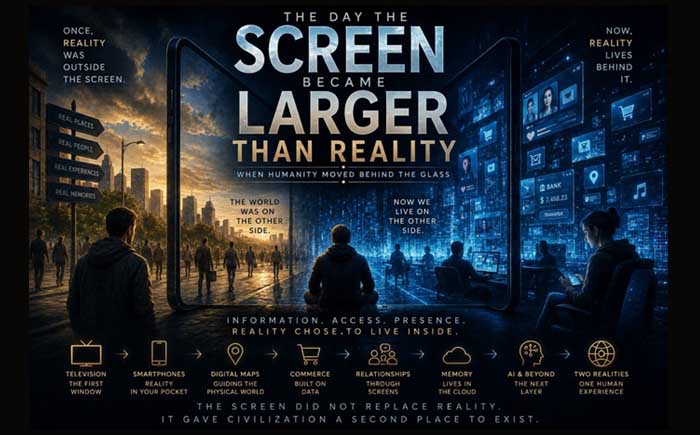
When the Window Became an Interface
There was a time when switching off a screen produced a very clear result.
The program ended.
The television became a dark piece of furniture, the room returned, and whatever had been happening inside the rectangle remained safely on the other side of the glass. A newsreader could describe a war, a film could show New York, an advertisement could display a car, but the screen itself possessed little power over what happened once you stood up and walked away.
That distinction now feels strangely old.
The screen still shows us things, but increasingly it also decides how we reach them. A restaurant exists in the city, yet the route to it appears through a map. A bank exists within a legal and financial system, yet for the customer it is increasingly encountered through an application. A friendship remains between two people, but part of its memory, rhythm and evidence may sit inside a message history. A hotel is made of walls, beds, staff and plumbing, but its commercial reality can be profoundly affected by photographs, rankings, booking systems and reviews displayed on screens thousands of kilometers away.
The physical world has not become less real.
Something else has happened.
The informational layer has become operational.
The screen is no longer merely a window through which reality is observed. It has become a surface through which reality is selected, organized, entered and sometimes altered.
That is the sense in which the screen became larger than reality.
Not physically.
Functionally.
When Did Screens Stop Being Windows?
The metaphor of the screen as a window is older than smartphones.
Cinema created worlds that appeared behind a rectangular surface. Television brought distant events into domestic space. Radar screens transformed invisible movement into visible information. Computer terminals allowed users to interact with processes inaccessible to the naked eye.
But the traditional screen still suggested separation.
There was something on one side and an observer on the other.
Even television, for all its cultural power, largely preserved this arrangement. A football match occurred somewhere else. The television transmitted it. A political speech happened elsewhere. The screen carried its image home.
The viewer could be influenced profoundly by what appeared there, but the interaction remained comparatively limited.
Computing changed the relationship because the screen began responding to action.
The user no longer merely watched.
The user selected.
Typed.
Moved.
Edited.
Stored.
Sent.
The image became an interface to an underlying system.
This may look like a technical distinction, but culturally it is enormous. Once the screen becomes interactive, representation and action begin to converge. Pressing an icon can move money. Selecting a destination can reorganize a journey. Writing a message can alter a relationship. Clicking a button can purchase an object that will appear physically at the door two days later.
The screen stops merely depicting causes and consequences.
It joins the causal chain.
How Did Smartphones Change Reality?
The smartphone did not invent this transformation, but it made it intimate.
Desktop computers required destinations. You went to the machine. You sat down. Work began. The interface had a location.
The smartphone removed much of that geography.
It travels with the body.
That simple fact changes almost everything.
The informational layer can now accompany the user through streets, shops, conversations, airports, restaurants and bedrooms. A map can update while the person moves. A camera can turn an event into an archive before the event has ended. A message can interrupt physical conversation because another social environment has entered the room invisibly.
The phone therefore occupies a strange position in human life. It is simultaneously object, portal, memory device, camera, map, identity token, payment instrument and communication system. It does not simply provide information about the world.
It often mediates the transition from intention to action.
You decide to eat.
The screen offers restaurants.
You decide to travel.
The screen compares flights.
You decide to remember.
The screen retrieves photographs.
You decide to contact someone.
The screen becomes the route through which the person becomes socially reachable.
This is why the smartphone matters more as an interface than as a computer.
Its power lies less in possessing extraordinary calculation than in sitting at the junction where desire becomes operation.

The New Geography
Consider navigation.
A paper map represents territory. It removes almost everything that exists in the real landscape in order to preserve selected relationships useful for movement. It is already a sophisticated compression.
Digital navigation adds something new.
The map watches movement.
It recalculates.
It estimates arrival.
It notices congestion.
It suggests another road.
The representation becomes responsive to the represented object moving through the world.
That changes the psychology of navigation.
A person may travel successfully through a city without constructing much internal geographic knowledge because the route is generated moment by moment. The system knows where the destination is relative to the user, and that may be enough.
This does not mean the digital map has replaced the territory.
Try driving through a wall because the software drew a line incorrectly.
The physical world wins immediately.
But the map increasingly influences which territory becomes behaviorally relevant.
A restaurant three streets away may effectively disappear if it does not appear in search.
A small hotel can become globally discoverable because the informational layer makes it visible.
A street can become crowded because an application routes thousands of drivers through it.
A place can acquire commercial importance because rankings, photographs and recommendations concentrate attention upon it.
The map does not become the territory.
The map begins altering traffic through the territory.
That is a much more serious transformation.
What Is the Informational Layer?
The phrase can sound more mystical than it is.
The informational layer consists of the models, records, profiles, databases, rankings, maps, interfaces and networks through which physical reality becomes computationally legible.
A restaurant has tables.
The informational restaurant has address, menu, rating, reservation availability, photographs, opening hours and customer comments.
A person has a body and biography.
The informational person has profiles, search results, messages, financial records, location traces, photographs and institutional identities.
A city has streets.
The informational city has traffic data, property databases, maps, schedules, reviews, sensors and predictions.
The two layers are not separate worlds.
They continuously affect each other.
A poor rating can reduce physical customers.
Physical customers produce new ratings.
A traffic jam updates the map.
The updated map diverts drivers.
The diverted drivers change traffic elsewhere.
A person’s offline action becomes a photograph.
The photograph alters how other people treat the person offline.
The loop closes.
This is why speaking of a simple “virtual world” beside the real one can be misleading. The more mature digital civilization becomes, the less cleanly the informational layer stays on its own side.
It returns.
It acts.
It changes what will be recorded next.
When the Copy Begins Organizing the Original
There is an older philosophical temptation to imagine representation as secondary.
First comes the real object.
Then comes its image.
The relationship seems obvious.
The portrait follows the face.
The map follows the landscape.
The record follows the event.
Modern informational systems complicate this sequence because the representation can exist before subsequent versions of the thing it represents.
A hotel may redesign a lobby partly because photographs perform poorly online.
A restaurant may alter presentation because dishes circulate visually.
A person may choose clothing according to how it appears on camera.
A public space may become crowded because photographs turned it into a destination.
In each case the representation returns to the original environment and begins shaping it.
This does not imply that reality has become fictional.
The lobby still has weight.
The meal can still taste bad.
The person still occupies a biological body.
But the anticipated representation becomes one of the causes acting upon physical design.
The photograph is no longer merely after the event.
It has entered the planning meeting.
That is the strange inversion.
The copy begins helping design the next original.
The Looking Glass Was Never Really Parallel
Lewis Carroll’s looking glass remains an irresistible metaphor because it suggests a second world existing behind a reflective surface.
Digital culture seems to fulfill the image superficially.
Accounts.
Virtual spaces.
Online worlds.
Synthetic identities.
But the comparison can mislead because the digital layer is not truly parallel.
It depends upon the physical world continuously.
Servers require electricity.
Devices require minerals.
Networks require cables, antennas and data centers.
Digital money rests on institutions, law and economic activity.
A profile belongs to a biological person or to an organization made of people and machines.
The mirror never leaves matter.
What changes is the degree to which things can be represented, manipulated and coordinated through informational models rather than direct physical contact.
This produces a paradox that runs through Transhumation.
The carrier remains physical.
The user experiences increasing distance from the carrier.
Money appears as a number while the financial infrastructure disappears.
A photograph appears instantly while the global network carrying it disappears.
An AI answer appears conversationally while the data centers, training infrastructure and computational processes behind it remain almost entirely invisible.
The world behind the glass feels immaterial because the machinery has become good at hiding itself.

The Screen Does Not Need to Become Bigger
Futurism has often imagined larger screens.
Walls of information.
Transparent displays.
Immersive rooms.
Headsets.
Entire environments converted into visual interfaces.
Some of these may become common.
But physical screen size is almost beside the point.
The deeper expansion concerns how many human activities become addressable through an interface.
A small phone can contain access to more domains of life than a cinema-sized screen ever did.
The real measurement is not inches.
It is dependency.
How many decisions begin there?
How many memories are accessed there?
How many relationships are coordinated there?
How much of the city becomes navigable through it?
How much economic activity requires it?
At some point the screen no longer needs to occupy much physical space because the world behind it has become sufficiently connected.
The rectangle remains small.
Its functional territory becomes enormous.
When the Screen Starts Selecting the World
This is where algorithms change the problem.
A passive screen displays whatever signal reaches it.
A modern platform selects.
Ranks.
Filters.
Recommends.
The screen therefore no longer presents a neutral opening onto an information space. It presents a particular ordering of that space.
The distinction matters because no person can inspect everything available.
Selection is unavoidable.
A search engine must rank.
A map must choose which establishments appear first.
A social feed cannot display every possible post simultaneously.
An AI system must compress an enormous field of information into a finite response.
The interface becomes a machine for deciding salience.
And salience is dangerously close to experienced reality.
A thing does not need to cease existing in order to disappear practically. It can simply fall below the threshold of attention.
A restaurant can remain open while becoming invisible to search.
An argument can remain available while never entering recommendation systems.
A person can exist while becoming difficult to find.
Digital reality therefore introduces an increasingly important distinction between existence and visibility.
The physical world determines what exists.
Interfaces increasingly influence what gets noticed.
What Happens When AI Moves Beyond the Screen?
Artificial intelligence may make the history of the screen even stranger because the ultimate direction may be away from screens altogether.
A conversational system does not require a visual dashboard for every operation. Voice interfaces can become ambient. Wearable devices can mediate information without demanding constant visual attention. Future systems may increasingly act through background assistance, augmented perception or delegated tasks.
The interface can become less visible while becoming more capable.
That possibility reverses the familiar science-fiction image.
Perhaps the culmination of screen civilization is not a wall-sized screen surrounding the human being.
Perhaps it is the moment the screen disappears because the informational layer has become integrated deeply enough into the environment that no single rectangle contains it.
Then the central problem changes.
When the interface was a television, you knew when you were watching media.
When the interface becomes ambient, knowing when mediation is occurring becomes harder.
The border moves from the device to the architecture of experience.
This is where AI connects directly to the larger Transhumation question.
A good interface should help us navigate reality.
But if the interface becomes too transparent, we may begin confusing its selected model of reality with reality itself.
The danger is not that the screen becomes enormous.
It is that the frame disappears.
Watch The Video
How to Read the World
Current Knowledge
Screens have long served multiple functions beyond passive representation. Cinema, television, radar, computer terminals and interactive displays all developed different relationships between information and action, so there was no single historical moment when screens suddenly changed from windows into interfaces.
The rise of personal computing and especially smartphones expanded the number of everyday activities mediated through screens, including communication, navigation, banking, shopping, photography, entertainment and information retrieval. These activities continue to depend upon extensive physical infrastructure even when the user experiences them primarily through digital interfaces.
Digital maps are representations rather than replacements for geography, but dynamic navigation systems can influence physical behavior by routing people, vehicles and commercial attention. The informational model can therefore have causal effects upon the territory it represents.
Online reputation systems, rankings, search results and recommendation systems can also influence the physical success of businesses, destinations and public figures. Visibility inside an informational system can consequently affect outcomes in material environments.
Artificial intelligence adds another form of mediation by allowing users to interact with complex informational systems through increasingly natural interfaces. This does not make AI an independent reality, but it can make the processes selecting and compressing information less visible to the user.
Open Questions
One major question is how much cognitive dependence on digital interfaces changes human abilities rather than merely redistributing them. Navigation systems can reduce the need to memorize routes, while freeing attention for other tasks. Whether that represents loss, adaptation or simply another form of distributed cognition likely depends on context.
Another question concerns visibility. As more choices depend upon ranking and recommendation, what responsibilities belong to the systems determining what becomes visible? The issue extends beyond social media into travel, commerce, news, employment and eventually AI-mediated knowledge.
There is also a problem of transparency. An interface can become more useful as it hides technical complexity, but at what point does hidden complexity make meaningful oversight impossible? The user benefits from not needing to understand every server or algorithm while still needing some way to know why important outcomes were selected.
Artificial intelligence introduces the deepest uncertainty. If future interfaces increasingly interpret the world before presenting it to us, will they enlarge human perspective by making complexity navigable, or narrow it by producing highly convenient models that users rarely feel compelled to look behind?
Transhumation Interpretation
The Day the Screen Became Larger Than Reality belongs to Transhumation because it shows how an interface can move from representing the world to participating in the conditions under which the world becomes accessible.
That is a subtle change.
A book presents information.
A map presents spatial relationships.
A screen can present both.
But a connected interface can also respond to the user, retrieve information from elsewhere, rank possibilities and trigger actions in the physical environment. The model becomes operational.
This is where the familiar distinction between map and territory becomes more complicated.
The map is still not the territory.
But once millions of people navigate according to the same map, the map can change traffic in the territory.
Once consumers select restaurants according to rankings, the ranking can change which restaurants survive.
Once people understand public identity through profiles and search results, those representations can influence how the biological person is treated.
The representation does not become physically primary.
It becomes causally entangled with what it represents.
This is exactly why Transhumation should resist the easy language of digital transcendence.
Nothing has escaped matter.
The digital city requires the physical city.
The digital bank requires an economy.
The digital person depends upon bodies, institutions, devices and servers.
But structures can acquire increasing independence from one particular carrier.
A message does not need one sheet of paper.
A map does not need one printed page.
A library does not need one building at the point of access.
An identity can appear through different devices while retaining enough continuity for recognition.
That is carrier independence in the useful sense.
Not carrierlessness.
The screen made that distinction visible because it became the place where different carriers could present themselves through one surface.
Text.
Image.
Voice.
Money.
Maps.
Faces.
Books.
Documents.
Eventually AI.
The same physical rectangle became a universal translator among many informational structures.
Perhaps this is why the screen became culturally larger than its dimensions.
It was never about glass.
It was about convergence.
But convergence produces another danger.
When many realities enter through one interface, they begin looking structurally similar.
A bank account becomes numbers on glass.
A friendship becomes messages on glass.
War becomes video on glass.
A photograph of lunch and evidence of atrocity may arrive through the same gesture of scrolling.
The interface creates visual equivalence among things whose real-world stakes are radically different.
This is an underappreciated cost of compression.
The screen gives extraordinary access while flattening differences in physical consequence.
The body still understands the distinction eventually.
A missed flight cannot be scrolled away.
A disease remains biological.
A broken relationship remains painful.
The informational layer can organize reality but cannot repeal its veto.
This may become the decisive principle for whatever comes after screens.
Artificial intelligence could make mediation more intelligent, responsive and personalized. It could help a person move through archives, compare routes, understand documents and navigate complexity at a scale no biological mind could inspect directly.
That would be an extraordinary interface.
But the better it becomes, the more important it will be to preserve the path back to the world underneath.
The source.
The map.
The competing interpretation.
The uncertainty.
The physical consequence.
A good librarian does not replace the library.
A good map does not pretend to be the city.
A good interface should not conceal the existence of reality merely because it has become extremely efficient at helping us navigate it.
This is where the title finally reverses itself.
The screen never actually became larger than reality.
Reality is still larger.
It contains the servers, bodies, cities, weather, hunger, gravity and death on which the digital layer depends.
What changed was our point of entry.
The screen became larger than our direct access to reality.
More and more of the world reaches us after passing through an interface.
That is the true civilizational shift.
And if AI eventually makes the physical screen disappear, the question will become even more important because mediation may continue without a visible object reminding us that mediation is taking place.
For most of the twentieth century, the frame told us where the representation ended.
The future may remove the frame.
The difficult task will be remembering that the world never did.
FAQ
What does “the screen became larger than reality” mean?
It is a metaphor for the growing number of activities and decisions that are accessed or organized through digital interfaces rather than through direct physical interaction.
Is the article claiming that digital reality is more real than the physical world?
No. Physical reality retains the final constraint. Digital systems depend upon material infrastructure and cannot override physical consequences.
How did smartphones change the role of the screen?
They made the interface portable and continuous, allowing digital systems to mediate navigation, communication, memory, commerce and identity throughout ordinary life.
What is the informational layer?
It is the collection of maps, databases, profiles, rankings, models and digital representations that make aspects of the physical world accessible and actionable through computation.
Can the map really become more powerful than the territory?
Not literally. But maps, rankings and other models can influence behavior strongly enough to change traffic, commerce and attention within the physical territory itself.
What is the deeper Transhumation question?
The crucial issue is no longer whether screens represent reality accurately enough.
It is whether we can preserve awareness of the difference between the world and the interface through which the world increasingly reaches us.
The screen never replaced reality.
It changed where reality begins for the user.
Continue the Transhumation Series
- Forgotten Religion | Ancient Gods, Symbols and the Hidden Structures of Human Civilization
- The Last Religion | Death, Immortality and the Future of Humanity
- The New Theurgy | AI, Information and the Future of Human Civilization
- End of Branding: You Were Never Meant to Become a Product
- Baal vs Ishtar: Why Ancient Gods Never Disappeared