
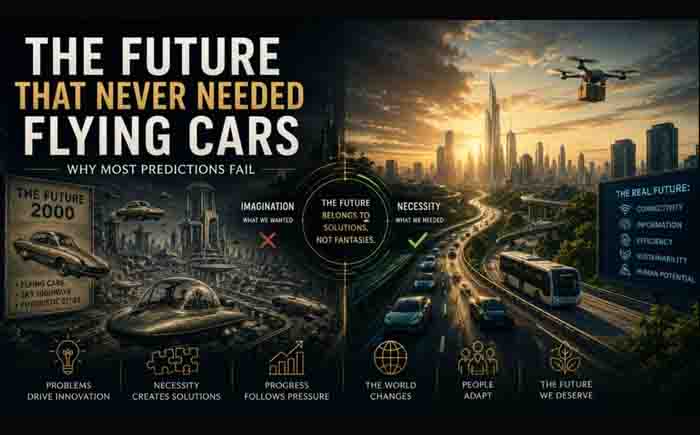
Why Most Predictions Fail
The future used to have chrome.
It had elevated highways curving between glass towers, personal aircraft descending onto rooftops, domestic robots carrying breakfast trays and families traveling through cities that looked suspiciously like airports. The machinery was conspicuous because futurism wanted the future to be recognizable at a glance. You should be able to walk into tomorrow and immediately know that you had arrived.
Instead, one of the most consequential objects of the early twenty-first century looks like a black rectangle.
It sits quietly in a pocket. It contains no wings, no visible engine and almost none of the theatrical machinery earlier generations associated with advanced civilization. Yet it can summon a car, navigate an unfamiliar city, translate languages, transmit money, display satellite imagery, connect a room in Warsaw with a room in Tokyo, carry an entire music collection, provide access to millions of books and increasingly open a conversation with artificial intelligence.
By the standards of an imagined 1960s future, the smartphone is almost embarrassingly modest.
By the standards of capability, it is outrageous.
This difference explains something important about why predictions fail. Futurists are often very good at recognizing desires and surprisingly bad at predicting the forms through which those desires will eventually be satisfied. They see transportation and imagine more spectacular vehicles. They see communication and imagine larger screens. They see computing and imagine more impressive machines.
History frequently does something less photogenic.
It changes the function while abandoning the expected form.
The flying car may therefore be one of the most useful failed predictions ever made. Not because humanity lacked the technical imagination to build one, but because the future found other ways to solve many of the problems for which the flying car had been cast as the answer.
Why Don’t We Have Flying Cars Yet?
The first correction is simple: flying cars have, in limited forms, existed.
For decades, engineers and inventors have built roadable aircraft, experimental hybrids and more recently electric vertical-takeoff-and-landing vehicles. The dream is not impossible in the strict engineering sense. A machine can be constructed that carries a small number of people through the air while occupying some conceptual territory between car, helicopter and aircraft.
The harder question is why such machines have not become an ordinary part of daily life.
That requires looking beyond the vehicle.
A normal car benefits from an enormous surrounding system: paved roads, traffic rules, repair shops, licensing, fuel or charging infrastructure, insurance, parking, manufacturing standards and social conventions developed over more than a century. Commercial aviation operates inside another highly specialized system involving airports, air-traffic control, trained pilots, maintenance standards, regulated airspace and extraordinary attention to safety.
The flying car inherits difficulties from both worlds while gaining some advantages of neither.
It must be light enough to fly and robust enough to operate safely. It creates noise. It consumes energy. It requires maintenance. It introduces questions about weather, airspace, pilot training, automation, emergency landings and what happens when thousands of privately operated machines occupy the sky above densely populated areas.
The problem is therefore not merely whether we can make a car fly.
It is whether a flying car can become part of a system that is better enough than existing alternatives to justify everything required around it.
This is where many futuristic predictions collapse.
They predict the object.
History has to build the ecosystem.
What Did Futurists Get Wrong?
Futurism often extrapolates from the most visible technology of its own age.
A civilization fascinated by automobiles imagines better automobiles. A civilization entering the jet age imagines personal jets. A civilization discovering television imagines walls covered with television. A civilization impressed by rockets imagines cities in space.
There is nothing foolish about this. The human mind reasons from available models.
But technological development does not respect aesthetic continuity.
The next solution to a transport problem may not be another vehicle.
It may be a telecommunications system that removes the journey.
The next improvement in shopping may not be a faster trip to the store.
It may be a network that makes the store come to you.
The next map may not be a larger or more detailed piece of paper.
It may be software that knows where you are and recalculates the route while you move.
This is the prediction error hidden inside the flying car.
People correctly sensed that the future would make distance easier.
They guessed the wrong carrier.
Flight was one possible implementation of that function.
Networks became another.
The desire was real.
The form was contingent.

The City That Was Supposed to Need the Sky
Many spectacular visions of future transportation assumed equally spectacular cities.
Population would rise vertically. Towers would become enormous. Ground-level roads would be overwhelmed. The urban environment would become sufficiently dense that adding another dimension of movement appeared almost inevitable.
Some cities did become dramatically vertical.
But cities also expanded outward, constructed rail systems, built ring roads, developed metros, reorganized commercial centers and later began using digital networks to reduce the need for certain journeys entirely. Remote work, online banking, e-commerce, digital entertainment and instant communication did not eliminate transportation, but they altered the structure of demand.
A meeting once required physical co-presence.
Now some meetings require bandwidth.
A bank transfer once required physical paperwork.
Now it may require seconds.
A document once traveled.
Now a pattern is reconstructed somewhere else.
This is one of the recurring surprises of technological history.
A problem that appears to demand a larger machine can sometimes be solved by removing the reason the machine was necessary.
That possibility is extraordinarily difficult to visualize in advance because it requires imagining not merely a new technology but a new arrangement of behavior around it.
Why Predictions About the Future Fail
Most forecasts fail for more than one reason.
The first is technological uncertainty. Engineers do not know in advance which laboratory possibilities will become cheap, reliable and manufacturable at scale.
The second is infrastructure. A brilliant device can fail because everything around it would need to change before it becomes useful.
The third is regulation and safety. A technology that works experimentally may be unacceptable when multiplied across millions of users.
The fourth is economics. A device can perform beautifully while losing to a less elegant alternative that is cheaper.
The fifth is culture. People do not always want to reorganize their lives around the possibilities engineers provide.
And the sixth may be the most interesting: another technology can solve the same underlying problem first.
The flying car does not compete only against other flying cars.
It competes against trains, normal cars, bicycles, taxis, metros, remote work, videoconferencing, delivery networks and every future technology that reduces the cost of movement or the need to move.
Technological prediction therefore resembles evolutionary prediction.
Knowing the pressure does not tell you which adaptation will win.
Does Necessity Really Drive Innovation?
The old proverb says necessity is the mother of invention.
History is less disciplined.
Necessity certainly creates pressure. Disease encourages medicine. Military threats accelerate weapons development. Expensive labor can encourage automation. Distance encourages transportation and communications technologies.
But invention also creates necessity retroactively.
Before widespread telephony, humans survived without instant voice communication across continents. Before smartphones, people did not experience the absence of a permanent portable network as a daily deprivation. Before search engines, nobody woke furious because all human knowledge had not been indexed into a box on the desk.
Then the capability appeared.
Behavior changed.
Expectations changed.
The optional became convenient.
The convenient became normal.
The normal became difficult to live without.
This means technology and necessity form a feedback loop rather than a one-way relationship.
Problems create technologies.
Technologies create possibilities.
Possibilities alter behavior.
Changed behavior creates new problems.
The next technology enters.
The future is therefore not simply pressure producing solution.
It is a conversation between constraint and invention.
The Hoverboard Problem
Back to the Future Part II remains entertaining partly because its future is so legible.
You know instantly that you are in 2015 because the ordinary objects behave differently. Shoes tie themselves. Boards float. Cars fly. Clothing performs tricks. The future has been applied visibly to the surface of everyday life.
Real technological progress often behaves in the opposite way.
Consider the bicycle.
It is technologically ancient by science-fiction standards, yet for many short urban journeys it remains extraordinarily difficult to beat. It is cheap, energy-efficient, mechanically understandable and requires minimal infrastructure compared with powered flight.
A hoverboard may look more futuristic.
The bicycle may be the better transportation technology.
That distinction exposes another weakness in technological prediction: we frequently confuse novelty with superiority.
A solution does not become obsolete merely because it is old.
Spoons remain useful.
Doors remain useful.
Books remain useful.
Wheels remain useful.
Sometimes technological maturity looks like a civilization becoming confident enough not to replace something that already works.
The future can contain very old objects.
The Technologies Nobody Drew
The strangest technologies of our era are often difficult to illustrate.
Cloud computing does not make a dramatic poster.
Compression algorithms do not resemble Tomorrowland.
Software protocols have no heroic silhouette.
A database can reorganize an industry while looking like nothing at all from the outside.
This may explain why twentieth-century futurism underestimated informational technology even when it correctly anticipated some of its components. Mechanical spectacle is easier to visualize than invisible coordination.
A flying car looks futuristic because the technological difference is visible.
A software update can change the capability of a billion devices overnight without altering their physical appearance.
That is a profound shift.
Industrial progress often announced itself with new machines.
Informational progress can arrive as new behavior inside existing machines.
The object remains.
The function changes.
The future becomes harder to photograph.
Are Smartphones More Futuristic Than Flying Cars?
In one sense, yes.
Not because smartphones are intrinsically more advanced than aircraft, but because they reveal a more important transition in how technology solves human problems.
Earlier visions imagined progress primarily as an extension of physical capability.
Travel farther.
Build higher.
Move faster.
Lift more.
Modern computing often extends capability by reorganizing information.
Know where you are.
Find the person.
Access the archive.
Coordinate the journey.
Predict the route.
Translate the sentence.
The physical world remains essential, but informational systems can reduce the amount of physical intervention required to accomplish the goal.
This is why a smartphone can quietly outperform the philosophical ambition of a flying car.
The flying car says:
we will defeat distance by moving the body faster.
The smartphone says:
perhaps the body does not need to travel for this task.
That is not always better.
A video call cannot reproduce dinner with someone you love. Digital images cannot substitute for visiting every place. Bodies remain physical, and presence remains biologically important.
But technologically the distinction is enormous.
The most radical future may not give us greater movement.
It may give us greater access without movement.
The Invisible Future
Successful technologies often become less conspicuous after adoption.
Electricity disappears into sockets.
Navigation disappears into the map application.
Computing disappears into appliances.
Networks disappear into the expectation that something should simply connect.
AI may eventually follow the same path.
Today artificial intelligence feels like a named technology because we are standing close to the transition. People discuss models, prompts, agents and capabilities precisely because the interface remains visible enough to attract attention.
If AI becomes mature infrastructure, much of it may stop looking like AI.
Documents may simply organize themselves.
Translation may simply occur.
Software may adapt without requiring explicit programming.
Search may become conversational enough that users stop distinguishing retrieval from synthesis.
The futuristic part disappears into ordinary function.
This gives us an inversion of the flying-car problem.
The technologies we imagine most vividly may never dominate because their visible form is not necessary.
The technologies that dominate may eventually become so normal that we stop recognizing them as technological achievements.
The future becomes invisible precisely when it succeeds.
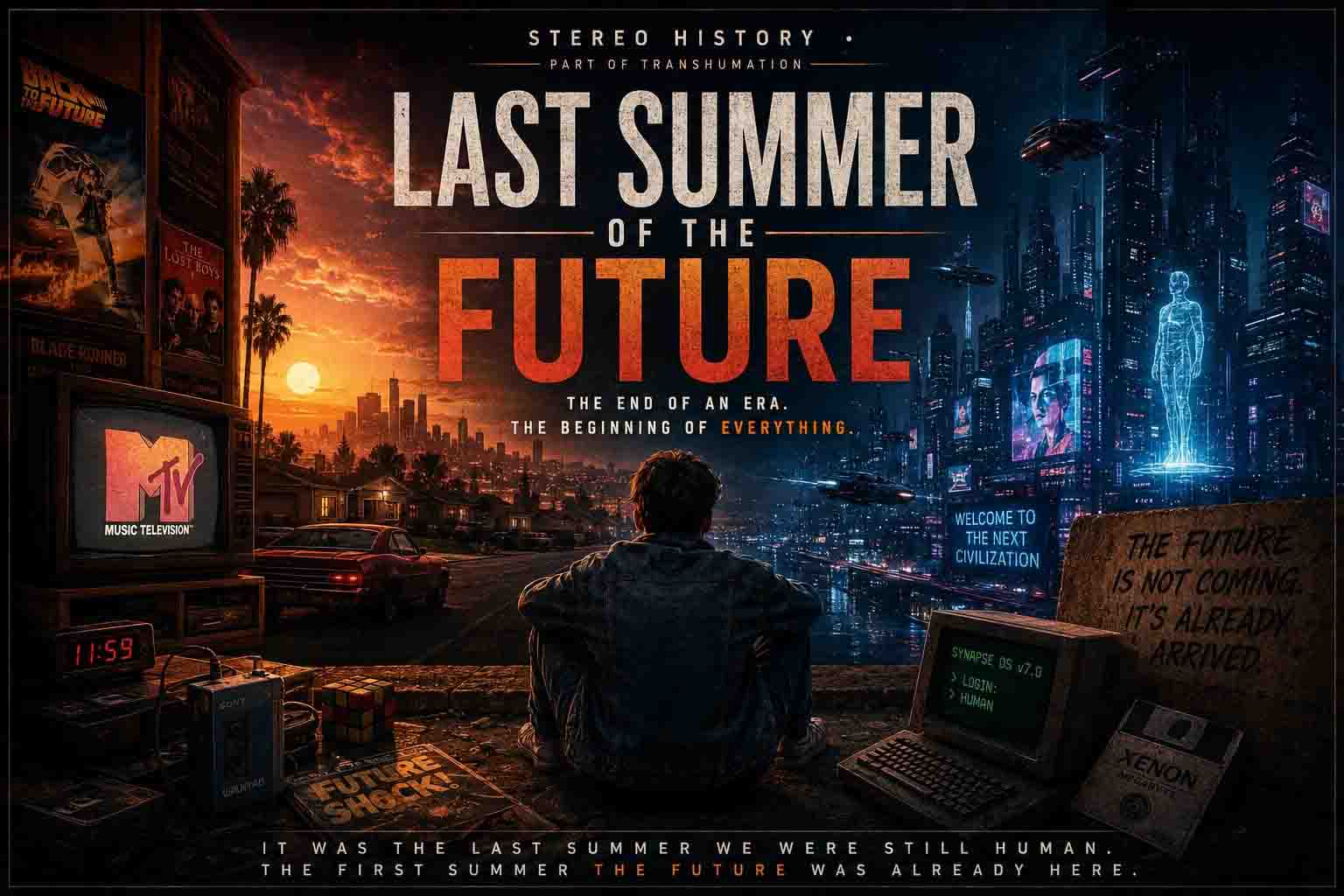
The Invisible Future
The most important technologies often become invisible.
Nobody imagined the future would arrive through software updates.
Nobody imagined maps would disappear.
Nobody imagined entire libraries would fit inside a pocket.
Yet that is exactly what happened.
The future did not become larger.
It became smaller.
Then it became invisible.
Compression replaced expansion.
Information replaced machinery.
The Real Future
The future is not built from fantasies.
It is built from pressure.
When enough people face the same limitation, civilization responds.
That is why some technologies seem inevitable.
Not because they are exciting.
Because they are needed.
Flying cars may eventually arrive.
But if they do, it will not be because humanity dreamed about them.
It will be because humanity finally encountered a problem that only flying cars could solve.
Until then, they remain what they have always been.
A beautiful answer waiting for a question.
The greatest lesson of futurism may be this:
The future does not belong to the technologies people want.
It belongs to the technologies people cannot live without.
Watch The Video
How to Read the World

Current Knowledge
Flying-car concepts have existed in experimental forms for decades, and current developments in roadable aircraft and electric vertical-takeoff-and-landing vehicles show that personal or semi-personal aerial mobility is technically possible in limited contexts. Their widespread adoption, however, depends on much more than flight capability. Safety, energy use, noise, infrastructure, air-traffic management, certification, cost and public acceptance all influence whether such systems can scale.
Technological adoption generally depends on ecosystems rather than isolated inventions. Standards, complementary infrastructure, regulation, manufacturing, supply chains and network effects can determine whether a technically impressive invention becomes culturally important. Historical winners are therefore not necessarily the most advanced devices in isolation.
Forecasting is also affected by path dependence. Existing infrastructure can favor technologies compatible with systems already in place. A slightly better solution requiring complete replacement of surrounding infrastructure may lose to an imperfect solution that works with what already exists.
Necessity is an important driver of innovation but not a sufficient explanation. New technologies can create behaviors and expectations that did not previously exist, while existing social needs can remain unsolved for long periods despite being severe.
Digital technologies have allowed some problems traditionally solved through physical movement, storage or objects to be addressed through information transfer, remote access and computational coordination. This does not eliminate physical infrastructure; it changes which part of the system is visible to the user.
Open Questions
One unresolved question is whether personal aerial mobility will eventually become practical once automation, battery technology and traffic-management systems improve sufficiently. The absence of mass flying cars today does not prove that the concept has no future; it may simply indicate that the surrounding system has not reached the necessary threshold.
A broader question concerns prediction itself. Can forecasters improve by identifying persistent human functions rather than projecting specific objects? Predicting that people will want faster communication may be more robust than predicting the device through which that communication will occur, but even functions can change as technology alters behavior.
There is also the problem of hidden substitution. How often does a predicted technology fail because another technology quietly removes the original problem? Remote work, digital documents and online services suggest that some transportation demand can disappear rather than merely becoming faster.
Artificial intelligence introduces another uncertainty. Many present predictions focus on visible forms such as humanoid robots or conversational agents. The more consequential future may instead involve AI becoming infrastructure so deeply integrated into existing systems that the public stops recognizing where it is operating.
Transhumation Interpretation
The future that never needed flying cars belongs naturally to Transhumation because it exposes the difference between function and carrier.
Human beings frequently become attached to the carrier because the carrier is what they can see.
We want faster transportation, so we imagine a faster vehicle.
We want larger knowledge, so we imagine a larger library.
We want more powerful computing, so we imagine a more powerful machine.
But the underlying function can survive a radical change in implementation.
A library does not have to become a larger building if its texts can be reconstructed elsewhere.
A meeting does not always require faster transportation if presence can be partially mediated across a network.
A map does not need more paper if the useful spatial relationships can be represented dynamically on a device.
The error of futurism is therefore often the same error Transhumation repeatedly encounters elsewhere:
confusing the current carrier with the underlying structure.
This is why the flying car is philosophically useful even if one eventually lands in every driveway.
The prediction assumed that the function of future mobility would remain attached to a familiar object called the car.
Four wheels become turbines.
Road becomes sky.
Speed increases.
But another future can preserve the function while discarding much of the carrier.
The need is not necessarily “I require a flying automobile.”
The deeper need may be “I want access to a person, object, service or place with less friction.”
Once the problem is stated at that scale, many more solutions become visible.
High-speed rail can answer it.
Telepresence can answer part of it.
Delivery systems can answer another part.
Digital services can eliminate some journeys completely.
None is universally superior because the underlying functions are not identical.
But the exercise shows why better questions reveal larger technological spaces.
This is also where the LEGO Principle becomes useful.
A prediction contains visible details.
Flying vehicle.
Glass city.
Elevated roads.
Silver clothing.
Remove the decorative pieces.
What relationship remains?
Human beings want distance to become less restrictive.
That pattern survived.
The visual prophecy did not.
This gives us a way to evaluate old futurism without treating it as either prophecy or comedy.
The wrong form can contain the right structural intuition.
A videophone imagined in 1960 may look ridiculous while correctly anticipating that remote visual communication would become ordinary.
A robot servant may mispredict the shape of automation while correctly sensing that machines would absorb increasing amounts of routine work.
A universal electronic library may get every piece of hardware wrong while correctly anticipating that access to texts would become less dependent on physical proximity to shelves.
The future is often present inside the prediction at the wrong scale.
Zoom out and the structure appears.
Zoom in and the prophecy collapses.
Artificial intelligence makes this lesson especially important because contemporary speculation is full of visible characters.
The humanoid robot.
The artificial person.
The machine colleague.
The synthetic companion.
Some may become real.
But the more historically cautious question is not which character appears.
It is which human limitation AI reduces sufficiently that behavior reorganizes around the reduction.
Perhaps the important change is not a robot walking into the office.
Perhaps the office changes because fewer tasks require the old organization of work.
Perhaps education changes because access to explanation becomes continuous.
Perhaps software changes because users increasingly specify intention rather than individual operations.
Perhaps libraries change because navigation through knowledge becomes conversational.
The carrier may be less dramatic than the function.
That possibility connects directly with the New Theurgy and the problem of interface.
A mature interface makes complexity disappear.
That is convenient.
It is also why profound technological change can become difficult to recognize.
The flying car announces itself.
The invisible librarian does not.
And this may be the deepest reason predictions fail.
We expect tomorrow to declare itself through strange objects.
History often changes first through relationships.
Between person and distance.
Between question and knowledge.
Between intention and action.
Between information and carrier.
The objects come later, or sometimes not at all.
This also prevents us from making the opposite mistake and claiming that progress always means dematerialization.
A video call still requires cameras, devices, networks, cables, servers and energy.
A digital library still occupies matter.
AI still requires computation.
Information never escapes infrastructure.
What changes is dependence on one particular visible implementation.
The technological future can become less material from the perspective of the user while becoming more materially intensive underneath.
The interface shrinks.
The infrastructure grows.
That is another thing old futurism rarely drew.
A final lesson follows.
We should be careful whenever a future technology appears “inevitable.”
Nothing guarantees that today’s favorite carrier will win simply because the underlying problem is real.
Humanity may need cleaner energy without choosing the technology currently dominating headlines. It may need better mobility without filling the sky with private vehicles. It may need better artificial intelligence without building human-shaped machines.
Needs create pressure.
They do not dictate form.
The future is selected from alternatives we can see, alternatives we cannot yet see and alternatives created only after another invention changes the problem itself.
The flying car therefore remains a perfect emblem of technological prediction.
It may still arrive.
That would not vindicate a century of futurism in the simple sense.
Its real value has already appeared.
It teaches us that the future is rarely the object waiting at the end of the drawing.
It is the changing relationship between a problem and the structures capable of solving it.
Perhaps that is why tomorrow so often looks disappointing from a distance and astonishing once we are living inside it.
We wanted machines that looked impossible.
We received ordinary-looking objects that do impossible things.
FAQ
Why don’t we have flying cars yet?
Flying vehicles are technically possible, but mass adoption requires much more than flight. They must compete with roads and conventional aviation while solving problems involving safety, noise, cost, energy, weather, regulation and air-traffic management. So far, existing transportation systems remain more practical for most journeys.
What is an eVTOL?
An eVTOL is an electric vertical take-off and landing aircraft. These vehicles can rise without a conventional runway and are being developed for possible uses such as urban air mobility, airport transfers and specialised transportation.
Why do predictions about the future fail so often?
Predictions frequently extrapolate visible objects while missing changes in infrastructure, economics and human behaviour. A futurist may correctly identify a human desire—faster travel, easier communication, greater convenience—while incorrectly predicting the technology that will satisfy it.
Did smartphones replace some older visions of the future?
Yes. Instead of producing dozens of separate futuristic devices, the smartphone absorbed many of their functions. Maps, cameras, calculators, recorders, tickets, music players, dictionaries and communications tools became layers of one interface.
Is necessity the main driver of technological progress?
Not by itself. Desire, profit, status, entertainment and curiosity also matter. A better predictor is whether a technology achieves a strong fit between human behaviour, infrastructure, economics and an existing problem or opportunity.
What does this have to do with Transhumation?
Transhumation interprets technological change partly as the movement of persistent functions and patterns between changing carriers. A map can leave paper, photography can leave the camera and memory can leave the physical library without the underlying human function disappearing. The future may therefore be less about new objects than about old structures finding new forms.
Continue the Transhumation Series
- Forgotten Religion | Ancient Gods, Symbols and the Hidden Structures of Human Civilization
- The Last Religion | Death, Immortality and the Future of Humanity
- The New Theurgy | AI, Information and the Future of Human Civilization
- End of Branding: You Were Never Meant to Become a Product
- Baal vs Ishtar: Why Ancient Gods Never Disappeared