
We, the Pirates
The ruins of a political experiment are usually easy to recognize.
The flag disappears. The laws stop being enforced. The buildings acquire another purpose. The people who once believed they were creating a new order become names in archival footnotes, if they are remembered at all. Historians place a date at the end of the episode and move on.
Nassau appears to offer exactly this kind of ending.
In the early eighteenth century, during a period of weak imperial control in the Bahamas, the settlement became a major base for pirates and former privateers. Figures later absorbed into legend used the islands as operating territory. Ships arrived with crews who were experienced, violent, commercially opportunistic and often detached from the ordinary authority structures of European naval and colonial life. Their world was unstable, dangerous and short-lived.
Eventually imperial power returned with sufficient force.
The experiment ended.
And yet the phrase Republic of Pirates survived.
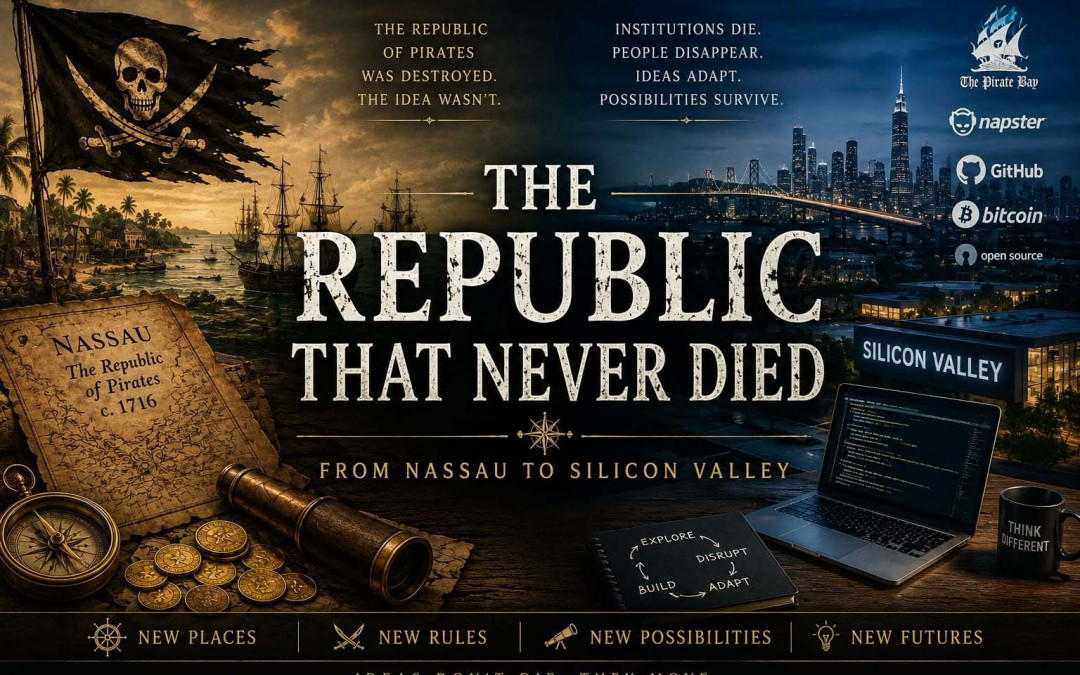
That survival invites a dangerous historical temptation. We look at later societies built around risk, autonomy, unconventional trade or rejection of established institutions and begin drawing a line through the centuries: Nassau becomes Silicon Valley; smuggling becomes cryptocurrency; pirate crews become startups; the outlaw harbor becomes the digital network.
The line is elegant.
It is probably false.
There is no need for it.
The more interesting question is not whether the Pirate Republic secretly survived under different names.
It is whether similar structural conditions can repeatedly produce similar kinds of behavior without direct historical inheritance at all.
That possibility gives us a different kind of republic.
Not an institution that never died.
A pattern that civilization keeps rediscovering.
Was the Republic of Pirates a Real Republic?
The name is more orderly than the place probably was.
Nassau’s pirate community is often described romantically as a rebellious alternative society in which sailors escaped empire, hierarchy and conventional authority. Some pirate crews did operate with strikingly participatory internal rules, including negotiated articles, forms of voting, elected captains and agreed distributions of prize money. Compared with the brutal discipline of many contemporary naval and merchant vessels, such arrangements could offer sailors meaningful forms of agency.
But none of this should be inflated into a modern constitutional republic hidden in the Caribbean.
Pirates were not philosophers conducting an Enlightenment seminar with cannons. Their communities contained violence, coercion, self-interest and unstable alliances. Their economic model depended substantially upon attacking and appropriating the wealth produced by other systems. The freedom available to participants could coexist with severe harm inflicted upon outsiders.
That qualification matters because romantic histories of marginal communities often preserve only the attractive side of rebellion.
Nassau was interesting not because it discovered the perfected society.
It was interesting because imperial weakness created a zone in which ordinary rules became negotiable.
That is enough for the argument.
When central authority weakens, behavior that is impossible in the center can become practical at the edge.
Sometimes the result is innovation.
Sometimes it is predation.
Often it is both.
Why the Edge Produces Strange Experiments
Established systems accumulate constraints for good reasons.
Rules standardize expectations. Institutions reduce risk. Professional norms preserve hard-won knowledge. Laws make long-term coordination possible. A functioning center is powerful precisely because not everything must be renegotiated every morning.
The cost of that stability is that alternatives become expensive to test.
An institution that employs ten thousand people cannot casually replace its operating model because somebody has an interesting idea. A government cannot suspend every regulation simply to see what happens. A large infrastructure system must prioritize continuity because failure harms people who never consented to the experiment.
Edges operate differently.
The stakes can be lower.
Authority may be weaker.
Participants may already be excluded from established channels.
Capital may be scarce enough that improvisation becomes necessary.
Under those conditions, strange things get tried.
Most disappear.
That last sentence is the part romantic histories usually omit.
The edge does not possess secret knowledge of the future. It produces variation.
The center filters.
Occasionally one of those variations exposes a possibility important enough that the center later adopts a transformed version of it.
That is not prophecy.
It is selection.

Did the Pirate Republic Really Survive?
No, if by survival we mean institutional continuity.
The pirate base at Nassau did not transform organically into the modern Bahamas. The political, legal and economic structures of the contemporary state belong to very different historical processes. Modern tourism, finance and international commerce cannot responsibly be presented as if pirate Nassau gradually changed clothes and entered a bank.
But there is another meaning of survival worth examining.
A structure can recur without descending directly from an earlier instance.
Imagine two societies separated by centuries encountering the same general constraint: a powerful center controls the established routes, while new technology or geography creates an edge where enforcement becomes difficult. People working at that edge may independently discover similar strategies: alternative exchange, informal organization, rapid experimentation, rule avoidance, unusual risk tolerance.
The later group does not need to have read about the earlier one.
The pattern can emerge because the problem recurs.
This is one of the most important distinctions in Stereo History.
Structural resemblance is not historical genealogy.
Two civilizations can invent arches independently.
Two myths can contain descent into an underworld without sharing one author.
Two technological cultures can celebrate outsiders without one being the descendant of the other.
When the same structure appears twice, our first question should not be What secret tradition connected them?
It should be What recurring conditions could produce this shape again?
Why Compare Nassau and Silicon Valley?
The comparison works only at that structural level.
Silicon Valley is not a pirate republic. It depends upon universities, venture capital, intellectual-property law, public infrastructure, global supply chains, highly educated labor and enormous institutional investment. Many technologies associated with the region emerged partly from government-funded research and established corporations rather than from heroic outsiders working beyond civilization.
Yet the culture surrounding technological entrepreneurship does reward certain behaviors that resemble the edge function.
Small groups can test ideas that large organizations consider too uncertain.
Failure can be tolerated when capital is deliberately structured around portfolios in which many projects are expected to collapse.
Young companies can challenge assumptions because they possess less legacy infrastructure to defend.
An established corporation asks whether a new product will damage an existing market.
A startup may have no existing market to protect.
That difference can make the same possibility look irrational from one position and obvious from another.
Nassau and Silicon Valley therefore do not share an institution.
They share a useful question:
What becomes visible when people have less invested in preserving the current map?
The answer can be dangerous.
It can also be historically productive.
Napster and the Republic of Temporary Possibilities
Napster provides a cleaner modern example of what a failed experiment can reveal without surviving in its original form.
The original service disappeared after major legal conflict over copyright. But the behavior it made culturally visible did not disappear with it. Users had experienced searchable, nearly immediate access to individual music tracks without visiting a store or handling physical media.
That experience changed expectations.
Later streaming systems were not simply legalized Napster. They required licensing, broadband, business models, infrastructure and agreements Napster did not possess. Spotify was not Napster becoming respectable by historical inevitability.
But the earlier system had exposed a possibility:
music could function socially as an accessible networked library rather than primarily as a collection of physical objects individually acquired and stored.
That possibility survived the failure of one implementation.
This is the distinction the article needs.
A failed institution can reveal a function that later institutions realize differently.
The failure remains real.
So does the discovery.
The Pirate Bay, Open Source and the Danger of Easy Analogies
This is where we need to resist putting every unconventional digital system under one black flag.
The Pirate Bay, open-source software, cryptocurrency and startup culture are not variations of one political philosophy.
Open-source development can operate entirely within established law and depend upon carefully defined licenses. Cryptocurrency projects range from serious technical experiments to speculative assets and fraud. File-sharing systems raise copyright issues different from those raised by collaborative software development.
Calling all of them pirates may produce a memorable brand while destroying the distinctions that make the history useful.
The Pirate Principle should describe a position relative to an established system, not a moral identity.
An outsider asks whether a capability exists that the system is not currently organized to use.
Sometimes the answer creates a legitimate innovation.
Sometimes it exposes a regulatory gap.
Sometimes it reveals an exploit.
Sometimes the rule being challenged exists for an excellent reason.
The test comes later.
Did the alternative produce durable value when the hidden costs were restored?
Could it scale?
Could it survive accountability?
Could people outside the experimental group live safely with the consequences?
The edge discovers possibility.
Civilization still has to decide whether the possibility deserves a city.
Why Failed Ideas Return
This is where the article moves beyond pirates.
History contains ideas that appear, disappear and later return in altered form.
But the return can happen for several different reasons.
Sometimes documentation creates genuine lineage. Later innovators read earlier thinkers, use earlier designs or deliberately revive old institutions.
Sometimes a concept becomes technically feasible only after complementary technologies appear.
Sometimes the apparent return is actually independent rediscovery.
And sometimes we create the continuity retrospectively because humans are extremely good at organizing scattered events into satisfying stories.
These cases must be separated.
The printing press did not make every earlier dream of universal knowledge into a hidden prediction of Wikipedia.
The telegraph was not the internet in embryonic form.
Nassau was not an early cryptocurrency community.
The better comparison identifies an invariant without pretending the carriers were historically identical.
In this article, the invariant is not piracy.
It is permission to test a system from outside its normal assumptions.
That function can recur.
The people performing it can be entirely unrelated.
The Bellamy Question
The figure of Samuel Bellamy is useful here only if we keep him historical rather than symbolic.
Bellamy became one of the best-known pirates of the so-called Golden Age of Piracy, and later narratives have often attached broader meanings to his short life. But the temptation to turn any historical pirate into a spokesman for a coherent philosophy of freedom should be resisted.
The more valuable Bellamy question is methodological.
What do we do when a person fails but the possibility represented by their life remains culturally productive?
History often evaluates people according to outcome.
The victorious ruler gets the architecture.
The failed rebel gets a paragraph.
But failure can expose constraints that success conceals.
A failed expedition tells us where logistics broke.
A failed startup can reveal that consumers wanted something even when the business model was wrong.
A failed political experiment can expose a real dissatisfaction without supplying a workable alternative.
This does not make failure secretly victorious.
It makes failure informative.
Some experiments matter because of what they demonstrate rather than what they preserve.
The Republic That Never Died
The title can now be taken seriously without taking it literally.
The pirate republic died.
Its particular people died.
Its historical conditions disappeared.
The modern Bahamas are not its institutional continuation.
Silicon Valley is not its descendant.
The internet did not inherit its constitution.
What survives is something more abstract and therefore harder to prove.
Human systems repeatedly create edges.
Edges repeatedly attract people willing or forced to operate differently.
Those people repeatedly discover possibilities the center has not yet normalized.
Most disappear with little consequence.
A few reveal functions that later systems absorb.
Once the function is absorbed, its rebellious origin may become irrelevant.
The pirate route becomes the commercial route.
The experimental interface becomes the standard interface.
The strange behavior becomes a button everybody presses without noticing that it once violated the expectations of an entire industry.
Successful rebellion can become boring infrastructure.
Perhaps that is the most complete form of victory an idea can achieve.
Not remaining revolutionary forever.
Becoming too normal to remember that it was ever revolutionary.
Watch The Video
How to Read the World

Current Knowledge
Nassau became an important center of Atlantic piracy in the early eighteenth century during a period of weak British authority in the Bahamas. The expression Republic of Pirates is a later and somewhat romanticized label for a loose pirate community rather than evidence of a stable constitutional republic comparable to a modern state. Pirate crews could employ participatory internal practices, but their activities also depended upon violence, raiding and appropriation, so they should not be idealized as straightforward experiments in political freedom.
There is no demonstrated historical continuity linking pirate Nassau to modern Silicon Valley, contemporary offshore finance or digital subcultures. Comparisons among them are structural analogies only. The modern Bahamas developed through later colonial, political and economic processes fundamentally different from the pirate environment of the early eighteenth century.
Innovation can emerge from both marginal communities and established institutions. Large organizations provide resources, infrastructure and accumulated expertise, while smaller or less constrained groups can sometimes test possibilities that incumbents find economically or institutionally difficult to explore. Neither position possesses an automatic monopoly on innovation.
Napster is a useful example of a failed institution revealing durable consumer behavior. The original service did not survive, but the demand for searchable, low-friction digital music access persisted and later became part of legal streaming systems developed through different technological and commercial arrangements.
Structural resemblance between historical episodes does not by itself establish direct influence. Similar behaviors can emerge independently when different societies encounter comparable constraints, incentives or technological possibilities.
Open Questions
The first unresolved question is how often innovation genuinely comes from the edge rather than merely appearing to do so because successful outsiders receive disproportionate attention. Established governments, universities and corporations have produced extraordinary amounts of innovation, while countless marginal experiments disappeared without consequence. Survivor bias can easily transform a rare successful outsider into a universal historical law.
A second question concerns the difference between discovery and viability. An experimental system may reveal that people desire a new function while failing economically, legally or ethically. When a later institution delivers a similar function successfully, it remains difficult to decide how much credit should belong to the earlier experiment.
There is also the problem of independent recurrence. If two distant societies produce similar structures under similar pressures, should we say an idea survived, or that the same possibility was discovered twice? The answer matters because Transhumation is interested in carrier-independent structures, but structural recurrence cannot be used as automatic evidence of historical transmission.
Artificial intelligence introduces another version of the same question. Many important uses of AI may emerge from users and small organizations working outside the laboratories that created foundational models. Whether those experiments become durable institutions will depend not merely on novelty but on evidence, safety, law, cost and their ability to function once the protections of the experimental edge disappear.
Transhumation Interpretation
The Republic That Never Died belongs to Transhumation because it forces a difficult distinction between survival and recurrence.
If an idea is written down, transmitted, read by another person and deliberately reconstructed, we can describe a chain of cultural survival with reasonable confidence.
The carrier changes.
The pattern travels.
There is historical continuity.
But suppose two societies separated by centuries discover the same functional arrangement independently.
Nothing traveled between them.
The structure returned because the conditions made it useful again.
That is not cultural immortality.
It is recurrence.
The distinction may seem academic until we begin building large theories from patterns.
Transhumation repeatedly looks for carrier-independent structures: relationships that survive changes in symbol, technology, institution or medium.
That method becomes valuable only if it remains vulnerable to disproof.
Whenever a familiar pattern appears in two eras, we should ask whether we have evidence of transmission, evidence of independent recurrence, or merely an attractive similarity produced by abstraction.
Nassau and Silicon Valley make a useful test.
At a very high level, both can be described as edge environments in which people experiment beyond some established expectations.
Zoom closer and the analogy begins losing pieces.
One is embedded in eighteenth-century Atlantic piracy, imperial warfare and physical commerce.
The other belongs to modern capitalism, research universities, venture finance, intellectual-property regimes and digital technology.
If we strip away too much detail, every innovator becomes a pirate.
Then the model explains nothing.
The pattern is useful only at the precise scale where the resemblance survives without erasing the differences that could falsify it.
This is the Test of Unnecessary Choice applied to history.
Do we need Nassau in order to explain Silicon Valley?
No.
Does comparing the two reveal a recurring structural tension between center and edge?
Potentially yes.
Those are very different claims.
This is where the Library of Mirrors needs a careful librarian.
A large archive makes analogy effortless.
AI can find thousands of things that look alike.
Pirate codes resemble startup culture.
Ancient religious symbols resemble network diagrams.
Roman administration resembles modern bureaucracy.
Myths resemble software architectures.
Sometimes the comparison exposes a genuine structural relation.
Sometimes it produces an elegant hallucination with perfect citations.
The future of pattern recognition will therefore depend less on finding similarities than on knowing when to stop trusting them.
A strong model must survive the return of detail.
This also changes the meaning of failure.
If a failed system demonstrates a function that later appears elsewhere, the question is not whether the original project secretly “won.”
The more disciplined question is what survived.
Did the institution survive?
No.
Did the personnel survive?
Usually not.
Did the legal structure survive?
Perhaps not.
Did a documented idea travel forward?
Sometimes.
Did a human need remain?
Often.
Did later technologies make another solution possible?
Very often.
A functional problem can persist even when every proposed solution disappears.
That persistence can create the illusion that an old idea was waiting for the future.
But perhaps what waited was not the idea.
Perhaps the problem remained unsolved.
This is a particularly powerful way to think about technology.
Napster did not survive into Spotify as a hidden soul migrating between companies.
A desire for frictionless access remained.
Digital infrastructure evolved.
The music industry adapted.
A new institutional arrangement became viable.
Enough functional similarity exists for the earlier experiment to look prophetic in retrospect.
But the path contains discontinuity as well as continuity.
That is how Transhumation should handle historical patterns.
Not by pretending nothing dies.
Many things die completely.
Languages disappear.
Books burn.
Institutions collapse.
Techniques vanish.
Ideas can be lost so thoroughly that later civilizations must discover them again.
The remarkable fact is not that everything survives.
It is that some structures can reappear after their original carriers are gone because the relationship they described remains possible.
This is where the republic metaphor acquires its final meaning.
A republic is normally a legal and political institution.
This republic is something else.
It is the recurring possibility of the edge.
The existence of some place, social space or technical layer where established assumptions become cheap enough to challenge.
A pirate harbor.
A garage.
An underground scene.
An experimental laboratory.
An open protocol.
A temporary online community.
The physical form matters less than the function.
But even here we should not romanticize it.
Edges can produce scams as easily as discoveries.
Freedom from old rules can reveal new possibilities or merely remove protections.
The experiment earns historical importance only when its value survives the return of responsibility.
That may be the deeper relationship between the Pirate Principle and the Crown Principle.
The pirate asks whether another route exists.
The crown asks whether the route can become infrastructure.
The edge discovers.
The center tests durability.
Somewhere between them, civilization decides what will become normal.
Artificial intelligence may accelerate this cycle dramatically.
Models make experimentation cheap. New interfaces can be assembled rapidly. Small groups can test uses that large institutions never anticipated. Most will disappear. Some will be irresponsible. Some will be banal.
A few may reveal something important enough that future institutions reorganize around it.
Years later, people may look backward and call those experiments inevitable precursors.
They will not have been inevitable.
They will have been possibilities selected from a much larger field of failures.
That is why the republic never dying is the wrong literal claim and the right metaphorical one.
The historical Nassau died.
What persists is not its constitution.
It is the fact that civilization repeatedly generates places where the current system becomes negotiable.
The flags change.
The technologies change.
The moral conditions change.
Sometimes there is no lineage at all.
Yet the question returns:
What becomes possible when someone steps far enough outside the accepted map to discover that the map was never the territory?
That republic has no capital.
Perhaps that is why it keeps appearing.
FAQ
What was the Republic of Pirates?
It is a popular name for the pirate community centered around Nassau in the early eighteenth century during a period of weak British control. It was not a stable modern republic and should not be romanticized as one.
Did the Pirate Republic survive?
Not institutionally. The pirate community ended, and modern Nassau belongs to a very different historical system. The article uses its “survival” as a metaphor for recurring edge environments in which existing rules become open to experimentation.
Why compare Nassau with Silicon Valley?
Not because one descended from the other. The comparison concerns a structural feature: people at the edges of established systems can sometimes experiment with possibilities that institutions have stronger incentives to reject or ignore.
Did Napster become modern streaming?
No. Napster disappeared, while later streaming services developed through different legal, technical and commercial structures. What persisted was partly the demonstrated demand for fast digital access to large music libraries.
Can ideas survive without direct historical transmission?
Sometimes what looks like survival may actually be recurrence. Similar solutions can emerge independently when different societies encounter similar structural problems.
What is the deeper Transhumation question?
The important distinction is between a pattern traveling through history and a pattern appearing again because reality permits the same relationship to be discovered more than once.
That means the most interesting things in history may not always be those that survive unchanged.
Some disappear completely, then return without knowing they have returned.
And perhaps that is a stranger form of continuity than immortality: not the preservation of the old republic, but the repeated rediscovery that another republic was possible all along.
Continue the Transhumation Series
- Forgotten Religion | Ancient Gods, Symbols and the Hidden Structures of Human Civilization
- The Last Religion | Death, Immortality and the Future of Humanity
- The New Theurgy | AI, Information and the Future of Human Civilization
- End of Branding: You Were Never Meant to Become a Product
- Baal vs Ishtar: Why Ancient Gods Never Disappeared