
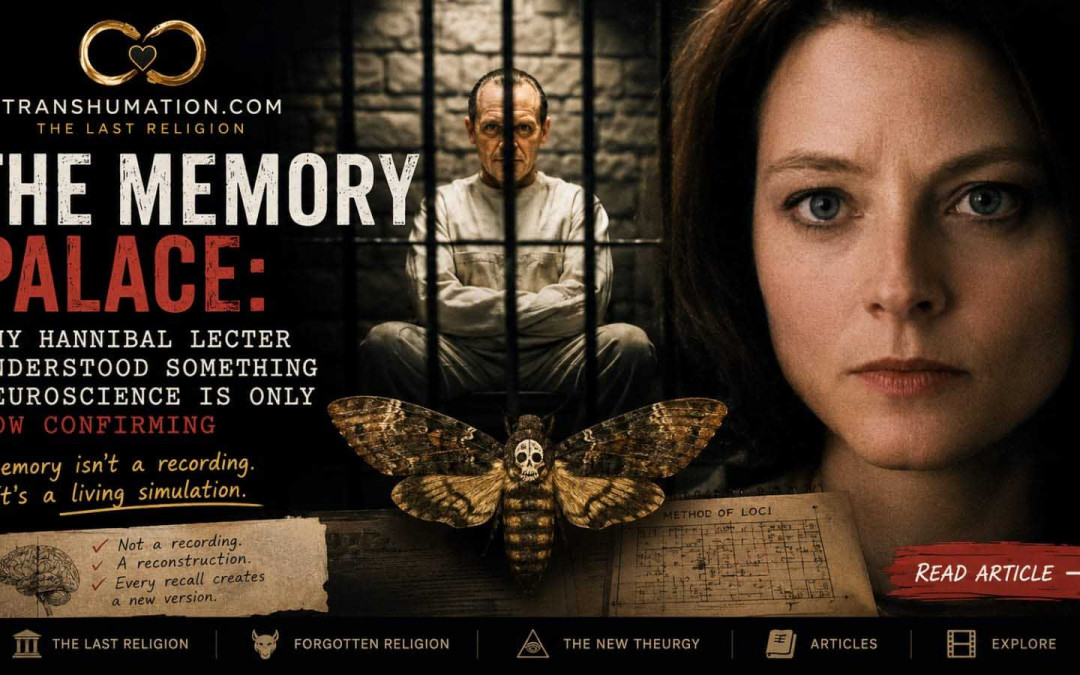
The Palace Built By Lecter
There is a peculiar luxury available to Hannibal Lecter that has nothing to do with Chianti, Renaissance drawings or the other refinements Thomas Harris gave him. Lecter can be locked inside a cell and still go somewhere else. He does not merely remember another place; he enters one. Somewhere behind the walls is an architecture more elaborate than the institution containing him: corridors, rooms, paintings, objects, conversations, fragments of childhood and carefully arranged pieces of knowledge. If the physical world gives him a few square metres, his mind answers by constructing an estate.
Harris did not invent the underlying trick. More than two thousand years before The Silence of the Lambs, Greek and Roman rhetoricians were already exploiting an extraordinary property of human memory. Instead of memorizing a speech as an abstract sequence of words, an orator could imagine a familiar building and distribute the speech through it: one argument beside the entrance, another beside a statue, the next at the foot of a staircase. To retrieve the speech, he mentally walked the same route. The technique became known as the method of loci, and versions of it are still used by competitive mnemonists.
Lecter simply takes the old device to its magnificent and slightly disturbing conclusion. His palace is no longer merely a filing cabinet with Corinthian columns. It becomes a place in which a mind can operate when the external world has become intolerably small. And that makes Harris’s literary invention interesting for a reason quite separate from Hannibal Lecter. The memory palace sits at the intersection of several things neuroscience increasingly understands as related: memory, imagination, navigation and the ability to construct worlds that are not presently there.
The palace, in other words, may be less exotic than its owner.
A Trick Older Than Psychology
The traditional explanation for the memory palace is wonderfully practical. Human beings are often poor at remembering arbitrary information but remarkably good at remembering places. You may forget a telephone number you heard thirty seconds ago while still being able to describe the arrangement of your childhood home decades after leaving it. Spatial environments provide structure: one room leads to another, the staircase occupies a particular position, the kitchen cannot suddenly appear behind the garage. Information attached to this architecture gains something it previously lacked—a location.
Ancient rhetoricians understood the effect without knowing anything about hippocampi or neural networks. They had discovered a technology before possessing its theory. A speaker could populate an imaginary route with exaggerated images and then recover the sequence by travelling through it mentally. Modern memory competitors use elaborations of essentially the same method, turning playing cards, numbers and names into vivid objects placed along familiar routes.
This is already strange enough. An imaginary building can improve the performance of a biological memory.
But Harris noticed, whether deliberately or simply through the instincts of a good novelist, that the idea contains another possibility. If a person can place information inside an imagined room and later return to retrieve it, what exactly is the room? It has no bricks, no measurable floor area and no address. Yet it possesses enough stability to be revisited.
The memory palace begins as a mnemonic device and quietly becomes a problem about reality.
The Prisoner With More Space Than the Guard
Lecter’s circumstances make the problem visible because Harris places the palace against its perfect opposite: confinement. A prison attempts to reduce a human being to controlled space. The door determines where the prisoner may go; the wall establishes the limit; the guard possesses the key. Lecter’s palace reverses this relationship. His body can be contained while his internal geography remains inaccessible to the people containing it.
This should not be confused with a claim that imagination somehow abolishes imprisonment. A locked door remains locked. The external world has an authority that fantasy cannot simply vote away. What makes the palace interesting is precisely that two kinds of space coexist: the physical environment that constrains action and the internally generated environment through which consciousness can nevertheless move.
Ordinary people perform modest versions of the same trick constantly. Think of your kitchen while sitting somewhere else. You can probably approach the refrigerator, turn toward the sink and picture what is above it. Now imagine a red chair in the middle of the room even if no such chair has ever existed there. You have combined memory with invention inside a space that is simultaneously familiar and fictional.
The brain did not retrieve a photograph and then somehow paste a chair onto it. It constructed a scene.
Once this becomes obvious, Lecter’s palace stops looking like an eccentric superpower. What is exceptional is its scale, discipline and literary extravagance. The machinery underneath it belongs to us.

Memory Does Not Press Play
The old popular metaphor of memory resembles a film archive. An event occurs, the brain records it, and recollection retrieves the stored sequence. This model is intuitively satisfying and largely wrong. Episodic memory is reconstructive. What we remember can be influenced by later knowledge, suggestion, emotion, context and repeated acts of recollection. Details can disappear while the sense of certainty remains remarkably strong.
That does not mean memory is simply unreliable or fictional. The more interesting point is that reconstruction appears to be part of its normal operation. A memory can preserve important relationships and meanings without preserving every sensory detail of the original event. When an episode is recalled, relevant information is reassembled into a present experience of the past.
A computer-game analogy gets closer than the video archive. A virtual environment need not store a separate photograph of every possible moment inside the game. It stores assets, relationships, rules and states from which a scene can be rendered when required. The next rendering remains recognizably the same world even though not every pixel must be identical.
Human memory is not literally a game engine, and neuroscience should not be reduced to a fashionable technological metaphor. But the comparison exposes something the recording metaphor hides. Continuity does not require perfect reproduction. A remembered room can remain recognizably your room even when details have changed.
This is precisely what makes the memory palace possible. The mind does not merely retrieve information. It can reconstruct an environment in which information becomes navigable.
The Strange Proximity of Yesterday and Tomorrow
The story becomes more consequential when we stop asking only about the past. Research on episodic memory has found substantial overlap between neural systems involved in remembering past events and imagining possible future events. This makes evolutionary sense. An organism does not need the past merely to admire it. The past becomes useful when it improves decisions about what happens next.
Imagine planning dinner tomorrow. You may picture a restaurant you already know, insert a person who has never been there with you, anticipate a conversation that has never occurred and estimate how the evening might unfold. Nothing you are experiencing is a memory, yet almost every component of the imagined scene has been assembled from memory.
The past has become construction material for a future that does not exist.
This suggests a more interesting purpose for our apparently imperfect memory. A perfect archive would be wonderful for historians. A flexible memory may be more useful for an animal. It allows experience to be broken apart and recombined: this place, that danger, this person, another outcome. Instead of preserving only what happened, the system can generate what might happen.
Lecter’s palace therefore leads somewhere far beyond memorizing lists. Once a mind can reconstruct yesterday, it possesses many of the ingredients required to simulate tomorrow.

When Thought Escapes the Brain
There is another version of the palace sitting on almost every desk. Take an idea that seems perfectly clear in your head and attempt to write it down. Quite often it becomes less clear for several minutes and then considerably better. The page reveals repetitions, contradictions and connections that were difficult to maintain simultaneously in working memory. By writing, we have not simply recorded a completed thought. We have altered the environment in which thinking occurs.
The notebook becomes a modest external room of the memory palace.
Civilization has been expanding these rooms for thousands of years. Writing allowed information to persist beyond biological memory. Libraries organized memories belonging to people who never met one another. Printing multiplied access. Computers made enormous archives searchable. The internet connected them. Artificial intelligence now introduces another layer: systems capable of helping users navigate, compare and reorganize information at scales no individual reader could inspect unaided.
A good library, however, still needs a good librarian. Information stored somewhere is not the same thing as information understood. The interesting function of the librarian—human or technological—is not to replace the reader but to make an otherwise overwhelming structure navigable.
Lecter walks through rooms to find what he needs. We build indexes, search engines and interfaces.
The architecture changes.
The problem remains surprisingly familiar.
The First Virtual Reality Machine
Virtual reality is usually discussed as though it began with screens strapped to the face. Technologically, that makes sense. Cognitively, it is much older.
A novelist can make a reader visualize a city that never existed. An architect can walk mentally through a building before construction begins. A composer can hear a passage before an orchestra performs it. A mathematician can manipulate objects that possess no physical counterpart. A frightened person can suffer because of an event that exists only as a possible future. A dreaming brain can manufacture an environment convincing enough that its unreality becomes obvious only after waking.
The human mind continually operates on absent worlds.
That ability may be among the quiet foundations of civilization. Before a cathedral could be built, somebody had to represent a cathedral that did not yet exist. Before a journey could be undertaken, somebody had to anticipate a destination. Before a political system could be changed, somebody had to conceive of an alternative arrangement. The capacity to construct unreal situations is not an escape from reality. It is one of the mechanisms by which reality becomes changeable.
Harris’s prisoner therefore offers an unexpectedly elegant image. Lecter appears to retreat from the world into an artificial palace, but the underlying cognitive ability is the same one that allows ordinary humans to plan, design, remember and invent.
The imaginary room is not necessarily the opposite of the real one.
Sometimes it is where the next real room begins.
Watch The Video
How to Read the World

Current Knowledge
The method of loci, commonly called the memory palace, is a well-established mnemonic technique with roots in classical antiquity. It associates information with locations along an imagined spatial route, and modern memory competitors continue to use versions of it effectively.
Contemporary research supports a reconstructive account of episodic memory. Recollection is not generally understood as the literal playback of a complete neural recording. Memories can be affected by later information, context, suggestion and repeated retrieval, while reconsolidation research indicates that reactivated memories can under some conditions become susceptible to modification.
The hippocampus and related brain networks are important both for episodic memory and spatial navigation. Research also shows substantial overlap between systems recruited when remembering personal past events and constructing possible future events. This supports the idea that memory contributes to flexible scene construction and future-oriented thought rather than functioning only as archival storage.
Writing can additionally serve as a form of cognitive offloading. External representations such as notes, diagrams and lists reduce demands on working memory and can support reasoning by making information available for repeated inspection and manipulation.
None of these findings demonstrates that the brain is literally a computer simulation engine. “Simulation” is a useful cognitive metaphor here, not an established claim that human consciousness operates like conventional software.
Open Questions
We still do not possess a complete account of how neural activity becomes the subjective experience of entering a remembered scene. Neuroscience can identify systems important for memory, navigation and imagination without yet explaining why a reconstructed childhood room feels like my childhood room rather than merely information about a location.
Another unresolved issue concerns the relationship between memory and identity. Memories change, disappear and are reconstructed, yet most people experience remarkable continuity of self. How much alteration can occur before that continuity fundamentally changes?
Artificial intelligence sharpens the question. A machine can maintain information, construct scenarios and generate descriptions of possible worlds without this demonstrating that it experiences any of them. Whether subjective experience requires biological mechanisms, a particular architecture, embodiment or something else remains unresolved.
And finally there is the oldest problem hidden inside Lecter’s palace: how internally complete can a constructed world become before the distinction between remembering, imagining and inhabiting begins to matter philosophically?
Transhumation Interpretation
The memory palace contains a structure that appears repeatedly throughout Transhumation: the carrier changes while something recognizable survives.
A physical room becomes a memory. The memory becomes an imagined architecture. A thought becomes writing. Writing enters a book. The book enters a library. The library becomes searchable information. At each stage something is lost, something is added, and yet enough structure can survive for another observer to reconstruct meaning.
This is why the memory palace matters beyond neuroscience. It suggests that the human mind does not require a perfect copy in order to preserve continuity. We reconstruct. We interpolate. We change the carrier. Nevertheless, we can return to the room and recognize it.
That does not prove that consciousness can be uploaded, nor that reconstructing someone’s information would recreate that person’s subjective experience. Information continuity and consciousness continuity remain different problems. But the palace attacks a simpler assumption: that identity must depend on preserving every original component unchanged.
Civilization itself has never worked that way.
The Odyssey survived manuscripts, languages, printing technologies and readers. Rome survives without Romans. A dead person’s thought can enter a living person’s mind through marks on paper. The carrier disappears; the structure migrates.
Perhaps this is why Harris’s image is so powerful. Hannibal Lecter appears to be a prisoner escaping into memory. Look more carefully and he is doing something civilization has always done.
He builds an architecture from information.
Then he places himself inside it.
A library does something similar at another scale. But a library exists for readers, not books. Without an observer capable of entering its structure, its information remains dormant.
Perhaps the memory palace was never merely a trick for remembering.
It was a miniature model of civilization.
And perhaps the strangest thing about Hannibal Lecter’s palace is not that a human being could build such a world inside his head.
It is that, in smaller ways, we have been living inside such worlds all along.
FAQ
What is a memory palace?
A memory palace, or method of loci, is a mnemonic technique in which information is associated with imagined locations and later retrieved by mentally navigating those locations.
Did Thomas Harris invent the technique?
No. The method predates Harris by more than two millennia. He transformed it into an important element of Hannibal Lecter’s fictional psychology.
Does the memory palace really work?
Yes. Spatial mnemonic strategies can substantially improve recall and are famously used by competitive memory athletes.
Is memory really reconstructed rather than replayed?
Episodic memory is generally understood as reconstructive. Recalling an event involves rebuilding it from stored information rather than playing an untouched internal recording.
Are memory and imagination connected?
Yes. Research has found significant overlap between neural systems involved in remembering past experiences and constructing possible future events.
Why does writing make thinking easier?
Writing externalizes information, reducing some demands on working memory and allowing ideas to be inspected, rearranged and compared.
Is the memory palace literally virtual reality?
Not technologically. It can, however, be understood as a cognitive virtual environment: an internally generated space that can be navigated without physically existing.
What is the Transhumation idea behind it?
The deeper question concerns carrier-independent structure. A place can become memory, memory can become language, and language can enter another mind. What survives is not necessarily the original matter, but enough of a pattern to allow the world to be reconstructed again.
Continue the Transhumation Series
- Forgotten Religion | Ancient Gods, Symbols and the Hidden Structures of Human Civilization
- The Last Religion | Death, Immortality and the Future of Humanity
- The New Theurgy | AI, Information and the Future of Human Civilization
- End of Branding: You Were Never Meant to Become a Product
- Baal vs Ishtar: Why Ancient Gods Never Disappeared